

Boring Training for Insurance Company Employees Is Costly
Training employees of an insurance company cannot be called just a cost item — it is a direct investment in the quality of sales and service.
When staff get bored at lectures and click through presentations “just to check the box,” new products remain misunderstood, regulations are violated, and clients leave for competitors after the first incorrect calculation or unconvincing consultation.
The problem is especially acute when launching new insurance programs. If employees have not understood the terms and profitable options, they cannot communicate the value to the buyer.
As a result, the company loses not only on commissions but also on reputation — and in insurance, trust directly converts into repeat business.
Classic corporate training formats yield low engagement: adults do not like being lectured. Employee motivation drops, knowledge fades within a couple of weeks, and managers spend time on repeated briefings. It becomes a vicious circle: training exists, but there is no result.
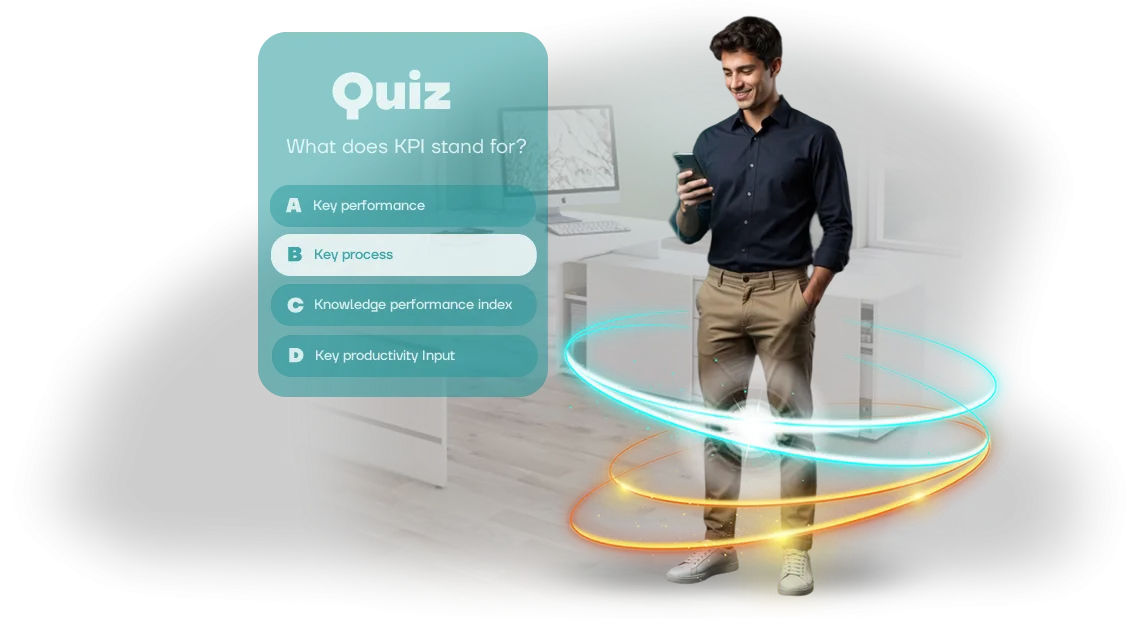
We address this need through educational quizzes that turn a boring mandatory duty into an exciting competition. The employee themselves wants to understand the product in order to show the best result in the colleague rating.
This is not entertainment for its own sake, but a controlled tool that improves the quality of knowledge and directly affects sales conversion and the speed of claim processing.
What a Corporate Quiz Delivers: 5 Business Benefits
A corporate quiz is a practical tool that transforms employee training from a formal obligation into a working process with measurable results.
For an insurance company, this means not only a more prepared team but also a direct connection to business metrics: from customer service quality to sales volume.
Employee engagement. A quiz holds attention better than the usual presentations or briefings. Employees compete, discuss the questions, and look forward to the next rounds — so training stops being boring and becomes part of the daily work routine.
Professional development. Instead of rote memorization, the quiz tests understanding of product nuances and regulations. The employee immediately sees which topics are weak and can improve them — and the manager sees the team’s real skill level without lengthy testing.
Growth in insurance product sales. An agent who is confidently familiar with the policy lineup and terms communicates more convincingly with the client and more often closes the deal. The quiz hones exactly the knowledge that directly affects sales results.
Employee loyalty. Investing in employee development through an engaging format increases their involvement in the life of the company. People feel care for their professionalism, are less likely to quit, and are more willing to recommend the company as an employer.
Fast onboarding for new hires. For new employees, the quiz becomes a short and clear introduction to the product base. They reach performance targets faster and start generating profit within the first weeks, not just learning.
Each of these benefits can be measured: by the share of employees who completed the training, by sales dynamics, by staff turnover. That is why a quiz is not a game but an element of a personnel development strategy in the insurance business.
Training Quiz Formats for Insurance Company Objectives
In an insurance company, employee knowledge directly affects sales, service quality, and compliance with standards.
A new hire needs to quickly master the product line, an experienced agent needs to regularly confirm qualifications, and a manager needs to see an objective picture of the team. That is why training quizzes are divided into formats for specific business tasks.
| Quiz format | Who it is for | What it gives the client |
|---|---|---|
| Onboarding quiz | New employees, interns | Fast integration into the role, fewer errors and lost deals in the first months |
| Certification quiz | Agents, sales managers, claims specialists | Objective knowledge assessment without disputes, a basis for development plans and personnel decisions |
| Regular training quiz | Current employees | Maintaining competencies, fast introduction to new products and regulations |
Each format is easily adapted to your product line, sales regulations, and the team’s skill level. You can combine them: run an onboarding quiz for new hires and simultaneously certify experienced staff. This way, training stops being a formality and becomes a result management tool.
We select the questions, mechanics, and scenario to match the client’s goals, and after launch we provide simple reporting: who completed it, which topics are lagging, and where training needs to be strengthened.
We use well-established development tools, so the quiz runs reliably on employees’ computers and requires no special preparation. In the end, you get not just a test but a ready-made solution for an insurance company’s task.
How Quiz Development for Your Company Works
We structure the process so that you see the result at every step and can influence the workflow — without surprises or lengthy approvals.
You do not need to understand the technology: we handle everything from idea to launch, and you receive a ready-made training tool that works for your business goals.
-
Brief and intake into the task. We discuss which employees need training, what knowledge to test, and what goals are in place: increasing sales, product knowledge, or handling objections. We record success criteria so that the quiz solves exactly your task.
-
Scenario and question design. Together with you, we define the structure: number of topics, difficulty levels, and question types — from simple tests to situational cases. At this stage, you see what the training will look like and can make edits before development starts.
-
Development and content. We build the game using a professional tool, add your branding, upload the questions, and configure the scoring logic. You receive a test version — you can already evaluate how the quiz looks and feels.
-
Testing and refinement. We check everything against real scenarios: how employees with different skill levels play the game, whether scores are calculated correctly, and whether explanations are shown properly. We make final adjustments — and only after your approval do we deliver the quiz.
-
Deployment and launch. We place the quiz where it is convenient for your employees: on the corporate portal, in a messenger, or on the website. We configure access, explain how to use it, and help you run the first game.
-
Support and development. After launch, we do not disappear: we update questions, add new topics, and help with completion analytics. If product lines or regulations change, the quiz will always remain relevant.
Each stage takes exactly as long as needed for a quality result, not “indefinitely.” You always know where we are in the process and what happens next.
What Is Included in the Delivery: A Complete Kit for Launching Training
The complete kit for launching training is a set of ready-made artifacts, not a “bare” program. After handover, you receive everything you need to work: scenarios, an admin panel, reporting, and instructions. All that remains is to set a date and invite employees.
What the Kit Includes
- Quiz scenarios. 10–15 ready-made modules on products, regulations, and customer service standards. We adapt them to your lineup and corporate rules.
- Administrator dashboard. A simple interface for launching quizzes, assigning groups, and editing questions — without involving developers or technical staff.
- Reporting for each employee. Who completed the quiz, who did not, and which topics cause difficulties. Data for control and targeted training improvements.
- Instructions for administrators and participants. Step-by-step guides: how to run the quiz successfully from the first time and what to do in case of technical issues.
- Methodological recommendations. Options for integrating quizzes into onboarding, certification, and scheduled staff training.
- Technical support at launch. We help you run the quiz, verify access, and support the first weeks of use.
The entire kit is a working tool for your team. You manage the training process and see results without getting into technical details.
Case Study: How a Quiz Improved an Insurance Team’s Results
For insurance companies, launching a new product comes down to one point — how quickly to teach agents to sell complex policy terms. Lectures and manuals provide knowledge, but not skill: the agent “passes the test” and a week later confuses the exclusions.
We proposed turning training upside down with a quiz where every question is a real working scenario: calculating coverage, handling a client objection, choosing a deductible.
This is how the case for the insurance company “Vector” came about. Before the launch of the “Protection for the Day” product, its agents underwent standard training: 80 people, two days of lectures, and a final test with 60% correct answers.
We set up a 30-question quiz with a rating across branches and an error review after each round. The agents played in three teams, competing for the right to be the first to access new sales materials.
Quiz Results
A week after launch, almost 90% of participants explained policy terms and closed objections without preparation — at the start, only a third could do this.
Sales also grew: in the first month, the product brought 45% more inquiries than planned, and the conversion to policy issuance increased from 14% to 21%. The winning branch maintained the best performance for another two months.
Importantly, the effect was not one-off: the quiz remained in the company as a tool for onboarding new employees and relaunching products.
Two months later, “Vector” ordered a second game for the next policy — this confirms that the game format directly hits the target metrics that management expects.
How to Choose a Quiz Format for Your Business Objectives?
The format of a quiz is determined not by trendy fads but by two things: what task your company faces and who exactly will take the training. The answer to the question “what should change after the quiz” is the foundation from which to start when choosing.
If the goal is to introduce employees to a new product or an updated regulation, short tests with fast feedback are suitable.
If the task is to teach the application of knowledge in complex situations, you need a scenario-based format with an analysis of the consequences of decisions.
For insurance companies, it is important to consider the specifics of the audience: agents, underwriters, client relationship managers, and back-office staff solve different tasks and perceive material differently.
Agents value situational cases that mirror real client dialogues, while for back-office employees, modular quizzes with repetition of key rules are effective.
It is also worth dividing training into groups: a mass launch for all employees and in-depth scenarios for those whose work involves sales and policy servicing.
A mandatory step before choosing a format is setting a measurable goal: increasing product recognition, reducing errors in policy issuance, speed of response to objections.
For example, if the quiz is designed to reduce the number of errors, choose a format with instant explanation of the correct answer and the option to retry.
If the main goal is to engage the team and create a reason to talk about the topic, competitive elements and team rounds are suitable.
We help you choose a format based on your tasks and audience: at the first stage, we analyze training goals, employee roles, and the current level of preparation.
Based on this, we propose the question structure, number of rounds, and play mechanics without overloading the interface with unnecessary details. The result is a quiz that solves a specific business task, not just entertains employees.
Frequently Asked Questions About Developing Training Quizzes
Before launching a training program, managers tend to ask the same questions. We have collected the most frequent ones — about difficulty, timing, integration, and result guarantees — so that you can make a decision on clear terms.
Employees do not need to learn new tools: the quiz runs in a regular browser, the questions are clear, and no technical preparation is required. Completing it takes 10–15 minutes, so it is easy to integrate into the work schedule.
The quiz does not resemble a strict exam — game mechanics help employees perceive it as a workout rather than a test, so they willingly complete the training and are not afraid to make mistakes.
A typical project takes two to four weeks: we agree on the scenario, design the UI, and fill the quiz with questions tailored to your specifics. The timeline is fixed in the contract — schedule delays are excluded, and any delays on our part are compensated.
The quiz works as a standalone module and does not require replacing your learning management system. Employee results are exported in a convenient format — you see the progress of each individual and the entire team over time.
What guarantees results?
We run a test launch on a control group and adjust the questions if the quiz does not show the desired dynamics. After launch, we stay in touch: support and refinements are included in the cost for the entire period of use.
Let’s Discuss Your Quiz Creation Project? Leave a Request
Leave a request — and within a day you will receive a clear plan for turning employee training into a lively format that people remember.
No “fluff”: we will ask 3–4 clarifying questions to understand the needs of your insurance company and prepare a personalized proposal based on your budget and timeline.
What you get after contacting us:
- Cost calculation — a transparent estimate without hidden additions: development, content creation, testing, and launch.
- Personalized proposal — the format, number of rounds, and task difficulty for your employees, not an abstract template.
- Implementation plan — a step-by-step schedule from brief to ready quiz, with clear deadlines at each stage.
- Approach demonstration — we show you what a completed quiz looks like and what engagement mechanics we use.
- Consultation — we answer questions: how to integrate the quiz into training, how to track completion, and what to do after launch.
- Fixed offer — after the terms are agreed, the price and timeline do not change during the project.
These six points cover the main questions of any manager: how much it costs, how long it takes, and what you get in the end. You do not need to understand the technical details — we handle the implementation, and you control the result.
Fill out the form or message us — we will respond within a business day, help you estimate the cost, and suggest a convenient time for a short call. After the conversation, you will know exactly whether this training format is right for you.