

Technopark visitors get bored at exhibitions — how to fix this?
Technopark visitors come for experiences, but most often they get static exhibits and long guided tours. Within a short time, attention wanders, guests start scrolling their phones, and they leave the venue without remembering a single booth.
In this way, the technopark loses the main thing — the opportunity to leave visitors with a vivid impression of a modern technology venue they want to return to.
While some venues keep fighting for attention with traditional routes, others introduce interactive experiences for technoparks and win a lively, engaged audience. Guests remember not signs and scale models but their own emotions and participation.
When people answer questions themselves, solve tasks, and see an immediate reaction, they spend 30–40 % more time at the exhibition and willingly share their impressions with others.
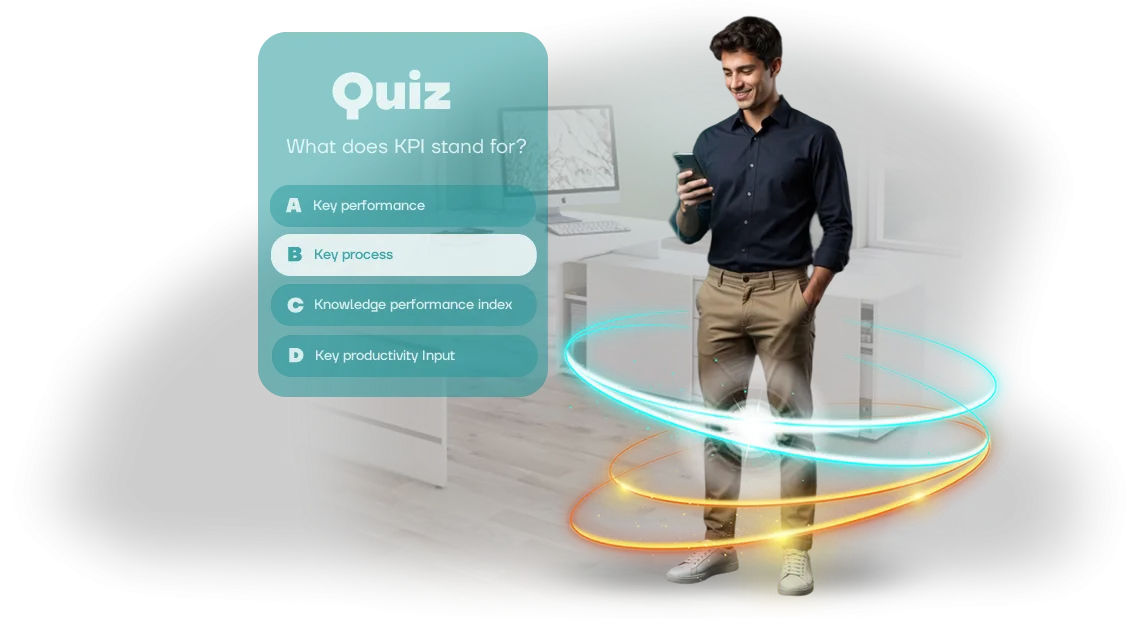
We create educational quizzes that turn an exhibition walkthrough into an engaging adventure.
It is visitor entertainment that simultaneously solves the important task of learning through play: park staff gain an interested audience, and guests get simple, fun scenarios about science, technology, and innovation.
The game format holds attention at every stage — from the first question to the final award of points and a memorable result.
Such a quiz purposefully works to retain attention both during the visit and after it. Guests compare their results, discuss questions with friends and family, return to the technopark again, and bring new visitors.
For the venue, this means higher attendance, longer dwell time, and a memorable brand that stands out from competitors.
Instead of a dull walkthrough, the technopark offers visitors a real quest through the exhibition, where each answer reveals something new.
This very approach turns a one-time event into lasting interest: a person leaves with an emotional impression, and the technopark gains a loyal guest ready to return again.
What benefits will your venue get from an educational quiz
An educational quiz is not just a game but a tool that turns an ordinary lecture into a vivid event for technopark staff and guests. It solves several tasks at once: increases engagement, teaches in an easy format, and strengthens your venue's image. Unlike boring presentations, the quiz holds attention and delivers measurable results.
Here is what the venue gains from implementing a quiz:
| Benefit | What it gives |
|---|---|
| Educational effect | Rules and standards are absorbed 2 times faster than by reading instructions |
| Audience reach | Even passive participants get involved in the game — activity grows by 40 % |
| Brand recognition | A bright branded quiz gets discussed on social media, and photos from screens extend the advertising effect |
| Contact collection | The registration form and final screen collect participants' e-mails and phone numbers |
| Additional revenue | The quiz can be run as a paid activity for guests and tenants |
"We launched a quiz for technopark staff and guests — in one evening we collected 80 requests for guided tours.
People asked to add more rounds on their own, and after the event three new tenants came to us," the technopark director noted in a review of the implementation.
Most importantly, such a quiz pays for itself within the first month: collected contacts turn into real inquiries, and trained employees start working with clients faster.
You get not just entertainment but a ready-made marketing and educational tool that is easy to adapt to your venue's goals. All that's left is to choose the topic and scenario — we handle the rest.
Quiz game formats for technoparks: from team trivia to a show
Different technopark audiences — school groups, families, corporate clients, and regular visitors — require different engagement formats. The same quiz will not work equally well at a children's party and a business event.
That is why we develop quizzes in three core formats, each solving its own task: from a quick warm-up to a large-scale show.
| Format | For whom | What it gives the technopark |
|---|---|---|
| Team game | School groups, corporate events, team building | Builds a spirit of competition and cooperation, increases dwell time, suits groups of up to 50 people |
| Individual quiz | Family visitors, solo guests | Open entry and exit, low participation threshold, boosts repeat visits without schedule dependence |
| Show quiz | Mass events, openings, celebrations | A vivid performance with a host and lighting, creates social media content, draws a large audience |
The choice of format determines the quiz scenario: for a team game, discussions and scoring mechanics matter; for an individual quiz, speed and interactivity matter.
In the show quiz, we add theatrical elements so each participant feels both a spectator and a hero at the same time.
We help select a format for a technopark's specific goal: if the aim is to reach the maximum number of visitors on a weekend day, we choose individual scenarios; if you need to keep a school group engaged for three hours, we run a team championship.
In any case, you get a ready-made scenario, questions, and a digital tool for displaying results on screens.
How quiz development and launch work: stages for the client
Developing a quiz for a technopark is not a "black box." The process is designed so that you understand at every stage what is happening, when materials will be ready, and what is needed from you.
On average, a project takes 3–4 weeks — we fix the exact timeline after the brief and confirm it in the contract.
- Quiz brief — we discuss goals, topic, audience, and number of participants. You receive a cost estimate and a project plan with dates.
- Scenario approval — we prepare question texts, answer options, and scoring logic. You make edits and approve the final version.
- Game development — we build the quiz on a professional platform, adding design in your technopark's style, animation, and sound. We show intermediate builds.
- Game testing — we check performance on your equipment and iron out details. You can let employees play it in advance to confirm it is simple.
- Quiz launch — on event day we arrive, set everything up, and run a technical rehearsal. We support the entire quiz live and assist the host.
- Post-launch analysis — we hand over participation statistics, photos, and videos. We advise on how to use the quiz for future events.
Your area of responsibility is the subject matter and decisions. Ours is timelines, technology, and a stable result on event day.
What is included in the delivery: a complete kit for launching the game
You get not just a game but a complete kit — everything needed to launch the quiz in a technopark from day one. No self-assembly, no searching for contractors, no dealing with equipment: when the project is handed over, you have a full set of documents, files, and a trained team.
The delivery includes:
- Ready-made quiz game — the final build installed on your computers in the technopark. Everything works immediately after launch, with no additional settings.
- Game rules and scenario — a clear document the operator follows to run a game session: from greeting guests to summarizing results. It also includes question variants, timings, and host prompts.
- Staff instructions — a short guide for technopark employees: how to start the game, what to do in an unusual situation, and how to help visitors begin the game.
- Operator training — we hold an online training session with your employee: we review the scenario, practice the launch, and run a couple of full game sessions. After that, the operator works confidently on their own.
- Admin panel — a simple interface for managing the quiz: changing questions, setting the number of rounds, and viewing play-through statistics. No technical knowledge required.
- Administrator guide — a step-by-step description of all settings, backup, and content updates. Suitable even for those encountering such software for the first time.
- Post-launch support — we stay in touch during the first weeks of operation: we answer the operator's questions, help adapt the game to the venue's specifics, and make adjustments quickly when needed.
All of this is packed into a single launch checklist so you can verify readiness before opening. In the end, you get not just a program but a working tool that delivers value from day one — attracting visitors, engaging them, and giving them a reason to return to the technopark.
Case study: how a Unity-based quiz brought an exhibition in a technopark to life
A typical guided tour of a technopark is 10–15 minutes of quickly glancing at exhibits. Visitors remember only a few exhibits and leave without any emotional connection to the space.
For the technopark's management, this means lost interest in the exhibition, weak repeat-visit flow, and untapped potential of the educational space.
This was the request brought to us by Exporus Technopark. We developed a quiz for them in Unity and deployed it on large touch panels right in the center of the exposition.
Instead of a dull walkthrough, visitors got a competitive game: they answered questions about technology, exhibits, and the technopark's history.
The game scenario was designed so that to get correct answers, people had to physically walk to different exhibition zones — that way they explored the entire exposition, not just the first booths.
The results exceeded expectations. In a month of the quiz's operation, more than 4,500 visitors played it, and the average time spent at a booth grew from two to fifteen minutes.
Attendance of themed tours increased by a third — people returned to the technopark with friends to "beat the game better." Organizers noticed that visitors started taking photos of the screens and posting them on social media — so the quiz also delivered free online reach.
The technopark's head of events noted: "Before, guests quickly walked through the hall; now there is a constant queue around the touch panels.
The quiz itself became a tour guide and entertainer." An important bonus was that the client changed questions themselves to match new exhibits — we trained the team and did not create any extra workload for them.
For technoparks, this format is not just a game but an attention-management tool. It turns passive observation into active participation, provides measurable engagement metrics, and increases visitor loyalty.
We adapt the quiz to your exposition so that every zone of the technopark gets its own game mechanics — and the exhibition comes alive for all ages.
How to choose the right quiz for your technopark?
Determine who needs the quiz and why. Different audiences come to a technopark: school groups, families with children, and sometimes adults at corporate events.
What captivates teenagers will be too simple for a professional team, so choosing a quiz should start not with the number of questions but with your guest profile and goal — education, image, ticket sales, or repeat visits.
Start from format criteria that reflect the technopark's specifics: game duration, number of participants, difficulty level, and connection to your exposition. If visitors go through a location in 40 minutes, the quiz should be short and dynamic.
If you are making it a standalone event, it can last 1.5–2 hours and include team competitions. It is important that the scenario adapts to your halls and exhibits — then the quiz is not perceived as an "app from the internet" but becomes part of your story.
Pay attention to individual requirements: the ability to change questions without involving a programmer, operation at several locations simultaneously, and support for guests' tablets or smartphones.
Even details like screens styled with the technopark's branding affect recognition and engagement. Choose a vendor that offers customization for your tasks, not just a single "boxed" option with a fixed set of games.
Check how the quiz will fit into your routine. If the visitor flow is continuous, you need a model that starts at any time without a host. If groups arrive on a schedule, a game with a moderator works well, where you can control the pace and provide explanations about exhibits.
Ask how technical support works on launch day and how quickly questions can be updated — flexibility matters for a technopark.
Ultimately, choosing a quiz is about finding a balance between entertainment and educational goals, between audience reach and depth of immersion. Ask yourself five questions: who plays, where, when, how many, and why.
If the format answers all five, it will become a working tool that increases guest satisfaction and brings them back again.
Answers to common questions: what is important to know before ordering
Before launching an educational quiz, clients always have several key questions: reliability, timelines, and how the project will live on after delivery. We answer them directly — without technical details, only what affects your result.
What reliability guarantees do you provide?
We stand behind stable operation at every stage. Through 10+ years of practice, we have refined the process so that a project is delivered on time and works without failures at the most crucial moment — your event.
We use professional server architecture that handles hundreds of employees working simultaneously.
If an unexpected situation arises, you will have a direct contact with our engineer — they will connect remotely within 15 minutes and resolve the issue without interrupting the event.
How long does development take?
A standard project takes 2 to 4 weeks from the moment the brief is approved. This timeline includes content creation, design, game assembly, and testing on different devices.
It is important to understand: we do not stretch the work artificially. If you need to run the quiz in 10 days, we will offer the optimal solution within your timeline while preserving the quality of the visuals and the game logic.
How does content updating work?
You get not a "static disk" but a living tool. Questions and answer options can be changed as needed: add new cases, update policies, or introduce up-to-date product data.
No need to hire a developer — updates are made through a clear admin interface. You decide for yourself when and what to change, without extra costs for programmers.
What about technical support after launch?
We do not disappear after project delivery. Support is included in the base package: you can contact us at any time, and we will help with setup, updates, or solving any problem.
In addition, before every major event we run a free health check — this is our guarantee that the quiz will launch without surprises. our team stays by your side even when the project is already running.
**The bottom line:** you get a predictable process, clear timelines, and a reliable partner who is accountable for the result. Still have questions? Contact us — we will tell you how we have solved similar challenges for companies in your industry.Ready to launch a quiz? Leave a request and we will do everything for you
You already know that an educational quiz for employees is not just entertainment but a working tool: it helps onboard newcomers faster, check knowledge without stress, and increase team engagement.
All that is left is to agree on the details — and we will handle the entire process from idea to launch. For technoparks, we adapt the format to the specifics of your residents and visitors so the quiz works both as training and as an audience-attraction tool.
To get started, simply leave a quiz request — from there, we will manage the project ourselves. Here is what our standard path looks like: you do not prepare anything in advance, and a manager accompanies every step.
- Leave a quiz request on the website or contact a manager in a convenient messenger.
- Within one business day, we hold a consultation: we clarify goals, audience, topics, and desired timelines.
- We prepare a proposal and help calculate the project — we fix the scope of work, stages, and cost.
- After approval, you receive a quiz demo with your questions — you see the design, logic, and mechanics before development starts.
- We build the full version, test it together with you, and launch it on employees' computers or in technopark zones.
No hidden stages and no unnecessary approvals: you always know what step the project is on and can contact the manager directly. We show the demo before payment of the full scope — so you make a decision with a clear understanding of what you will get.