

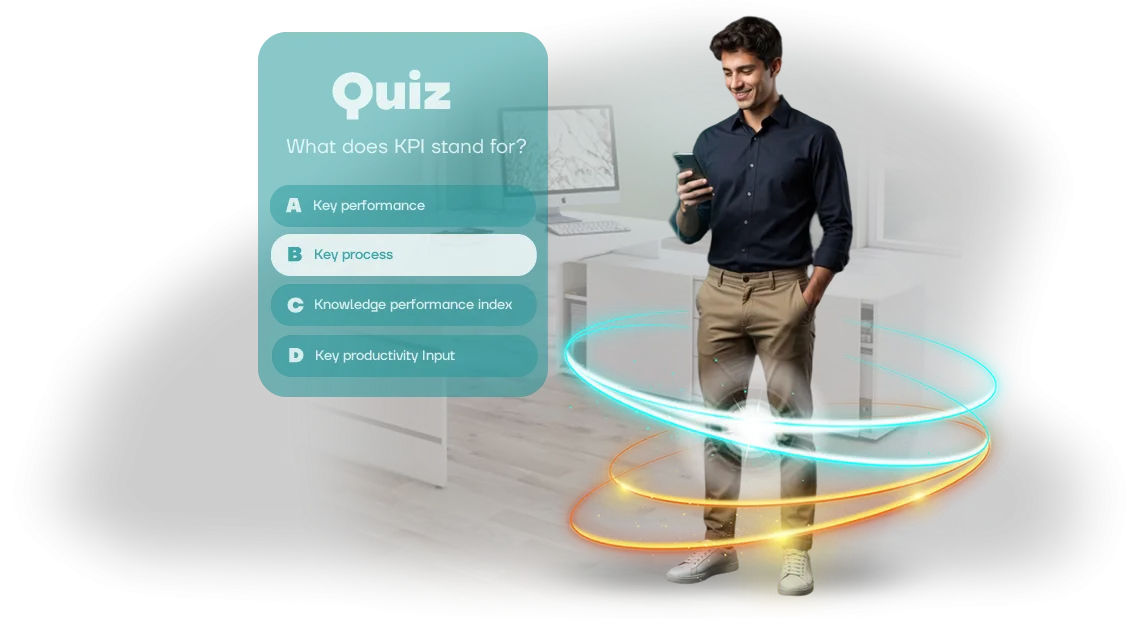
Why personnel retraining centers lose interest in training
Learners come to retraining centers for a new skill, but after just a few sessions interest visibly drops. Formal attendance at lectures turns into mechanical sitting-through, and this directly affects certification results and the institution's reputation.
The problem is not the motivation of a specific group, but the delivery format. Adults absorb material better when they can test themselves, compete, and see their progress.
Educational quizzes solve exactly this problem: they turn a course from passive listening into active — almost game-like — work with the content.
This approach gives the center several growth points at once. First, employee engagement increases dramatically: learners return to the materials, discuss questions, and strive to improve their results.
Second, the short-round format reduces fatigue, which means it also reduces learner dropout mid-program. People are less likely to abandon training when they see interesting and clear tasks.
For us, this is standard practice: we build quizzes on a professional platform, but the client receives not technical complexity but a ready-made tool that is easy to integrate into the curriculum.
The personnel retraining center saves on manual knowledge checks and gets live feedback: it is clear which topics have been mastered well and which should be explained again.
In the end, quizzes become not just entertainment but an element of the training quality control system. The manager sees an objective picture of performance, the instructor sees growth points, and the learner sees their own dynamics and achievements.
This is exactly what helps retain clients and earn the recommendations that sustain the flow of new groups.
What benefits educational quizzes bring to your business
Employee training is not a one-time formality but an investment in work quality. However, classic lectures and briefings are poorly absorbed: after a week, only a small portion of the information remains.
Educational quizzes turn the process into an active game where the employee tests themselves, makes mistakes, and immediately gets the correct answer — this is exactly how knowledge is retained long-term.
The main value of quizzes is increased training effectiveness. Instead of passively listening to material, a person solves tasks, analyzes situations, and remembers key rules through their own actions.
This is especially important for personnel retraining centers, where different employees need to be quickly brought to a unified knowledge standard. The game format multiplies engagement, which means it reduces the number of repeated briefings and on-the-job errors.
The second benefit is time savings for the team and HR. The quiz automatically checks answers, collects statistics, and shows which topics cause difficulties for the majority.
The manager sees the real picture without manual test checking, and employees complete training at a comfortable pace without being pulled away from their tasks for long. The result is faster preparation, lower costs for mentors, and transparent result control.
And finally, quizzes increase staff loyalty. People appreciate when training is interesting and respectful of their time. A healthy competitive element, points, and feedback create a positive attitude toward the company and its standards.
As a result, employees do not just remember the rules — they follow them more willingly and share knowledge with colleagues, which directly affects service quality and the atmosphere in the team.
Quiz formats for personnel training and their features
For personnel retraining centers, the quiz format determines whether knowledge stays in practice or is forgotten within a week. Regular tests are perceived as control, quizzes as a game, and competitive modes add emotion. We select the format for a specific task: check knowledge, reinforce material, or unite the team.
Comparison of quiz formats
| Format | For whom | What it gives the client |
|---|---|---|
| Test on knowledge of instructions and regulations | For new employees at the adaptation stage | A clear picture of knowledge gaps before starting a shift |
| Quiz with questions on completed material | For groups that have already finished the course | Quick review of key topics without a boring lecture |
| Competitive mode between teams | For departments and divisions | Increased engagement, healthy competition, and team spirit |
Each format solves its own task in personnel training. Tests are convenient as entry control and final certification, quizzes for regular material review, and competitive modes for motivation and team building.
At the same time, all three options are easily combined in one program: for example, first a test on basic rules, then a review quiz, and at the end a team tournament.
We will design the quiz so that it fits into your training program and requires no additional preparation from instructors. After each stage, the manager receives clear results: which topics have been mastered and where employees need help. This turns personnel training into a manageable process with clear feedback.
How quiz development proceeds for your company's tasks
Quiz development for a personnel retraining center starts not with questions but with your tasks.
We analyze which employees need to be trained, which knowledge needs to be checked, and which result matters for the business — so that the quiz works to raise competencies rather than being mere entertainment. Below are the stages we go through together with you.
- Brief and immersion in tasks. We have a call, discuss the audience, training goals, material complexity, and the format that suits your employees. As output, we get a short technical specification that you approve before work starts.
- Material audit. We study your training programs, regulations, presentations, and method guides. We determine which knowledge is truly critical to check and turn it into the quiz structure.
- Scenario and content. We develop the quiz logic: number of rounds, question types, hint mechanics, and feedback. We think through how the employee will see their mistakes and what they can repeat on a problem topic immediately after completion.
- Assembly and design. We build the quiz on a professional platform and adapt it to the corporate style and required devices. Your employees complete the training in a convenient interface without installing additional software.
- Testing on a real group. We run a pilot with several employees, collect feedback, and adjust questions, difficulty, and completion time if needed.
- Integration into the training process. We place the quiz in your system — via a link, in a personal account, or through an internal portal. We prepare instructions for the administrator and employees so the launch happens without your involvement.
- Support and refinement. After launch, we stay in touch: we update questions, add new topics, analyze completion results, and help increase engagement.
Each stage ends with a clear result that you can see and evaluate. We work remotely, so you do not need to rent a venue or gather everyone in one place — just set the deadlines, and we will organize the process so that the quiz is delivered on time and without disruptions.
What you get in the finished product for employee training
You get not just a game but a complete kit for launching training. We have gathered all the necessary materials and tools so that your employees can start using the quiz immediately after project handover.
- Ready-made quiz. The program works on regular computers and requires no special equipment. Results are saved automatically, and employees complete it at their own pace.
- Methodological materials. The kit includes a class scenario, a question bank with correct answers, and facilitator recommendations. You can use this as a ready-made lesson outline or split it into modules.
- Content rights. All created questions, texts, and program code are fully transferred to you. This is your property — you can freely refine and use them in any training program.
- Launch instructions. Step-by-step guides for organizers and participants: how to prepare the room, launch the game, award points, and summarize results. Even a new employee will figure it out without help from development.
- Administrator training. We conduct a short practical webinar for the employees who will be responsible for the quiz. They will learn how to change questions, create sessions, and view results.
- Launch support. For the first month after handover, we stay in touch and help with any questions. The first sessions will run confidently without hiccups.
Such a kit covers all needs from the first launch to regular knowledge checks. You do not need to hire contractors for refinements and maintenance — the product is fully ready for use.
Case study: how a quiz doubled training completion rates
A personnel retraining center faced a typical problem: learners dropped the course midway, and fewer than half the group passed the final test. Internal surveys showed the material felt dry and was not retained.
The head of the training department understood: a format was needed that would hold attention and boost engagement.
How we did it
We developed an educational quiz in Unity — a compact program that fit naturally into the training portal. Instead of standard tests, learners completed a quiz with interactive questions, instant feedback, and competitive elements.
Each correct answer awarded points, and at the end a participant ranking was displayed — this added excitement and the desire to finish the course.
We worked using the classic scheme: first a brief, then we selected game mechanics suited to the specifics of retraining. The quiz was adapted for mobile devices so learners could practice at any time.
The result was not a "toy for the checkbox" but a full-fledged knowledge reinforcement tool that is easy to update for new disciplines.
Quiz results
A month after launch, we compared the metrics. Course completion rates grew 2 times — from 30% to 60% of learners. Of these, 92% noted that the quiz helped them absorb the material better, and the average training satisfaction score rose by 1.5 points.
Additionally, time spent on knowledge checking decreased: training department heads stopped manually checking tests — the system delivers results immediately.
The client was satisfied and ordered three more quizzes for other retraining programs.
As this case showed, a quiz's effectiveness is not limited to entertainment value — a properly designed quiz solves a business problem: it increases engagement, improves results, and saves instructors' time. We are ready to repeat this result for your training center.
Frequently asked questions about implementing quizzes in training
Doubts are a normal stage: will the system have to be restructured, will quiz implementation take a lot of time, will it be expensive. We answer the main questions so you can assess whether this format suits your personnel retraining center.
We have already implemented quizzes in retraining, advanced training, and corporate education programs. Launch takes from a few days to a couple of weeks — depending on the number of questions and class format.
The quiz does not require replacing training materials and works as an additional knowledge control tool.
Is it difficult to implement a quiz into current training?
No. Computers or tablets are enough for employees to take the test. We adapt the quiz to your program: we take your questions, configure the difficulty level, and integrate it into existing courses without reworking materials.
How much does quiz development cost?
The cost depends on the volume of questions and scenarios. We provide a transparent estimate after clarifying your tasks, and the investment pays off through automatic checking — instructors save hours of manual work and immediately see which topics need review.
Will the quiz be compatible with our training materials?
Yes. We build questions from your manuals and tests, so the quiz naturally continues the training. We add explanations to answers so the employee reinforces the material, and we can export results in a format convenient for you.
Have more questions? Write to us — we will recommend the optimal format for your personnel retraining center.Order quiz development — a test module is included.
Order quiz development for your personnel retraining center — and receive a test module as part of the project. On it, your employees can try out the mechanics before the full launch: they will complete a mini-version of the course and see the questions and interface.
This way you evaluate the product by actual experience rather than by description, and understand in advance how the quiz will fit into employee training.
What is included in the test module and what bonuses you get when ordering a quiz:
- Test module for a pilot group — launch the quiz before final payment and test it on real users.
- Methodologist assistance — we turn your training materials into a scenario with questions, hints, and feedback.
- Administrator training — we prepare your specialists to independently launch quizzes and view result statistics.
- Adaptation to your programs — the quiz is integrated into existing courses and certification rather than created separately.
- Quick start — only a few days pass from brief to test version, with no lengthy approvals.
- Post-launch support — after the pilot, we make edits and add new questions based on the first results.
The test module is not a shortened demo version but a full-fledged piece of the future quiz. Employees complete it in the same format they will use after launch, and you see the effectiveness: who succeeded, where difficulties arose, and which topics need more explanation.
You can order the quiz remotely — we work with retraining centers from different cities. Leave a request, and the next day we will send a work plan and propose a date for the test module. This is a safe step: you lose nothing and gain a working tool for knowledge control.
How to choose a quiz format if you have specific requirements?
When you have specific training requirements, ready-made quiz templates often do not work. For example, you need to check knowledge of internal regulations, terminology, or production specifics, and a standard questionnaire does not account for your particular situation.
In this case, the choice of format should start not with the tool but with the business task: what result should the employee have after the quiz, and how will you know the result has been achieved.
Before choosing a format, answer three questions. First — what professional task does the quiz solve: knowledge checking, skill practice, or new-hire onboarding? Second — by what criteria will you know the training was successful?
Third — how much time do employees have to complete it and on what devices will they work? The answers determine whether standard solutions will work or whether an individual quiz is needed.
At this stage, it often turns out that standard formats hit limitations. For example, production employees find it more convenient to take the test on a phone rather than a computer, or results need to be saved in your internal system.
Other scenarios involve working with a large volume of questions, different difficulty levels for different positions, or confidentiality requirements. None of this can be solved by adding a couple of questions to a typical quiz.
An individual quiz is created for your scenarios. It can use real cases, adapt questions to your industry's terminology, and configure scenario branching depending on the answer.
In addition, it becomes possible to implement a hint and explanation system — this turns the quiz from a check into a training tool that increases personnel engagement.
Therefore, with non-standard requirements, do not try to choose a format from a catalog. The right path is to document the requirements, discuss them with a developer, and get an individual quiz that solves your specific task.
That is how we work at our team: first we study the specifics, then we propose a suitable solution, and only then do we implement it. This way you get a tool that works immediately after launch and easily adapts to business changes.