

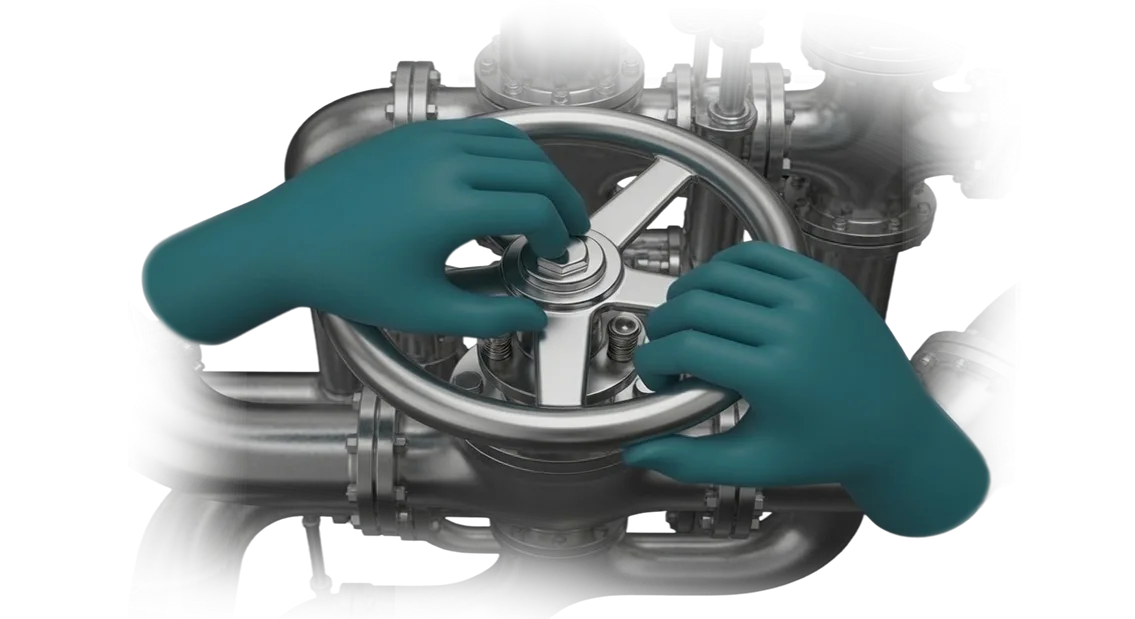
Modeling a Rocket Engine: The Cost of an Error in Manufacturing
Designing a rocket engine involves dozens of iterations, expensive test stands, and tight deadlines. Any mistake at an early stage results in budget overruns: reworking tooling, postponing launches, losing contracts.
Traditional modeling often fails to reveal how components actually behave in an assembly, which is why engineers only discover problems during testing.
Every day of production line downtime costs tens of thousands of dollars, and a missed launch means lost contracts and damaged reputation.
In the rocket industry, the cost of an error is especially high: a defect discovered at a late stage can lead to an accident or a batch recall.
That is why enterprises are increasingly using VR modeling of rockets at the design stage to rehearse assembly, maintenance, and even emergency scenarios. This reduces manufacturing risks and protects the budget.
VR modeling moves verification into a virtual environment: the engineer "assembles" the engine, checks fastener accessibility, alignment, and kinematics — without a physical prototype. This is industrial modeling that works before production begins, not after.
Errors that used to be found on the test stand are now visible on screen within days. Engineers see the engine at 1:1 scale and can inspect even areas that are unreachable in reality.
We help enterprises implement such VR solutions: we reduce the number of expensive iterations, accelerate approvals, and lower the cost of errors. Instead of paying for rework, the customer pays once for a digital check. This speeds up time-to-market and preserves the reputation of a reliable manufacturer.
What a VR Trainer Delivers for Training and Skill Development
A VR trainer for staff training delivers measurable results. Here is a checklist of what an enterprise gets in the first few months:
-
Fewer accidents and errors. Practicing emergency situations in VR trains responses to equipment failures without any risk to hardware. The number of erroneous actions drops by 40–70%.
-
Faster operator reaction time. After 15–20 hours of training, decision-making time in an emergency scenario decreases by 2–3 times. The operator acts on autopilot rather than trying to recall the instruction manual.
-
Quick onboarding for new hires. Trainees master standard operations in 2–3 days instead of 2–3 weeks on a real test stand. Mentors are unburdened, and equipment downtime decreases.
-
Savings and ROI. Trainees make their first mistakes in VR rather than on an expensive test stand. With a trainer cost starting from the amount calculated after audit and monthly savings in the thousands, the project pays for itself within 3–6 months — ROI of 200–400% per year.
-
Transparent certification. The system records every action: time, errors, trajectory. Management receives an objective report on each employee's readiness.
The effectiveness of VR trainers is confirmed in the aerospace industry — for example, in training personnel for assembling units similar to those used at NPO Energomash. After implementation, repeat incidents occur less frequently and operator responses become predictable.
If at least two items on this list matter to your production — a VR trainer will pay for itself faster than you expect.
VR Trainer Formats for Modeling Technological Processes
Industrial VR trainers address specific production tasks: from practicing a single operation to preparing a shift for an emergency situation. That is why simulator formats vary — modular, comprehensive, team-based, and certification-oriented.
We match the type of VR simulator to your technological process, rather than "fitting" the process to a ready-made solution.
For example, modeling a rocket engine often only requires a modular scenario, while an entire technological chain calls for a comprehensive system.
Every format gives employees hands-on experience without risk to equipment or people. Mistakes in the virtual environment do not lead to defects or downtime, and skills are reinforced just as they would be on a real installation.
Below are the typical types of VR trainers ordered by industrial enterprises and the tasks they solve.
| Format | Who it is for | What it delivers to the client |
|---|---|---|
| Modular VR trainer | Enterprises that need to quickly train employees in a single operation — assembly, welding, component inspection | Reduces onboarding to 2–3 days instead of weeks, creates a uniform operational standard |
| Comprehensive full-cycle simulator | Production facilities with multi-stage processes, including startup, setup, and emergency modes | A complete picture of the technological chain, fewer errors when transitioning between stages |
| Team-based VR trainer | Shifts, crews, and specialists who work together | Practicing team interaction, reducing downtime caused by personnel |
| Certification format | HR and training departments seeking objective skills assessment | A transparent qualification control system, clear criteria for work authorization |
If you are unsure which format you need, start with a task audit. Our engineers will analyze your technological process and propose an option that will pay off fastest through reduced defects and faster staff training.
How We Develop a Trainer: Stages and Timelines
Stages and checkpoints
We understand that for an industrial enterprise, a VR trainer is not entertainment but a working tool that must integrate into training processes and deliver measurable results. That is why we work transparently: we define goals, stages, timelines, and checkpoints. What follows is a clear sequence of actions from the first brief to launch and support.
- Brief and task audit — we meet with your team to clarify which employees will be trained, which skills will be practiced, and what outcome you consider successful. We collect materials, regulations, and constraints.
- Concept and scenario — we design training scenarios, exercise structures, and an action assessment system. For complex products, such as rocket engine modeling and maintenance, we determine which components and operations need realistic representation.
- Prototype and approval — we show an interactive mockup of the trainer across key scenes. You see the visual design, mechanics, and logic before full development — this eliminates rework risks.
- Development and content creation — we build the full trainer: realistic 3D models, animations, equipment operation simulations, tasks, and feedback.
- Testing with operators — your employees, methodologists, and engineers test the trainer. We collect feedback, fix weak points, and refine the scenario to a production-ready state.
- Deployment and launch — we configure equipment, install software, and train instructors. We launch the trainer within the agreed timeline.
- Support and evolution — we stay in touch after launch: updating content, adding new scenarios, and monitoring stability. When needed, we expand the system for new tasks.
Specific timelines are set after the brief: typical scenarios take 4–6 weeks, while complex, highly detailed simulations take 2 to 4 months. You always know where things stand, what is ready, and what remains — with no hidden stages or budget surprises.
What Is Included in a VR Trainer Delivery
When you order a VR trainer, you receive not just a program but a complete solution for employee training. The delivery package includes everything needed for launch and day-to-day operation: from virtual scenarios to methodological materials and technical support.
We assemble the package around your specific task — whether it is practicing rocket engine assembly or responding to an emergency situation. A typical delivery includes:
- Training scenarios — virtual exercises based on your production regulations: standard operations, emergency situations, rare equipment failures.
- Methodological materials — instructor guides, action assessment criteria, checklists, and recommendations for integrating the trainer into your training program.
- Documentation — a complete set: installation description, operating manual, and maintenance schedule.
- Personnel training — our specialists train your instructors and operators to work with the trainer and conduct acceptance testing.
- Trainer updates — regular content and scenario updates to reflect changes in regulations, technologies, and safety requirements.
- Technical support — assistance with any questions, remote diagnostics, and operational consultations.
Importantly, we do not disappear after launch. Throughout the entire period of use, the trainer is updated, methodological materials are kept current, and your team can always reach out for support. This ensures stable workforce training without additional investment or downtime.
Case Study: Trainer Implementation at an Industrial Enterprise
For a major machine-building enterprise, we developed a VR trainer for engine assembly and diagnostics. Previously, trainees practiced operations on real equipment: risk of breakage, expensive components, and constant mentor involvement.
The enterprise needed to train about one hundred new specialists per year, and each such training session cost an average of the amount calculated after audit.
We created a virtual replica of the unit with a full cycle of work operations. In the trainer, trainees can make mistakes without consequences and repeat difficult stages as many times as needed. This is especially important for operations that in reality require stopping the production line.
Implementation Results
Within two months, the time required to train new specialists dropped by 30%, and the number of errors on real equipment fell by 45%. The client noted increased employee confidence and fewer emergency shutdowns.
"We saved approximately the cost calculated after audit per year on training and were able to increase trainee intake without additional strain on the workshop." — Head of the Enterprise Training Center
The savings came from three sources: eliminating consumable material costs during training, avoiding machine downtime caused by novice errors, and freeing up mentor time.
Following the pilot project, the enterprise ordered additional modules for three workshops, and then a complete package for its factory training center.
Today the trainer is used across five workshops, and repeat orders confirm that VR solutions pay for themselves within the first year and continue to deliver value as they scale.
How to Choose a Trainer Format That Fits Your Budget and Objectives?
A VR trainer format should not be chosen for the sake of a technological novelty, but based on three specific parameters: the number of trainees, the budget, and the complexity of production operations.
If you have few employees and the process is already well-established — a compact solution is sufficient.
If you are dealing with mass training or work in hazardous conditions, you need a full-scale training ground with professional equipment and a statistics collection system to track each specialist's progress.
The key criterion is the cost of an error in real production. Rocket engine modeling is exactly the case where an emergency situation is extremely expensive, and practicing rare scenarios on a real object is impossible or dangerous.
A VR trainer allows employees to safely work through emergency modes and build muscle memory without risking people or equipment. Moreover, there is no need to stop production — training runs in parallel with regular work.
The second criterion is training throughput. For a small team, a single workstation used on a schedule is enough.
If dozens or hundreds of people pass through training each year, it makes sense to invest in multiple stations: this reduces the queue and accelerates new hires' path to full independence. Such a system scales easily — you can start with one scenario and gradually add new areas.
The budget determines not the size of the solution but its starting point. Instead of "everything at once," it makes sense to choose one critical operation, perfect it, and then expand to adjacent processes — assembly, diagnostics, routine maintenance. This way investments are distributed gradually, and results are visible from the very first stage.
We help you choose a format that fits your objectives and budget: from a single workstation to a full training classroom. The main thing is to define which skills need to be measured and improved — our engineers will handle the technical implementation.
Frequently Asked Questions About VR Trainer Development
Before launching a project, managers ask the same questions: when will the investment pay off, how will the trainer fit into training, and will staff find it easy to use? We answer the main concerns — without technical details.
How quickly will a VR trainer for rocket engine modeling pay for itself?
The trainer reduces costs for mockups and materials, decreases errors, and minimizes downtime. VR training takes significantly less time, so the investment is recouped after just the first few groups of employees.
Is the trainer compatible with the enterprise's current processes?
We integrate virtual scenarios into the existing training program: employees complete the VR module before being allowed to work on real equipment. All you need to get started is a room and one computer with a headset — there is no need to stop production.
Will employees find it difficult to adapt to a virtual environment?
The controls are built around natural hand and eye movements — employees start working during their very first training session. The briefing takes minutes, and the scenarios mirror real operations, so skills transfer directly to the production floor.
Is the trainer safe for practicing emergency situations?
The main advantage of VR is practicing abnormal scenarios without any risk to people or equipment. Employees learn to act when engine parameters deviate: in the virtual environment a mistake costs nothing, while on a real object the consequences would be severe.
Submit a Request: Get a Cost Estimate and Implementation Plan
After you reach out, you receive not abstract promises but a concrete result: a cost estimate for the VR trainer, an implementation plan, and a turnkey pilot project.
We structure the task ourselves, so you do not need to prepare a technical specification or understand the implementation details — simply describe what skills your employees are missing.
Submitting a trainer request starts a short VR consultation: we clarify the area of application, current equipment, and training requirements. Within just a few days, you see the cost, timeline, and sequence of work — with clear stages and results for each one.
Next comes a transparent implementation plan:
- Day 1 — VR consultation: we discuss objectives, answer questions, and determine how the trainer will fit into your processes.
- Days 2–3 — we prepare a cost estimate for the VR trainer and propose the optimal configuration.
- Days 3–4 — we send a commercial proposal with an implementation plan and scope of work.
- Week 1 — we agree on the training scenario, scenes, and employee assessment criteria.
- Weeks 2–4 — we develop a turnkey VR pilot project: from modeling to program setup.
- Month 1 — we launch the pilot at your enterprise, conduct training, collect feedback, and showcase initial results.
- Beyond — we scale the solution to new areas, replicate trainers, and keep the program supported.
If you want to evaluate VR in action without lengthy approvals — submit a request. Get a cost estimate and implementation plan to see a working pilot at your enterprise within a month.