

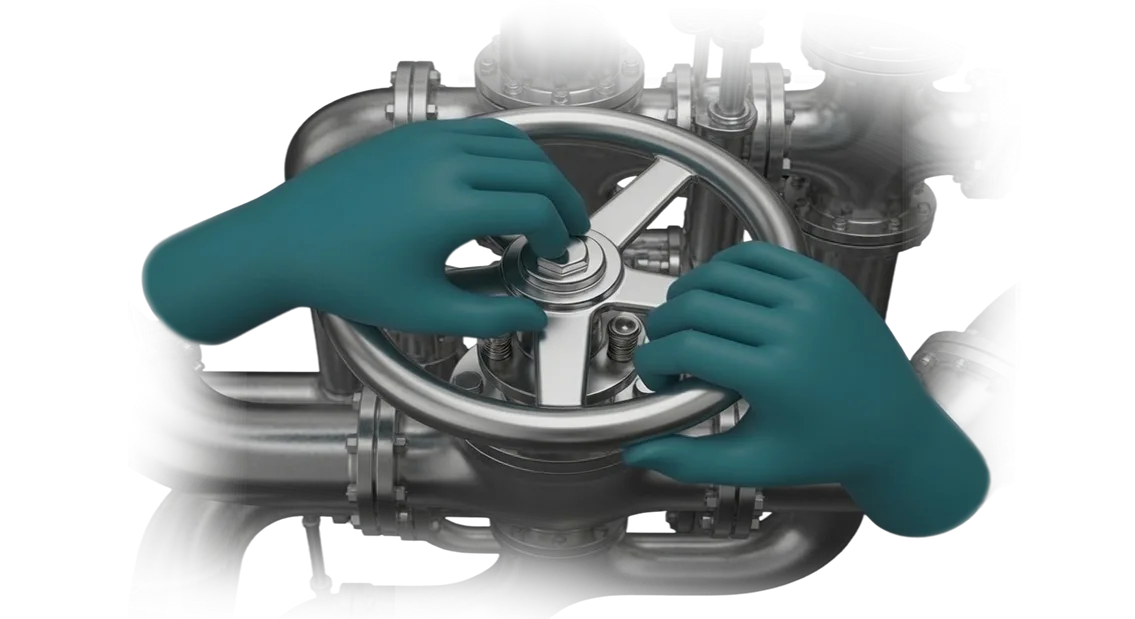
A Mistake at a Nuclear Reactor Costs Too Much
A mistake made by an operator at a nuclear reactor costs too much. Even a single wrong step during a routine procedure can result in downtime of expensive equipment, and in an emergency situation it can threaten human health and the environment.
The cost of such an error consists not only of direct losses: it also includes the enterprise's reputation, the trust of regulatory authorities, and the validity of permits and licenses.
That is why personnel training in nuclear energy cannot rely on the "right to make mistakes" in real conditions. An operating reactor does not forgive wrong actions — it is not a place to learn by trial and error.
A trainee needs conditions in which they can calmly practice an algorithm to the point of automation, understand the consequences of every decision, and regain confidence after a failure — all without stopping the production cycle or creating a threat to the facility.
We address this need. The VR simulator reproduces the operator's logic and sequence of operations in exact accordance with regulations, including startup operations, planned switching operations, and emergency scenarios.
A person can train as many times as needed until the action becomes stable and an error becomes impossible. This way, safe training becomes a full-fledged specialist preparation system, and the cost of a potential mistake at a real facility simply becomes irrelevant.
What a VR Simulator Gives an Enterprise
A VR simulator shifts personnel training from theory to safe practice. An employee practices actions on a nuclear reactor in conditions as close to real as possible, but without risk to themselves, equipment, or production.
An error on the simulator is not an accident or downtime, but valuable experience that could cost a great deal in real life.
Training becomes several times faster: instead of long lectures and waiting for equipment access approval, a newcomer quickly works through key scenarios — from routine operations to emergency situations.
At the same time, the skill level of all personnel grows uniformly, not just for those who were lucky enough to get practical training. The enterprise gets a predictable level of employee preparedness regardless of shift, seniority, or the instructor's personal experience.
An additional benefit is resource savings. VR training does not require fuel, raw materials, production line stops, or expensive equipment dedicated to training purposes.
A simulator created once pays for itself through reduced instruction costs, fewer errors, and less wear on real machinery. Moreover, the program is used for years and can be easily scaled to new groups of employees.
The main result is manageable risks. Personnel who have already gone through scenarios in a virtual environment act more confidently and calmly in critical moments.
For a manager, this means fewer emergency shutdowns, a lower probability of incidents, and peace of mind regarding human safety and production continuity.
VR Simulator Formats for Your Task
Simulator formats for the nuclear industry differ not in "hardware" but in scenarios and objectives. A simulator for an enterprise can be designed for a single operator, for an entire shift, or for a certification committee.
That is why we select a format for a specific task rather than selling a "boxed" VR solution.
There are three key formats: individual operation practice, team drills, and certification scenarios. Each one addresses a specific need in its own way — from reducing emergency risks to documented employee readiness.
| Format | For whom | What it delivers to the customer |
|---|---|---|
| Virtual simulator for practicing actions | Operators, equipment operators, maintenance personnel | Practice of rare and dangerous operations without stopping production; a stable skill before the first real activation |
| Team drill simulator | Shifts, emergency response teams, work supervisors | Team coordination in emergency situations; testing interaction protocols without risk to people or equipment |
| Certification simulator | HR departments, training centers, admission committees | Objective assessment of actions according to criteria; a ready-made protocol for certification and a basis for retraining |
Formats can be easily combined: on the same reactor model, you can run individual scenarios, team drills, and certification tests. This reduces the total cost of ownership — you pay for a universal tool rather than for three separate systems.
We help you choose a starting format after analyzing your regulations and typical personnel errors. We will send a brief recommendation within one day — start with that rather than with a lengthy technical specification.
How We Develop a Simulator: 6 Steps
Developing a VR simulator for an industrial enterprise is not a "boxed solution" but a sequence of development stages, where each step brings you closer to the main goal: the employee acquires a skill that carries over to real work.
We have structured the process so that you, as the customer, always see what is happening and what you will receive at the end.
- Brief and task immersion. We visit your site or work with your technologists: we collect scenario requirements, a list of critical operations, and potential errors. This is the foundation of all future simulator development.
- Scenario and evaluation methodology. We describe the scenario as a sequence of actions with time and error tracking. The result is an approved document showing which skills are trained and how the outcome is assessed.
- Prototype. We quickly demonstrate key scenes and basic interaction before any major investment. You evaluate ergonomics and logic, and we get early feedback.
- Full development. We create graphics, animations, and behavior using professional equipment. At this stage, the simulator becomes realistic, and training becomes safe and manageable.
- Testing with employees. We test the simulator with your audience: usability, clarity of instructions, and learning speed. We make corrections before final delivery so VR implementation goes smoothly.
- Implementation and support. We install equipment, set up workstations, and train instructors. We support the simulator and update it when regulations change or new tasks appear.
Each of these six steps is documented in agreements and is understandable without technical details. You get not a "black box" but a manageable process with checkpoints and a predictable outcome — a simulator that is actually used in training from day one.
What Is Included in the Simulator Delivery
The full delivery package is not just a "box with a program" but a complete training system that can be put into operation from day one.
We build the simulator around your enterprise's tasks: so personnel can practice regulations, and you can see training results and monitor each employee's progress.
The standard delivery includes:
- Training scenarios — typical operations based on real regulations: startup, shutdown, normal operating modes, and emergency situations. The employee receives step-by-step prompts and acts in a safe environment without risking equipment.
- Accurate 3D equipment models — visually accurate copies of work areas and mechanisms. Personnel remember the layout of components and the sequence of actions faster than with drawings and paper instructions.
- Instructions and manuals — a built-in knowledge base that employees can access during training. Everything needed is always at hand, with no need to search for documentation.
- Analytics system — a manager's dashboard with results for each employee: number of attempts, errors, completion time, and progress. You can see who is ready for independent work and who needs additional training.
- Technical support and updates — we help with setup, answer questions, and refine scenarios to reflect regulatory changes. You can contact us at any time — we work remotely nationwide.
All of this is packaged into a unified interface that is easy to understand even for those putting on a VR headset for the first time. Training does not require an instructor to be present: the system guides the employee and records the result. You get a transparent picture of personnel readiness without adding extra workload to instructors.
Delivery takes 2–3 weeks from the moment scenarios are approved. After that, we stay in touch: we update content, add new exercises, and help expand the simulator to other production areas. You are not buying a one-time service but a long-term tool for improving safety and qualifications.
Case Study: Nuclear Reactor VR Simulator for a Training Center
Training centers that prepare nuclear reactor operators face a difficult challenge: practicing actions on real equipment takes a lot of time, costs a lot, and almost never allows simulation of emergency situations.
Every error on real equipment is serious stress and lost hours, and under real conditions such errors cannot be allowed at all. our team solved this problem by developing a virtual simulator that fully imitates the operator's work and allows safe training in any scenario.
What Was Done for the Training Center
The simulator reproduces the reactor control panel and work processes so that trainees are immersed in a realistic environment. Instead of lectures and static mock-ups, there are interactive scenarios: startup, normal operation, equipment failures, and emergency algorithms.
Trainees see the consequences of their actions immediately, learn to make decisions, and bring them to the point of automation. At the same time, instructors can change conditions from their own workstation, introduce failures, and monitor each trainee's actions.
Results Noticed by the Customer
The introduction of the virtual simulator allowed the training center to prepare operators twice as fast, because each scenario can be repeated without restrictions and without consuming resources.
In the first year, more than 150 specialists completed the program, and 95% of them passed the final certification on the first attempt — previously that figure never exceeded 70%.
The center's management noted that operators became more confident in non-standard situations, and the simulator itself simplified the training process so much that the customer extended the cooperation and expanded the program to other energy facilities.
The project experience shows: a virtual simulator is not a replacement for an instructor, but a tool that amplifies their work and delivers measurable results.
If you need to prepare personnel faster and more reliably, contact our team — we will show you how it works in practice.
How to Choose the Right Simulator Format?
There is no universal VR simulator — just as no two enterprises are the same. So the first thing to understand is which VR simulator suits you, and that depends not on trendy equipment but on your specific training objectives.
The format choice is influenced by the number of trainees, scenario complexity, and the main goal: deep practice of one algorithm or covering a large group in a short time. For individual actions, a standalone workstation is suitable.
For team work, a shared scenario with the simultaneous participation of several employees is better.
Managers often ask for one "big simulator for everything," but in practice it is more effective to combine formats: a brief introductory scenario for all employees, a detailed simulator for operational personnel, and team exercises for practicing emergency situations.
This way, training takes less time and delivers a measurable result: fewer personnel errors and faster reaction in critical moments.
We do not sell a "boxed" product. We start with an audit of your objectives, training program, and regulations, and only then propose a simulator tailored to a specific process.
If needed, we show a demo scenario at your site so you can assess realism and usability before the full project is launched.
The main criterion is not the number of virtual zones, but what personnel actually learn. Choose the format that solves your task: employee training, skill verification, or reducing onboarding time. A properly selected simulator pays off through safety and stable shift performance.
Common Customer Concerns: We Answer Directly
Any new tool in production raises questions — especially a simulator that employees will need to work with.
The most common concerns are the same: is implementation too complicated, will the project be too expensive, will the solution fit existing regulations, and is it secure for data. We answer directly and to the point.
Is it difficult to integrate a VR simulator into current processes?
No, it is not more difficult than launching any other training. We handle installation, setup, and preparation of your instructors — they will be able to conduct sessions on their own from day one.
The simulator does not require reconfiguring production or stopping a workshop: just allocate a small room or use an existing training classroom. Employees quickly learn the controls, and the briefing takes minimal time.
Isn't it too expensive?
The cost of a VR simulator often seems inflated until you calculate how much an enterprise loses on personnel errors, consumables, and risks when practicing emergency situations.
The simulator allows you to practice emergency scenarios without stopping production and without endangering people — the savings usually exceed the development investment many times over.
We offer several collaboration formats: purchase, subscription, or lease. At the start, we calculate the payback period for you and show how it is achieved.
Will the simulator fit our regulations and equipment?
The simulator is created for the specific technological process of a specific enterprise. We take your instructions, diagrams, regulations, and work scenarios — and reproduce them in a virtual environment with the accuracy needed for training.
That is why it fits naturally into your personnel training system: results can be linked to training logs, used as a work permit, or used as an examination tool. There is no "generic" picture — only your processes.
Is enterprise data secure?
Data on training completion and employee results is stored on your server or within the enterprise's secure perimeter. We do not transfer information outside and do not use it for third-party purposes.
Access to scenarios and reports is configured according to your roles: some users see only their own results, while managers see statistics for the entire shift. This is a fully closed loop that operates by your rules.
Get a VR Simulator Cost Estimate for Your Enterprise
Every industrial facility is unique: a standard VR simulator will not account for your regulations, equipment layout, and specific risks.
For a nuclear reactor, this is critical — scenario accuracy directly affects personnel safety and the correctness of actions in an emergency situation. That is why we begin with an estimate for your facility, not with selling a ready-made solution.
When you request an estimate, you will receive:
- A preliminary budget and realistic timelines — you understand the cost before the start, with no hidden expenses.
- A selection of scenarios for your tasks: from planned regulated operations to emergency and rare situations.
- An audit of the training process and recommendations on how to integrate VR into your current training program.
- A pilot segment of the simulator that can be shown to management and the safety department.
- A calculation of the scope of work and a turnkey development roadmap with accountability for the result.
- Consulting from engineers and methodologists at all stages — from task definition to launch.
We work remotely or visit your site to collect accurate data for the simulator. We process requests within one business day and prepare the estimate for your facility and regulations.
It is non-binding — but after the estimate, you will know exactly what can be done, how, and in what timeframe for your enterprise.