

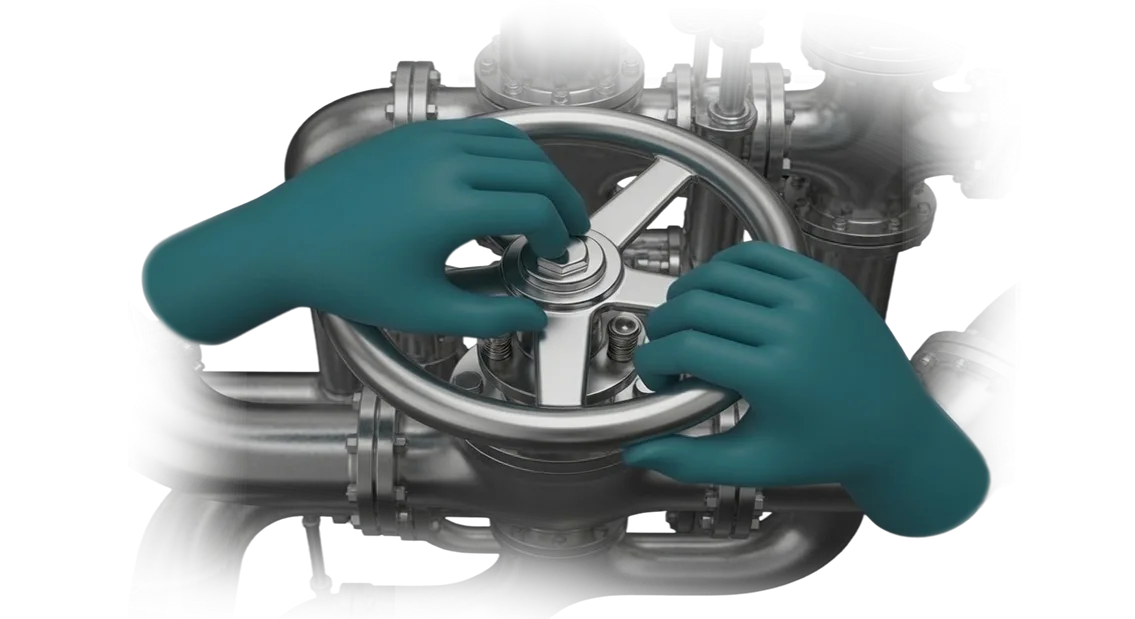
VR distillation column simulator: how to reduce training risks
Training distillation column operators on real equipment always involves risk. Every wrong action is a potential accident, process shutdown, injury, or costly repair. To avoid this, companies delay allowing newcomers to work independently, but this slows down staff training.
Traditional briefings and internships don't allow practicing emergency situations: the operator encounters them for the first time at a real facility, when the cost of error is at its highest.
That is where the main training risks lie — a lack of practical experience combined with high responsibility for workplace safety.
The VR distillation column simulator from our team solves this problem. The operator is immersed in a virtual copy of the plant and practices both normal operating modes and emergency scenarios — without danger to people or equipment.
Mistakes made in the virtual environment have no real consequences but provide invaluable experience.
This approach directly reduces the cost of accidents: personnel arrive at the production site already prepared and able to act in non-standard situations.
The company gets fewer operator errors, stable plant operation, and confidence that every employee knows what to do in any emergency.
We create simulators that integrate into existing training systems and allow tracking the progress of each specialist. If you want to improve workplace safety and reduce costs associated with the human factor, let's discuss your task.
What a VR simulator provides for operator training
Training distillation column operators is an expensive and high-stakes process: safety, product quality, and uninterrupted plant operation depend on proper staff actions. Traditional training on real equipment involves risks, downtime, and inevitable mistakes by newcomers.
A VR simulator moves training into a safe virtual copy of the plant, where every skill can be practiced without consequences for production.
The main benefit of a virtual simulator is reduced accident rates. The operator calmly learns normal operating modes and action algorithms for deviations — from pressure surges to emergency column shutdown.
The virtual model can simulate any failure and require a quick response, while nothing explodes or breaks. When such an employee reaches the real site, they already know how to act in a difficult situation and make fewer mistakes.
Staff training speeds up significantly: time to full competency is reduced from months to a couple of weeks. Instead of waiting for operating equipment to become available, the trainee works in the simulator classroom at their own pace.
They complete more practical cycles in one day than in a month on the production floor and get authorization for independent work faster. This directly affects how quickly vacancies are filled and provides flexibility in shift management.
Cost reduction is tangible for the budget: no money is spent on feedstock for training runs, energy, or depreciation of the real column. The load on mentors decreases — they no longer need to constantly shadow a trainee at a hazardous facility. And better preparation reduces losses from defects and downtime caused by the human factor.
Training quality becomes predictable: the system records every operator action, compares it with the reference scenario, and shows growth areas. Practicing until automaticity builds stable skills uniform across the entire shift.
As a result, the company gets a competent distillation column specialist faster, more safely, and with lower costs — exactly the benefits of a virtual simulator that pay back the investment.
VR simulator formats for distillation columns for your task
There is no universal solution for training personnel to work with rectification columns. One company just needs a short introductory module; another needs a full-fledged environment that replicates the actual control panel.
The VR simulator format should match the operators' skill level, the complexity of the technological process, and your objective: from initial authorization to emergency response training.
We distinguish four basic formats that cover the needs of most production facilities. The table below shows which tasks each one suits.
| Simulator format | For whom | What it gives the client |
|---|---|---|
| Introductory VR demonstration | New employees, trainees, plant visitors | Quick immersion in the process, reduced stress on first visit to the real site |
| Standard operations simulator | Operators, process engineers | Practicing startup, shutdown, and normal modes without risk to production or feedstock |
| Emergency scenario simulator | Experienced personnel, engineers | Confident actions during parameter deviations, fewer emergency shutdowns and losses |
| Full "virtual plant" package | Training centers, large production facilities | A unified environment for practicing all key units, potential savings on real-world training |
Note: the cost and timeline depend not on how "pretty" the graphics are, but on the depth of process simulation and the number of scenarios.
We select the format at the brief stage and fix it in the technical specification — you pay only for what actually affects the training result.
If none of the basic formats fits, we develop a custom simulator based on your process diagrams and regulations.
This provides a simulator that replicates the specifics of your equipment as accurately as possible, and employees get hands-on experience without downtime or risk to production.
Simulator development stages: from brief to launch
We live in a world where an operator error can result in production downtime or an accident. That is why the development of a distillation column simulator must be transparent — you always know where the project stands and what comes next.
We have completed dozens of implementations and built a workflow that saves your time: from brief to launch takes 8–12 weeks, and you make every key decision deliberately.
Below are the stages we go through together with you.
-
Brief and needs audit. We interview process engineers and operators and study your production regulations. You receive a technical specification with a clear list of training scenarios and staff assessment criteria.
-
Concept and work plan approval. We fix timelines, stages, and cost. You approve the scenarios and the list of skills employees will practice in the virtual environment. No hidden tasks — only a transparent budget and schedule.
-
Virtual model and scenario development. We create a digital twin of your equipment with realistic control logic and emergency situations. In parallel, we prepare training instructions and a hint system for the operator — this speeds up learning the simulator.
-
Intermediate demonstration. You see a working prototype with basic scenarios before the final version. At this stage, it is easy to adjust model behavior or add new situations without extra costs — revisions are many times cheaper than after delivery.
-
Final development and testing. We fine-tune all scenarios and incorporate feedback from your process engineers. We conduct test sessions with real operators — the simulator must be clear to employees with different levels of experience, including beginners.
-
Launch and post-deployment training. We install the system, train your instructors to use the simulator, and hand over documentation.
After launch, we maintain the scenarios: we update them to reflect regulation changes and help integrate the simulator into your personnel training program.
As you can see, at every stage you control the process and see the result. We handle the technical side, and you get a ready-made tool that reduces accident risk and accelerates the transition of newcomers to independent work.
What is included in the simulator delivery
When a company orders a VR simulator, it is important to understand: you are getting more than just a program — you are getting a complete training solution.
We put together a full package that can be used in the training process immediately, from installation to the first operator sessions.
The delivery includes the distillation column simulator itself and everything needed for its deployment and operation. This allows the training department to launch the program without involving external specialists or lengthy approvals.
What you receive under the contract
- VR distillation column simulator with a set of training scenarios: from basic operations to emergency situations. Each scenario reflects the real work of your plant.
- Methodological materials for instructors and operators. Ready-made lesson plans, recommendations for assessing employee actions, and guidance on reviewing mistakes.
- Technical documentation and operating instructions. Everything needed for startup, configuration, and day-to-day operation without constant contact with the developer.
- Adaptation to your company's regulations and process diagram. The simulator is configured to your specific equipment and production parameters.
- Training for administrators and instructors. Your staff will learn to manage the system, generate reports, and monitor operator progress.
- Simulator updates and technical support for the entire period of use. We keep materials up to date and help whenever questions arise.
This approach addresses the client's biggest fear: "bought it and forgot about it." You get a working tool that fits into your existing training system and delivers results in the very first week.
And when regulations change or new tasks appear, the simulator can be upgraded for new conditions — without replacing equipment or retraining staff.
Case study: how a VR simulator reduced accidents at a production facility
At one petrochemical production site, the client faced a typical problem: distillation column operators trained on real equipment, and every beginner's mistake resulted in downtime or an accident.
Theoretical briefings did not build the required skills, and mentors spent up to half their shift supervising trainees. Management was looking for a way to reduce the number of incidents and accelerate personnel training without stopping production.
We developed a VR simulator that fully replicates startup, normal operation, and emergency scenarios on a distillation column.
The operator trains in a safe environment but with realistic parameter behavior: temperature, pressure, liquid level, and fraction compositions react to every action.
This allowed emergency protocols to be practiced as many times as needed before an employee was allowed at the real control panel.
The project results exceeded expectations. In the first six months of operation, the number of operator-related incidents dropped by 40%, and the time for newcomers to reach independent work was cut in half — from six months to three.
Training costs decreased because the simulator requires no feedstock, energy, or time on operating equipment. The client's feedback confirms this: "For the first time, we saw trainees confidently handle depressurization before ever starting a real shift. The VR simulator has become a mandatory part of our training program."
For the business, this is primarily manageable risk and predictable timelines: the company gets employees with a uniform skill level, regardless of the mentor's experience. The simulator itself stays on-site — it can be extended with new scenarios as regulations evolve.
This case shows that VR solutions pay off not after years, but within the very first months of operation, and we are ready to bring this experience to your site.
Frequently asked questions and client concerns
Any new training tool raises questions — that is normal. Especially when it comes to a VR simulator for a distillation column: clients worry that the equipment will break, staff will not be able to use it, and the result will not fit into the existing operator training program. Below we answer the most common concerns.
What happens if the simulator breaks down?
We take over full maintenance and technical support. The contract specifies response times, equipment replacement, and engineer visits. Even in an emergency, training stops for a few hours at most — not for weeks, as with a broken physical training stand.
Our staff has not worked with VR — will they need a long time to learn?
The simulator is built around the real operations of your process engineer and operator; the interface is intuitive, with hints at every step.
At launch, we conduct a short orientation for instructors — 15–20 minutes is usually enough for an employee to confidently start working on their own.
Is the simulator compatible with our training program?
Yes. We customize scenarios to your regulations: standard actions, emergency situations, performance standards. The simulator easily integrates into the existing training process, and the reporting system shows which skills each operator has practiced.
How long does deployment take and when will we see results?
From brief to first launch — typically 4–8 weeks, depending on scenario complexity. During development, you receive intermediate demos to see progress and make adjustments. You are not waiting for results alone — we keep you informed at every stage.
If you still have doubts, ask us directly. We will send examples of completed projects for industrial companies, show you what the distillation column simulator looks like in action, and help estimate timelines for your scenario.Order a VR simulator and get risk-free training
Ordering a VR simulator is not just buying a program and equipment. It is launching a training system that removes a company's biggest risks: staff errors on real equipment, production downtime, and injuries.
That is why we have structured the process so you get results right after contacting us, not after a long implementation.
Here is what is included in a simulator order and what you get at each stage:
- Consultation: we review your training program and advise where a VR simulator will deliver the greatest effect — for onboarding, retraining, or emergency response practice.
- Demonstration on your scenario: we show what training looks like before the contract is signed — you assess realism, usability, and compliance with your regulations.
- Contract with fixed timelines: we specify stages, simulator scope, and areas of responsibility — no hidden work or additional payments.
- Fast launch after approval: we create a scenario for your specific processes rather than adapting a generic model.
- Methodological support: we provide instructions for instructors, recommendations for integrating the simulator into your training program, and checklists for staff assessment.
- Post-launch support: we update content, help with technical questions, and refine scenarios based on the first sessions.
This way you do not just get a simulator — you get a working training tool that pays for itself by reducing accidents and accelerating staff preparation. Contact us — we will discuss your task and show how a VR simulator will fit into your production.
How to choose a simulator format for your production specifics?
There is no universal VR simulator that works equally well for oil refining and food production.
The format depends on which operations you want to practice, who will be trained, and which mistakes are the most costly — that is why the selection starts with analyzing production specifics.
In our practice, we choose a simulator format based on specific goals: emergency response practice, onboarding newcomers, or advanced training for experienced personnel.
It is important to account for equipment features, real interlock systems, and sequences of actions — then the training becomes truly useful rather than just an impressive demonstration.
Individual production requirements directly influence the format: the depth of scenario development, the number of simultaneous trainees, and the ability to integrate the simulator into an existing staff training system.
All of this is discussed with you before work begins — we do not offer a "one-size-fits-all" solution; we design scenarios around your regulations and staffing plan.
To get a recommendation for your specific production, book a consultation with our engineer. They will ask a few questions about the process, typical mistakes, and training goals — and suggest a suitable simulator format with a clear implementation plan. Leave a request, and we will prepare options tailored to your specifics.