

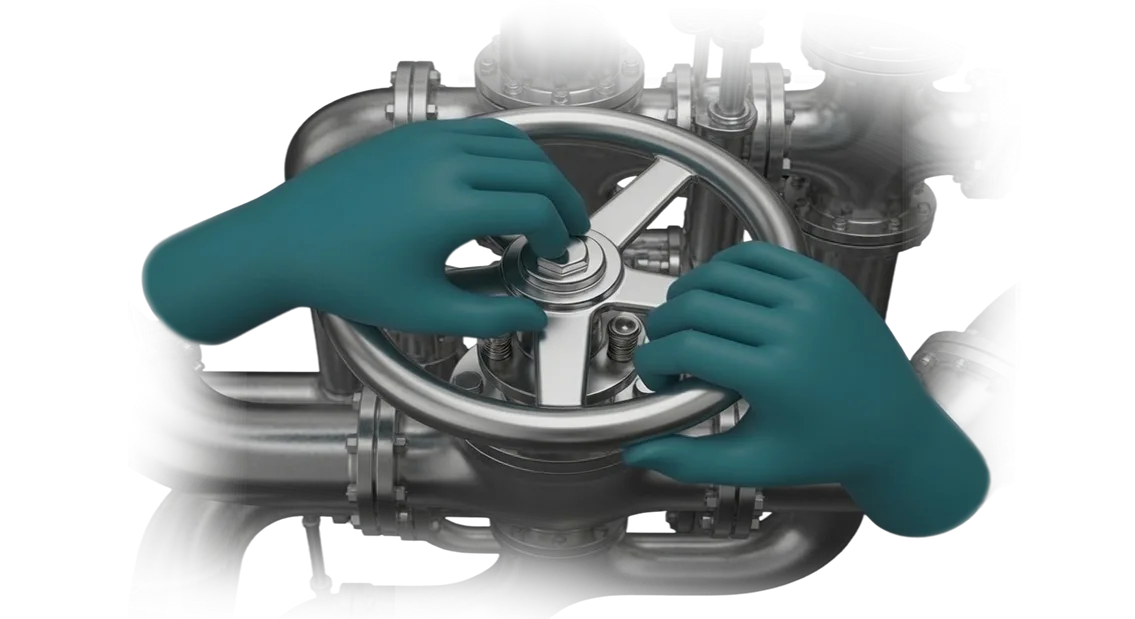
Accidents and Downtime: The Cost of Mistakes in Turbine Engine Maintenance
Any operator mistake during turbine engine maintenance is not just a minor oversight — it means production line stoppage, accidents, and direct financial losses. An hour of downtime at a modern enterprise is expensive, and recovery after a serious breakdown can take weeks.
Meanwhile, most of these situations occur not because of machine complexity, but because of poor staff training.
Routine briefings and theory do not prepare an employee for an emergency. When an operator faces an unusual task, stress takes over, and operator errors repeat again and again.
The cost of downtime grows, and reputational risks are added: contract deadlines are missed, customer trust declines, and people's safety suffers.
To break this cycle, we need to change the approach to staff training. Instead of lectures and paper regulations — practice in an environment as close to real as possible, but without risk to production.
A VR trainer allows every employee to repeatedly practice turbine engine maintenance, including emergency scenarios that cannot be safely demonstrated on a real asset.
A person remembers correct actions at the level of muscle memory, and in a critical situation they act confidently rather than chaotically.
This training format reduces the likelihood of industrial accidents and cuts financial losses before they even arise. The enterprise gets predictable equipment operation and stable operation, while the owner gains control over risks that previously seemed inevitable.
We help implement exactly this kind of training: we develop VR trainers for your specific equipment and staff tasks.
What a VR Trainer Gives Your Production
Every production manager knows how expensive staff training can be. A trainee can break equipment, disrupt the plan, or get injured — the cost of a mistake on a real turbine engine is too high.
A VR trainer moves skill practice into a safe digital environment where mistakes don't cost money or endanger people.
Here is what this gives you as a customer:
- Production safety. Employees train on a virtual copy of the turbine engine, so neither equipment nor people are put at risk. At the same time, you can simulate emergencies and teach staff to act correctly without consequences for production.
- Training speed. Skills are mastered 2–3 times faster compared to the classic "lectures plus on-site practice" scheme. Newcomers reach full productivity faster, and experienced employees refresh their knowledge without leaving their shift.
- Lower costs. There is no need to spend money on training stands, consumables, or downtime of operating equipment. Investment in the trainer pays off through faster personnel preparation and fewer emergency situations.
- Unified training standard. All employees go through the same scenarios, so you know exactly which skills have been practiced. This simplifies personnel assessment and allows you to quickly introduce new regulations.
- Predictable results. We create a trainer for your specific turbine engine and your instructions. You get measurable performance indicators and can control the quality of training for every specialist.
All the advantages work as a whole: safety provides peace of mind, speed saves time, and result control ensures confidence in employee actions. A VR trainer becomes not an extra expense, but a tool that increases production efficiency.
VR Trainer Formats for Turbine Engines
We understand that different enterprises solve different problems: somewhere you need to quickly train staff in standard operations, and somewhere you need to work through a unique turbine engine model in the smallest detail.
That is why we offer several development formats — from an off-the-shelf solution to a fully custom trainer.
| Format | For whom | What it gives the client |
|---|---|---|
| Off-the-shelf solution | Enterprises that need to launch training quickly without lengthy approvals | A ready-made trainer with already debugged logic — staff start training right after a short setup. Saves time and budget at the start, suitable for mass training. |
| Custom trainer for a turbine engine | Companies with unique equipment and regulations | Full alignment with the real unit: accurate 3D model, your scenarios, emergency situations, and control indicators. Workers train exactly on the equipment that stands in the workshop. |
| Modular format | Companies that want to combine ready-made blocks and custom development | Quick launch of the base part + step-by-step addition of new modules for the turbine engine. Allows you to spread costs and scale the trainer as tasks grow. |
The key point is not choosing "standard vs exclusive," but matching the format to your task. If you need to prepare staff for typical operations, an off-the-shelf solution will deliver results in the coming weeks.
If it is important to practice actions on a specific turbine engine, with its features and emergency scenarios, custom development pays off through fewer errors and faster employee onboarding.
We help you choose the format and cost estimate before the project starts, without unnecessary spending on options you don't need. In any case, you get a proven tool, support, and training for your internal team.
How We Create a Trainer: 7 Steps from Brief to Launch
An industrial VR trainer is not a "helmet with a picture," but a training tool that must deliver measurable results. Therefore, the creation process is structured as a joint project: you control every stage, and our team handles the technology side. Below are seven steps from brief to launch of the VR trainer.
-
Trainer brief. We clarify which turbine engine operations need to be practiced, the skill level of employees, and training conditions. We set goals and performance indicators — speed, number of errors, time to mastery.
-
Project approval. Together with your technologists and instructors, we describe a step-by-step scenario: worker actions, possible mistakes, and how the trainer provides hints and evaluates results. You approve the scenario before development begins.
-
Prototype on key operations. We create a test version that operators try live. We gather feedback and adjust details before significant resources are invested.
-
Full VR environment development. We model the turbine engine, tools, and working environment. We show intermediate versions so you can see progress and make changes at every development stage.
-
Assessment system. We build in tracking of errors, time, and number of attempts. The manager receives a readiness report for each trainee and decides whether to allow them to work on real equipment — this removes the risk of human error.
-
Launch and staff training. We set up workstations, conduct instructor briefings, and put the trainer into operation without stopping the production process.
-
Support and development. After launch, we stay in touch: we update scenarios, add new operations, refine the trainer to match regulatory changes, and transfer the program to other areas.
This approach delivers predictable results: you know in advance what you will get, and you can influence the final product during the process.
In the end, the trainer genuinely reduces the number of errors and accelerates staff training — which is the main goal of industrial training.
What You Get in the Delivery Package
When you order a VR trainer, it is important to understand exactly what is included in the delivery package.
We specify the contents in the contract — you receive not a "semi-finished product," but a ready-made tool that can be immediately integrated into employee training.
The standard package includes:
- Training scenarios — ready-made exercises for practicing typical operations: startup, shutdown, parameter control, and response to emergency situations. Scenarios are adapted to your regulations.
- 3D equipment models — detailed virtual copies of turbine engines and their components that can be inspected, disassembled, and studied in a safe environment.
- Learning management system — an instructor dashboard with a results log, task assignments, and progress tracking for each worker.
- Technical documentation — installation, configuration, and update guides for the trainer, as well as methodological materials for your instructors.
- Team training — we conduct a demonstration and transfer knowledge to your specialists so they can independently manage the trainer and develop scenarios.
- Updates and support — technical support for an agreed period, consultations, and scenario refinements based on your feedback.
This approach eliminates the situation where the trainer exists, but no one knows how or lacks the means to use it.
You immediately receive a complete delivery package: scenarios, models, documentation, training, and support — everything needed to launch training without additional investments or complications.
Case Study: Cutting Training Time by 40%
Turbomash — a large manufacturer of power equipment — approached us with the task of accelerating the training of turbine engine operators. Previously, training took several weeks: first theory, then work with a mentor on a real asset. Any beginner mistake could lead to downtime or damage to expensive equipment.
We developed a VR trainer that replicates key work scenarios: startup, normal operation, and emergency situations. Operators train in a safe environment, and the plant gets a stable result without stopping production.
The implementation results proved measurable: training time decreased by 40%, the number of successful certifications grew 1.5 times, and the load on instructors dropped — they now review digital reports instead of spending hours in the workshop.
The reduction in training time allowed the client to get personnel onto shifts faster and reduced the risk of errors in the first months of work.
The production manager noted that trainees now act more confidently in emergency situations — something that cannot be practiced on a real unit without risk.
The VR trainer case continued: after the first three months, the plant ordered additional modules for other types of equipment. We continue to support the project, updating scenarios to reflect regulatory changes.
This confirms that the trainer does not solve a one-time problem, but becomes part of the personnel training system.
How to Choose the Right VR Trainer Format for Your Task?
Choosing a VR trainer starts not with equipment, but with the task you want to solve. Some enterprises need to train operators to work with a turbine engine, others need to test employee actions in an emergency, and still others need to demonstrate the process to visitors.
There is no universal solution, but there are simple selection criteria that help narrow the task down to a specific format.
The first criterion is the training objective. If you need to practice a practical skill in operating the unit, you choose a full-fledged simulator with a realistic scenario and sequence of operations.
If the goal is to assess knowledge of safety or process regulations, a short VR scenario with questions and error analysis is sufficient. In both cases, you get a measurable result: the employee completes the scenario, and the system records their actions.
The second criterion is scale and audience. When dozens or hundreds of people at different sites are being trained, you need standardized modules that work uniformly and do not require individual customization for each user.
For a small group of highly qualified specialists, it makes sense to build a scenario with branching and varying difficulty levels — this approach holds interest longer and allows rare skills to be honed. The format choice depends on how many people will actually work with the trainer over the year.
The third criterion is how the trainer fits into your current processes. It is important that it can be updated when equipment design changes, integrated into the training schedule, and results exported into your usual reporting.
These are the points that determine whether the VR trainer becomes a one-time demonstration tool or a permanent part of staff development.
At a meeting, we clarify these parameters and suggest the optimal option — from a short interactive demonstration to a comprehensive trainer with multiple modes.
Therefore, if you are looking for a ready answer to "which format is better," it is more accurate to first define the task: whom you are training, what, and how often. We help you make a choice of VR trainer based on this data, not abstract characteristics. Send us a description of your situation — we will select the format that solves your specific task.
Frequently Asked Questions and Customer Objections
We are used to customer questions before the start of a VR project: timelines, integration with current processes, real business value, and quality guarantees. Below we address the most common objections and explain how we handle each one.
How long will it take to develop a VR trainer?
Timelines depend on the number of scenarios and the depth of detail. For typical tasks, we fit into 8–12 weeks: first we immerse ourselves in your production process, then we approve the plan and show intermediate results step by step. You see the trainer in action at early stages and adjust details without losing time.
How will a VR trainer fit into our training system?
We design the solution around your existing processes, not the other way around. The trainer easily integrates with the corporate portal, allows tracking completion, and keeps statistics for each employee. There is no replacement of your learning management system — VR becomes a prominent part of it.
Is this just an expensive toy, or is there real return on investment?
A VR trainer pays off by reducing costs on real equipment and emergency situations. Training is faster, and employees work more confidently from day one. In our practice, enterprises recoup their investment after training the first few groups of specialists.
How do you guarantee quality and results?
Each trainer is developed by engineers and current enterprise employees: they verify that actions match real processes. If necessary, we refine scenarios until they fully align.
Guarantees are specified in the contract, so you receive a working product, not a "raw" prototype.
Leave a Request for Trainer Development
Implementing a VR trainer is like building a house: it is important to understand the scope of work, timelines, and budget in advance. We structured the process so you can make a decision without risk or unnecessary effort.
Simply leave a request — and then we guide you along a clear route:
- You leave a request through the form or by phone — we call you back within one business day.
- We conduct a consultation: we analyze your task and explain how VR solves it in practice.
- We prepare an individual cost and timeline estimate — you see the scope of work before signing the contract.
- We agree on the technical specification and fix the results, stages, and responsibilities.
- Development starts. Your manager regularly sends progress reports.
- You accept the work together with your specialists — we make changes until it fully matches expectations.
- We train your staff and hand over documentation. After launch, we stay in touch for further improvements.
In the end, you receive not an abstract service, but a working tool with clear timelines and budget. Therefore, we can confidently say: ordering a VR trainer from us means taking all technical responsibility off your shoulders.
Why leave a request now?
- Consultation — you will find out whether VR is suitable for your production task.
- Accurate cost and timeline calculation — before work begins, with no hidden payments.
- Agreements fixed in the contract — legal protection for both sides.
- Proprietary know-how and proven tools — we reduce time and risks.
- Post-launch support — updates and support on request.
- More than 10 years of production experience — you work with specialists, not resellers.
Leave a request — and we will prepare your estimate and preliminary implementation plan.