

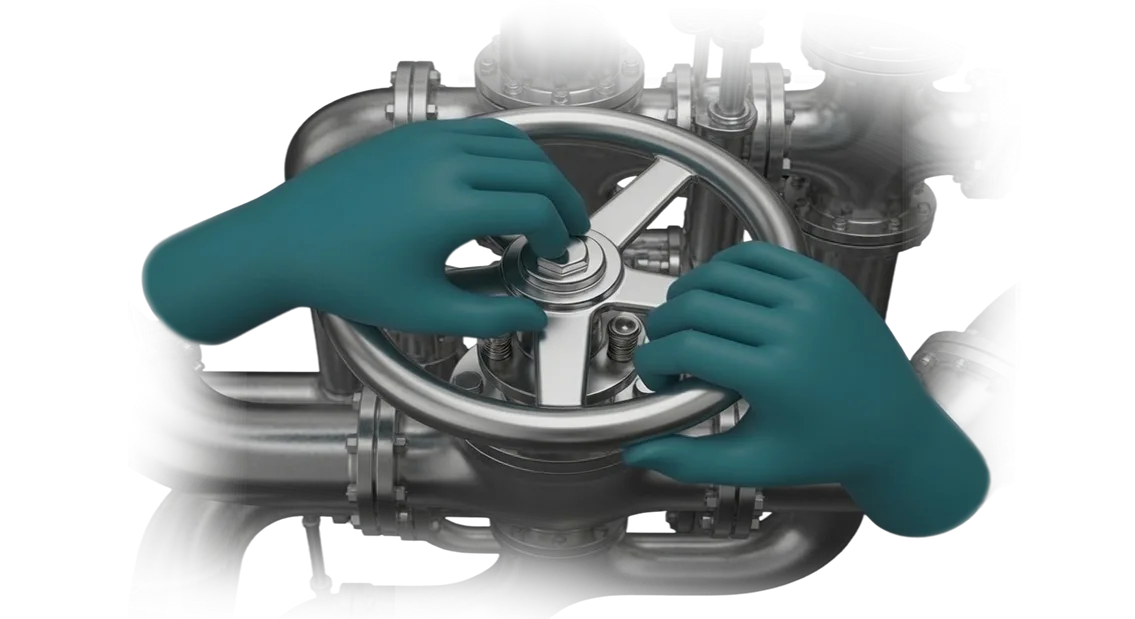
Mistakes on Real Equipment Are Unacceptable: Aviation Goes VR
Training aviation personnel is one of the most expensive items in the industry. An hour of training on real equipment costs significantly, and a grounded airport plus occupied instructors costs even more.
At the same time, crews always face a shortage of the main resource — time to practice rare but critical skills.
An error on a real asset is unacceptable for another reason — it is a matter of life and the safety of training flights.
Emergency scenarios: engine failure, severe weather, emergency evacuation — are either extremely dangerous in the real sky or physically impossible to train for.
VR for aviation solves both problems. A simulator allows training any scenario any number of times, without risk to people or equipment, and it develops the same muscle reflexes as real work.
This is not a replacement for practice — it is a tool that makes every real hour in the sky as effective as possible.
Less spent on fuel and machine maintenance, more repetitions of complex scenarios, a lower barrier to entering the profession. For a manager, this means several people can complete targeted training in one day that previously took weeks and a significant budget.
What a VR Simulator Delivers: Fast Skill Growth and Safety
In aviation, the cost of a mistake is measured not in money but in lives and the company's reputation. Training on real equipment takes months, requires expensive hardware and instructors, and crucially does not allow safe practice of emergency scenarios.
This is where the main advantages of VR simulators come in: you can make mistakes without consequences and repeat complex operations until they are fully mastered.
Reduced training time is the most measurable effect. Instead of long lectures and waiting for an available aircraft, the employee immediately enters a scenario, and task difficulty is adjusted automatically.
Key operations are mastered two to three times faster than with classical training, without losing skill quality.
Practicing emergency scenarios in VR happens without risk to people or equipment. Fire on board, engine failure, severe weather — scenarios are run repeatedly, bringing crew actions to automaticity.
This kind of training reduces accident rates: the employee has already faced an emergency, and therefore acts more calmly and quickly.
Staff skill development stops being a formality. VR holds attention better than any training film: the employee controls the process, sees the results of their decisions, and receives objective feedback.
This increases engagement and motivation, and therefore also the real level of preparedness in the team.
We design simulators around a specific company's objectives: from short scenarios for beginners to complex exercises for experienced crews. This approach delivers measurable competence growth and peace of mind for the manager: the staff is ready for any situation.
VR Simulator Formats: We'll Find the Right Fit for Your Task
For an aviation training center or manufacturing enterprise, the choice of a VR simulator directly affects the speed of staff training and flight safety.
Different tasks require different virtual reality training formats: one thing is practicing pilot actions in single mode, another is coordinated crew work as a group.
That's why we develop simulators in several formats and help you select the optimal one for your tasks, space, and budget.
Below is a comparison of the main types of VR simulators for aviation that we use in projects.
| Format | For whom | What it gives the client |
|---|---|---|
| Standalone VR headset-based | Pilots, engineers, dispatchers — individual skill practice | Compactness, rapid deployment in any space, flexible training schedule, reduced instructor costs |
| Group with multiple headsets in a shared virtual scene | Crews, coordinated work of flight and ground personnel | Training interaction and communication, fewer mistakes on real flights, high participant engagement |
| Fixed module with cockpit simulation | Training centers that need maximum realism | Full immersion with familiar instrument layout, quick skill transfer to real aircraft, ability to conduct exams |
Such a classification helps you choose a VR simulator for aviation without overpaying for unneeded features. We analyze your training scenarios, number of learners, and available space, then propose a format that delivers the greatest results in your conditions. If necessary, we combine formats: individual training for the basics, group training for teamwork.
If you're not sure which type fits, leave a request and we'll prepare a recommendation within one business day.
How We Create a VR Simulator for Your Enterprise
For aviation enterprises, what matters is not just a VR simulator but a predictable result: fast launch, clear scenario, and tangible benefit for the staff.
That's why we built a process where you control every stage of simulator development, and at the end you receive a ready-made turnkey solution — from idea to deployment and support.
- Brief and task audit. We immerse ourselves in your processes: which operations need to be practiced, which mistakes to prevent, who will undergo training. We record the criteria by which you will assess the effectiveness of the future simulator.
- Concept and scenario development. We propose a training structure: scenario, difficulty levels, action options, and responses to mistakes. We align the scenario with your technical specialists — so the simulator replicates your production's real procedures, not generic templates.
- Creating 3D models and environments. We model the workplace, equipment, and objects so they are recognizable. The level of detail is sufficient for realistic training yet does not require extremely expensive hardware.
- Simulator assembly and programming. We fill the scenario with interaction logic and action practice. Already at this stage, you see how the future system looks and works, and can make edits before the final version.
- Testing with your participation. We invite client representatives, walk through the scenario, find discrepancies with real procedures, and correct them. This is a key point: we bring the simulator to your standards, not to our assumptions.
- Launch and support. We deploy the simulator to workstations, train instructors, and hand over documentation. We stay in touch: update content, add new exercises, and support operation.
Simulator development timelines depend on the complexity of the scenario and the detail of the models — typically 6 to 12 weeks. The process is fully transparent: you always know what stage is running and what you'll get at the end.
This approach allows us to create VR simulators precisely for your tasks, not for abstract standards.
What's Included in the VR Simulator Delivery
You don't receive separate components but a complete simulator complex fully integrated into your training system. The simulator delivery package includes everything needed for launch and operation — from hardware to instructions.
What the simulator complex includes:
- VR hardware with headsets and controllers for full immersion in work operations;
- Training software with virtual scenarios adapted to your regulations and procedures;
- Instructor module — viewing the trainee's actions, logging mistakes, and generating reports;
- Educational and methodological kit: class scenarios, reference guides, test materials;
- Technical documentation for operating and maintaining the simulator;
- Installation, configuration, and integration with your training system;
- Training for your instructors on using the simulator;
- Warranty and technical support for the entire service life.
We pay particular attention to simulator documentation: in the aviation industry, it must comply with internal regulations and industry requirements.
That's why, along with the simulator, you receive a complete set of guides and instructions that allows you to organize training without additional requests.
Support doesn't end at delivery: we accompany the first launch, update virtual scenarios when needed for new requirements, and help expand the staff training program. All of this is established in the contract, not in verbal promises.
Case Study: Aviation Implemented a VR Simulator and Reduced Downtime
In aviation, the cost of a mistake is high, and training a specialist takes months. Traditional training on real equipment requires significant resources: instructors, facilities, consumables, while some skills are only practiced theoretically. This creates downtime: a new employee cannot start working until all stages are completed.
We solved this problem for an aviation training center with a VR simulator. Instead of real aircraft and test benches — virtual scenarios that simulate normal and emergency situations.
The trainee gets practice in a safe environment, while the instructor sees their actions and mistakes in real time. This approach doesn't replace real flights, but provides basic skills before first contact with the equipment.
The implementation took three months. During this time, we trained 50 specialists — from maintenance engineers to ground personnel. The simulator reduced time-to-competency by 40%: employees arrived with refined action sequences, not just theory.
The main result is reduced downtime and savings on training. Consumables and instructor hours are no longer needed at the initial stage, and mistakes are practiced without risk or consequences.
The VR simulator's results were so convincing that the client immediately ordered the next module for a new direction. The repeat order confirms: the project delivers measurable value to the business, not just a technology demonstration.
How to Choose the Right Format for Your Task?
Choosing a VR simulator format starts not with technical specifications but with answering the question: what skill needs to be practiced and under what conditions will it be used?
For aviation, this might be practicing actions during engine failure, training ground personnel, or preparing for onboard emergencies.
The type of skill determines whether you need a full cockpit simulator with tactile feedback or whether a scenario with a standard virtual reality headset is sufficient.
The second criterion is the number of trainees. If hundreds of specialists are trained annually, a stationary complex that operates almost non-stop is more cost-effective.
For small groups or individual departments, a mobile VR zone that can be set up directly on the production site or in a training center is suitable.
It's also important to consider whether you already have existing equipment — training stands, simulators, documentation. It's good when a VR solution integrates with existing processes rather than creating a parallel system.
Budget and timelines determine the scale: from a ready-made scenario in a few weeks to fully custom development with prototyping and testing on real tasks.
We help you choose the right format for your task before development begins.
We conduct a short audit, ask the right questions about skills, audience, and constraints — then come back with a concrete proposal: which VR simulator you need, what stages are required, and when the result will be ready. This way you make a decision based on clear criteria, not technical jargon.
Ultimately, choosing a format is always a compromise between speed, immersion depth, and cost of ownership. We help you find this balance and avoid overpaying for features that don't solve your challenges.
Frequently Asked Questions About Implementing VR Simulators
Before buying a VR simulator, clients most often wonder: will it fit into current processes and won't it become a dead weight. We've collected answers to the most frequent questions.
Integrating the simulator is a technical task, but it's simple on your end: we handle installation, configuration, and connection. The simulator integrates into the training program and saves reports without disrupting current processes. The Russian-language interface is standard for our projects.
How does the simulator integrate with the current training program?
The simulator works as a standalone module: you set scenarios, and it sends results to your tracking system. We coordinate the data format with your methodologists; there won't be double work. Implementation takes from two weeks to a couple of months.
What difficulties will arise during implementation?
The main difficulties are organizational, not technical: allocate a room and staff time. The equipment is compact; a 2×2 meter corner and a power outlet are enough. We handle installation, configuration, and instructor training.
Will the interface and instructions be in Russian?
Yes, the interface is fully in Russian. We adapt terminology to your industry and internal regulations, and built-in prompts guide the employee at every step.
What guarantees and support are there after launch?
We provide a warranty on hardware and software, and free scenario updates for the first year. Support is available by phone and remotely, and we can visit your site if needed. No project is ever abandoned — all clients receive simulator improvements after launch.
Still have questions about VR simulators? Write to us — we'll explain how we'll solve the task for your production.Order a VR Simulator — Get Timelines and Guarantees
Planning a VR simulator for the aviation industry is always about questions: how long will development take, how accurately will the simulator reproduce real processes, and who is responsible for the result if something goes wrong. We remove these risks before work even starts.
Leave a request for a VR simulator — and within a couple of business days we'll prepare a simulator cost estimate with a clear stage-by-stage plan and timelines. You receive a commercial proposal with guarantees and the final result already fixed.
What's included after your request:
- Initial VR consultation: we break down your task and answer questions, even if you haven't fully formulated your requirements yet.
- Simulator cost estimate tailored to your training scenarios, with no hidden payments or "extra charges for nothing."
- A timeline plan with dates — from prototype to launch, so you understand what happens at each stage.
- Contractual guarantees: we fix timelines, responsibilities, and accountability for results.
- Demonstration of a trial version of the simulator before full payment — you see the product at an intermediate stage.
- Post-launch support: content updates, refinements, and technical support for your staff.
This approach has already proven itself in industry and aviation. The client doesn't face uncertainty — they get a managed process and understand what they're paying for. To order a VR simulator, fill out a short form or contact us.
We'll prepare a proposal within two business days, and we'll discuss the details in a consultation.