

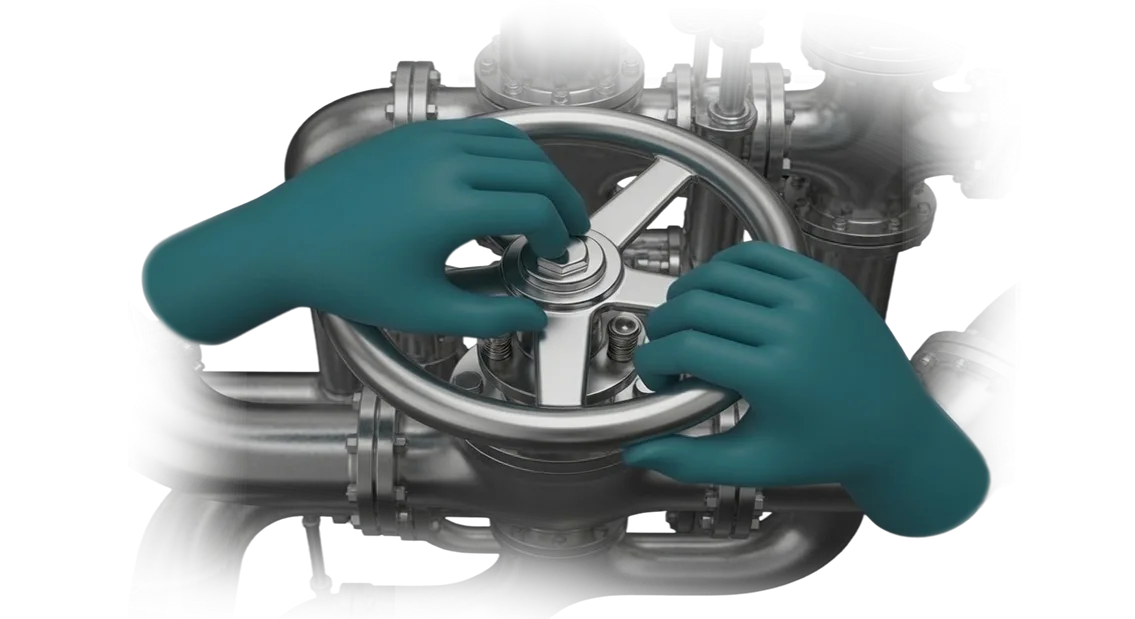
VR Simulators for the Space Industry: How to Reduce Risks and Costs
Personnel training in the space industry is one of the most expensive budget items.
Real equipment costs tens of millions, every training exercise requires experienced instructors to be present, and a beginner’s mistake can lead to production downtime or damage to unique machinery.
At the same time, training a single specialist takes months, and throughout this period the enterprise incurs costs without getting any return.
VR simulators solve this problem differently: the employee practices operations in a virtual environment that faithfully reproduces working conditions. They can make as many mistakes as they like — the cost of a mistake is zero. The training process does not block real equipment, so production continues to operate normally.
In the space industry, the complexity of operations is especially important: assembly of units, work with fuel systems, actions in emergency situations. All of this can be trained repeatedly, until it becomes automatic, before letting a specialist work on the real object.
The result for the enterprise is shorter training times, fewer accidents, and a consistent skill level among all employees.
We build VR simulators for specific production tasks and are already helping space industry enterprises reduce risks and costs. Leave a request — we’ll show you how it works at your site.
4 Key Benefits of Implementing a VR Simulator
For space industry enterprises, the cost of a mistake is especially high — which is why personnel training must be as effective as possible.
Virtual simulators allow complex operations to be practiced without risk to equipment or people, and every minute of training delivers measurable benefit. The customer gets four key advantages: time savings, safety, skill growth, and fewer errors.
The first result is time savings. An employee masters procedures and emergency scenarios on the simulator several times faster than with traditional one-on-one mentoring.
There is no need to wait for an available industrial sample: training runs in parallel with the production cycle, so the company reduces downtime and gets specialists to independent work faster.
The second is training safety. Practicing emergency scenarios in a virtual environment eliminates injuries and damage to expensive equipment.
The employee can make mistakes without consequences, and the system records every action — this allows skills to become automatic before the first visit to a real site.
The third is skill development. The simulator adapts difficulty to each operator’s level, so both beginners and experienced employees get a useful workload.
As a result, the team’s overall competence level rises, dependence on a few key specialists decreases, and onboarding of new employees becomes easier.
The fourth is fewer errors. Regular training on the VR simulator reinforces correct action sequences and reduces the number of defects in real work.
A specialist who has repeatedly practiced a technological operation in a virtual environment acts more accurately and confidently, which is especially important when working with unique space industry equipment.
Implementing a VR simulator pays off through lower training costs and reduced production risks. A manager gets a transparent view of each employee’s progress and can fine-tune the training program.
This is not just technology — it is a tool for managing quality and the enterprise’s competitiveness.
Formats of VR Simulators for the Space Industry
Different tasks in the space industry require different training approaches.
An assembly shop operator needs precise movement practice, a test engineer needs to understand how components behave in emergency situations, and a technologist needs to verify operation sequences before production launch.
There is no universal “one for all” simulator, so we select the format based on the specific business task and expected result.
| Format | Business task | What it delivers to the enterprise |
|---|---|---|
| Immersive training | Training new employees and retraining staff | Shorter onboarding time and fewer errors in the first months of work |
| Assembly shop simulator | Practicing key operations, controlling sequence and tolerances | Higher assembly quality and less waste due to muscle memory without risk to real products |
| Virtual testing | Checking component behavior in abnormal and emergency modes | Lower costs for physical prototypes and safe practice of actions during failures |
| Operations modeling | Designing technological processes and optimizing workstations | Identifying bottlenecks before production launch and reducing downtime |
Each format solves its own task, but they all share one goal — to make sure an employee arrives at a real site already prepared. The simulator does not replace practice; it provides a safe environment for mistakes that would be costly on the shop floor or at a test stand.
This approach is already used at enterprises where precision matters: from instrument assembly to crew training.
We work with professional VR equipment and adapt the scenario to your procedures and standards so that the result is measurable — in speed, quality, and risk reduction.
How VR Simulator Development Works: 6 Stages
Developing a VR simulator for the space industry is not a “black box” where the result appears only at final delivery. We have structured the process so that at every stage you understand what is happening, which decisions are being approved, and what you get at the end. This reduces the risk of rework and helps meet planned deadlines.
- Brief and task analysis. We study your procedures, equipment, and personnel assessment criteria. Together we determine which scenario will deliver a measurable effect for employee training.
- Technical specification and work plan. We record scenarios, scope, deadlines, and acceptance criteria. We agree on the technical specification with you and your specialists to avoid misinterpretation before development starts.
- Design and 3D content preparation. We create a model of the workstation, unit, or workshop based on your drawings and photographs. We show intermediate versions for approval — you have input on details rather than accepting the result blind.
- Development of interactive logic. The simulator responds to employee actions, provides hints, and records errors. You get a working prototype and can adjust the scenario before the final stage.
- Testing with your instructors. We test the simulator on real tasks and refine it to a level of convenience important to your team. We fix any comments before official delivery.
- Launch and support. We deploy the simulator on your equipment, train instructors, and hand over materials. After launch, we stay in touch for support and improvements as your procedures change.
Each stage has an approval point: you do not just sign off — you see an intermediate result and understand that you are getting exactly the simulator that solves your task.
What Is Included in the VR Simulator Delivery
Every VR simulator for the space industry is not a “bare” program but a complete turnkey solution that can be integrated into the training process from day one.
We plan the full package in advance so that your team does not have questions like “how do we operate this” or “where do we get materials for instructors”.
The standard package includes:
- Software — a fully configured simulator ready to run on your equipment. We help with installation and initial setup so the system starts without issues.
- Methodological materials for instructors — ready-made lesson scenarios, instructions for conducting training and evaluating results. The instructor does not need to invent anything: open a scenario — run the lesson.
- Manuals for operators and administrators — clear instructions in Russian for working with the simulator: how to launch the program, select a scenario, and track employee progress. No separate IT specialist is required to maintain the system.
- Technical documentation — a description of the equipment composition, workstation requirements, and procedures for emergency situations. This simplifies system commissioning and workstation preparation.
- Training for your team — we provide remote or on-site instruction for those who will use the simulator. Employees gain practical skills before the official start, so you do not spend time on self-study.
- Startup support — during the first weeks after launch, we stay in touch: we promptly answer questions, help adapt scenarios to your tasks, and make adjustments when necessary.
- Updates and refinements — when procedures change or new tasks appear, the simulator can be upgraded: add scenarios, change logic, integrate with other training systems.
Such a package reduces the workload on your specialists and shortens the time from delivery to full use. You get not just a program but a tool that is already “fine-tuned” to your enterprise’s tasks — with methodology, instructions, and support.
Launching the simulator becomes a clear process rather than a search for answers to unexpected questions.
Case Study: How a VR Simulator Accelerated Specialist Training
Training specialists for the space industry means months of theory and practice on real equipment. Any beginner’s mistake can lead to defective expensive components or line downtime, so instructors may keep employees away from complex operations for years.
We offered the enterprise a different path: replace part of the practice with sessions on a VR simulator.
For JSC “Progress Rocket Space Centre” we developed a virtual test stand that replicates real assembly of components. The employee works with their hands, sees tools and parts, but instead of the workshop — a safe simulation.
This makes it possible not only to practice actions until they become automatic but also to model emergency situations that are dangerous to create in production.
What the Implementation Showed
The customer measured results during the first quarter of operation. Training for new specialists sped up by 40% — instead of three months of basic practice, a month and a half is enough.
At the same time, the number of errors when moving to real equipment fell by half: VR experience provides precise motor skills and an understanding of operation sequences.
The project paid for itself through reduced instructor time and a lower defect rate. The workshop manager noted that after the VR simulator, employees act more confidently and adapt more quickly to real assembly. The enterprise is now planning to expand the program to other areas.
We are ready to deliver a similar result to your production: we will develop a simulator for your operations, implement it, and measure the effect. Write to us — we will send case details and a payback calculation.
What If You Have Non-Standard Tasks for a Simulator?
Yes, and this is more the rule than the exception. Every enterprise has its own procedures, equipment, and safety requirements, so a standard simulator often does not cover real tasks.
It is for these cases that we design custom solutions — from analyzing your processes to the final configuration of scenarios.
An individual approach for us does not mean choosing from a ready-made catalog but building a simulator around your tasks. First, we analyze which operations need to be practiced, which errors are critical, and which conditions matter to recreate.
Then we design a virtual environment that mirrors your reality: the sequence of actions, equipment response, and emergency situations.
In the space industry, non-standard tasks constantly arise: working in a spacesuit, emergency situations, operations with unique components and onboard systems.
Our simulator adapts to these scenarios — we do not use a template; we build an environment around your process charts and procedures. This allows employees to train in conditions as close to real as possible.
We also iteratively refine the simulator together with your specialists: we test, make changes, and clarify details. As a result, training is conducted on a tool that employees perceive as their own rather than someone else’s product. This directly affects engagement and training quality.
So a non-standard task is not a limitation but an opportunity to create a simulator that precisely matches your processes. Tell us about your specifics — we will propose a solution that fits into existing procedures and delivers measurable results in workforce training.
Answers to Frequently Asked Questions About VR Simulator Development
Customers in the space industry most often ask the same things: how quickly can we get a working simulator, what quality guarantees are there, how to update it, and whether it will run on current equipment. Here are our answers.
What are the real development timelines?
The timeline depends on the complexity of the scenario and the number of modeled components. A standard simulator for one technological process takes 6 to 10 weeks.
Of that, two weeks are spent on documentation analysis, then scenario design, graphics and logic development, and final testing with your technologists.
We set a calendar plan with checkpoints after clarifying the initial data — you see intermediate versions and understand at what stage the project is. Delays occur only if you change requirements.
What guarantees do you provide?
We guarantee that the simulator matches the agreed scenario: realistic model behavior, correct hints, and no errors when performing standard operations. During the testing stage, we fix all comments that affect training quality free of charge.
After project delivery, there are 12 months of warranty support, which is stated in the contract. If you find a malfunction or inaccuracy during operation, we will fix it on a priority basis within the agreed timeframe.
How is the simulator updated after changes in technological processes?
Production technologies change, so the simulator is designed so that updating a scenario or equipment parameters takes minimal time. A typical change is made and tested in a few days — you do not need to order development from scratch.
We provide documentation with the package and, if needed, train your specialist to make edits independently. If changes are large-scale, we handle them as a separate stage or under a long-term support contract.
Will the simulator be compatible with our computer fleet?
Before starting work, we analyze the specifications of your computers and select the level of detail to match their performance. In most cases, a standard office PC is enough; if the equipment is insufficient, we will help with specifications for new workstations.
The simulator runs standalone or on the enterprise’s local network, without sending data externally. This is important for the space industry, where restrictions on cloud services apply.
Order a VR Simulator for Your Enterprise
Leave a request for VR simulator development — and within one business day you will receive a cost estimate and a preliminary implementation plan. We deliberately simplified the first step so you can assess budget and timelines without long approvals and technical details.
To do this, we will arrange a short consultation with our engineer and methodologist: we will review your task, help you formulate training objectives, and advise which simulator format will deliver the greatest effect.
As a result, you will receive an individual proposal — with clear stages, scope of work, and time frames.
What is included in the estimate and preliminary plan:
- Analysis of your task and training scenarios — we identify the key skills an employee must practice.
- Selection of simulator format: from individual operations to a full cycle of working with equipment.
- Assessment of labor intensity and a preliminary estimate — transparent figures without hidden surcharges.
- Recommendations on equipment and software taking into account your budget.
- Preliminary launch plan: stages, checkpoints, and the date of the first demo version.
- Individual proposal after the consultation — we record the agreements and prepare a commercial offer.
We work remotely across the country and have been creating VR simulators for industrial enterprises, including the space industry, for over 10 years. Therefore, the estimate immediately takes into account real requirements for accuracy, safety, and training reporting.
Leave a request through the form on the website or call us — we will discuss your task, answer questions, and prepare an individual proposal. We start with a consultation so you clearly understand how the VR simulator will fit into your personnel training system.