

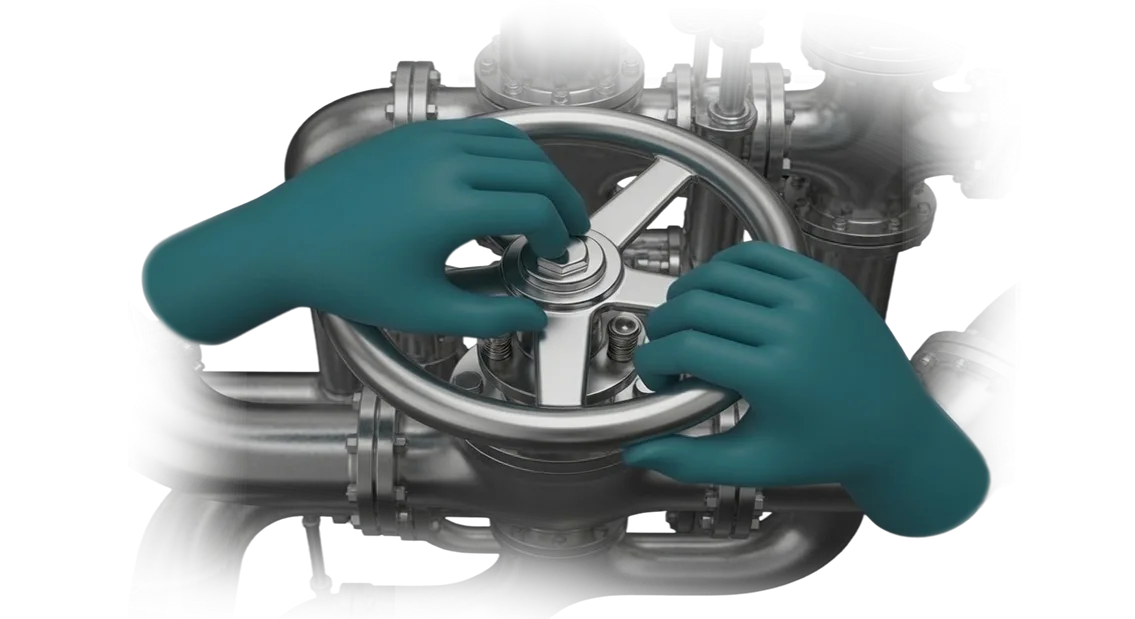
VR simulators for logistics: how to reduce losses from staff errors
A logistics error in a warehouse is not just a workflow disruption, but a direct loss: damaged cargo, missed delivery deadlines, equipment downtime and — critically — the risk of employee injury.
The consequences have to be fixed at your own expense, while retraining staff "on live processes" halts the work rhythm. While a newcomer is learning the routes and safety rules, the company loses time and money.
The problem is that classic on-the-job training does not give the employee the right to make mistakes, and briefings do not build lasting skills.
This is where a virtual simulator comes in — a digital copy of the warehouse where the worker experiences real scenarios without risk to themselves or the cargo: from receiving to shipping, including emergency situations.
This approach moves "costly errors" from the category of unavoidable to manageable. VR staff training repeats extreme conditions over and over until actions become automatic.
The employee practices warehouse safety procedures without stopping current operations, and the quality of preparation is immediately visible in the numbers: fewer errors at receiving, faster order picking.
Wecover this need completely: we take a drawing or layout of the warehouse, create a realistic scenario, launch training — and support the project until the result is achieved.
Logistics errors stop being an expense item and become an indicator of the team's growing expertise.
Three key effects of implementing VR simulators at an enterprise
Implementing VR simulators gives an enterprise not just a modern training format, but three measurable results: increased safety, faster staff preparation, and reduced costs.
Unlike classic programs that take people away from production or require expensive training grounds, the virtual format fits into the work process and pays for itself quickly.
The first effect — fewer injuries. An employee practices dangerous scenarios in a safe virtual environment: from fire response to forklift emergencies. They gain muscle memory and behavioral procedures without risking their health.
As a result, the enterprise reduces the number of incidents, which means fewer downtime periods, investigations, and compensation payments to injured workers.
A safer workforce operates more confidently, and management gains peace of mind regarding compliance with occupational safety standards.
The second effect — speed of new employee onboarding. Instead of weeks of theory and practice with a mentor, a person masters key operations in two or three days. The program itself guides them step by step, records errors, and shows the correct procedure.
This is especially important in warehouses and logistics, where staff turnover is high and every shift must reach full capacity as quickly as possible. Fast onboarding reduces the load on experienced employees and accelerates newcomers' progress to target performance levels.
The third effect — budget savings. VR training eliminates the costs of renting training grounds, wear and tear on real equipment, and paying instructors for each group. One simulator replaces many repetitive sessions: scenarios are re-run with no spending on consumables.
In addition, losses from trainee errors are reduced — they no longer damage racks, goods, or equipment. By our estimates, investments in the simulator pay off within a few months through lower defect rates and fewer accidents.
These three effects work together: safety increases process stability, onboarding speed accelerates order fulfillment, and savings free up funds for development. A VR simulator is a tool that impacts an enterprise's operational metrics from the first week of use.
VR simulator formats for logistics and manufacturing tasks
For logistics and manufacturing, every employee error results in downtime, damaged cargo, or lost time. Ordinary briefings provide rules but do not build the skill to act quickly and without mistakes.
Virtual reality for the warehouse closes this gap: the employee enters an exact copy of working conditions and can train in a safe environment as many times as needed.
Simulator formats are selected for the specific task — from interactive simulators for a single operator to group scenarios for an entire shift. We use different training methods, so each scenario reflects the client's real process. Here are the typical types of simulators already working in warehouses and workshops.
| Simulator format | For whom | What it gives the business |
|---|---|---|
| Warehouse orientation and route learning | New employees, storekeepers, order pickers | Quick ramp-up to standard speed, fewer errors in order picking |
| Warehouse equipment operation | Forklift and stacker operators | Skill practice without risk to cargo and people, exam before work authorization |
| Emergency response | Shift staff, occupational safety specialists | Confident actions in emergencies, fewer injuries and downtime |
| Shift coordination and operation handover | Area supervisors, teams | Synchronized work, no delays at shift boundaries, predictable rhythm |
This is not an exhaustive list. We will build a scenario for your process based on your real operations and routes. Employees train on their own premises, so the first changes in speed and quality are visible after just a few shifts.
VR simulator development stages for logistics: from brief to launch
The project is divided into stages with approval checkpoints. We start by analyzing the real operations in your logistics, so the simulator reflects exactly your warehouses, equipment, and procedures. From brief to launch usually takes 4–8 weeks.
- Brief and process immersion. We conduct interviews with managers, operators, and training specialists — identifying typical errors and the most complex operations.
- Training scenario audit. We review your regulations and instructions. We determine which skills are needed most often and where newcomers lose time.
- Concept and plan approval. We present a prototype of the exercises and evaluation criteria. You make corrections before the main scope of work begins.
- Simulator development. We create realistic 3D models of your warehouse and equipment — the employee immediately works in a familiar environment.
- Pilot project. We launch the simulator with 5–10 operators and adjust the difficulty of tasks. You see the result before mass training.
- Launch and handover to instructors. We train your staff and set up reports — you track student progress independently.
- Ongoing support. We update scenarios to reflect process changes and add new exercises for other staff categories.
What is included in the VR simulator delivery for your enterprise
You receive not just a VR program, but a complete training complex for warehouse staff and logistics personnel. We handle all stages — from adapting scenarios to your procedures to launching the simulator into operation. Here is what is included in the delivery package.
- Software with courses tailored to your specifics. Scenarios are built on your operational tasks: working with a forklift, receiving and placing cargo, moving through warehouse zones. Employees practice exactly the operations that occur at your facility.
- Professional equipment. We select VR headsets, controllers, and supporting components for intensive training. The package includes a spare set for replacement — training will not stop due to a breakdown.
- Installation and setup at your site. We deliver, mount, connect, and test the simulator. You do not need to understand the technical side: after setup, you get a working tool.
- Training for your trainers. We conduct separate sessions for the staff who will lead the training. They learn the system, review typical scenarios, and receive materials for conducting sessions on their own.
- Documentation and procedures. We provide operating instructions, skill assessment methodology, and checklists for trainers. Everything is ready for integration into the training process — without lengthy preparation.
- Technical support and updates. For the entire service life of the simulator, you receive support from our team. We regularly release improvements and refine exercises to meet new requirements when necessary.
- Performance analytics. The system collects data on each employee: completion time, errors, progress dynamics. The manager sees who is ready for real work and who needs additional training.
The result — you launch a ready-made tool for logistics staff training without engaging external contractors at every step. Everything needed to start is already included in the delivery.
Case study: how a VR simulator reduced defects in logistics by 60%
The VR simulator implementation case in logistics begins with a problem typical for the industry: defects in order picking. This is exactly what the logistics operator "Severny Terminal" faced — a company processing thousands of items per day.
Errors occurred among both newcomers and experienced storekeepers: mixed-up SKUs, incorrect labeling, damaged packaging. Every such defect resulted in delays, returns, and customer dissatisfaction.
Severny Terminal — a distributor with three warehouses — came to us with a clear task: reduce staff training time and make training more reliable.
We developed a VR simulator that immerses the worker in a realistic warehouse environment with its zones, racks, and receiving scenarios. In virtual reality, a newcomer refines operations to automaticity, and the instructor sees errors at the moment they are made. This makes it possible to correct wrong skills before they carry over into real work.
Implementation results
After three months of operation, picking defects decreased by 60%, and order processing speed increased by 25%. Training a group of 120 employees took eight weeks instead of the usual six months.
Nine out of ten workers continue to work without errors for six months after completing the training.
Even after six months, the metrics remain stable: the difference between experienced and new employees has practically disappeared. The client scaled the solution across all three warehouses and made the VR simulator a mandatory stage in hiring and retraining storekeepers.
A repeat engagement is the best indicator of value. For us, this confirms that a VR simulator in logistics works not as a one-off initiative, but as a systematic tool for reducing defects and increasing efficiency.
How to choose a VR simulator: 5 questions you need to ask
Choosing a VR simulator starts not with equipment, but with the question "what business problem are we solving." For logistics, this could be warehouse staff training, practicing emergency procedures, or knowledge assessment.
Until the goal is formulated in business terms — training time, number of errors, employee work speed — any solution seems expensive and ineffective.
Our advice: ask the supplier five questions. They will filter out unsuitable proposals and protect your budget.
- "What scenarios have already been developed?" — it is not about quantity, but about the company's experience in your industry. Ready-made developments speed up the launch — not a "pretty picture."
- "What happens to the training results?" — the data should flow into convenient reporting. Can you see progress for each employee and for the group as a whole?
- "How quickly is the training updated when processes change?" — logistics changes regularly: new routes, rules, equipment. Find out who makes the edits and how many days it takes.
- "What is needed for launch?" — will you need a separate room, special preparation of the space, or is a regular room enough. This directly affects the implementation budget.
- "What support is available after launch?" — what is included in the service: updates, operator assistance, scenario refinement for new tasks.
Table for comparing proposals:
| Criterion | Key question | What it addresses |
|---|---|---|
| Training goal | What should an employee be able to do after the simulator? | Measurable result and clear plan |
| Number of trainees | How many people complete training per year? | Choice between a stationary and mobile kit |
| Process changes | How often do routes and rules change? | Speed and cost of content updates |
| Infrastructure | Is there a separate room for VR? | Ease of launch and final budget |
| Support | Who is responsible for maintenance and development? | Long service life without surprises |
If there are clear answers to all the questions, the simulator will become a working tool rather than an expensive toy in the corner. That is exactly how we work: first we formulate the task together with you, then we select the appropriate format.
In the end, you get a measurable result — fast staff preparation, fewer errors, and confident work even in stressful situations.
Common customer concerns when ordering a VR simulator
A customer encounters a VR simulator for the first time, and that is normal — a number of doubts arise. It seems that the technology is complex, employees will not understand how to use it, and the investment will not pay off.
We hear such questions on every pilot project in logistics and industry, so we have gathered answers to the most common ones — briefly and to the point.
Below we address typical concerns: from safety to the real effectiveness of training. If your question is not here — just write to us, and we will tell you in detail about your specific task.
A VR simulator is just a game. How can it teach an employee real work?
The virtual environment is as close as possible to real warehouse or production conditions: the same mechanisms, the same sequences of actions, the same errors that occur on the job.
The employee does not just watch instructions — they repeatedly practice operations to automaticity, and in a safe environment. That is exactly why the skill transfers to real work faster than with classic training.
Is it dangerous for an employee to be in VR? Does it cause motion sickness or eye strain?
We use professional equipment and control the workload: sessions last the recommended time with breaks. A briefing before starting is mandatory, and the training itself takes place sitting down or in a specially equipped area.
In all our years of work, there has not been a case where an employee was injured or felt serious discomfort — and if necessary, we adapt the program to individual needs.
Is it really effective? Can the result be measured?
Yes, the effectiveness is confirmed by numbers. In our projects, after a course of VR training, the number of errors in performing operations decreases by an average of 40%, and employees' reaction speed noticeably increases.
Analytics is built into the simulator: you see who practiced what, which actions are lagging, and where additional training is needed. This is not "entertainment," but a tool with clear metrics.
How long does implementation take? Will we have to stop production?
Training takes place in a separate room without affecting the work process. Preparing a standard simulator for your site takes from several weeks to a couple of months — depending on the complexity of the operations.
The built-in scenario allows training to be launched in parallel with the main activity, and updating the program takes minutes when procedures change.
For us, what matters is not just the "fact of implementation," but measurable benefit: reduced accident rates, faster onboarding of newcomers, and peace of mind for the manager that every employee acts according to standard. If you doubt the applicability of VR to your logistics — start with a pilot in one area and evaluate the result for yourself.Let's discuss creating a VR simulator for your tasks
Logistics is the speed, accuracy, and safety of every operation. A ready-made simulator rarely covers all the needs of a company, so we start with a conversation about your tasks.
At the consultation, we will identify where training delivers the greatest effect and propose a solution that will pay for itself.
What we will discuss at the meeting:
- Your business tasks and scenarios: which operations we train — loading, sorting, equipment operation, or emergency response.
- Target metrics: how we will understand that the training works — execution speed, number of errors, reduced injuries on site.
- Integration with the current training system: how the simulator will fit into existing programs, procedures, and the staff training schedule.
- Estimated timelines and cost calculation: we will give a range after the first conversation, and an exact estimate — after reviewing your materials.
- Collaboration format: full development, adaptation of a ready-made solution, or a pilot project to test the hypothesis on a small group of employees.
- Support and development: how we update training content and support the simulator after launch.
The meeting takes place remotely and is not binding. An expert will answer your questions, show examples, and prepare an individual proposal. After the consultation, you will receive a clear action plan and cost calculation — without fluff or hidden conditions.
Leave a request on the website — and we will contact you within one business day to arrange a convenient time. We will discuss how a VR simulator will speed up employee onboarding and reduce training costs.