

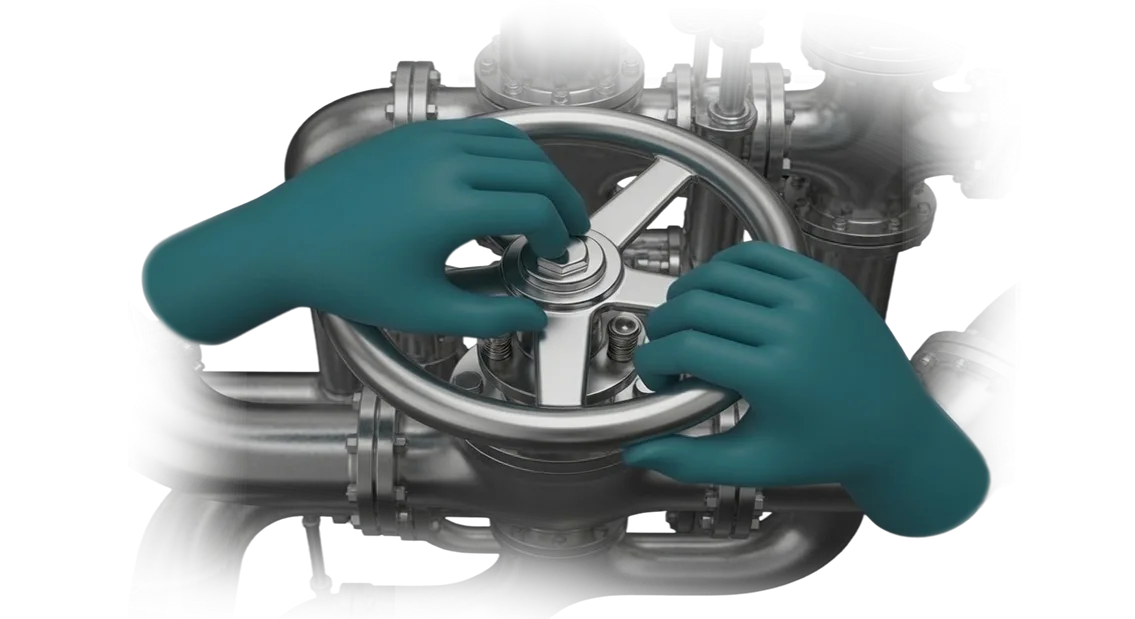
Why defense industry enterprises lose time and money on personnel training?
In the defense-industrial complex, the cost of an error isn't measured only in money. Working with expensive equipment, strict safety requirements and high quality standards force companies to rethink their approach to workforce training.
Traditional training of defense industry personnel stretches over weeks and months, requires constant participation of mentors and gives trainees access to real equipment — and that is a risk both for people and for the production cycle.
Occupational safety issues are especially acute here. Training operations on real equipment can lead to injuries, damage to machinery and unscheduled downtime.
Every such session effectively stops production, forcing the employer to balance between the need to train an employee and the need to fulfill a state order on time.
The cost of an emergency situation during skill practice is even higher: an incorrectly performed operation means a rejected batch, damaged tooling, an emergency line shutdown and reputational damage.
Expensive mistakes by beginners often exceed the cost of the training system itself. At the same time, requirements for regular certification and revision of regulations only get stricter, while training time does not increase.
That is why defense industry enterprises are increasingly replacing risky drills with practice in a safe virtual environment.
A VR simulator allows an employee to master the technological process on a realistic model of the workshop, without stopping production or threatening lives.
Mistakes are analyzed calmly, skills are reinforced faster, and the exam takes place in conditions as close to real as possible.
We help meet this need: we implement VR training for defense industry personnel that shortens preparation time, improves safety and eliminates expensive mistakes before the employee ever reaches a real site.
What benefits you will get from implementing a VR simulator
Implementing a VR simulator at a defense industry enterprise is not just a modern tool, but a way to make training safe, fast and economically justified. The virtual environment allows practicing actions without risk to the employee's life or the integrity of equipment.
This is especially important when preparing for emergency situations, working with hazardous substances or complex machinery.
Training speed is the second key advantage. An employee can repeat an exercise as many times as needed, and the program adapts to their individual pace. There's no need to wait for an instructor or stop production.
Savings come from lower costs for consumables, equipment wear and organizing training grounds, while the quality of preparation grows — every skill is brought to the point of automation.
Personnel motivation is another benefit that is often underestimated. The VR format is perceived as a modern and engaging way to develop skills; it involves employees and increases their interest in the profession.
For young specialists, it's an argument to stay at the enterprise; for experienced ones, it's a safe way to learn new competencies.
Thus, a VR simulator addresses several tasks at once: it improves safety, shortens training time, reduces costs and strengthens the workforce potential. It is a systemic solution that delivers predictable results and pays off at every stage of working with personnel.
VR simulator formats for the defense industry: comparison and selection
Choosing the VR simulator format for defense industry enterprises directly affects the speed of personnel training and the cost of implementation.
The same VR platform can work in different ways: from individual practice of complex operations to mass training of employees at multiple sites.
There's no need to chase "maximum realism" here — first it's important to define the task. The simulator format must address a specific need: quickly train a group, simulate a rare emergency situation, or embed virtual practice into an existing training process.
| VR simulator format | Who it's for | What it gives the customer |
|---|---|---|
| Stationary VR simulator with full immersion | Operators of complex installations, maintenance personnel | Practicing actions to the point of automation, detailed simulation of emergency scenarios, reduced risks when working with real equipment |
| VR classroom on standalone headsets | Training centers, factory departments | Simultaneous training of several people, deployment in any space, quick switching of task variants |
| Mobile VR kit | On-site training, branch offices | Training on location without business trips, minimal preparation time for a session |
| VR simulator integrated into a training stand | Universities, design bureaus | Combining real hardware with a virtual environment, in-depth training of engineers and testers |
After the format is selected, we design scenarios for your specific needs: sequence of operations, typical faults, safety standards.
Implementation takes from several weeks, and each employee's progress is visible through simple reports — this helps confirm training quality before a customer or regulatory bodies.
How VR simulator development works: stages and timelines
We understand that for defense industry enterprises predictability matters more than speed. That's why the development process is broken into transparent stages with checkpoints: you always know what's happening and when you'll get the result.
We follow a well-tuned procedure that eliminates unexpected changes at the final stage.
- Brief and task audit. We study your equipment, regulations and typical personnel mistakes. We document the simulator's goals and agree on acceptance criteria — this removes disagreements at the end of the project.
- Concept and scenarios. Together with your technologists, we describe work situations, sequences of actions and evaluation criteria. The approved document becomes the basis for development.
- Prototype and approval. We build a basic version with the key mechanics. You see the product in action and make changes before full-scale development begins.
- Full-scale development. We fill the prototype with detailed graphics, an interface and an action analysis system. We regularly show intermediate versions and record decisions.
- Testing with your instructors. We check scenarios at your site or remotely, fix issues and make sure the simulator is convenient for your employees specifically.
- Launch and support. We train your team, hand over documentation and stay in touch for improvements — for example, when regulations change or new equipment appears.
A typical project takes from 4 to 12 weeks depending on the number of scenarios and the level of detail. The exact schedule is fixed in the contract at the start, and at each stage you get a finished result that can be approved or adjusted.
This approach is already used by factories and defense industry companies that care about deadlines and predictable quality.
What's included in the VR simulator delivery for an enterprise
When you receive a VR simulator, you get not "hardware with software" but a ready-made workplace for skills practice — from first startup to regular sessions.
Everything needed for launch and use is delivered "turnkey": no hidden stages, no additional purchases, no lengthy setup by your own specialists.
What you receive:
- Delivery of equipment and software. A complete set: VR headsets, controllers, a computer station and pre-installed software. Everything is tested, calibrated and works right after unpacking.
- A simulator scenario based on your regulations. It reflects the real operations of your enterprise: sequences of actions, emergency situations and error control as defined in your documentation.
- A complete documentation package. Operator's manual, installation instructions, maintenance schedule, commissioning certificates — ready-made documents for your technical control department and certification committees.
- Training for your employees. We conduct in-person or remote training for instructors and operators: how to run sessions, track results, and make changes to the scenario.
- Methodological materials. Ready-made lesson plans, assessment checklists and training logs — so you can launch training the day after delivery.
- Technical support. Help with setup, software updates and consultations throughout the entire period of use. If needed, our specialists connect remotely and resolve the issue within one business day.
- Source data and access. A login for the administration system, activation keys and the ability to extend or adjust scenarios on your own with your team.
The result: after the kit is handed over, your enterprise gets an independent training unit. You don't need to hire external contractors for every session — your own trained instructors with all materials at hand are enough.
Case study: how a VR simulator for the defense industry reduced training time by 40%
One of our projects was developing a VR simulator for a plant that produces components for the defense-industrial complex.
A new production line required mastering a complex operation in a short time: standard training on real equipment took six weeks and constantly distracted mentors from their work.
Moreover, every session at the training stand meant machine downtime and the risk of mistakes for beginners.
We proposed a fully virtual training solution to the customer: an employee puts on a professional VR headset and practices all actions in a digital copy of the workshop.
The simulator is designed so that a mistake doesn't lead to breakdown or injury, and the system prompts the correct sequence of operations. Training happens without stopping production and doesn't interfere with output.
Implementation results
After three months of use, operator training time was reduced by 40% — from six weeks to three and a half. The number of errors during the first independent shifts dropped by half, and staff turnover decreased because newcomers gained confidence in their actions faster.
The customer was so impressed with the effect that they expanded the program to neighboring workshops and ordered a second module for assembling other equipment.
The secret is not technology for technology's sake, but the fact that a person masters a skill faster when they can repeat an operation many times without fear of consequences. An employee arrives at the real workplace already prepared, so they idle less and don't create defects.
This is especially important for the defense industry: any production failure is expensive, and personnel quality directly affects the fulfillment of state orders. That's why such solutions pay for themselves within a few months.
Frequently asked questions about VR simulator development for industry
Managers of industrial enterprises usually ask the same questions: how long will development take, what will a VR simulator for the defense industry cost, and how can you be sure it will actually improve personnel qualifications.
This is fair — any training program should be effective and predictable. That's why we answer honestly rather than with "market averages."
We started with small pilot projects for factories and grew into comprehensive solutions for the defense-industrial complex.
Over that time, we learned to forecast timelines and costs accurately, and we prove quality with measurable results: employees master skills faster and make fewer mistakes on real equipment. Below are answers to the objections we hear most often.
How long does VR simulator development take?
The timeline depends on the number of scenarios and the complexity of the equipment that needs to be reproduced. A typical personnel training simulator is created in 8-12 weeks — enough time to integrate it into an existing training program.
We break the project into stages with intermediate demos so you can monitor progress and make changes without losing momentum.
How is the cost calculated?
The cost is directly tied to the number of scenarios, the detail of the models and integration with your training materials. We don't include anything extra: you pay only for the features that are actually used in practice.
You receive an exact estimate after a preliminary discussion of the tasks, so the stated budget doesn't change during the project.
How do you guarantee quality?
Quality is confirmed on two levels: technical testing on our side and acceptance testing with your specialists. For the defense industry, it's especially important that the simulator precisely matches regulations and real conditions, so we involve industry experts. After launch, you get documentation, instructor training and support at all stages of operation.
This is only the beginning — you'll find the full list of questions and answers below. If your situation isn't covered here, write to us: we'll advise on how a VR simulator can solve your specific personnel training challenge.Ready to discuss a VR simulator project for your enterprise?
We know that implementing a VR simulator is a responsible step for any enterprise. So that you can evaluate its value before investing, we offer a simple and transparent process.
- Request. Leave a short request through the form — we'll contact you within one business day.
- Consultation. We'll discuss your production tasks, expectations from the simulator and possible usage scenarios.
- Estimate. We'll prepare an assessment of timelines and scope of work for your requirements — without complex technical documentation.
- Pilot. We'll develop a demonstration version of the simulator so you can see it in action on real tasks.
- Adjustment. We'll quickly make changes based on the pilot results and record the final parameters.
- Launch. We'll deliver the full version with training for your employees and support during the implementation phase.
This approach removes risks and unnecessary expenses: you pay for a finished result, not for promises. We work remotely, have more than 10 years of experience in developing simulators for industry and have already helped dozens of enterprises.
Leave a request — during the consultation we'll show which of your production tasks can be solved with a VR simulator. No prepayments and no hidden conditions — only clear stages and a clear result.
How to choose the right VR simulator format for the defense industry?
There is no universal VR simulator format for the defense industry — and that's a good thing. The choice is determined by two things: what the employee needs to learn and under what conditions the training will take place.
The right format saves budget and time; the wrong one gathers dust in a corner after the first presentation.
For practicing sequences of operations, equipment structure and regulations, a virtual twin with prompts and error control is sufficient.
If behavior in emergency situations matters more — scenarios of accidents, fires, equipment failures — the format should allow changing the scenario without rebuilding the simulator. This is the key question: static or dynamic.
Defense industry enterprises have a particular specificity: a high cost of error, limited access to real facilities and strict confidentiality requirements.
VR solves these problems simultaneously: employees get realistic experience without risk to life or equipment, and rare dangerous situations can be practiced an unlimited number of times.
A practical piece of advice: choose a format based on three parameters — how many people need to be trained, how often training sessions will take place, and how complex the movements that need to be reproduced are.
For high-volume personnel training, a mobile workstation that can be set up in any space is suitable. For assembly and repair skills on complex products — a simulator with physical elements that replicate the construction.
We help you choose a format after a short audit: we record the goal, scenario and constraints, and then propose a solution that fits into your training system. You get a tool that will be put to use right away — not a "check-the-box" technology.