

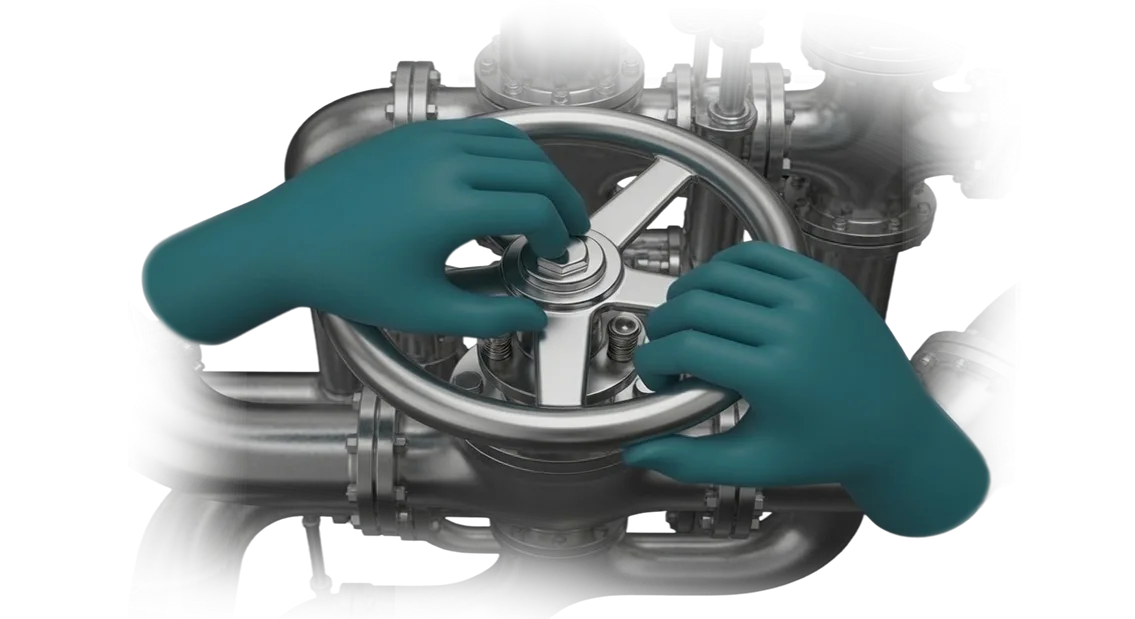
Shipbuilding: How to Reduce Errors and Losses on the Production Floor
Shipbuilding is an industry where the cost of a mistake is measured not only in materials, but also in order delivery deadlines, reputation, and safety.
Complex technological operations, work with large-scale structures, and tight tolerances require confident hands-on skills from personnel. A lack of such experience results in defects, rework, and downtime that directly hit the cost of each vessel.
Traditional training often comes down to theory and rare hands-on practice under a mentor's supervision. On a real production floor, a newcomer won't be allowed to practice emergency scenarios or non-standard situations — it's too risky and expensive.
As a result, employees learn from their own mistakes during actual work, and the enterprise bears production losses that could have been avoided.
A VR simulator solves this problem: it allows key operations to be practiced safely and repeatedly — from welding and assembly of units to actions in emergency situations.
Training in a virtual environment gives the employee muscle memory and an understanding of the technological sequence before ever stepping onto the floor. At the same time, equipment and materials are not consumed, and a mistake does not lead to injuries or defects.
That is why companies are implementing VR simulators as a tool for reducing production losses and improving the quality of personnel training.
We develop such solutions for the specific needs of each enterprise: we model your units, operations, and scenarios so that the employee practices exactly what they will encounter in the workshop. The result: fewer errors, more consistent quality, and faster onboarding.
What benefits does a VR simulator deliver to an enterprise?
Production safety
Practicing actions on real equipment involves risks to people and expensive components. A VR simulator allows the employee to operate in a completely safe environment, make mistakes, and see their consequences without accidents or downtime.
This is especially important in shipbuilding, where working with cranes, welding machines, and lifting mechanisms requires precise procedures.
"The simulator gave us the ability to prepare people for emergency situations that cannot be realistically modeled without stopping production," notes the chief engineer of the Atlant shipyard.
Training speed
The typical "mentor + training stand" scheme takes weeks, and there is often not enough free equipment for practice. The virtual environment is available around the clock and allows several people to train in parallel.
Complex operations are broken down into short scenarios, so an employee can master a skill to the point of automation in a matter of days.
Cost reduction
Material, electricity, and equipment wear costs during training drop to zero. There is no need to set aside a workshop or bring in an instructor for every shift — one mentor is enough for a group.
The company gets qualified specialists without halting production capacity and with minimal investment in consumables.
Quality of personnel training
Each scenario records the trainee's actions — how long the operation took, whether there were errors, and where exactly. The manager sees an objective picture of progress and only allows those who have completed all stages to start work. This approach reduces the risk of defects and increases employee accountability.
VR simulator formats for different tasks
Shipbuilding yards, repair docks, and assembly shops have different requirements for personnel training.
VR transfers the operations that determine the outcome to the simulator: precise welding of assemblies, safe load movement, and actions during an emergency situation in the dock.
That is why we compare formats by task — it makes it easier to choose a solution that will pay off for a specific type of production.
Formats for shipbuilding tasks
| VR simulator format | Who it suits | What it gives the enterprise |
|---|---|---|
| Welder's workstation | Welding areas, hull assembly units | Fast training for newcomers, less scrap and material consumption |
| Emergency scenarios in the dock | Repair dock crews, occupational safety services | Practicing emergency actions without stopping work or risking people |
| Crane operations | Shipyards with overhead cranes | Safe training for complex movements, fewer incidents |
| Pipeline work | Ship repair facilities, tankers | Compliance with operational sequences, fewer failures caused by personnel |
The format is selected based on the task and skill level: a simple scenario is enough for a newcomer, complex scenarios for an experienced specialist, and a different mode for certification.
We choose a combination that covers several training tasks at once — from internship to annual knowledge reviews. Identify the key areas of your shipyard or dock — we will suggest a format with measurable results and clear implementation.
How we develop a VR simulator: stages and timelines
We have structured the process so that you understand what is happening and when results will appear at every stage.
We break the project into stages, approve key decisions — and only move forward after your "OK." This approach eliminates surprises and missed deadlines, and you always know what stage the simulator is at.
- Briefing — we dive into your task, study the enterprise's technological processes, and review training requirements. You get an accurate work plan, team composition, and timeline — without unnecessary costs.
- Scenario design — we create the simulator structure, exercise list, and skill assessment criteria. We align the scenario with your experts so that the simulator replicates the real workflow as closely as possible.
- Development of 3D models and environment — we build digital copies of equipment and work areas. You see interim renders and make edits before assembly begins — this saves time and money.
- Assembly and programming — we combine the models, add interactive elements and hints. At this stage the simulator becomes a full-fledged training tool and you get the first working version.
- Testing with your specialists — we test the simulator on real scenarios, fix errors, and refine it to the required quality. You get a stable version ready for training.
- Launch and handover — we install the system on your equipment, train the instructors, and hand over all materials. The project does not end there: we stay in touch for support and refinements.
The average development time is one to three months, depending on equipment complexity and the number of scenarios. We set precise timelines in the contract and meet them, and you get a tool that quickly starts delivering value to the enterprise.
What is included in the VR simulator delivery package?
We have prepared a complete delivery package so that the VR simulator can be launched into the training process from day one. The package includes all the components needed for full-fledged training: from the scenarios themselves to methodology materials and ongoing support.
- VR scenarios that replicate real shipbuilding operations — typical situations are practiced: assembly of units, work with equipment, and actions in emergency circumstances. Scenarios are adapted to your technological processes.
- Training methodology — a ready-made course program, lesson plans, skill assessment criteria, and a sequence for practicing actions. The instructor understands how to conduct sessions and check results.
- Instructor and trainee guides — detailed instructions for working with the simulator, including safety procedures and enterprise regulations. Suitable for quickly onboarding new employees.
- Technical documentation for installation and maintenance — descriptions of room requirements, system configuration, and equipment servicing. Your specialists can keep the simulator operational on their own.
- Training for your team — we train instructors and administrators who will then run sessions and manage the system themselves, without developer involvement.
- Post-sales support — updates to VR scenarios to reflect changes in technological processes, operational consultations, and content refinement as production requirements evolve.
All package elements are delivered with source materials and adapted to your enterprise's regulations. We support you after launch as well, so that the simulator remains a relevant training tool for years to come.
Case study: VR simulator implementation in shipbuilding
For the Nord-Ship shipbuilding plant, we developed and implemented a VR simulator for hull structure assemblers.
The plant needed to reduce the time required to bring new employees up to speed on high-complexity assemblies — errors at this stage led to expensive rework and slipway downtime.
Previously, training took weeks and required a mentor's constant presence. The virtual simulator enabled practicing key operations without risk to equipment, and the real-time assessment system provided immediate feedback on quality of performance.
Results after launch
Results were measured after two months of operation. The training time for a new welder was cut threefold — from 14 to 5 working days. The defect rate when assembling experienced units dropped by 42%, and section productivity increased by a quarter.
The plant also received a digital progress log for each trainee. The workshop manager can see which operations are most difficult and adjust the training program without interrupting production.
Project development
The pilot's success led to a repeat order: the company ordered two more simulators — for riggers and compartment painting specialists. Up to 40 people per month now train on the simulators, and savings on materials and defect correction cover the project within a year.
This case study confirms: VR simulators in shipbuilding deliver measurable production results — faster onboarding, fewer errors, and consistent assembly quality.
Answers to frequently asked questions about VR simulators
Managers at shipbuilding enterprises ask the same questions before ordering a VR simulator: how long will development take, will special equipment be needed, and how will employees adapt to the virtual environment.
We answer these and other common questions — it makes project planning easier and clarifies the results you can expect.
How long does VR simulator development take?
On average, two to four months — the timeline depends on the number of scenarios and the depth of detail. The exact schedule and stages are fixed in the contract before work begins, so there are no delays.
Do we need to purchase equipment for VR training?
No, that is our responsibility. We supply the complete kit, set it up at your site, and train your personnel. All we need from the client is a room and a standard power outlet.
How will employees adapt to the simulator?
No special skills are required: the interface is simple, with hints and an instructor nearby. In shipbuilding, scenarios are built on real production operations, so the skill transfers easily to the workshop.
Is it safe for production?
Training takes place without stopping equipment and without risk to personnel. A mistake in the virtual environment does not result in injury or defects — the employee calmly practices a complex operation to the point of automation.
What about support after launch?
We support the simulator after handover: we update scenarios according to your regulations, add new operations, and advise your team. Our line of communication remains open after the project ends.
Discuss a VR simulator for your enterprise
Every shipbuilding enterprise faces the same personnel training challenge: welders, hull assemblers, repair specialists. Safety and training speed directly affect order delivery deadlines.
A VR simulator enables practicing complex operations in near-real conditions — without risk to equipment or people. But to make the simulator solve your specific problems, a preliminary process analysis is needed.
In a 30-minute consultation, we assess where VR will deliver the greatest impact: protection against accidents, reduced material consumption, shorter onboarding times. You get a concrete plan, not generic words. Tell us about your task — we will propose a format for it.
What you get after contacting us:
- An express assessment of your production: we identify the areas where a VR simulator will pay off fastest.
- A simulator type matched to the task — from weld quality control to emergency response practice.
- An indicative launch plan with timelines and stages.
- An economic justification: we estimate how training and defect costs will decrease.
- Examples of implementations at shipbuilding and machine-building enterprises.
- Answers to integration questions: who supports the system, how personnel are trained, what equipment is needed.
- A final commercial proposal if the format suits you.
No obligations — the consultation is non-binding. Submit a request for VR simulator development on the website or write to us in a messenger — we will call you back within one business day.
How to choose a VR simulator format for shipbuilding tasks?
Choosing a VR simulator format in shipbuilding starts not with technology but with the production task. Hull work, welding, pipeline installation, crane operations — each process has its own specifics, cost of error, and level of risk.
This is what determines which training format delivers real value and which remains just an impressive demonstration.
For high-volume operations — for example, standard weld seams or assembly of units — short drill scenarios that can be repeated without consuming materials are the more sensible choice.
For complex and rare situations, such as emergency equipment shutdown or working in confined spaces, a full scenario with a detailed action algorithm is required. One format saves resources, the other prepares for emergency conditions.
The deciding factor is the level of realism your specialists actually need. Practicing a skill requires accurate simulation of actions and clear feedback.
Verifying readiness for an emergency situation requires full immersion and a vivid visualization of the consequences of error.
We help you choose a format for your tasks: we analyze the list of operations, their frequency, and the cost of error. Based on this, we propose an optimal solution — from individual modules to a comprehensive program integrated into the enterprise's training system.
This answers the key question: the client gets not a simulator for technology's sake, but a tool that solves a specific production problem.
The result: an employee who comes to production already familiar with the process, makes fewer mistakes, and gets up to speed faster. For shipbuilding, that means less rework, savings on expensive materials, and a safer site.