

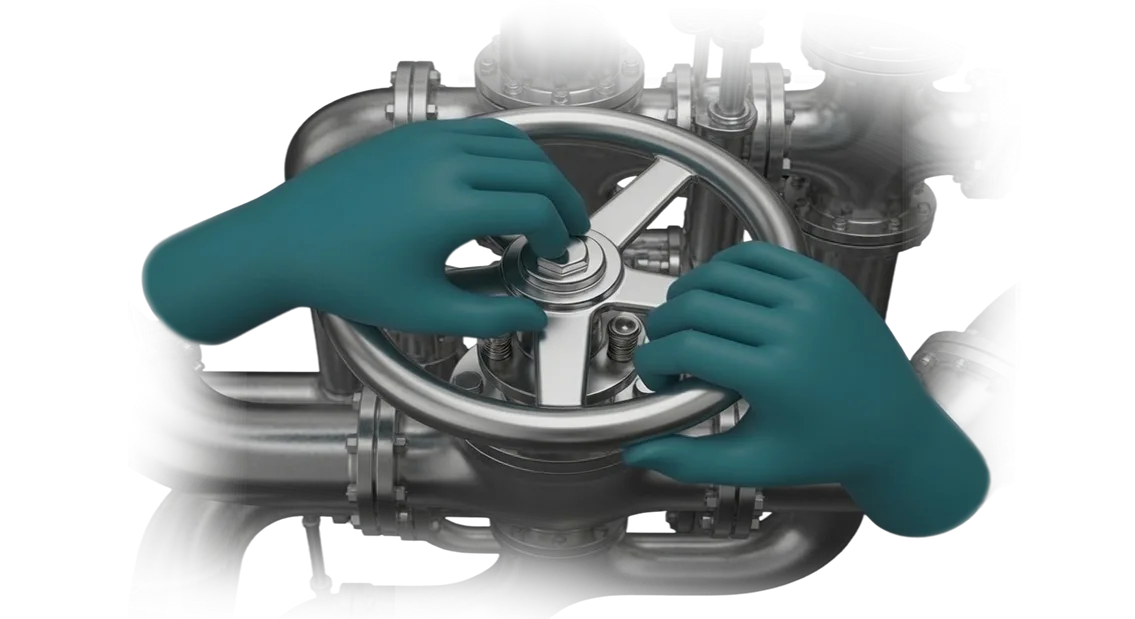
Personnel Errors in the Pulp and Paper Industry Are Costly
Personnel errors in the pulp and paper industry are costly — and this is not just about fines. Every accident on the production floor halts technological lines, disrupts shipments, requires expensive equipment repairs, and leads to proceedings with regulatory authorities.
According to industry statistics, most incidents occur not because of equipment wear but because of the human factor: incorrect sequence of actions, inattention when handling chemicals, violation of procedures during equipment maintenance.
Pulp and paper production combines high temperature, pressure, corrosive reagents, and heavy machinery. An operator error here results in more than just downtime — employee health and the company's reputation are put at risk.
Every such incident means lost money, time, and trust: on the part of workers who begin to fear for their safety, and on the part of customers who question the reliability of supply.
Training personnel on real equipment is risky and slow: any drill on a live line is a potential emergency and downtime. And theory without practice does not build lasting skills — in a stressful situation, an employee acts on autopilot and often incorrectly.
That is why companies are switching to safe training in a virtual environment, where dangerous scenarios can be practiced without consequences for people or production.
We help pulp and paper mills eliminate this risk with VR simulators. An employee is immersed in a digital copy of your workshop, acts in realistic scenarios, and learns to make the right decisions — while the cost of an error in the simulator is zero.
This is how occupational safety stops being a formality and becomes a manageable process that saves enterprise resources.
What a VR Simulator Will Bring to Your Production
In pulp and paper production, the cost of an error is not just financial losses but also a risk to people. A VR simulator allows complex and emergency scenarios to be practiced without stopping equipment or threatening personnel. The employee gains hands-on experience, and the company gains manageable safety.
The second advantage is training speed. What an instructor explains over weeks can be mastered in a few sessions: an experienced employee refreshes skills in a couple of hours, and a newcomer completes the full course without disrupting production.
The workshop gets qualified specialists faster, and instructors are not distracted from their own tasks.
Savings on training are built into the very logic of the simulator. There is no need to stop machines, spend expensive raw materials, or put up with defects — the first mistakes move into the virtual environment.
The VR simulator pays for itself with the first trainee groups through reduced material, energy, and depreciation costs.
Finally, personnel training becomes standardized. Every worker repeats the same correct sequence of actions, and the system records errors and suggests what to fix.
For the pulp and paper industry, with its staff turnover and seasonal workloads, this is a way to maintain qualifications regardless of place and time.
We build VR simulators around your technological process — from pulp cooking to paper finishing. We will show you a demonstration based on a real scenario from your production facility.
VR Simulator Formats for the Pulp and Paper Industry
Pulp and paper enterprises need different training formats: some require mass operator training, others require practicing emergency situations on digester vessels and paper machines.
There is no universal "one simulator for everything," so we select the virtual simulator format for the specific task and budget.
Below is a table of the formats we use in the pulp and paper industry:
VR Simulator Formats for Enterprise Tasks
| Format | Target Audience | What It Delivers |
|---|---|---|
| Screen-based simulation trainer | Training centers, high-volume throughput | Training without stopping production or material costs |
| Fully immersive VR trainer | New employees, hazardous areas | Familiarization with the plant, practicing emergency procedures |
| Group VR trainer | Shifts, maintenance crews | Coordinated actions, fewer errors during operations |
| Training + certification module | HR department, occupational safety service | Objective skills assessment and automatic reports |
The desktop format is suitable when you need to quickly train a large flow of employees and verify their knowledge of the technology.
Full immersion is chosen for hazardous areas — cooking, bleaching, work with chemicals — where the cost of an error is high and training on real equipment is impossible.
We begin selecting a simulator with an analysis of your procedures and typical personnel errors. Scenarios are adapted to real workplaces rather than taken from a catalog.
Leave a request — within a few days we will prepare a recommendation on the format, timeline, and implementation scope.
How a VR Simulator Development Project Works
A VR simulator development project for the pulp and paper industry is built as a partnership: you immerse us in the specifics of your production, and we immerse you in the technology. We work according to a transparent procedure where every stage is agreed upon and measurable. You see the result at each stage, not just after final delivery.
- Briefing and production immersion. We collect tasks, scenarios, and safety procedures and define the skills an employee must practice. This is the foundation on which the entire future simulator is built.
- Scenario design. Together with your technologists, we describe work situations: from routine operations to abnormal emergencies. We establish criteria for evaluating operator actions.
- Prototype on your equipment. We show the basic version of the simulator at an early stage to align expectations and make corrections before full-scale development.
- Full-version development. We create a realistic 3D model of the workshop, interactive mechanisms, and an operator action evaluation system. The simulator runs on professional equipment — stable and failure-free.
- Implementation at the enterprise. We configure equipment, install software, and conduct pilot training with a small group of personnel. We integrate the simulator into the existing training schedule.
- Instructor training. We prepare your specialists to conduct sessions independently and update scenarios. You do not depend on us in day-to-day operations.
- Support and refinement. We collect analytics, adjust scenarios to reflect changes in procedures, and expand the simulator for new tasks. Support continues after launch, not just "until project delivery."
At every stage, you understand what is happening and what it costs. The result is a ready-made tool that quickly pays for itself through reduced accident rates and faster onboarding of new employees.
What's Included in the VR Simulator Package
When ordering a VR simulator, there is a risk that the package will include only "the box," with all necessary refinements becoming additional services. To avoid hidden work, we document the scope of supply at the contract stage. You know in advance what you will receive, when, and by what criteria you will accept the work.
The package includes everything needed to launch and regularly use the simulator:
- Training modules for your processes. You work through typical pulp and paper production operations: from equipment setup to emergency response actions.
- Scenarios based on your procedures. Virtual zones reflect the specifics of the enterprise: premises, equipment units, safety algorithms, and regulatory requirements.
- Training analytics. Each employee has a personal dashboard with progress, number of errors, and completion time. Management can see who has mastered the material and who needs a repeat session.
- Instructor tools. You configure tasks, launch training sessions, and review results independently, without developer involvement.
- Technical support. Includes system updates, consultations, and implementation assistance to keep the simulator running reliably throughout its service life.
- Training for your specialists. We transfer the methodology and administration rights — you do not depend on us in daily operations.
- Guarantees and acceptance. The timeline, scope of work, and acceptance criteria are all documented.
A defined scope of supply protects against unexpected extra costs and misunderstandings. You receive a working tool that employees begin using within the first month and clearly understand what you are paying for.
Real-Life Case: Fewer Accidents and Less Downtime
When an accident occurs at a pulp and paper mill, it is not just damaged equipment. It is a line stoppage, disrupted supply, risk to people, and serious financial losses.
In such conditions, personnel training is a matter not of formality but of stability across the entire production.
Classic safety briefings do not give workers experience in handling abnormal situations, and training on real equipment is too expensive and dangerous — especially at facilities with a continuous cycle, where every hour of downtime translates into losses.
We carried out an implementation for one pulp and paper producer — let's call it BumTech. Employees practiced skills on a VR simulator that replicated the scenarios of their own technological line: equipment startup and shutdown, clearing blockages, and responding to smoke.
Operators made mistakes in a safe environment, and the system recorded every action and guided them through the correct sequence.
Training proceeded without stopping production and without consuming real materials — which immediately simplified the logistics of the training process.
The project results speak for themselves: the number of emergency shutdowns fell by almost a third, injuries were cut in half, and the time required to bring a new employee up to speed dropped from three months to six weeks.
The production economics also improved — less downtime, fewer defects, lower training costs. After the pilot, the customer expanded the program to other workshops, revised their training curriculum, and made the VR simulator a mandatory stage of personnel preparation.
That is the key indicator: the system works not as an experiment but as part of the production process.
How to Choose the Right VR Simulator Format?
The format of a future simulator is always determined by two factors: the specifics of the particular production facility and the project budget.
There is no universal "silver bullet" solution — what works perfectly for training operators in a boiler and turbine workshop may be excessive for inducting warehouse staff in the finished goods section.
That is why the first thing we do at the briefing stage is study real workplaces, typical personnel errors, and occupational safety requirements. These data drive the selection of the VR simulator in terms of level of detail, scenarios, and session duration.
As for the specifics of the pulp and paper industry, the key factors are the aggressive environment, complex technological cycles, and the high cost of error. A virtual simulator can replicate either a single piece of equipment or an entire production area.
In the first case, skills practice is faster and cheaper; in the second, the employee sees the interconnections between processes, but the development budget is higher.
We do not push expensive scenarios — we offer options that fit the task: from a compact module to a full-scale virtual workshop.
The open question of the project budget is resolved step by step. Start with a pilot simulator covering one or two key scenarios — that is enough to evaluate the effect on a specific group of employees.
After measuring training speed and reduced accident rates, you make the decision about scaling. This approach lowers risk and allows you to plan expenses without stopping the production process.
Another important selection criterion is the enterprise's technical equipment. We design the solution around the hardware the customer already has, or we select the minimum necessary set.
You will not have to change training logistics or remodel the classroom — the simulator fits into existing personnel training procedures. The final format is always fixed in a document: what you receive, within what timeframe, and with what guarantees of results.
Common Concerns When Ordering a VR Simulator
Ordering a VR simulator for the pulp and paper industry is a significant step. We understand that managers have legitimate concerns: how the simulator will fit into current processes, whether it will damage equipment, and when the investment will pay off. We answer the most frequent questions.
Is the VR simulator compatible with our equipment?
The simulator does not require replacing existing lines. We configure scenarios to your specifics — equipment parameters, typical abnormal situations, and procedures. Our specialists will audit the workplace and select the optimal configuration.
Is training in virtual reality safe?
Training takes place without contact with real equipment, eliminating the risk of injury or accidents during the session. At the same time, the employee gains realistic experience in handling dangerous situations, and the system monitors the correctness of their actions.
When will the simulator pay for itself?
The economic effect comes from reduced emergency downtime, lower consumption of raw materials during training, and shorter onboarding time. As a rule, enterprises see a return on investment within a few months. We will prepare calculations for your scenario.
What about warranty and support?
We accompany the project after implementation: we update scenarios, adapt the simulator to changes in procedures, and train instructors. Support is included in the contract — you are never left alone with the system.
If you still have doubts — ask us directly. We will help you assess whether a VR simulator makes sense for your production.Order a VR Simulator for Your Production Facility
For enterprises in the pulp and paper industry, personnel safety and practicing rare emergency scenarios are directly tied to losses and downtime.
A VR simulator allows you to practice actions without risk to people or equipment and gives the customer a measurable result: fewer errors, faster onboarding, and stable processes.
We develop turnkey VR simulators tailored to your production needs. Our launch process is designed so you spend minimal time on organization while staying in control of every stage.
The procedure is simple:
- Submit a development request on the website — we will contact you within one business day.
- We hold a consultation: we clarify the task, the simulator scenario, and the target training metrics.
- We prepare a project cost estimate — cost calculated after audit — based on scope, complexity, and timeline.
- We agree on the technical specification, budget, and schedule — no hidden conditions.
- We develop the VR simulator turnkey, test it on your equipment, and train your instructors.
- We hand over the project and provide ongoing support — you receive a working tool, not a demo file.
Start with a consultation: tell us about your task — we will propose a solution that fits your budget and timeline.
Let the development request be the first step toward a simulator that genuinely improves safety and production efficiency.