

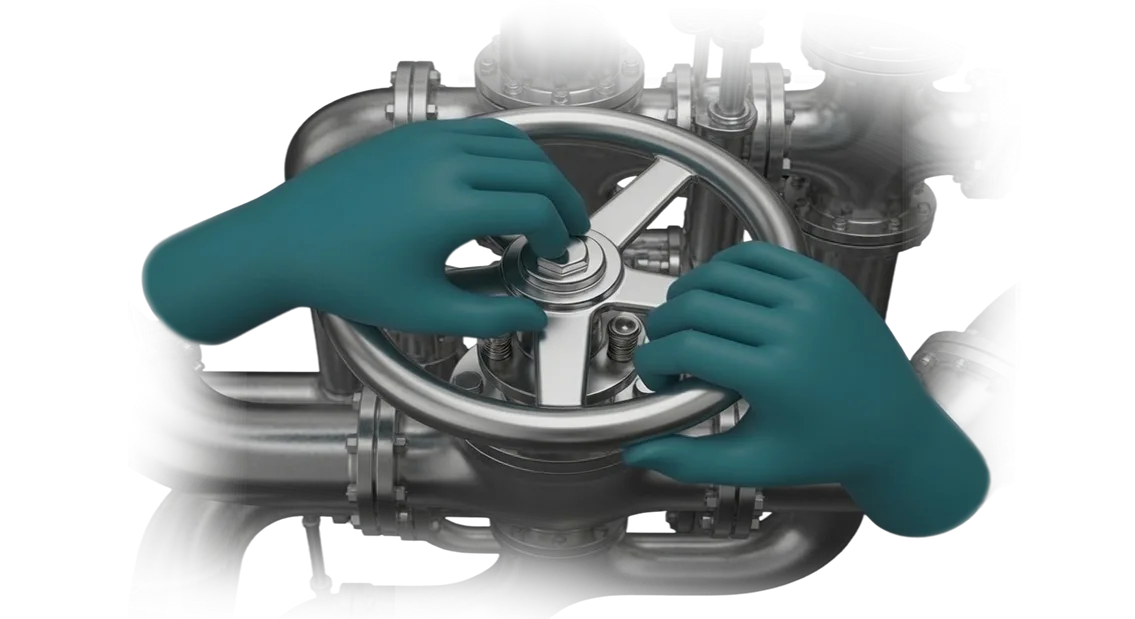
Why VR Simulators for Railways Reduce Accident Rates
On railways, the cost of an error is especially high: lives and the reliability of transport depend on the attentiveness of train drivers and the actions of duty personnel.
At the same time, hands-on staff training in real conditions is limited — you cannot stop traffic to practice an emergency situation, and training time is always in short supply.
That is why enterprises are looking for ways to train employees without risk to infrastructure or the schedule.
Virtual simulators for enterprises solve this problem: VR driver training takes place in a safe digital environment where any accident, equipment failure, or adverse weather condition can be modeled.
The worker repeatedly practices correct actions until they become automatic, rather than encountering a problem for the first time on an actual run. Such a simulator for railway workers builds stable response skills, which directly reduces accident rates on real tracks.
Railway safety is further strengthened through objective assessment: the system records every action of the trainee, their reaction speed, and compliance with regulations. The supervisor sees who is truly ready for independent work and who needs additional training.
This reduces the time spent on initial briefings and improves training efficiency without interrupting operations.
We develop virtual simulators integrated into existing training programs and make them as close as possible to the real tasks of your enterprise. The result — trained personnel, fewer emergencies, and confidence that every employee acts precisely and according to instructions.
What You Gain from Implementing VR Training
Conventional railway staff training takes time, costs money, and carries risks. Trainee mistakes result in downtime and repairs. VR simulators solve this problem: employees gain hands-on practice in a safe virtual environment, and the enterprise sees a measurable result.
Fast Training Without Stopping Operations
Reduce onboarding time: the employee masters the procedures on the simulator without tying up real equipment or disrupting the traffic schedule. Training happens at any time, not just according to the instructor's timetable.
Objective Skills Assessment
The simulator records every action and produces a final report. The supervisor sees who is ready to work independently and who needs additional training. This eliminates subjectivity and speeds up clearance decisions.
Savings on Consumables and Fuel
Training on real equipment is expensive: fuel, electricity, wear and tear on machinery. In a VR simulator, the same situation can be replayed an unlimited number of times at no cost. Training savings become tangible after the first few groups of employees.
Fewer Downtimes and Accidents
Well-prepared staff act more confidently, which reduces the number of incidents and forced stops. This directly affects the efficiency of the enterprise.
our team has been creating VR simulators for industry for over 10 years. Our railway solutions help improve employee qualifications and cut costs without compromising training quality.
VR Simulator Formats for Railways for Your Enterprise's Tasks
On the railway, the cost of an error is measured not in fines but in human safety and uninterrupted traffic. Conventional briefings and paper procedures do not let an employee experience an emergency situation — they encounter it for the first time only during real work.
VR simulators close this gap: the worker practices actions in an environment as close as possible to the real one, but without any risk to rolling stock, infrastructure, or the schedule.
We select the format for a specific enterprise task — from initial training to annual skills checks. Below is a summary table of typical solutions already used on Russian railways.
| Simulator format | For whom | What it gives the enterprise |
|---|---|---|
| Train driver simulator | Train drivers and assistant drivers | Practicing train handling in any weather conditions, actions in emergencies, and response to signals — without stopping traffic or consuming fuel |
| Traffic dispatcher simulator | Train dispatchers, station duty officers | Decision-making under stress: managing traffic flows, schedule disruptions, equipment failures — with a review of the consequences of each decision |
| VR for track repair workers | Track repair workers, infrastructure maintenance teams | Safe practice of repair procedures and actions when a train approaches — fewer injuries and procedural violations |
| Custom training scenarios | Employees of any specialty | Training on exactly the procedures and emergencies relevant to your section and infrastructure |
Each format runs on professional software adapted to the customer's actual station layouts, route profiles, and rolling stock types.
This means employees train not on an abstract picture but on familiar infrastructure — and transfer their skills to real work without "re-learning."
The main thing the enterprise gains is a measurable result: less time to bring new employees up to speed, fewer procedural violations, and confident staff actions in emergencies.
If you are not sure which format to start with, send us a description of your task — we will recommend a solution for your specific section and budget.
How VR Simulator Development Works: 6 Steps
Developing a VR simulator for railways is a process you control at every stage. We have completed dozens of implementations and built a six-step workflow: you make decisions, we are responsible for the results and deadlines.
-
Simulator development brief. We discuss training goals, the target audience, and the enterprise's current procedures. You receive a timeline and scope estimate without technical details.
-
Scenario approval. We create a methodological scenario: the situations employees face, action sequences, and assessment criteria. You approve it — and we move on to graphics.
-
Prototype and mechanics. We build a trial version with basic scenes. You see what the simulator looks like, how the hints work, and make changes before full production.
-
Full version build. We add all approved scenarios, briefing elements, and the action assessment system. The simulator is ready to be tested with real employees.
-
VR training testing. We run the training on a pilot group, collect feedback, and adjust scenarios. This confirms that the material is absorbed and the assessment works correctly.
-
Simulator launch and VR technical support. We install the solution at workstations, train administrators, and hand over documentation. After launch, we update scenarios and respond promptly to questions.
What's Included in the Simulator Delivery Package
You get not just a set of hardware, but a complete workstation for staff training. Everything listed below arrives configured and tested — all you have to do is set up the equipment in the room and start training.
- VR equipment for instructor and trainee — professional headsets, controllers, and base stations. Everything is pre-calibrated for your room; no need to figure out the settings.
- Instructor interface — a workstation from which the instructor sees the trainee's actions in real time, can give hints, pause the scenario, and switch exercises.
- Training scenario library — ready-made railway situations: from standard operations to emergencies. Scenarios can be added and edited, so the simulator will not become outdated in a year.
- Results reporting system — a report is generated after every attempt: time, mistakes, correct actions. The instructor sees the progress of each employee and the group as a whole.
- Server component — storage for scenarios and results. It runs on your machine or local network, so data never leaves the enterprise.
- Complete documentation package — operating instructions, training materials for instructors, and maintenance procedures. All in Russian, no need to customize anything.
- Training for your instructors — two to three days working with your team, after which they can launch the simulator and run sessions on their own.
- Technical support — phone and email contact, scenario updates, and consultations. Equipment is serviced remotely, and our engineer can come on site if needed.
This package covers the entire cycle: you get the hardware, the content, and the training management system. All that remains is to switch on the simulator and run the first session.
Case Study: Driver Training on a VR Simulator Paid Off in 4 Months
Deploying a VR simulator for train drivers started with a problem: conventional training took up to two months and required taking locomotives out of service. Mistakes by newcomers were costly — incidents on the tracks led to downtime and reputational risks.
We offered TransZhelDor, a regional railway directorate, a simulator that models real routes and emergency situations without any risk to people or equipment.
The implementation results confirmed its effectiveness. In three months, 150 train drivers were trained on the simulator, and exam pass rates rose from 78% to 96%. Training time was cut in half: four weeks instead of eight, with some sessions conducted remotely.
Staff training assessment became objective: the system records every action and automatically generates a report on each employee's readiness for a run.
The economic benefit came from several areas. No need to rent a test track or spend diesel fuel on training trips. Instructors stopped repeating the same scenarios over and over — 30% of their working time was freed up.
Overall, training costs per driver dropped by 42%, and the investment in the simulator paid off in four months.
The HR director at TransZhelDor noted: "Before, we could not check how a driver would behave in the event of brake failure or a sudden obstacle.
Now such situations are practiced safely, and clearance decisions are made based on objective data, not the instructor's personal impression." After the first training batch, the company ordered additional scenarios for freight operations — the follow-up project became a logical continuation of the partnership.
How to Choose the Right VR Simulator Format for Your Tasks?
Choosing a VR simulator format starts not with technology but with the task. For railways, this means practicing emergency response, onboarding new staff, or improving the skills of drivers, dispatchers, and maintenance personnel. The scenarios, level of detail, and session length all depend on this.
The second selection criterion is the number of workstations. For centralized training, a fixed classroom with several sets is the rational choice.
For employees at different depots and remote sections, mobile solutions that can be set up within an hour and require no dedicated room are a better fit.
The third point is integration with your training program. A VR simulator fits into the schedule, stores each employee's results, and lets the instructor see mistakes and return trainees to difficult segments. This way you get a measurable result, not a one-off entertainment.
The VR budget is often seen as a one-time payment. Smart VR simulator selection accounts for scaling: you can start with one key scenario and two workstations, then expand the system. The platform remains the same, which protects your investment.
For railways, one more factor matters: compliance with regulations and safety standards. A good contractor will take your regulatory documents into account and adapt scenarios to your actual instructions.
Choosing a format comes down to a balance between employee coverage, depth of detail, and timelines — these are the key selection criteria, and we help find that balance during an audit.
Frequently Asked Questions About VR Simulator Development
Every project starts with questions about cost, timelines, and integration into existing training. Here are our answers, based on our team's experience in the railway industry.
How much does VR simulator development cost?
The cost depends on the number of scenarios and the level of operational detail. During the meeting, we record your requirements and offer options to fit your budget — from a basic module to a full course with action assessment. The estimate does not change after the start.
What are the development timelines?
A typical project takes 2–3 months; a minimum set of scenarios can be launched within a month. We approve a plan with checkpoints, so the timeline is known before the work begins.
What are the room requirements?
A 2×2 meter area and a power outlet are enough — the set works in a regular classroom or office. A mobile version is available for transport between departments.
Can scenarios be updated after launch?
Scenarios are modular, so changes can be made without stopping training. We update instructions and add emergency situations based on your new regulations.
How do I integrate the simulator into the training process?
The simulator integrates into existing programs: refresher courses, driver training, or regular skills checks. The instructor receives a report for each employee, and a short introductory session is enough to get started.
Order a Pilot VR Simulator for Your Enterprise
Start with a pilot project — it is the fastest way to see how a VR simulator affects the quality of your staff training. We adapt the scenario to your railway's specifics: from standard operations to emergency response.
You don't need to deploy the system across the entire enterprise — one section or profession is enough to measure the result.
After you get in touch, you will receive a VR training consultation: we will look at which of your enterprise's tasks the simulator addresses. We will prepare a cost estimate for the pilot and full deployment, and show you a simulator demonstration on a real example. This will help you evaluate the fit and next steps.
What you get after submitting your request:
- A VR training consultation — scenario selection tailored to your procedures and tasks.
- A cost estimate for the pilot project and scaling to other departments.
- A simulator demonstration on our equipment or remotely — you will see the interface and training logic.
- A pilot scenario developed from your instructions and real work situations.
- Training for the first group of employees and before/after measurement — you will see the concrete effect.
- A roadmap for rolling out the solution to other professions and sections.
A pilot project is a chance to test the technology on your team without major investment or risk. You get a measurable result, not a presentation.
Submit a request for a VR simulator — we will contact you within one business day, answer your questions, and propose the optimal collaboration format.