

Don't understand sign language? Implement sign language translator 3d
Deaf and hard-of-hearing employees and clients are full participants in the work process, but without a shared language they face a barrier at every step: instruction, meetings, visitor support.
A regular interpreter is not always available, and written speech slows down dialogue. As a result, a company loses time and sometimes the loyalty of people who need quick help.
The problem is broader than it seems at first glance. If an employee does not understand a safety instruction or cannot explain service terms to a client, that is a direct risk to reputation and revenue.
A manager has to either hire a sign language interpreter on staff or put up with misunderstandings. Both options are expensive and inconvenient.
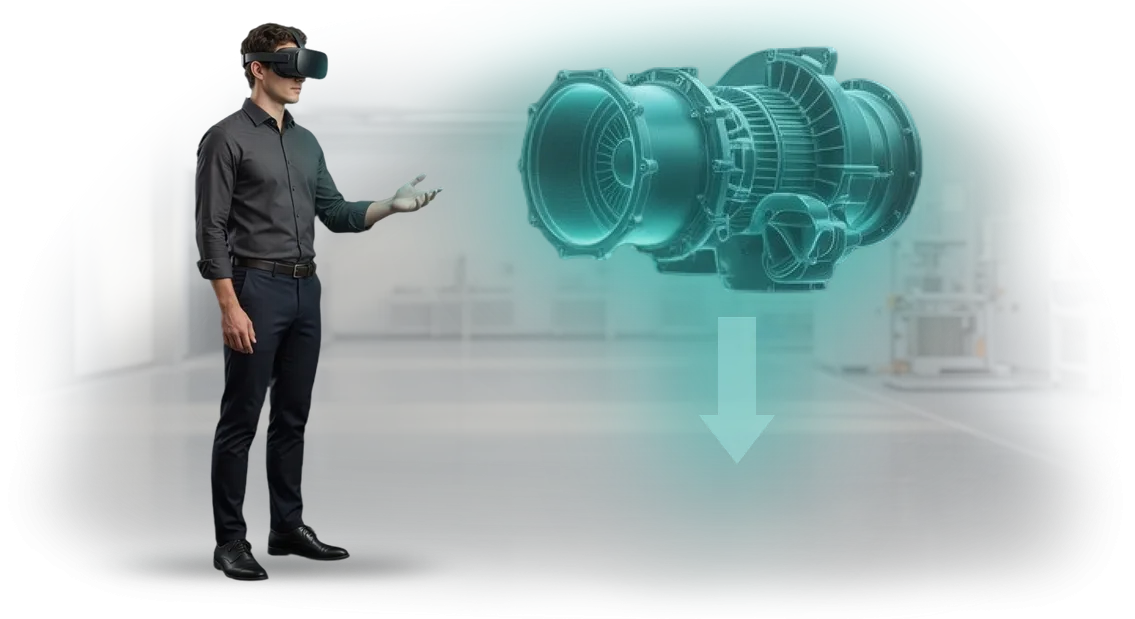
The solution is a 3D sign language translator embedded in the training system. Instead of text memos and static videos, the employee sees an avatar that accurately replicates gestures and facial expressions.
This format is clear to both deaf and hearing people: the same scenario can be played in virtual or augmented reality, dialogues can be practiced, and material comprehension can be checked. Training becomes accessible, and communication becomes alive.
We help you implement a 3D translator in your training programs: we configure scenarios to your specifics, integrate the solution into VR/AR courses, and support you at every stage.
As a result, you address the need for an accessible environment without hiring additional specialists and get a tool that works for brand recognition and audience loyalty.
What benefits does sign language training bring to business
Inclusivity has long ceased to be just a buzzword — it is a working tool that affects staff turnover and the speed of filling vacancies.
Companies where hearing and non-hearing employees work in the same space onboard newcomers faster and are less likely to lose valuable specialists due to misunderstandings.
Sign language training removes the main barrier — communication. When the team understands each other the first time, errors related to the "human factor" disappear, and new employees join the workflow in weeks, not months.
Reducing workplace injuries
In manufacturing and logistics, the cost of misunderstanding is not just a missed deadline but people's safety. An employee who did not fully understand the instruction puts themselves and colleagues at risk.
Sign language training for key teams allows warnings and commands to be conveyed instantly without losing meaning. The result is fewer incidents, less downtime, and consequently lower costs for compensation and staff replacement.
Increased engagement and loyalty
Employees stay where they are valued. When a business invests in an accessible environment and trains the team in the language of non-hearing colleagues, it changes corporate culture from within. People feel part of a common cause, not cogs in a machine. This directly affects retention: the company gets a motivated team ready to stay for the long term.
Inclusivity as a competitive advantage
For clients and partners, openness to different people is a marker of a mature business. Companies that develop an inclusive environment win both in reputation and in access to a wider labor market.
You attract talent that competitors don't consider and show clients that you can be trusted. Our team helps you build this process through training that delivers quick practical results without interrupting production.
Sign language training formats for employees
Companies increasingly include sign language in their employee development programs — it is convenient both for clients with hearing impairments and for internal communication.
But the choice of format directly determines how quickly the team will master the skill and not lose motivation. It is important to know the strengths of each approach to avoid overpaying for unnecessary features.
Research by PwC shows that immersive training in a virtual environment takes four times less time than classic courses, and the level of comprehension is higher. That is why businesses are increasingly combining different formats — for different employees and tasks.
| Format | For whom | What it gives employees and the business |
|---|---|---|
| VR training | Companies with distributed offices and those who need practice in live dialogues | Full immersion: an employee practices virtual conversations with an interlocutor without fear of making mistakes. Emotional engagement speeds up memorization, and the manager sees objective progress statistics. |
| AR training | Teams that learn without interrupting their work tasks | Augmented reality overlays hints onto the real environment: an employee sees the correct gesture in their field of view and immediately repeats it. This reduces context-switching time. |
| Mobile training | Large numbers of frontline employees and remote teams | Short lessons anytime, gamification, and reminders. Employees choose their own pace, and HR specialists see who has already mastered the skill. Fast rollout to thousands of people without capital expenses. |
Which format should you choose? If the goal is to give basic courtesy to all company employees, start with a mobile app. When you need to prepare a team for live communication with clients, add a VR simulator.
AR scenarios are convenient for knowledge support right at the workplace. We can help you choose a combination of formats for your budget and task, implement it, and set up analytics to track results.
How we develop sign language training
We break the development process into six clear project stages. Each stage ends with a measurable result — you always see what you are paying for and what you get after a couple of weeks of work.
-
Brief and task immersion. At the start, we examine who will learn, which gestures are needed, and in what situations the language is used. We define success criteria: speed of mastery, confidence in communication, reduction of errors in interaction.
-
Plan and estimate. We fix the scope, timeline, and cost of each stage. No hidden work — you know in advance when the first results will appear and what budget the whole program will require.
-
Concept approval. We create a prototype and a training scenario and show real examples of what a lesson will look like. We agree on character style, material presentation, and the level of detail.
-
Training development. We fill the modules with animation, dialogues, and exercises. We check every gesture together with language teachers to eliminate interpretation errors and make training lively rather than "robotic."
-
Testing with learners. We launch a pilot version with a small group of employees. We collect feedback, adjust the scenario, and refine the product to a result that future users will be happy with.
-
Implementation and support. We roll out the program in your system, train administrators, and hand over the materials. We stay in touch after launch: we help update the gesture set and adapt training to new business needs.
What is included in the delivery of a sign language project
After the project is completed, you receive not just a "technology" but a ready-to-use working package that can be implemented as early as next week.
Everything needed to launch sign language training for employees is collected in a single delivery — from the 3D translator itself to materials for teachers and an administrative panel.
The delivery includes:
- A ready-made 3D sign language translator — an interactive module that employees use directly in their workflow.
- Training scenarios tailored to your tasks — from basic phrases to the professional vocabulary of your industry.
- Methodological materials for teachers: ready-made lesson plans, exercises, and criteria for assessing employee progress.
- An administrative panel — you can add new gestures, update content, and track each employee's progress on your own.
- Training for your team: administrators and teachers gain practical skills in working with the system.
- Instructions for launch and operation — clear guides for all process participants.
- Post-launch support: we help with setup, answer questions, and refine modules based on feedback.
The entire package is handed over with accompanying documentation and project source materials. You do not depend on the developer — training, updates, and system development remain in the hands of your specialists.
Case study: how we improved the effectiveness of sign language training
The hotel chain Seaside Hotels faced a problem: classic sign language training for staff took two months and required time away from work. Guests with hearing impairments arrived every week, but new employees did not have time to master the basic dialogue.
According to managers, preparing one person took up to 15 working days, plus additional costs for a teacher.
We proposed replacing lectures and posters with an interactive VR simulator. An employee steps into a virtual reception desk, holds a real dialogue with a guest, and receives instant feedback on the accuracy of gestures.
The simulator itself points out mistakes and allows repeating difficult phrases until they become automatic — without a teacher and outside the schedule.
Implementation results
Over three months, 120 employees from three hotels in the chain completed the VR simulator. Translation accuracy in test dialogues grew from 72% to 96%, and the onboarding time for newcomers decreased by 40% — now they start working independently in 9 days instead of 15. Training takes place in short sessions right during shifts, so the schedule does not suffer.
Guests also noticed the effect: the number of positive reviews from people with hearing impairments doubled, and complaints about misunderstandings disappeared. The manager ordered a follow-up — VR training for the housekeeping and restaurant services. This confirms that the technology paid off and became part of the standard onboarding system.
How to choose a sign language training format?
The sign language training format should be chosen not by how flashy the picture is, but by how quickly employees will start applying the skill at work.
For a company planning to implement a 3D translator, three things matter: the number of staff to be trained, the specifics of their roles, and how the skill will be used in daily tasks. There is no universal solution — there is only a solution that fits your business processes.
Start with the number of employees. If we are talking about 5-10 key specialists, an individual format with detailed gesture development for their profile is enough.
If you need to train an entire department or several divisions, it is economically justified to create a single training platform that employees use as needed.
The second criterion is the specifics of roles: a cashier needs one set of phrases, an administrator another, medical staff a third. The more precisely the 3D translator is tuned to real employee dialogues, the faster it pays off.
The third criterion is the available equipment and the goal of training. If the skill is needed for communicating with specific clients as early as tomorrow, choose a format that works on regular computers and tablets without complex setup.
If the goal is systematic upskilling and brand inclusivity, it is worth investing in interactive modules that employees complete at their own pace. And the main piece of advice: do not chase maximum detail at the expense of implementation speed.
It is better to launch a working basic module in a month than to wait six months for a perfect product that requires constant refinement.
We help you choose a format that fits your business goals: we analyze role specifics, the number of employees, and the budget, and then propose a solution that delivers measurable results — reduced communication barriers and higher customer satisfaction.
Discuss your task with us, and we will offer an option that fits into your processes without unnecessary costs.
Frequently asked questions about implementing sign language
When implementing corporate training with sign language support, customers ask the same questions. We answer them in advance — so that you understand how the work is structured and see that behind the technology there is a transparent process.
How much does development cost?
The cost depends on the scope of the course, the number of training scenarios, and the integrations with your learning system. We calculate it individually for your task and provide an estimate with a rationale — you pay only for what you actually use.
What are the timelines?
A typical project takes 2-3 months, but the timeline depends on the complexity of the scenarios. At the start, we fix the dates in the contract and meet them. If you need it urgently, we can discuss options and prioritize the stages.
We have no experience in VR / AR — will it be difficult?
You do not need to understand the technology. We design and develop a turnkey solution, and after launch we conduct a short training for employees. Usually, teachers master the program in a couple of hours.
What about post-launch support?
We support the project: update content, fix errors, and help users. The warranty on the technical part is 12 months. After that, you decide for yourself whether you need support.
If you did not find your question, write to us. We will tell you what the solution looks like in your case and prepare an answer within a couple of days.Order the development of a 3D sign language translator now
Employees with hearing impairments often face barriers in standard training: videos without sign language interpretation, text materials without adaptation.
A 3D sign language translator solves this problem — it integrates into your learning system and translates any content into sign language in real time.
You do not need to understand the technology. We will provide a consultation, calculate the cost of translating your training materials into sign language, and show how the solution will work in your learning process.
Leave a request — and get a solutions presentation, a personal project plan, and guarantees for the result.
What you will get after contacting us:
- Expert consultation. We will analyze your task and advise which translation scenarios your employees specifically need.
- Cost estimate for your project. A transparent estimate with no hidden payments — you know what you are paying for.
- Solutions presentation. We will show 3D model options, interface options, and ways to connect to your system.
- Personal project plan. Timelines, stages, responsible people — you see the entire path from start to launch.
- Guarantees for the result. We fix in the contract that the translator will work exactly according to your requirements.
- Post-launch support. We update sign content, help adapt new materials, and train your specialists.
We have already implemented projects for companies that train employees with hearing impairments, and we know how to make the process convenient for all participants.
Order the development of a 3D sign language translator now — we will contact you within one business day, answer your questions, and prepare a cost estimate based on your needs.