

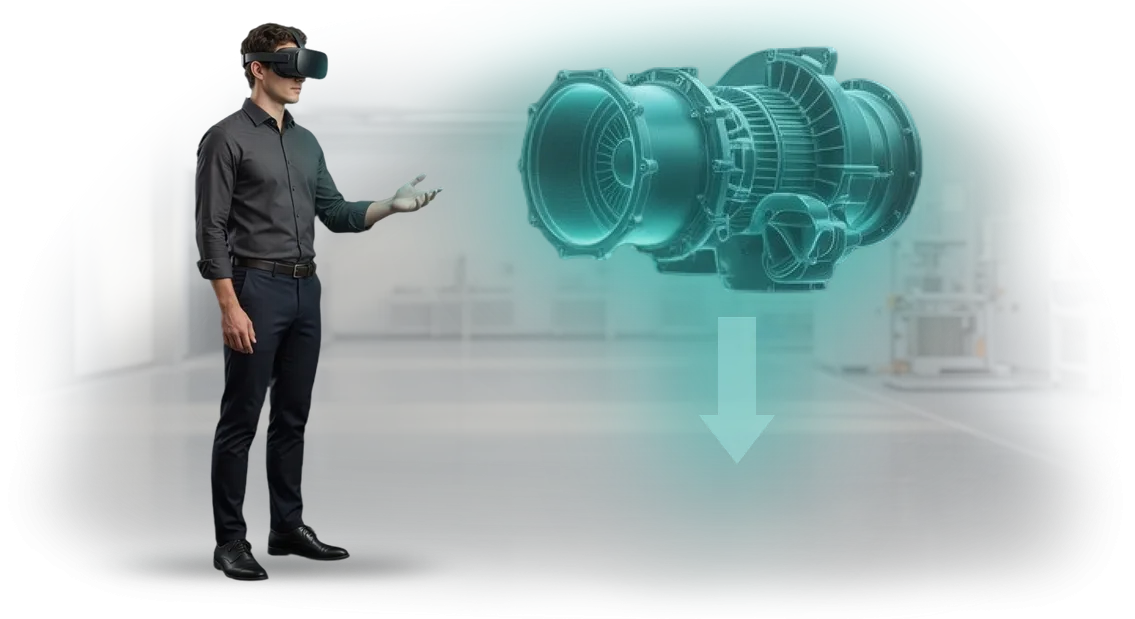
VR simulators for hepatobiliary surgery — reduce risks and accelerate surgeon training
In hepatobiliary surgery, the price of a mistake is especially high: damage to the bile duct or a major blood vessel can cost patients their health, and clinics their reputation and substantial costs.
At the same time, traditional surgeon training is built on practice in the operating room, where every action already carries risk. Young specialists learn on real patients, while experienced surgeons rarely encounter unusual anatomical variations at the right moment.
That is why surgeon training turns into a lengthy process that is difficult to accelerate without losing quality.
VR training solves this problem: a simulator for surgeons allows practicing interventions in a completely safe environment, mimicking real hepatobiliary scenarios.
The surgeon sees three-dimensional anatomy with precise placement of ducts and vessels, practices dissection, clipping, and other key steps before they happen in the operating room.
Scenarios can be repeated an unlimited number of times, errors can be analyzed, and movements can be refined to automaticity.
For the clinic, this means lower surgical risks: fewer complications, fewer repeat interventions, and fewer insurance claims.
For the department head, it is an opportunity to objectively assess each surgeon’s readiness for independent work, without relying only on length of service and number of assisted operations.
And for the surgeon personally, it is confidence in their actions in the most complex anatomical situations, up to rare variants found in only a few percent of cases.
VR training does not replace operating room practice, but it makes it significantly more effective. The surgeon enters the real operating room already with practiced skills and an understanding of the entire sequence of the intervention.
This shortens the adaptation time for young specialists and allows them to move faster to independent operations. Training takes place without stress, without time pressure, and without any risk to the patient.
We develop simulators for the tasks of a specific clinic: we take real operation protocols, adapt anatomical models to the specifics of your practice, and integrate a system for assessing the surgeon’s actions.
As a result, you get a tool that systematically reduces surgical risks and accelerates surgeon training — from the first day of use in the educational process.
What you get from implementing VR training in a clinic
Benefit: Safe practice of complex interventions
The surgeon gets the opportunity to repeatedly practice the stages of hepatobiliary operations in a virtual environment where a mistake does not cost the patient their health.
The simulator reproduces anatomical features, allowing manual skills to be refined to automaticity before working in the operating room.
Each session is recorded, and the doctor sees progress in time, precision of movements, and number of errors — a clear picture of growing mastery.
Benefit: Training without a patient and without stress
The virtual scenario replaces practice on real patients, on which complex stages were previously learned. This reduces the load on surgeons and staff and eliminates the risk of complications from insufficient experience.
Young specialists can calmly try different tactics, while experienced ones can refresh rare techniques without disrupting their work schedule.
Benefit: A unified standard for the whole team
The clinic receives a tool that levels the training level of its staff. The same scenario can be practiced again and again, so every surgeon acts according to a proven methodology.
For management, this means predictable quality of operations and fewer differences in approaches between departments and shifts.
Benefit: Control and personnel development for management
For clinic administration, VR training is measurable indicators: how many hours were practiced, which skills were developed, and who is ready for independent practice. Such analytics helps to plan workload, identify growth areas, and make evidence-based staffing decisions.
In addition, the digital format frees senior surgeons from constant supervision of every step of junior colleagues.
VR simulator formats: choose the right one for your task
Surgeon training is not just the transfer of theory, but the practice of precise movements and decisions in conditions close to a real operation. It is one thing to study anatomy, and quite another to react in time to bleeding or duct damage. That is why we do not offer one universal simulator, but select a format for your training goal.
If the task is to quickly introduce residents to topography, one option is needed. If you need to practice a new method with experienced surgeons, a completely different one is needed. Below are typical formats we deliver and what task each one addresses.
| VR simulator format | For whom | What it gives the client |
|---|---|---|
| Anatomical atlas | Students, residents | Visual study of the spatial structure of organs without dissection, faster basic training |
| Practice of a single stage | Surgeons mastering a specific skill | Repeated practice of one movement without risk to the patient, bringing technique to automaticity |
| Full operation scenario | Experienced specialists, new technique | Training of action sequence, timing, and confidence before the first real operation |
| Complication scenario | Advanced surgeons, certification | Safe training for rare situations and objective assessment of actions with error analysis |
If you are not sure which format is suitable, we will discuss your task and propose the optimal simulator. This is non-binding.
Stages of developing a VR simulator for surgery
The development of a VR simulator for hepatobiliary surgery is a structured process in which medical expertise, training methodology, and technical implementation work as a single mechanism.
Below are the stages your project goes through, from the initial brief to launch and real use in surgeon training.
-
Brief and immersion into working specifics. We discuss training goals, the level of surgeon training, specific types of operations, and scenarios that need to be practiced.
We agree on skill assessment criteria — what we consider a successful intervention, which errors to record, and how to analyze them later.
-
Methodological development of scenarios. Together with expert surgeons, we describe the sequence of actions, possible complications, and decision points. We create training scenarios that reproduce a real operation, from access to the intervention area to the suturing stage. Here we also build in a system of hints and difficulty levels.
-
Prototype and approval of key parameters. We show a working prototype of the simulator: anatomy, instruments, interface, interaction logic. You see how the solution looks and works before full development, and you make edits on detail, realism, and usability. This stage removes the risk of rework at later stages.
-
Full development of the VR application. Based on the approved prototype, we create a full version: models of anatomical structures, tissue physics, instrument dynamics, and response to user actions.
We work on professional equipment — this guarantees stable and smooth operation of the simulator on your headsets.
-
Testing with the target audience. We involve surgeons and residents who go through training scenarios in conditions close to real ones. We collect feedback, refine the simulator, and verify that success metrics truly reflect the level of skills. In this way, we achieve objectivity of assessment.
-
Implementation and launch. We install the simulator on the clinic’s or training center’s equipment, set up workstations, and train teachers and instructors.
We hand over methodological materials and instructions — the team can start using the solution immediately, without a long adaptation period.
-
Evaluation of effectiveness and development. After launch, we analyze how the simulator affects the speed of skill acquisition, the number of errors, and the confidence of surgeons. Based on this data, we update scenarios, add new cases, and adjust complexity to your tasks.
What is included in the VR simulator delivery: complete package
When you order a VR simulator, it is important to understand in advance what is included in the delivery package. We form it as a turnkey solution — from equipment to license and technical support. You will not have to buy or configure anything yourself. Here is the complete package:
- VR equipment: professional virtual reality kits, already configured for your scenario. Nothing needs to be selected or purchased separately.
- Software license: the official right to use the simulator on the required number of workstations, without hidden payments or annual renewals.
- Scenarios and anatomical models for hepatobiliary surgery: the trainee practices interventions on the liver, biliary tract, and pancreas in a realistic environment.
- Integration with your training system: staff progress, scores, and training times are recorded automatically, without manual tracking.
- Methodological materials for teachers: ready-made lesson plans and recommendations on how to integrate the simulator into the existing surgeon training program.
- Installation and launch: our specialists connect the equipment at your site or configure the server remotely — you do not need to find a contractor.
- Support and updates: consultations, bug fixes, and scenario development throughout the entire period of simulator use.
As a result, you receive a simulator that can be launched immediately after installation. All components are aligned with each other, and the team stays in touch to ensure training runs without interruptions.
Case study: how a VR simulator for hepatobiliary surgery accelerated surgeon training
Surgeon training in hepatobiliary surgery is one of the most complex tasks in medicine. Each operation requires jewel-like precision, and a mistake can cost a patient their life.
Practicing on real operations is unacceptable, and classic simulators and cadaveric material do not provide the necessary depth of immersion and do not allow the scenario to be repeated many times.
How we solved the problem
For the medical center Hepaton, we developed a VR simulator that fully reproduces the course of a surgical intervention. The surgeon works with a three-dimensional model of organs — the gallbladder and liver — repeating all stages, from tissue dissection to anastomosis placement.
The system evaluates the precision of movements and depth of impact in real time and shows a detailed error analysis.
Results after six months
After implementation, we recorded measurable changes. The average training period for residents was reduced from 18 to 9 weeks — twice as fast. The number of repeated attempts on the simulator tripled: doctors got the opportunity to practice without risk to patients.
The key result — the number of errors at the anastomosis stage decreased by 40%. This directly affected the clinic’s surgical workload: it began accepting 15% more elective patients, and mentors freed up time for other tasks.
Development on our own visualization platform showed a stable result and is now being scaled to other surgical areas.
For the client, this means lower staff training costs, shorter training time, and greater surgical safety, which directly affects patient trust and the clinic’s reputation.
Frequently asked questions about implementing VR training in surgery
Heads of surgical departments and training centers usually ask before ordering how to implement VR in hepatobiliary surgery, how difficult it is for staff, and who provides support. We answer directly so that you can evaluate the process before starting the project.
How does VR training integrate into the training of hepatobiliary surgeons?
The simulator complements the existing program, not replaces it. The scenarios repeat the key stages of interventions: access to the bile ducts, resection, and bleeding control. The surgeon practices actions to automaticity and then transfers the skill to the operating room.
Is it too difficult for staff?
The controls are built on natural movements of the hands and instruments, so mastering them takes from one training session. We conduct instruction for teachers and provide on-call support for staff — personnel do not need to understand technical details.
Who is responsible for equipment and technical support?
We select professional equipment for the clinic’s tasks, configure it, and guarantee stable operation for the entire period of use. If failures occur, our specialist resolves the issue remotely or, if necessary, visits the site.
How to measure the training result?
The system collects objective indicators: completion time, precision of movements, and number of errors at each stage. You see the progress of each surgeon and adjust the training program if necessary.
How to choose a VR simulator for your clinic’s tasks?
Choosing a VR simulator for hepatobiliary surgery starts not with technical specifications, but with training questions. What exactly skills should surgeons practice? Which operation scenarios are most common in your practice?
What is more important to you: practicing standard interventions or rare complications? The answers to these questions determine which simulator format suits you: short modular exercises, a full operation scenario, or simulation of complex anatomical variations.
Pay attention to how the simulator evaluates the surgeon’s actions. A good option provides objective feedback: time, precision of movements, sequence of steps, and number of errors. This allows the teacher to see the progress of each resident and adjust the program.
It is also important that the simulator can be easily integrated into the existing training process — for example, used for preparation before a real operation or for regular practice.
Another criterion is support. The simulator you receive should evolve with your clinic: scenario updates, adding new cases, technical support, and teacher training. Clarify how quickly changes are made and who is responsible for the result of implementation.
We work on professional equipment, but the main thing is not the hardware, but the methodological development and adaptation to your tasks.
If you are in doubt about the choice, invite us for a consultation: tell us about your training program, the number of surgeons, and types of operations.
We will show how a VR simulator can address your specific needs and offer an option that gives a measurable result — surgeon confidence and patient safety.
Ready to discuss a VR simulator for your surgeons? Leave a request
Surgery is a field where the price of a mistake is especially high, and every hour of practice affects the confidence of the specialist.
A VR simulator allows practicing complex scenarios of hepatobiliary operations without risk to patients, but the decisive step is discussing your specific task.
We work remotely across the CIS, and we have more than 10 years of experience in interactive solutions for business.
At the consultation, we will analyze how VR training fits into your clinic’s educational process, which surgeons will benefit first, and how to measure the effectiveness of the training.
What you get after submitting a request
- A personal consultation with a specialized expert — we will discuss your tasks and answer questions about implementing VR training.
- A preliminary analysis of your operation scenario and proposals for the simulator format — from realism to level of detail.
- An estimate of development time and a project budget reference — without unexpected surprises in the process.
- A demonstration of our previous projects in medicine and training — you will see what a working solution looks like.
- A step-by-step pilot implementation plan — what is needed from you, what from us, and how simulator testing with your surgeons will go.
- Answers to questions about integration with your training system and post-launch support.
Leave a request now — we will help you make surgeon training safe, visual, and effective. We will discuss the project and show that a VR simulator pays off through reduced risks and growth in team qualifications.