

Cardiac surgeons learn on real patients — and that is a risk
Training cardiac surgeons has traditionally been built on live patients: a young specialist assists, then performs increasingly complex stages under a mentor's supervision. Each such operation is a clinical risk for a specific person and a reputational risk for the clinic. A mistake on a real heart is costly, and correcting it in the moment is nearly impossible.
Dummies and plastic models do not solve the problem. They provide basic motor skills, but they do not reproduce the anatomy of a specific patient, tissue response, or the behavior of a vessel under load.
The doctor goes into a real operation without ever having encountered what awaits them on the table.
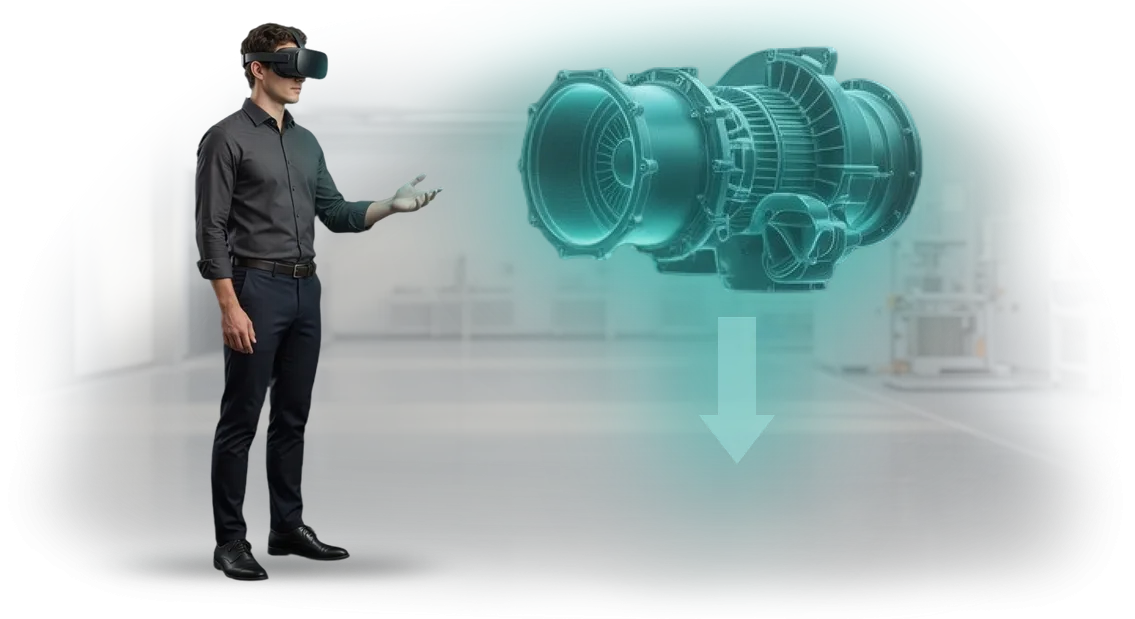
A VR simulator for cardiac surgery closes this gap. The surgeon goes through a simulation of operations in an environment close to reality: the same stages, the same sequence of actions, the same cost of error — only without a patient. Practice continues until a confident result, not until the first successful attempt.
For a clinic manager, this removes several tasks at once. Cardiac surgeon training stops depending on the flow of "suitable" patients and the operating room schedule — you can train at any time and for as long as needed.
Young specialists reach independent work faster, while experienced ones maintain their form ahead of rare and complex interventions.
Surgical simulation also provides an objective picture: you can see where the doctor slows down, which stages they skip, how many times they return to the same action.
The mentor gets not a subjective "seems to be coping," but clear dynamics — and decides who can already be allowed to work with a patient and who needs more time.
The risks of training on patients do not disappear completely, but they stop being the primary way to gain skill. First — the simulator, then — the operating room.
We build such simulators for a specific specialization and specific operations of the clinic, not abstract "courses about VR."
What a clinic gains from a VR simulator
A VR simulator for cardiac surgery is not a replacement for the operating room, but a way to get a resident to it prepared.
The head of the clinic gets a manageable process: complex interventions are practiced in a virtual environment where a mistake does not cost the patient their health, nor the clinic its reputation and a review.
Instead of learning on a living heart under a mentor's supervision, the resident builds motor skills and a sequence of actions in advance — and arrives in the operating room with an already formed skill.
Reducing complications here is a direct economic effect. A complication means rehospitalization, an additional bed, the burden on intensive care, and a reputational trace.
When a surgeon has practiced a scenario dozens of times before their first independent intervention, the share of technical errors falls, and along with it the cost and duration of treatment.
Credentialing residents accelerates without lowering the bar.
The training program becomes reproducible: everyone goes through the same scenarios, and the mentor sees an objective picture of readiness rather than a subjective "seems to be coping." This takes part of the load off experienced surgeons — they step in where their experience is truly needed, not at every basic stage.
Training without risk to the patient ceases to be a compromise between safety and practice.
The clinic gets a predictable pipeline for training personnel: new specialists reach independent work faster, and the quality of care remains a manageable metric rather than a matter of luck.
VR training formats for department tasks
The same simulator addresses different department tasks in different ways: sometimes you need to quickly onboard a young surgeon, sometimes you need to fine-tune the interaction of the entire team, and sometimes you need to confirm clearance to perform surgeries.
That is why we do not sell a "boxed product" but assemble a format for your goal: from individual skill practice to team scenarios for the entire operating room.
| Format | For whom | What it gives the clinic |
|---|---|---|
| Individual simulator | An individual surgeon, interventional cardiologist | Developing motor skills and sequence of actions without risk to the patient, repeating complex stages to the point of automaticity |
| Team scenarios | The team: surgeon, assistant, anesthesiologist, nurse | Coordination in emergency situations, a unified protocol of actions, fewer discrepancies in the real operating room |
| Course with a mentor | Young specialists, residents | Controlled immersion under the supervision of an experienced physician, debriefing of errors in a safe environment |
| Surgeon certification | Department, HR service | Objective assessment of clearance to perform surgeries, transparent criteria, tracking of progress for each employee |
How to choose a format for your department
An individual simulator and team scenarios solve different tasks: the first accelerates the growth of a specific specialist, the second reduces the number of failures when working as a team. In practice, departments take both — first skill practice, then joint run-throughs.
Surgeon certification is built on top of any of the formats: we define the criteria by which the simulator evaluates actions in advance, and you get a clear picture of clearance.
A course with a mentor is convenient when you need to introduce new people to your protocols rather than to abstract scenarios.
The formats combine and scale: you start with one team, then add scenarios and employees as they become ready. Let's discuss your department's task — we will come back with an assessment and a plan for which set of formats will address it fastest.
How the project works: from brief to launch in the department
The process is structured so that you understand what stage the project is at and what will be required from you.
We guide the client from the first meeting to the moment when training is already underway in the department, and we take on the entire technical part — all that's left for you is expertise and acceptance of the result.
- Brief and training goals. We discuss the task: who we are training, which skills and mistakes are critical, and how we will know that the training has worked. The output is a shared understanding of the result, not an abstract "make us some VR."
- Plan and scenarios. Our engineers, together with your expert physicians, describe the clinical scenarios: what the employee does, which actions are considered correct, and where mistakes most often occur. You approve the scenarios before development begins — revisions at this stage are free and quick.
- Developing the simulator. We build the virtual environment and refine the realism of actions and feedback. We show intermediate versions so that you can see progress and provide clarifications in time.
- Testing with physicians. A pilot group goes through the simulator, we collect feedback on usability and accuracy, and we refine it. This eliminates surprises before launch in the department.
- Implementation at the clinic. We help deploy the training on your equipment, train instructors, and prepare methodological materials for employees.
- Launch and support. After the start, we provide ongoing support: we update scenarios for new methodologies, monitor stability, and answer your team's questions.
Each stage ends with a clear result and your approval — you are not paying for a "black box." This order allows us to meet deadlines and deliver a simulator that truly integrates into the department's training process.
What is included in the delivery
The customer receives not a "simulator file," but a ready-to-use educational framework that can be launched in the clinic and defended before management.
The delivery includes everything needed for the first cohort of residents and for your team of instructors to continue working independently.
- VR cardiac surgery simulator — working scenarios for key interventions: access, stages of the operation, typical complications. The trainee goes through them at their own pace, and the system records every action.
- Methodological materials — training program, breakdown of stages, criteria for correct and erroneous actions. The instructor does not need to rewrite the course for the new format.
- Instructor training — our specialists guide your teachers through the simulator and show how to conduct a class, analyze mistakes, and support a group.
- Assessment regulations — transparent admission criteria: what counts as a completed stage, which mistakes are critical, and how the final grade is formed.
- Dashboard for management — a summary by group: who has completed the module, where mistakes occur most often, and how long the training took.
- Technical support and updates — support after launch, refinement of scenarios for new methodologies, and adjustment of assessment criteria.
- Transfer of rights and documentation — the simulator remains yours, and so do the operating and administration instructions.
This package covers the entire cycle: train, assess, and admit to practice. You do not need to assemble contractors for individual pieces — methodology, technology, and assessment come as a single solution.
The final scope of delivery is fixed during the task discussion stage: it depends on the number of scenarios, the size of the group, and how resident admission is currently organized at your institution. Describe your task — we will get back to you with an estimate and a plan.
Case study: how a VR simulator reduced the number of complications
We worked with a cardiac surgery center where young specialists took a long time to reach independent operations: clearance dragged on for months, and every first operation carried increased risk.
The leadership of the department wanted to shorten the path from trainee to confident surgeon without exposing patients to unnecessary danger. We built a VR simulator that trains exactly those manipulations where complications most often occur.
What changed after implementation
The key metric is the share of complications at the stage of the first independent interventions.
Over the period of working with the simulator, it dropped by roughly a third: surgeons came to the operating table with already-trained motor skills and an understanding of the sequence of actions.
The second result is the speed of clearance: the time to the first independent operation was cut almost in half, because the skill was confirmed not only on live patients but also on the simulator.
The third effect is the confidence of the specialists themselves. According to surveys, fear of complex cases dropped noticeably, and the number of requests for a prompt from more experienced colleagues during surgery decreased.
For a manager, this means more predictable operating room utilization and fewer unplanned situations.
Why it worked
We did not rewrite the training program but embedded the simulator into the existing preparation process — as a mandatory stage before clearance.
The scenarios are based on the center's real clinical cases, so the training immediately answered the questions that arise in the operating room.
We work on professional equipment, which provides a stable result and a predictable response of the simulator to the surgeon's actions.
Separately, I would like to mention КардиоЦентр: after the first training cohort, they came back to us to expand the scenarios to related areas. A repeat order is the best indicator that the training metrics turned out to be not reporting figures but real practical value.
How to choose the right format for the department's tasks?
You should start not from the technology, but from the tasks the department faces.
If the goal is to allow residents to perform independent interventions, that calls for one format; if the goal is to practice rare complications or prepare the team for certification, that calls for another.
That is why we always begin selecting a training format by analyzing the department's profile: which procedures are performed most often, where difficulties most often arise, and whom needs to be brought to which level of clearance.
The staff's level of training is the second reference point. A novice needs a simulator with hints and step-by-step guidance, while an experienced surgeon needs scenarios with complications and time limits.
Mixing these groups in one scenario makes no sense: some will get bored, others won't have time to master the basics. We help categorize staff by levels and select a separate trajectory for each.
The third reference point is certification goals. If clearance needs to be objectively confirmed, recording the result matters: how many attempts, what mistakes, and what outcome the employee reached.
Then vr simulator cardiac surgery becomes not entertainment but a working assessment tool — and the department head sees the picture across the department, not isolated impressions.
In practice, the choice comes down to three questions: whom we are training, in exactly what, and how we will know the goal has been achieved. The answers determine whether it will be a short module for a single skill or a full course with several scenarios.
We work through these questions together with you and propose a format that addresses the task, not one that simply looks good.
If you are unsure between options — describe the department's tasks and the residents' level, and we will come back with an assessment and a plan: which format will fit, what will be included in the first stage, and what the result will look like.
Common concerns before ordering a VR simulator
Concerns before ordering are usually the same: "what if the equipment breaks down," "how do we change scenarios when protocols are updated," "will we have to keep a dedicated specialist on staff." These are normal questions from a manager who is responsible for the result, not for the hardware. Let's go through each one.
What if the equipment breaks down
The reliability of a VR simulator is built in at the design stage: we select proven headsets and sensors suited to the conditions of a real clinic or training center, not "the trendiest ones." Every kit comes with a warranty, and during repair or replacement we offer a loaner set — training doesn't stop.
How to update scenarios
Cardiac surgery changes: new techniques emerge, protocols get updated. That's why we build scenarios in a modular way — editing one stage of an operation doesn't break the others.
You send us the changes, we implement them and deliver the update, and your instructors don't have to relearn everything from scratch.
Do you need a dedicated specialist
No. We train your methodologists and instructors to work with the simulator and provide a clear manual. Starting a session, selecting a scenario, exporting results for each employee — all of this is done by your own team, without an in-house programmer.
What if we need modifications six months after launch?
We stay in touch after the project is delivered too: equipment support and scenario updates are part of the work, not a one-time service. Describe what has changed in the training process, and we'll come back with an estimate and a modification plan.
How realistic is the simulator for cardiac surgery?
We build scenarios together with your surgeons and methodologists: real stages of the operation, typical complications, error analysis. The doctor practices the sequence of actions and responses to non-standard situations before encountering them with a patient.
Let's discuss your task and come back with a plan
Ordering a VR simulator for cardiac surgery is not buying a "box" but launching an educational product that must fit into your specialist training program.
That is why we start with a substantive conversation: which operations your surgeons practice, where time is currently lost, and which mistakes are most expensive to learn from.
Based on the discussion, you receive an implementation plan with stages, timelines, and areas of responsibility — without vague wording.
From there, the work follows a clear route: developing scenarios based on your real clinical cases, assembling the simulator, training your instructors, and handing over the regulations.
We do not disappear after delivery — post-launch support includes updating scenarios, adjusting difficulty, and assistance when your protocols change.
What you get after ordering:
- An implementation plan with stages, timelines, and result checkpoints
- Training scenarios built around your operations and typical mistakes
- A simulator ready for use in your training classroom or on site
- Regulations and instructions for instructors and program coordinators
- Training for your team: how to run classes and assess progress
- Post-launch support: updates, refinements, and answers to questions
- Completion reporting — you can see who practiced the skill and how
Describe your task: which operations are the priority, how many specialists you train, and in what timeframe you want to launch. We will come back with an estimate and a plan — specific, with stages and a result at each one.