

Catheterization Training: Why Employees Lose the Skill
Catheterization training in a clinic almost always hits the same wall: an employee's catheterization skill lasts exactly as long as they perform the procedure regularly.
As soon as a nurse or doctor moves to another department, goes on vacation, or changes jobs, the precision of their movements drops — and along with it, the number of catheterization errors grows.
The department head sees this not in medical staff training reports, but in patient complaints, repeat procedures, and the workload on mentors.
The second side of the problem is the cost and accessibility of practice.
Traditional catheterization training requires a live patient or expensive consumables, which means every repetition of the procedure runs into limitations: a queue for practice, risk to the patient, the impossibility of practicing a rare scenario.
At the same time, the mentor evaluates "by eye" — there is no objective criterion that would show exactly where an employee loses confidence and how many attempts they need to reach a stable result.
The third pain point is turnover. Every new employee has to go through the same path again, and mentors spend hours repeating basic actions instead of analyzing complex cases.
As a result, medical staff training turns into a permanent expense item with no clear return: it is unclear who is truly ready for independent work and who has simply sat through the required hours.
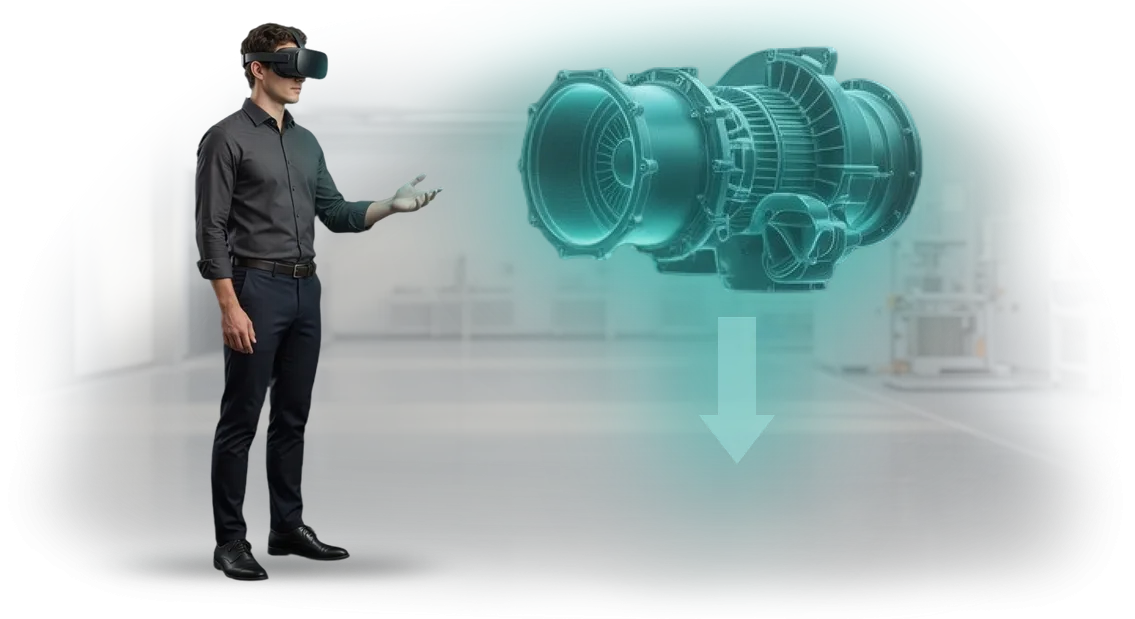
We solve this with a virtual simulator, where an employee practices catheterization as many times as needed, without risk to the patient and without consuming materials.
The system records every action and shows an objective picture: where the employee makes mistakes, which step they skip, how many attempts are needed to achieve confident catheterization skill.
The manager receives not an attendance mark, but a measurable result — and understands who can be put on independent work and who should be sent back for another cycle.
What a clinic gains from a VR simulator
Fewer complications through practiced technique
A doctor who picks up an instrument on a live patient for the first time makes mistakes for objective reasons — there aren't enough repetitions.
A VR simulator for a clinic provides those repetitions in advance: an employee goes through dozens of scenarios before their first real intervention.
As a result, the share of complications related to access technique decreases, rather than those related to the complexity of the case itself.
Objective skill assessment instead of "I think he's ready"
A mentor assesses a resident by subjective impression — this is slow and not always fair. The simulator records every step: accuracy of entry, time, number of extra movements, precision of tissue handling.
A supervisor sees the progress of each employee and understands who can already be allowed to work with patients and who still needs more practice.
Mentors are freed from routine
An experienced doctor spends hours explaining basic movements and supervising first attempts. A safe learning environment removes this burden: an employee practices the basic level independently, and the mentor gets involved only when analyzing complex scenarios. The time of an expensive specialist goes to what truly requires their qualifications.
A mistake costs nothing
In a virtual environment there is no risk to the patient, no consumables, and no consequences for the department's reputation. An employee can make mistakes as many times as needed for confident skill — and comes to the patient already with practiced technique.
Repeatability and a single standard
The simulator reproduces the same situation for all employees — catheterization training stops depending on who exactly was the mentor on shift. A new doctor in the department reaches the single level of technique accepted at the clinic, rather than "whatever came out."
VR Catheterization Training Formats for the Task
The format of catheterization training is chosen not by how "fancy" it is, but by where and how your employees learn.
Some practice the skill one-on-one with a simulator during their free hours, some need a group debrief in a classroom, and some need an on-site program for branches. Below are four working scenarios that we assemble for the task.
| Format | For whom | What it gives the client |
|---|---|---|
| Individual simulator | Doctors and nurses practicing the skill independently | Each employee trains at their own pace, without risk to the patient and without burdening a mentor |
| Group VR class | Departments and training centers where teamwork matters | The instructor leads a session for a group at once, sees each person's progress, and reviews common mistakes |
| Mobile kit | A network of clinics and branches where it is difficult to gather everyone in one place | Training comes to the site — no need to stop the department's work or pay for travel |
| Integration into the training system | Companies with their own base of courses and assessments | Simulator results feed into overall reporting: you can see who passed, who fell behind, and who is ready to be cleared |
How to choose a format for the task
If the skill is critical and requires many repetitions, start with an individual simulator: the employee returns to the exercise as many times as needed until the movement becomes automatic.
For mass training at a single location, a group VR class is more cost-effective: one instructor covers an entire shift in a single session.
When there are many sites and gathering people in one place is expensive and time-consuming, a mobile kit works — catheterization training comes to the employees on its own.
And if you already have a training and assessment system, we connect the simulator to it so that results don't get lost in separate reports.
One simulator — different scenarios
The formats are not mutually exclusive: the same program can be deployed in a classroom, on-site, and on personal devices. We assemble it so that scenarios become more complex as the employee grows — from first attempts to an exam situation with a complication.
Let's discuss your task — we'll advise which format will deliver results faster and with less hassle for the department.
How the project unfolds: from brief to launch
We run the project transparently: at every stage, the client understands what is happening, why, and when they will get the result. Below is the path from the first conversation to a working VR classroom where nurses and doctors practice catheterization without risk to patients.
- Brief and learning objectives. We discuss the task: whom we are training, which skills are critical, how many employees need to be trained, and how you will know that the training worked. We capture the expected result in clear metrics — the share of successful attempts, reduction in errors, the speed at which a newcomer reaches independent work.
- Plan and scenarios. Our instructional designers, together with your expert doctors, write out the clinical scenarios: anatomy, sequence of actions, typical mistakes, passing criteria. You approve the content before assembly begins — edits on paper are cheaper and faster than in a finished simulator.
- Building the simulator. Engineers build the virtual environment, the instruments, and the feedback: hints, error analysis, scoring for each step. We show you interim versions — you see progress instead of waiting blindly for the final result.
- Pilot training. We launch the simulator with a small group of employees. We watch how they go through the scenarios, where they stumble, what is unclear. Based on the pilot results, we refine the delivery and difficulty to match your team's real level.
- Launching the VR classroom. We roll out the training to the required number of workstations, train your instructors, and hand over the methodological materials and rules for conducting sessions. From there, you run the training yourselves — without our ongoing support.
- Support. We stay in touch: we update scenarios for new protocols, help with non-standard situations, and monitor stable operation. The simulator does not become outdated along with a paper manual.
What this gives the client
You get not a "box" but a working training process with clear timelines and accountable people. The pilot removes the main risk — investing in a simulator that the team will not accept.
And support after launch means the methodology lives and evolves along with your requirements instead of sitting on a shelf.
What is included in the delivery
The delivery is not a "file with a simulator" but a ready-to-use educational product that can be launched without us. You receive scenarios, the simulator itself, methodological materials for instructors, training for your instructors, and reporting for each employee. Below is exactly what is included in the package and why you need it.
- Training scenarios. A set of clinical situations on catheterization — from basic technique to complications and non-standard cases. We coordinate the scenarios with your methodologists so that the order and emphasis match your internal protocol.
- VR simulator. A workstation where an employee practices the manipulation with their hands: they see the anatomy, the instruments, and the reaction to each action. A mistake can be repeated and corrected without risk to the patient.
- Methodological materials. The course program, assessment criteria, analysis of typical mistakes, and recommendations for integrating into your curriculum. The instructor does not need to figure out how to explain this.
- Instructor training. We train your instructors: how to conduct a lesson, review results, and support an employee. After that, you conduct the training yourselves, without our support at every step.
- Reporting. Clear reports for each employee and group: who passed, how many attempts it took, where mistakes repeat. Management sees the learning picture, not just the fact that "a lesson was conducted."
- Implementation and support. We help launch the simulator at your site, answer questions during the adaptation period, and make adjustments if the protocol changes.
Such a package covers the task entirely: employees train on realistic scenarios, instructors understand how to run it, and management gets a measurable result. Let's discuss your task — we will come back with an estimate and a delivery plan for your flow of learners.
Case Study: How a Clinic Reduced Complications
Client's Challenge
A clinic approached us where young specialists were starting independent work with catheterization after a standard training course on mannequins.
The problem was not theory — the doctors knew the sequence of actions, but in real conditions they got lost: they lacked practice to the point of automaticity, and every mistake on a live patient meant a complication, a repeat procedure, and stress for the entire shift.
The department head wanted to reduce the number of failed first attempts and accelerate newcomers' progress to a confident level.
What We Did
We built a VR simulator where an employee performs the procedure under conditions close to real ones: different anatomy types, time limits, feedback on every movement.
Training was structured as a series of attempts with increasing difficulty — from a calm mode to scenarios with complications.
Each employee's progress is visible to the supervisor: where they get stuck, how many attempts it takes to reach a confident skill, which mistakes repeat.
Implementation Results
- The share of successful attempts grew from 61% to 92% over the training period.
- Time to a confident independent skill was cut almost in half.
- The number of complications during newcomers' first procedures decreased more than threefold.
- Repeat procedures due to failed access became less frequent — less strain on the shift and fewer consumables.
The clinic separately noted the effect for mentors: instead of constant supervision at the patient's bedside, they see objective training metrics and step in only where needed.
Six months after launch, the department expanded the simulator to related procedures and returned to us for the next version — the best indicator that the result proved workable.
How to choose the right format for the task?
Choosing a format starts not with technology, but with answering a simple question: what skill should an employee have after training.
If the task is to practice a sequence of actions hands-on, one type of simulator is needed; if the goal is to teach decision-making in a non-standard situation, another is needed.
That is why we first break down your task: who is learning, what they already know, where they most often make mistakes, and how you will know that the training worked.
Next, we look at the conditions. How many people need to be trained, how often the roster changes, whether it is possible to free them from shifts during the session, and who will conduct the training inside the clinic.
This determines whether we create a short scenario for a single skill or a full course with several difficulty levels and repeated attempts.
Separately, we discuss how to integrate the simulator into your processes: self-paced completion, sessions with a mentor, or preparation before being cleared for independent work.
The format is selected for the clinic's task, not the other way around — we do not offer a "universal solution," because universal tasks do not exist.
If you are unsure where to start, that is normal. Describe the task and constraints, and we will come back with an estimate and a plan: what scope makes sense at the start, what can be added later, and how to measure the result.
It is often wiser to begin with one scenario, see the return, and expand it based on actual results than to order a large course right away.
Common doubts before ordering
Doubts before ordering a VR simulator are usually the same: "what if it breaks — who will fix it", "will we have to keep our own specialist", "when will it pay off" and "will we be able to later expand training to other departments".
These are normal questions from a manager who is responsible for the result, not for the hardware. Let's go through each one in order.
What if the equipment fails
VR kits are a consumable resource, like any medical instrument, and we account for this in advance. The delivery includes a spare headset pool, and equipment support follows a schedule: diagnostics, replacement of failed components, scenario updates.
The customer gets a predictable maintenance schedule instead of emergencies like "everything went down before certification".
Do you need your own specialist
No. The simulator is launched by a methodologist or a senior nurse after a short training — the interface is designed for people without a technical background. We take on scenario setup, adding new clinical cases and updating content when protocols change. Your employee focuses on training, not on maintaining the system.
How quickly does it pay off and scale
Savings come from eliminating consumables on live mannequins, freeing up mentors' time and reducing the number of errors during real procedures.
One simulator covers the flow of residents and nurses without limiting the number of attempts — each one practices catheterization as many times as needed until the skill is confident.
After that, scenarios scale to other procedures and departments without replacing equipment: catheterization training becomes the first module, not a one-off project.
What if we have no experience with VR — will we be left alone with the system?
No. We support the launch: we help with the first group of trainees, set up scenarios according to your protocols and stay in touch for equipment support. The customer does not need VR experience — only an understanding of which skills you want your employees to achieve.
Can we start with one procedure and expand later?
Yes, this is the most common scenario. First we launch catheterization training at one site, look at the results and employee engagement, and then add new modules and move the practice to other departments. Scaling training does not require rebuilding the system — scenarios and kits are added.
Let's discuss the task and come back with a plan
To discuss the task, you don't need a ready-made requirements document — it's enough to tell us how catheterization training currently works for you: who is allowed to perform the procedure, how long preparation takes, and where difficulties most often arise.
We'll ask clarifying questions, work out which skills are critical specifically for your department, and propose a simulator format for that task. No template "one-size-fits-all" solutions — the scenario is built around your protocol and your category of employees.
After the review, you receive an implementation plan: stages, timelines, areas of responsibility, and clear criteria by which you will evaluate the result.
The project estimate comes together with the plan — with no hidden line items and no "we'll clarify as we go." If the task allows for a quick start, we'll propose a pilot with one group of employees: you'll see how a trainee goes through the scenario, how errors are worked through, and what the reporting shows, before scaling to the entire staff.
- Review of the current training process and weak points
- Simulator scenario tailored to your protocol and employee categories
- Implementation plan with stages, timelines, and acceptance criteria
- Project estimate with a transparent scope of work
- Option for a pilot with one group before scaling
- Recommendations for integrating into the training and certification program
Describe the task in whatever form is convenient — as it is, without preparation. We'll come back with a plan, an estimate, and a pilot proposal so that you make your decision based on facts, not promises.