

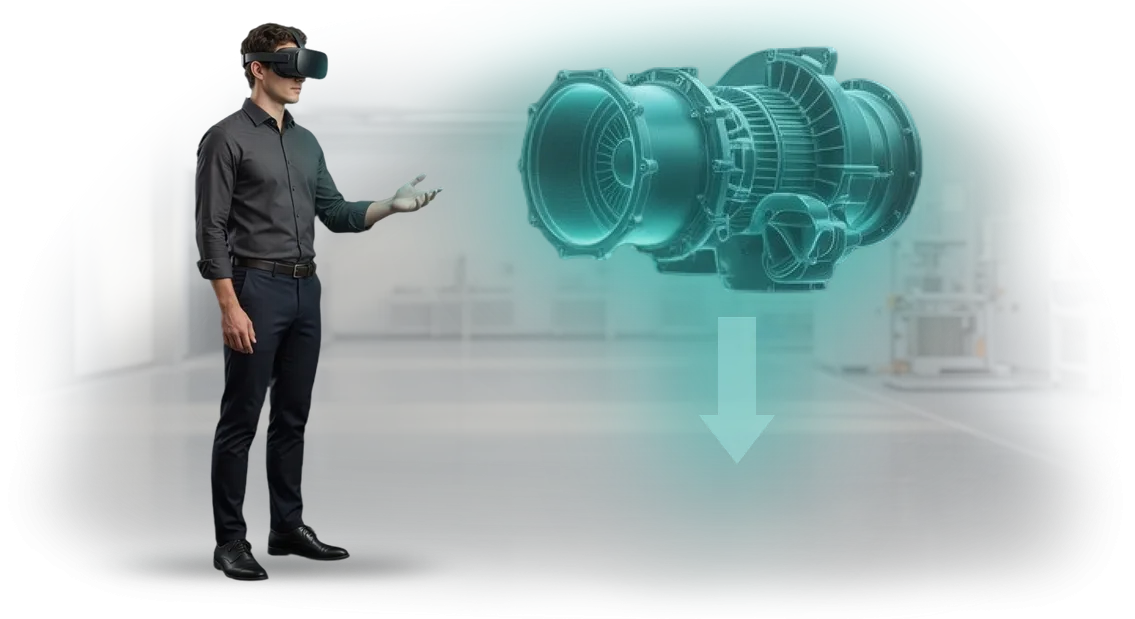
Surgeons Fear Microsurgery — It Costs the Clinic Money
Microsurgery is a field where the cost of error is at its maximum. Operating on blood vessels and nerves smaller than a millimeter is difficult even for an experienced doctor, which is why many surgeons internally avoid such procedures.
The fear of surgery does not arise from nowhere: the doctor has no room for maneuver, and the slightest hand tremor is a risk for the patient. As a result, the clinic loses service lines that could bring profit and status.
A department head notices this through indirect signs: patients go to other clinics, surgeons prefer simple cases, complex operations get postponed. Every postponed operation is lost revenue and a hit to patient trust.
A mistake on a real patient costs even more: reputational damage, legal risks, idle operating room time. Moreover, the problem is not the doctors' qualifications, but the fact that there is nowhere to safely build experience — this cannot be solved by simply hiring a specialist.
A VR simulator changes this logic.
It is an environment where a surgeon trains microsurgery without a patient and without the fear of making a mistake: the virtual operating field replicates a real scenario, and a complex technique can be practiced dozens of times until the movement becomes confident.
Training microsurgery in this format requires neither an operating room, nor consumables, nor risk to a human being. The department head sees the progress of each doctor and understands who is truly ready for a complex procedure.
our team has been designing VR trainers for medical clinics for over ten years. Our solutions reduce surgical risks, accelerate surgeon training, and restore confidence in complex cases.
This is not an experiment but a working tool: scenarios are adapted to a clinic's specific profile — from practicing individual techniques to the full sequence of an operation. Surgeon training becomes systematic rather than left to chance.
What a VR Trainer Will Give the Clinic and Its Patients
A VR trainer for microsurgery is the opportunity to refine movements that require jewel-like precision without risk to the patient.
A surgeon can repeat a complex stage of an operation dozens of times, bring it to automaticity, and enter the real operating room with complete confidence in every movement.
For the clinic, this means predictable results: fewer errors caused by the "human factor," consistently high quality of operations.
And for patients — peace of mind: they understand that their health is entrusted to a specialist who regularly trains on the most modern simulators rather than "learning on living people."
Surgeon Confidence — Patient Safety
Microsurgery does not forgive haste or hesitation: working with vessels one millimeter in diameter requires perfect coordination and steady hands.
A VR trainer makes it possible to model the most complex scenarios — from emergency bleeding to atypical anatomy — and find the right solution in a safe environment.
Each such training session builds muscle memory. When a surgeon in a real operation acts almost intuitively, the duration of the procedure decreases, invasiveness is reduced, and the patient's recovery accelerates. These are the indicators that directly affect the clinic's reputation and patient loyalty.
A Clinic Reputation That Works for You
A modern clinic competes not only on price but also on the level of expertise. Implementing VR training is a signal to the market: your team invests in surgeon mastery and patient safety.
This is a strong argument in negotiations with partners and insurance companies, as well as a reason for patients to choose your clinic.
Stories of successful operations and accounts of surgeons undergoing regular simulator training work well in marketing.
Patients remember clinics that care about quality and recommend them to acquaintances — this is a free acquisition channel that pays back the investment in training.
Microsurgery Training Formats for Clinic Needs
Every clinic trains its surgeons differently: some need a fast cycle for residents, others need retraining for an experienced team, and still others need regular skill maintenance for a new technique.
A universal "boxed" solution does not work here: the starting points for background, time, and goals are too different. That is why we have assembled three VR microsurgery training formats — from a short course to full clinic support.
Below is a table of formats so you can immediately map them to your task. All of them are built on real clinical scenarios, not abstract theory.
| Format | For Whom | What It Gives the Clinic |
|---|---|---|
| Basic Microsurgery Course | Residents, interns, surgeons without microsurgery experience | Fast entry into practice: mastering work with magnification, instruments, and suture material on virtual models. Reduces the risk of errors on the first real operations. |
| Custom Program for a Specific Technique | Experienced team, adoption of a new technique or equipment | Practicing specific stages of an operation according to your protocol. Shortens retraining time and standardizes the actions of all team members. |
| Full Clinic Support | A department or several surgical teams | Ongoing skill maintenance, progress assessment, scenario updates for new cases. Improves predictability of results and supports mentoring within the team. |
Any format begins with an audit of your needs: we look at which skills need to be covered, within what time frame, and how many people will be trained.
Then we propose a program that fits into the work schedule and requires no technical preparation from surgeons — the entire interface is adapted for a doctor, not an engineer.
Such training pays off not only through the quality of preparation but also through speed. A virtual microsurgery trainer allows repeating a complex stage of an operation an unlimited number of times without consuming materials and without risk to the patient.
This is especially important for practicing rare or emergency situations that in ordinary practice occur only every few months.
How We Will Build Training for Your Surgeons
We do not take a standard scenario or "stretch" a generic product over your needs. Each training program is assembled for a specific clinic: for your surgical profile, equipment, and level of surgeon training.
That is why the entire process is broken down into clear stages — you always see what is happening, what you get as a result, and when training can be launched.
-
Brief and Audit — we discuss your task: which operation or skill needs practice, who will be trained, how many surgeons and with what experience. We define success criteria — what a doctor should be able to do after training.
-
Scenario and Methodology Development — together with your leading surgeons, we work out the clinical scenario: operation stages, typical errors, complex cases. At this stage, we build in realism and educational value.
-
Simulator Creation — we model the operating environment, instruments, and tissues. We use professional equipment and refined development tools, but for you the main thing is something else: a realistic image, correct physics of actions, and clear feedback to the surgeon.
-
Testing with Doctors — your specialists test the pilot version. We collect feedback, refine the mechanics, interface, and scenario. We bring it to a state where training produces measurable progress.
-
Clinic Implementation — we install the system, connect the equipment, and conduct briefings for administrators and instructors. We configure it to fit your educational program and schedule.
-
Post-Launch Support — we monitor system stability, update scenarios as your needs change, and help with the onboarding of new staff. You are not left alone with the product — we are right there.
Thanks to this process, everything is clear and manageable. You know the timelines, checkpoints, and the final result in advance — ready-made training that integrates into the clinic's work and gives surgeons safe practice without risk to patients.
What Is Included in the VR Trainer Delivery
When purchasing a VR trainer, it is easy to get carried away with the "hardware" and miss the main thing: a training process that is ready to use. We put together a turnkey package — from virtual scenarios to instructor support.
All you need to do is assign a group and start practicing skills from the first day after installation.
The delivery includes everything needed for full-fledged microsurgery training without any modifications:
- Ready-made VR scenarios — step-by-step situations from basic maneuvers to complex surgical stages, with the ability to propose your own clinical cases.
- Methodological materials for instructors — lesson structure, assessment criteria, checkpoints. The instructor does not need to develop a program from scratch, and students do not need to adapt to "raw" content.
- Results tracking system — automatic reports for each employee: progress, mistakes made, time taken on completed techniques. Suitable for both certification and internal assessment.
- Instructional guides and quick-reference materials for users — short hints so the first launch takes no more than a couple of minutes and does not cut into training time.
- Adaptation to your equipment — we align the system with your headsets and workstations so there are no compatibility surprises.
- Technical support for the entire period of use — available on request: scenario updates, bug fixes, instructor consultations. This is insurance that the trainer will not "die" a month after delivery.
The assembled package saves months of developing your own program and eliminates situations where "we bought it, but nobody knows how to use it." You get a working training tool that does not require coordinating with multiple contractors — everything is already inside a single delivery.
Case Study: How a Clinic Trained Surgeons in 3 Weeks
The surgical profile requires jewel-like precision: the cost of error in microsurgery is the patient's health and the clinic's reputation. Beginners need months to move from theory to confident action, and mentors spend hours on individual sessions.
Training on real patients or animals is expensive and risky, so the clinic was looking for a way to speed up preparation without losing quality.
our team developed a VR trainer that reproduces real microsurgery workflows: from basic instrument movements to complex stages of operations. Surgeons get the opportunity to train in a safe environment where a mistake has no consequences but is well remembered. The program is designed so that within 3 weeks an employee brings key skills to a stable level.
The main result was a 40% reduction in errors during standard stages of operations.
In the group that completed the training, the number of successfully performed procedures increased: fewer complications, more confident actions by young surgeons, and a faster transition to independent work. The head of the training center noted that previously this effect took months to achieve.
The clinic received not just trained specialists but a repeatable training program. Now every new surgeon can be put through the same scenarios without relying on the experience of a particular mentor.
This reduces onboarding time and makes team quality predictable — an important argument for accreditation and patient trust.
After the launch, the clinic ordered two additional trainer modules: one for practicing emergency situations and one for working with new equipment.
Such a repeat order is the best confirmation that VR training works not as a one-off initiative but as a permanent tool for staff development.
Frequently Asked Questions About Implementing VR Training
Implementing VR training in medical practice is not buying a "box with a program" but restructuring the training process.
That is why managers have reasonable questions: will the department's work stall, how long will adaptation take, and what happens if the result does not meet expectations. We have collected answers to the main concerns of clients — no technical complexity, just the essentials.
Is it difficult to integrate a VR trainer into an existing training schedule?
Implementation does not require stopping work or a complete overhaul of programs. We adapt the course to your curriculum: the trainer can be used as a separate continuing education module or as a mandatory stage before allowing access to patient practice.
Our team handles installation, configuration, and initial instructor training — you get a ready-made tool, not a headache.
How long does it take to launch training?
The first pilot module launches within a few weeks after signing the contract. A full course with multiple scenarios is implemented in stages — this allows doctors to get used to the format without interrupting their main work. This usually takes one to two months.
At each stage, we collect feedback from your surgeons and refine the scenario so that it solves exactly your tasks.
What guarantees are there that training will produce results and not just be a "checkbox"?
You get measurable results. We show the progress of each surgeon: movement precision, decision-making speed, and the number of errors at each stage of the course.
If after the pilot launch you do not see clear progress in your staff — we will refine the trainer until the result satisfies you. Over the years, we have completed more than a hundred specialist training projects, and this procedure is already well proven.
Won't doctors refuse to use the new equipment?
Resistance arises when the technology is inconvenient or unclear. We solve this in two ways: we make the trainer as intuitive as possible and conduct a short introductory session for each surgeon.
Experience shows that already after the first session, specialists see the benefit for themselves — the opportunity to safely practice a complex case without risk to the patient. This quickly changes attitudes toward the format.
Shall we discuss your scenario and implementation timeline? Ask us directly — we will respond within one business day.How to Choose a VR Training Format for Your Task?
Choosing a VR training format is not a question of "which trainer is newer" but a question of "what exactly should the program change." For microsurgery, the key things are sterile technique, speed of decision-making, and confidence in emergency situations.
It is precisely for these goals that we select a scenario, not the other way around: task first, then equipment and depth of immersion.
At our team, every project begins with a short audit: which operations most often cause difficulties, how many employees need training, and what budget is available.
Based on this, we propose three or four format options — from compact modules for practicing a single skill to a full course with analysis of complex clinical cases.
This is what an individual approach means: you get not a "boxed solution" but a program that doctors actually complete and use.
For example, if the task is to bring new surgeons up to speed faster, a short scenario focused on standard operation stages works well.
If the priority is to raise the mastery of an experienced team, we emphasize rare complications and non-standard situations that are difficult to practice in ordinary practice without risk to the patient.
Budget affects not the quality but the scale: you can start with one module and expand the program as results come in.
The main thing is that the VR training format is convenient for your staff and delivers measurable results — fewer errors, faster adaptation, stable technique. We help you choose the option that solves your task rather than selling the most expensive equipment.
We will send you example microsurgery scenarios and calculate an appropriate format for your budget and clinic schedule.
Ready to Improve Surgeon Skills Without Risk?
In surgery, the cost of error is the health and life of the patient. Even the most experienced surgeon experiences stress during a rare operation, and young specialists get too little practice before their first independent procedure.
A VR trainer solves this problem: you refine movements, bring them to automaticity, and learn to act in complex conditions without risk to patients. We help implement such training in your clinic or training center.
We take care of everything — from setting training goals to launch and support. During the consultation, you will learn how VR training fits into surgeons' work schedules, how many specialists can be trained simultaneously, and how to measure each person's progress.
No theory for its own sake — only practical scenarios that can be applied in operating rooms as early as tomorrow.
What you will get after the consultation:
- An assessment of the current surgeon training system and growth points in microsurgery
- A clear plan for implementing a VR trainer tailored to your department's needs
- A selection of scenarios: from basic motor skills to practicing multi-stage operations
- A calculation of equipment load and instructor time
- A pilot project option for quickly testing effectiveness
- Methodological and technical support after launch
Leave a training request — and within one business day we will contact you, answer your questions, and offer options that fit your team.
You will receive a consultation with no obligation and can assess how a VR trainer will improve surgeon qualifications and reduce risks in real operations. Take the first step — request a conversation with our specialist.