

Why Doesn't Classical Neurology Training Work?
Diagnosing neurological diseases is above all a practical skill, not theoretical knowledge. During a single appointment, a physician assesses dozens of symptoms, reflexes, and patient reactions, and every detail can change the diagnosis. Yet classical neurology training hardly trains these skills at all.
Lectures and seminars provide a foundation but do not build clinical thinking. The learner stays passive, information is forgotten within the first few weeks, and the neurologist's main tools — hands and attention — are not engaged at all.
The shortcomings of lectures are especially obvious in complex cases: they can be described in words, but the feeling of a "live" appointment cannot be conveyed.
Meanwhile, the cost of a mistake in real practice is high. A wrong diagnosis means a conflict with the patient, lost time, and a hit to the clinic's reputation — plus a young physician who is afraid to make independent decisions.
The clinic invests months in training, yet the specialist still encounters a complex case for the first time in the consulting room.
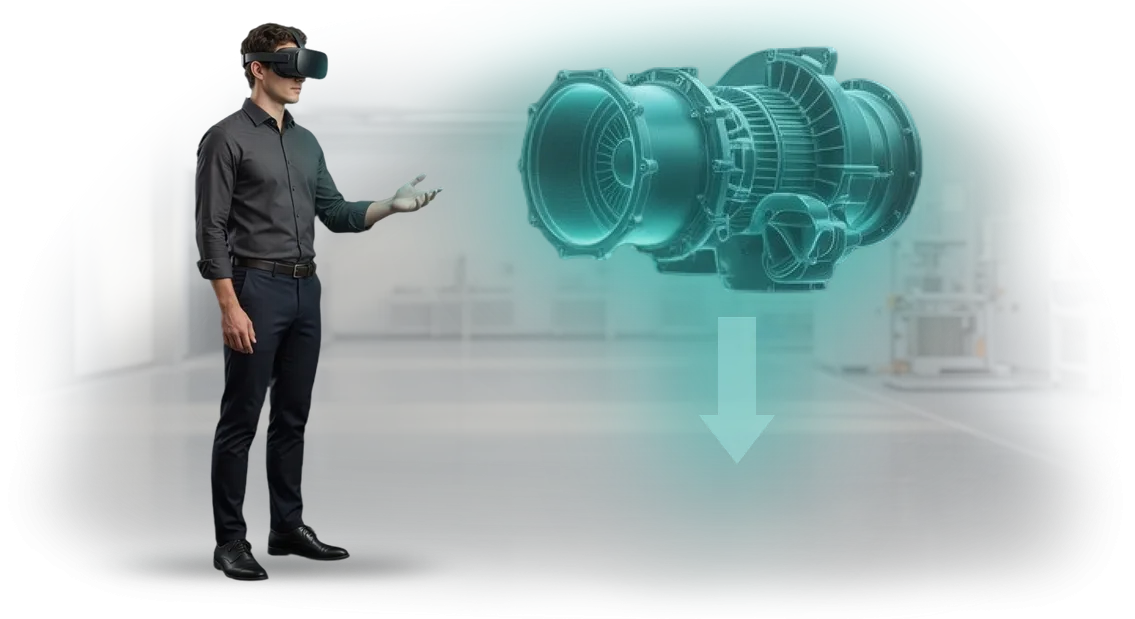
We meet this need: we develop VR simulators where a physician is immersed in realistic diagnosis of neurological diseases and can practice an appointment as many times as needed — at their own pace and without risk to patients.
Every action is recorded and analyzed, so the manager sees skill growth rather than just the fact that a lecture was attended.
For the clinic, this is a predictable outcome: faster onboarding of new staff, confident personnel, and fewer mistakes during appointments. Practice that used to take months and depend on luck now becomes a manageable neurology training process.
What Benefits Does a Clinic Get from VR Training?
Medical education always runs into a contradiction: physicians need to practice, but mistakes on real patients cost too much.
This is felt especially acutely in neurology — the diagnosis depends on the ability to notice subtle reflex asymmetry, interpret non-obvious symptoms, and make quick decisions in an unusual situation.
Clinics spend months preparing specialists, while young physicians are afraid to take on complex cases.
We meet this need — VR simulators allow practicing scenarios without risk to patients and with measurable benefits for the clinic. Written on behalf of our team — a team with 10 years of experience developing training solutions for business.
What the clinic gets
Patient safety and reputation. Physicians train on virtual cases, not live ones. This reduces the likelihood of mistakes during real appointments — which means fewer conflicts, higher patient trust, and peace of mind for clinic management.
Fast preparation without taking time off work. An employee completes a scenario in 20-30 minutes — no internship days, no mentor, and no time away from patient care. The clinic saves senior physicians' resources and keeps the department's schedule intact.
Measurable skill growth. The system records every action: how the physician conducts the examination, which reflexes they check, where they hesitate.
Based on the results, the clinic receives an objective report on growth areas — this replaces subjective "experienced or not" assessments with concrete progress metrics.
Diagnostic accuracy. The simulator trains attention to details that are easy to miss in the usual flow of appointments: reflex asymmetry, coordination nuances, reactions to specific tests.
The neurologist practices the algorithm to the point of automation — and diagnostic accuracy grows without risk to patients.
Resource savings and scaling
VR training works both for new employees and for upskilling the existing staff. A simulator developed once can be used across all branches, for residents, and in continuing education programs.
The clinic gets a systematic tool: onboarding time shrinks, the mentoring load decreases, and diagnostic quality stays consistently high.
VR and AR Training Formats for Neurology
In neurology, the cost of an error is high: an inaccurate diagnosis or an improperly conducted examination directly affects treatment and the clinic's reputation.
Classical lectures and video materials do not give physicians the opportunity to practice in a safe environment — they practice on patients or learn on the job.
VR and AR formats close this gap: an employee practices scenarios as many times as needed, and the clinic gets a predictable level of staff training.
We select the format based on the medical center's task — from initial training to regular skill checks. Below are the main scenarios already working in clinics.
| Format | Target audience | What it gives the clinic |
|---|---|---|
| VR simulator with a virtual patient | Neurologists, residents | Examination and diagnostic practice without risk to patients, fewer mistakes among beginning specialists |
| AR cues in the workflow | Nurses, treatment rooms | Real-time protocol control, fewer violations during procedures |
| Clinical case simulation | Physicians in continuing education courses | Quick skill checks in rare and non-standard situations, readiness for complex appointments |
| VR rehabilitation scenario | Rehabilitation medicine specialists | Patient interaction practice and unified patient management standards |
Each format integrates into the clinic's training system: it can work as a standalone module or as part of a program with reports for management.
All solutions run on professional VR equipment — this provides a stable image and user comfort, not test demos from the gaming industry.
After launch, you receive statistics for each employee: number of sessions, mistakes, and scenario completion time. With this data, it is easier to control training quality and develop staff based on evidence rather than impressions from one-off courses.
How VR Training Is Created: Project Stages
Any VR training project differs noticeably from typical development — the final result is evaluated not by the interface but by how employees apply their skills at work.
We structured the process so that at every stage you understand what is happening and what you will get as a result. Below are the stages a neurology project goes through, from the first conversation to regular use of the simulator.
-
Brief and task immersion. We study exactly which skills need to be practiced: diagnosis, actions in acute conditions, rehabilitation techniques. We gather information from your specialists and analyze real work situations.
-
Training scenario development. Together with your neurology experts, we write clinical cases, dialogues, and employee action algorithms. The scenario becomes the foundation of the simulator — it incorporates your protocols and work standards.
-
Scenario and prototype approval. We show what the virtual space will look like, what actions the employee performs, and what feedback looks like. You see the product before full development and can make changes without losing time.
-
VR simulator development. We build a virtual environment with realistic patients, instructions, and an assessment system. We use professional equipment and proven tools — this guarantees stable operation on any VR headsets you plan to use.
-
Focus group testing. Your future users complete the training, we collect their feedback and observe their actions. Based on this, we refine the logic, task difficulty, and interface.
-
Launch and integration into training. We set up access, connect the simulator to your training system, or run separate sessions. We prepare short instructions for employees and remind them of key scenarios.
-
Support and development. We provide technical support, update scenarios when protocols change, and add new training cases. You can contact us with revision requests at any time — we stay in touch.
What Is Included in the VR Complex Delivery for a Clinic
A VR complex for a clinic is not equipment — it is a ready-made solution that starts working from day one. We assemble it for the neurology department's tasks: from training modules to staff support, so physicians and nurses use the system instead of figuring it out.
The standard delivery includes:
- Neurology training scenarios — virtual patient situations: diagnosis, reflex assessment, post-stroke rehabilitation. Employees practice skills in a safe environment without risk to patients.
- Methodological materials and instructions — guides for working with the complex, action algorithms, recommendations for instructors. Staff gets up to speed quickly without lengthy training.
- Administrative panel — session management, class scheduling, and progress statistics for each employee. The manager sees who completed the training and how successfully.
- Staff training — we conduct a hands-on training session for the clinic team. Employees learn to launch scenarios, work with results, and integrate VR sessions into everyday practice.
- Technical support — consultations and assistance at every stage of work. If questions arise, you get an answer instead of looking for a solution on your own.
- Content updates — scenarios are expanded as clinical recommendations change, so training always stays relevant.
The key point: the clinic receives a working tool, not a set of components that need to be configured. Physicians save time on preparing classes, the administrator manages the process through the panel, and management sees objective training results.
Case Study: How a VR Simulator Cut Neurologist Onboarding Time by 4x
In neurology, the cost of a beginner's mistake is especially high. In the clinic that invited us, onboarding of new physicians took almost three months: a newcomer observed, then worked under supervision, and only then — independently.
Experienced neurologists spent a third of their time on mentoring, and the patient queue kept growing.
We proposed replacing passive observation with practice in a virtual environment. For the Center of Restorative Neurology, we developed a VR simulator: medical history collection, reflex checks, coordination assessment, diagnosis.
An employee trains on virtual patients and sees the consequences of mistakes without risk to real people.
Implementation results: onboarding time shrank by 4 times — from 12 weeks to 3 weeks. Errors in initial examinations dropped by 60%, and the mentoring load decreased threefold: mentors now handle only complex cases.
The clinic's chief physician commented on the result: "Previously, we invested months in every new specialist and worried about their first month of work. The VR simulator brought predictability: a physician starts seeing patients with polished examination protocols. We cut onboarding by four times and maintained the standard of care."
For the clinic, this directly affects the bottom line: less mentoring, a faster path to full patient load, and stable diagnostic quality. If your organization needs to reduce employee onboarding time — write to us, we will show a demo and calculate the result for your metrics.
Frequently Asked Questions and Concerns: Answers Before You Start
Before launching VR training, every manager has doubts: will the equipment break, how hard is it to integrate into current programs, and will you have to rework the workflow.
This is especially important in neurology, where the cost of an error is high and qualification requirements are strict. Below we answer the main questions — briefly and to the point.
What if the VR equipment breaks or fails?
Each kit is checked before launch and receives scheduled maintenance during use. If something goes wrong, we replace the device within a couple of business days — your employees will not be left without training. All equipment has a safety margin for intensive use in training groups.
Is it difficult to integrate a VR simulator into an existing training system?
VR is an addition, not a replacement for your processes. We set up the simulators to fit your schedule and methodology: we connect to your internal tracking system, assign exercises, and export results in the format you need. No extra load for instructors — they simply see completion statistics.
Does such training comply with medical standards and requirements?
The simulators are created with the participation of practicing neurologists and methodologists, and every exercise records objective metrics: accuracy of actions, reaction speed, number of mistakes. This data can be used for qualification control and internal reporting. The program adapts to your organization's regulations.
Doubts are normal, especially when it comes to investing in employees. To make sure VR training is right for you, we can run a demonstration and do a pilot launch on a small group.Order VR Training: We Will Calculate a Scenario for Your Task
Leave a request on the page or write to us in a messenger — within one business day we will contact you, clarify the task, and answer your questions. You will receive a cost calculation, demo access, and format recommendations.
We work transparently: you know the stages, timelines, and costs in advance. We will show what the launch will look like — from the first inquiry to the delivery of the finished course.
How the launch works
- Request and briefing: you describe the task, the number of employees, and the desired result.
- Expert consultation: we select the VR/AR format for your training goals, including neurology.
- Scenario design: we create a training narrative integrated into your preparation program.
- Cost and timeline calculation: we set the scope of work, resources, and stages.
- Demo access: we show a prototype on your device so you can assess usability before launch.
- Launch and support: we deliver the materials, train administrators, and stay in touch.
What you get after your request
- Cost calculation for VR training for your task with no hidden fees.
- Consultation on the format and scenario for your industry.
- Demo access to the prototype — you will see what the training looks like in action.
- Equipment recommendations for your hardware fleet.
- An implementation plan with stages, timelines, and a person responsible for each step.
- Fixed deadlines and guaranteed support after launch.
You can order VR training and calculate the cost as early as today. Leave a request — we will prepare a proposal with fixed timelines. Your employees will gain the experience they need, and you will get fewer mistakes and lower retraining costs.
How to Choose the Right VR Training Format for Your Tasks?
Choosing a VR training format is not a question of technology, but a question of tasks and budget. A universal solution does not exist: what is perfect for practicing complex medical procedures will be overkill for introductory instruction.
That is why at the start we always ask three questions: what exactly should employees learn, how many people need to be trained, and what result you expect a month after launch.
If your task is to refine rare or dangerous skills — for example, actions in neurological complications — a full-fledged VR simulator with a realistic scenario is justified.
It allows an employee to repeat the algorithm many times in a safe environment, bringing actions to the point of automation. In this case, the selection criterion is the depth of scenario detail and realism, not the number of screens or a "pretty picture."
When you need to familiarize the team with a new protocol or standard, a lightweight interactive format is enough: short 10-15 minute VR modules are faster to complete and do not require dedicated equipment. This solution covers mass training and saves the budget.
Here, the key criterion is speed of deployment and ease of use for employees with different levels of digital readiness.
We select the format based on a short audit: we analyze goals, the number of trainees, current equipment, and budget. As a result, you get a recommendation with the rationale — why this particular option was chosen and how it will affect training speed and skill quality. If the task can be solved more simply and cheaply, we honestly say so.
The bottom line is simple: the right format is the one that solves your task without overpaying. Describe your situation to us — and we will offer an option that fits your timeline and budget right away. This way you get a working training tool, not "VR for VR's sake."