

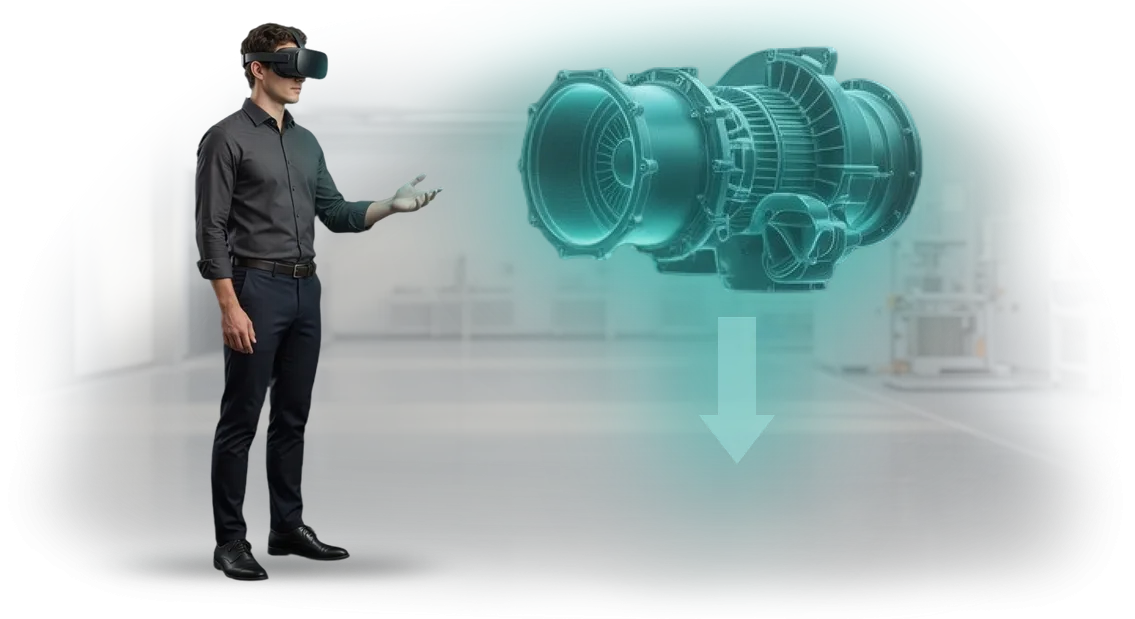
Plastic Surgery: How VR Training Reduces Surgical Risks
Plastic surgery is one of the few fields of medicine where an error is immediately visible and publicly discussed by the patient. A scar, asymmetry, or an unsuccessful shape is not only a medical risk but also a blow to the clinic's reputation.
Therefore, training a surgeon before a real operation is a matter not of pedagogy but of the financial stability of the business.
Classic training formats offer limited options: practicing on patients is undesirable, practicing on cadavers is expensive and not always available, and rare complications cannot be modeled at all.
VR training closes this gap: the surgeon repeats the intervention dozens of times, learns to act in non-standard situations, and feels more confident in the operating room.
The result for the clinic is lower surgical risks and fewer complications. The surgeon has already seen a complex scenario on the simulator, which means he makes informed decisions rather than acting at random.
Satisfied patients return on their own and bring friends — this works stronger than any advertising.
We develop VR simulators for specific techniques and protocols of the clinic: from aesthetic corrections to reconstructive interventions. Surgeons train on realistic scenarios, with detailed practice of complex stages and error analysis.
This is how precision in plastic surgery begins not in the operating room but in a safe virtual field, where the cost of a mistake is a couple of minutes of restarting, not the patient's health.
What Benefits Does a Clinic Get from VR Simulators in Training
VR simulators allow the clinic to train surgeons without risk to the patient.
Practicing complex scenarios of a plastic surgery operation in a virtual environment turns every training session into a safe rehearsal: the doctor brings movements to automation, and the clinic gets a predictable result.
This is especially important in plastic surgery, where the cost of a mistake is the patient's health and appearance, as well as the clinic's reputation.
Systematic VR training builds stable muscle memory and confidence in surgeons' actions. When skills are practiced to automaticity, the doctor is less distracted by technical details and focuses entirely on the patient.
The number of complications and repeat interventions decreases, and this directly affects patient satisfaction and their willingness to recommend the clinic to acquaintances.
For the clinic, this is also a manageable system of qualification growth. Management sees which scenarios have already been practiced and which ones require additional training.
Instead of “training for show,” a transparent development path appears for each surgeon — from basic techniques to complex reconstructive interventions.
Finally, the use of VR simulators becomes part of the clinic's image as a technology leader. Modern patients value a high safety standard and innovations.
The story that surgeons undergo training on virtual simulators strengthens trust in the brand and sets the clinic apart from competitors. This is not a costly experiment but an investment in quality that returns through an increased flow of patients.
VR Training Formats for Plastic Surgery: A Comparison
When a plastic surgery clinic has several operating tables and different skill levels among staff, one universal simulator does not solve all problems.
Someone needs to refine the technique of a specific operation, someone needs to practice team actions in an emergency situation, and new doctors need to quickly get up to speed with the clinic's standards.
Therefore, VR and AR training formats are better compared not by “coolness” but by what task each one covers.
| Format | For whom | What it gives the clinic |
|---|---|---|
| Individual VR simulator for an operation | Surgeons, residents | Practice of intervention stages without risk to the patient, increased confidence and speed |
| Scenario-based training with a virtual patient | Entire surgical team | Coordinated actions, readiness for complications, unified communication protocols |
| Immersive 360-lecture | New employees, all staff | Quick immersion in the clinic's techniques, uniform level of team knowledge |
| AR hints at the workplace | Assistants, junior medical staff | Control of checklists and preparation stages, fewer forgotten steps and errors |
The choice of format is directly related to operating load: if the clinic has a large flow of same-type interventions, an individual simulator pays off faster by reducing operation time.
If the quality of the whole team's work is more important, scenario trainings and AR hints give a systemic effect — from the admission department to the dressing room.
At the same time, the formats do not have to be chosen on an “either-or” basis. Some clinics combine individual VR simulators for surgeons with team scenarios for staff — this way training covers both technique and team interaction.
We help you choose a format that fits the clinic's real workload and budget, test it on a pilot group, and adapt the program to the specific operations you perform most often.
How VR Training Is Implemented in a Clinic
Implementing VR training in a plastic surgery clinic is a clear step-by-step process in which you control the result at each stage.
We do not “disappear for a month” after the contract but go through the journey together with your team — from the first briefing to launch and support.
-
Briefing and immersion in the clinic's tasks. We discuss which procedures need to be practiced, which skills of surgeons and medical staff should be improved, and which errors should be reduced.
We record training goals — for example, standardization of the operation technique or safety at every stage.
-
Scenario and methodology design. Together with your experts — leading surgeons or methodologists — we develop a training scenario: the sequence of actions, typical errors, and options for correcting them. The training becomes clinically accurate, not “just nice graphics.”
-
Approval of the plan and prototype. You see the logic of the future simulator before the main development begins: the scenario, interface, and key training points. You make edits — and only after your “yes” do we move to full implementation. This eliminates expensive rework at the final stage.
-
Development of the VR simulator. At this stage, we create training modules and debug them on professional equipment. You receive intermediate versions — you can track progress and get used to the training format in advance.
-
Testing with your specialists. We test the simulator on a real audience: surgeons and nurses go through the scenario, and we collect feedback on difficulty and realism. If any moments are inconvenient or raise questions, we refine them before launch.
-
Launch into regular operation. We integrate VR training into the clinic's schedule: set up user accounts, plan sessions, and train administrators. Your employees start training without disrupting their schedule — for 20–30 minutes a day.
-
Support and development. After the launch, we stay in touch: update scenarios, add new procedures, view completion statistics, and help increase engagement. You get not a one-time development but a tool that evolves together with the clinic.
The entire process is transparent: you always know what stage the project is at, what has already been done, and what will happen next. At every step you make decisions — and we are responsible for timelines and quality so that VR training works for the clinic's practical result.
What Is Included in the Delivery of a VR Solution for Surgeon Training
When a clinic orders a VR simulator, it is important to understand: you receive not just a program but a complete system for regular surgeon training. The delivery includes all components — from training scenarios to equipment and support. Nothing needs to be purchased additionally or configured by your IT team.
We have put together a turnkey package so that surgeons can start practicing skills in the first weeks. Here is what it includes:
- Training scenarios — virtual operating rooms for practicing plastic surgery techniques, including rare and complex cases. Each scenario can be adapted to your method.
- VR equipment — professional headsets, controllers, and workstations, fully configured and ready to use. The hardware is selected on the principle of “just turn it on and work.”
- Software — the simulator interface, a result tracking system, and content update licenses for the entire usage period.
- Integration with the clinic's training program — scenarios are embedded into the residents' training schedule and advanced training courses, with reports generated for each specialist.
- Training for your instructors and technical support — we transfer the skills of working with the simulator to your team, and then we support: consult, update scenarios, and, if necessary, quickly replace equipment.
Support is a separate item of the delivery, not an “option for later.” We are responsible for the stability of the system so that training is not interrupted by technical failures. You get a single point of contact: one request — and the issue is resolved.
This delivery format is convenient for the clinic because all costs are clear in advance, and launch does not require the involvement of your IT department. You only need to allocate a room and surgeons' time for training — we take care of the rest.
Result: How a VR Simulator Helped a Clinic Reduce Errors
One of our projects is the implementation of a VR simulator for practicing plastic surgery skills at a clinic.
The clinic faced a typical problem: young surgeons knew the theory well, but during their first independent operations they made mistakes in the sequence of actions and in technique.
Training on silicone models did not provide an objective assessment, and mentors could not attend every training session.
We developed a simulator that reproduces the key stages of a plastic surgery operation and reacts to every movement of the surgeon. The doctor trains in a virtual operating room, receives a detailed analysis of errors, and can repeat complex stages an unlimited number of times.
This is not a replacement for practice with a mentor but a safe intermediate step between theory and a real operation.
The clinic saw results within three months. Based on the results of a test group of 24 surgeons, the number of errors in performing basic stages decreased by 38%, and the average operation time decreased by 15 minutes.
The head of the department ordered an additional license for all new employees and included the simulator in the mandatory adaptation program.
Surgeon's Testimonial
“Previously, we noticed shortcomings only in the operating room. Now the surgeon himself sees his area of growth even before he picks up a scalpel.
The confidence of young specialists has grown, and the number of corrections during operations has noticeably decreased,” comments the head of the surgical department of the clinic.
This case shows that VR training gives a measurable result, not just a “wow effect.” We support the implementation, collect statistics, and help adapt the program to the tasks of a specific clinic.
Frequently Asked Questions from Clinics Before Launching VR Training
Before launching VR training in a plastic surgery clinic, managers ask the same questions: whether they will have to deal with complex technology, how quickly the staff will master the system, and what will happen if the equipment fails.
These concerns are understandable — VR looks more complicated than a familiar presentation. We answer the main ones so that you make a decision based on facts rather than fears.
Will the equipment break down and who maintains it?
We deliver the kit with a warranty and service support. If something fails, the contractor takes over maintenance: you simply continue working, and we handle the technical part. No repair hassles for your staff.
Will the staff be able to handle the VR interface?
The simulator is designed so that a doctor or nurse can start working after a short instruction. We train employees in one day and leave a reference guide. Mastering it takes no more time than getting familiar with a regular medical system.
How long does the launch take?
From the brief to the finished solution usually takes two to three weeks. We take on the scenario, rendering, configuration to your standards, and installation at the clinic. You only need to allocate employees to participate in the training.
How quickly will the effect appear?
VR training allows you to practice actions without risk to the patient and noticeably faster than classic trainings. The first results are visible after the first launch: staff remember the sequence of steps, and you save time on mentors.
Leave a Request — We Will Prepare a VR Training Plan for Your Clinic
Leave a request, and in the coming days your clinic will receive a concrete plan for implementing VR training. We do not send a “general commercial proposal”: we analyze your situation, training tasks, and offer a solution for surgery.
We have been working with medical clinics for more than 10 years: we know how to integrate simulators into doctors' schedules and achieve a sustainable skill before the first operations.
| Stage | What happens | What you get |
|---|---|---|
| Request | We discuss your task | Action plan without unnecessary introductory details |
| Brief | We record scenarios and skills | Technical specification for your clinic |
| Demo mockup | We show an example of a VR scenario on your case | Understanding of what the training will look like |
| Launch plan | We agree on stages and timelines | Calendar plan with dates and results |
Immediately after your inquiry, you receive:
- a personal VR training scheme for surgeons and medical staff;
- format options: from short modules to a full course with certification;
- evaluation metrics for skills control and reports to management;
- recommendations for the training schedule so as not to interfere with patient intake;
- a clear cost estimate with payment stages and guarantees.
The next steps take a minimum of time: request — short conversation — plan within a few working days. Start with a consultation — and you will see how VR training integrates into your clinic without chaos.
How to Choose the Right VR Simulator Format for Your Clinic's Task?
The choice of a VR simulator format begins not with technology but with your clinic's task. For plastic surgery, this may be practicing a specific operation, mastering a new technique, training with medical equipment, or practicing communication with a patient.
The format depends on the goal of the training: from a short 15-minute scenario to a full multi-session course with different scenes and difficulty levels.
Before proposing a solution, we answer four questions: who exactly needs to be trained — surgeons, mid-level medical staff, or the entire team; how many people will undergo training; whether the necessary VR equipment is already available; and how ready the employees are for the new format.
If the equipment has not been purchased yet, we will recommend the optimal kit for your tasks. If you need to train a large team, we will include a simple administration system that allows you to launch scenarios without developer involvement.
An important part of the choice is result evaluation. A good VR simulator not only imitates the procedure but records the doctor's actions: movement accuracy, completion time, and errors.
Based on this data, you can adjust the training program and improve the quality of staff work. We implement this on professional equipment and support the clinic at all stages — from scenario preparation to launch and result tracking.
If you are unsure which format is right for your clinic, we will help you decide: describe the task, and we will offer a suitable option with justification.
For an initial assessment, it is enough to answer a few questions — send a request, and we will send a short checklist that removes most of the uncertainty.