

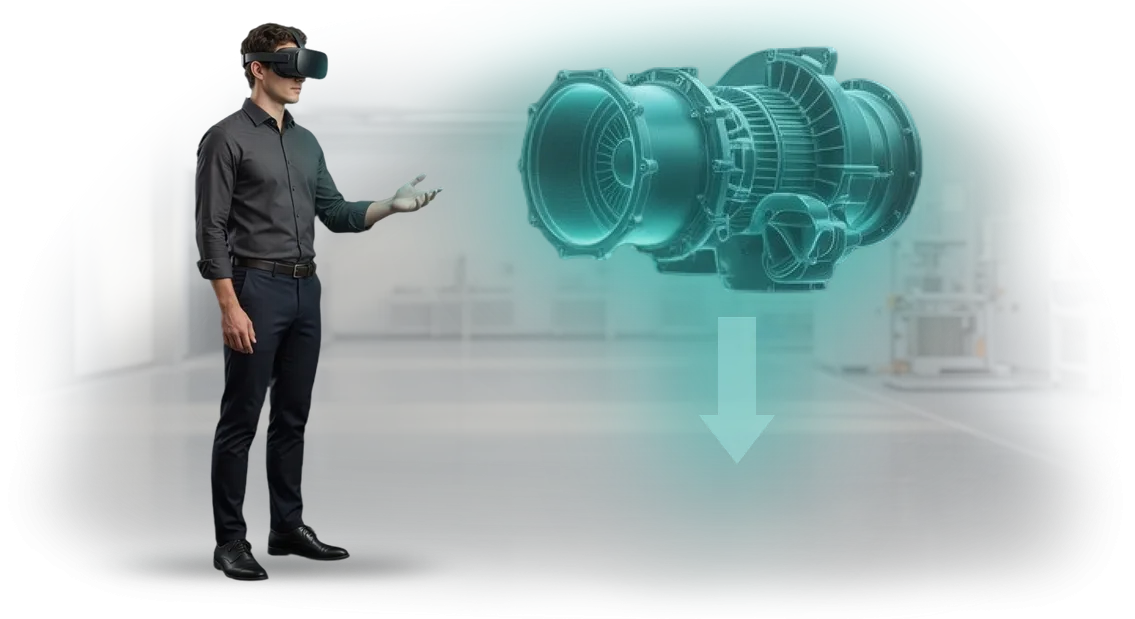
Why auto mechanics should be trained on VR simulators
Classic training for auto mechanics today runs into the same limitations: keeping a real car on site is expensive, a beginner's mistakes lead to real breakdowns, and one mentor physically cannot give time to everyone.
As a result, employees train for months, and their first independent work is still accompanied by fear and losses. VR staff training changes this logic — the simulator for auto mechanics moves practice into a safe digital environment where mistakes cost nothing.
The virtual auto repair shop simulator reproduces the real process of diagnostics and repair: from inspecting components to replacing parts.
A student can disassemble and reassemble a component dozens of times until the skill becomes automatic — without consuming spare parts, tools, or fuel.
Training becomes predictable: every mechanic goes through the same scenarios, and a manager sees an objective picture of readiness before the employee enters the workshop.
Implementing VR training pays off not only through lower material costs. It cuts the time for a beginner to reach independent work several times over — weeks of intensive practice are enough instead of months.
Moreover, the virtual simulator makes it possible to practice rare and complex cases: faults that occur once a quarter in real life become available to any trainee on any day.
This reduces mistakes in real work and increases the confidence of auto repair shop customers in the level of service.
We help businesses design and launch such a program turnkey: we analyze your typical tasks, create scenarios based on real regulations, and integrate simulators into the daily training process. You get a tool that works for team stability and quality of service.
What results VR training delivers in an auto repair shop
An auto repair shop loses money not on equipment but on employee mistakes and the time it takes to bring them up to speed. A beginner needs months to stop asking questions and work at a normal pace, and every diagnostic error means lost hours, spare parts, and reputation.
VR training removes this risk: the auto mechanic gains experience on the simulator before picking up a tool.
The result you will see in numbers is the speed of training. What used to take weeks now takes days or even hours: the employee does not wait for a mentor to become free or for the right car to appear.
He works through scenarios in the virtual workshop at a convenient pace, and the system immediately shows where he made a mistake and what needs to be corrected.
The second measurable result is fewer mistakes. In VR, you can model dozens of typical breakdowns and emergency situations that rarely occur in real life. The auto mechanic learns to recognize them at a glance and act according to an algorithm without causing defects.
The consequences: fewer reworks, fewer customer complaints, and a higher average check thanks to quality diagnostics.
Finally, safety. We can recreate dangerous scenarios — working with the fuel system, electrical wiring, heavy components — and teach employees to act safely, without the risk of injury or property damage. This reduces downtime, insurance risks, and occupational safety costs.
In essence, you get a predictable training outcome with clear metrics: faster preparation, fewer mistakes, safe work.
VR simulator formats for different business tasks
VR simulator staff training addresses different needs: one employee needs to be quickly brought up to speed, another needs to hone a complex skill without risking equipment.
There is no universal format, so at our teamwe select the type of simulator for a specific business goal — from the first introduction to a car to practicing emergency situations within a team.
The solution embeds into the existing training system and requires no technical preparation from the employee: it is enough to put on a headset and follow the prompts.
For auto mechanics, we develop turnkey simulators — with scenarios, assessment methodology, and post-launch support. This makes training measurable: you can see who is ready to work and who still needs practice.
Main VR simulator formats
| Format | For whom | What it gives the client |
|---|---|---|
| Interactive 3D car model | Beginners, students, during hiring | Quick study of component structure and operating principles without the risk of breaking something in a real car |
| Step-by-step diagnostic simulator | Experienced masters and mechanics | Practicing fault-finding algorithms, reducing mistakes in real work |
| Repair operation simulation | Experienced team | Training complex operations and non-standard repairs without service bay downtime |
| Multi-user scenario | The whole team | Practicing interaction and task allocation during complex repairs |
If you are not sure which format suits your task, we will run a short pilot on your scenario. For auto mechanics, a typical project is a turnkey simulator in 3-4 weeks, with clear criteria for evaluating results and adaptation to your equipment.
You receive a tool that immediately integrates into the training process and delivers measurable impact already in the first quarter.
How VR simulator development for auto mechanics works
So that you fully understand how we work, we’ll show the project’s path from the first conversation to the launch of training.
The stages of VR simulator development for auto mechanics have been refined across dozens of implementations — so every step is transparent, timelines are clear, and the result is predictable.
- Brief and immersion in the task. We discuss what skills need to be practiced: diagnostics, component repair, maintenance schedules, or working with equipment. We capture training goals, the number of employees, and the desired outcome.
- Development of the scenario and methodology. Together with your mechanic experts, we write out the scenario: situations, mistakes, prompts. This is the simulator specification where learning value is built, not just a pretty picture.
- Prototype creation. We assemble the key scene with basic interaction — you see how VR training will look and can make changes before full development starts.
- Full VR simulator implementation. Programmers and 3D artists build all the scenarios, interfaces, and the system for evaluating employee actions. This is the largest stage, but it is strictly time-bound.
- Testing and refinement. We test the simulator on real users, collect feedback, and bring it to stable operation. Here we make sure that even a beginner can start and complete the training.
- VR training launch. We install the equipment, configure the software platform, and train your administrators and instructors. Employees start training, and you receive the first results.
- Support and development. We consult along the way and update scenarios when technologies or regulations change. If new tasks arise, we expand the project without losing quality.
This format turns VR simulator development from a “black box” into a manageable project. You always know which stage the VR training launch is at, what has already been done, and what will happen in two weeks.
Most importantly, the final result becomes embedded in your business: employees gain practical experience without risk to equipment or customers.
What is included in the delivery package for a business simulator
When you order a VR simulator for auto mechanics, you get not just a program but a ready-made solution for employee training.
The delivery package includes all components — from the scenario to regular support — so you don’t need to dive into technical details or think about how to integrate the technology into your workflow.
- Training scenario tailored to your tasks. We analyze your mechanics’ real work situations: diagnostics, component repair, maintenance schedules, emergency breakdowns. We turn them into interactive tasks so employees practice hands-on without risking equipment or materials.
- Turnkey VR simulator development. We build the application, install it at workstations, configure it to your processes, and, if needed, integrate it with your accounting system. You receive a fully finished product, not a “raw” program that needs further work.
- Instruction sets for staff and instructors. Clear guides on how to run training, how to complete a scenario, and what to do in case of failures. This reduces the load on your specialists and allows training to be launched without external tech support at every step.
- Training reports. The built-in module collects statistics on each employee: time to complete, number of mistakes, action success rates. You can see who has already mastered the skill and who needs extra attention — and make personnel decisions based on facts.
- VR project support. We maintain the system, update content to reflect changes in technologies or work regulations, and refine scenarios on your request. The simulator does not become outdated and does not require a dedicated IT specialist on staff.
This package allows you to launch auto mechanic training in a couple of weeks and immediately get measurable results. At the same time, you pay only for the options that your business actually needs, and we are responsible for ensuring everything works stably.
Case study: how an auto repair chain cut training time
For the auto repair chain AvtoTechTsentr, we designed a VR simulator to train auto mechanics.
The challenge was typical for the industry: new employees came without practical experience, training took almost a month, and mistakes on real jobs were expensive — from rework to losing a customer.
At the same time, in-house mentors could not keep up with knowledge transfer: there were five beginners for every master.
Instead of classic briefings, we created an immersive scenario for practicing real operations: brake system diagnostics, oil changes, and work with electrical equipment.
In the virtual workshop, the employee works with their hands, trains the sequence of steps, and receives instant feedback — without risk to equipment or people. This is an example of what modern VR implementation in an auto repair shop looks like.
The results of auto mechanic training impressed even the chain’s owners. Training time dropped from three weeks to four days, and 92% of employees now pass the final test on the first attempt, compared with 60% before.
The number of errors in real jobs fell by almost a third, and the time for a beginner to start an independent shift was cut in half.
After the pilot, the chain ordered simulators for three more sites — the best proof of the simulator’s effectiveness for an auto repair business.
For us, this VR training implementation case confirms that a proper scenario and careful implementation turn the learning process into something manageable and predictable.
The simulator is now also used to upskill experienced mechanics — they learn new car models without interrupting their work.
How to choose a VR training format for your task?
Choosing a VR simulator starts not with technology but with the task — which auto mechanic skill needs to be developed. If an employee must learn fuel system diagnostics or component assembly in a limited time, the format will be one.
If the goal is to practice non-standard faults and action algorithms, it will be another. That’s why the first thing we clarify at a VR project consultation is: where in your service’s work do mistakes, lost time, or injuries most often occur? That is the starting point for choosing a training format.
The second criterion is the employee level. Beginners need step-by-step instructions with prompts and visual contact with key components, while experienced mechanics need a simulation with emergency and rare-fault scenarios to maintain their qualifications.
Determine what percentage of the team needs basic training and what percentage needs advanced training. Based on that, we will propose VR modules with different depth of immersion and scenario duration.
The third factor is the volume and regularity of training. For a one-time hiring course, a 15–20 minute simulator that validates knowledge before work on a real car is enough.
For ongoing retraining of the whole workshop, a series of modules with an assessment system and progress tracking for each mechanic works better.
Here we look at the number of employees, how often regulations are updated, and how you want to measure results: through fewer errors, faster work, or reduced material consumption.
The key principle is that there is no universal VR training for an auto repair shop. There are always several implementation options — from compact tablet scenarios to full immersion using professional headsets.
During our preliminary consultation, we ask 5–7 questions about your regulations, the complexity of operations, and the metrics you want. Then we give a recommendation: which simulator to choose, which scenario to launch first, and how quickly you can get a tangible effect. You don’t need to understand technology — just describe the problem, and we’ll handle the rest.
Addressing the fears: what if VR doesn't take root?
We understand why you have doubts: VR training seems expensive and complex, and the main fears are equipment breakdown, employee resistance, and long implementation. We have faced these questions dozens of times and developed solutions that address every objection.
Our experience with auto repair shops and manufacturing companies shows that VR simulators take root where support and motivation are thought through. That is why we build these mechanisms in from day one.
What if the VR equipment breaks down at the worst possible moment?
We know that equipment downtime means interrupted training and lost money. That is why we provide technical support for the entire period of simulator use: diagnostics, repair, replacement of components.
The contract specifies response times — you will never be left alone with a non-working system. The average resolution time is up to 24 hours.
What if employees don’t want to learn?
VR training is perceived as easier than regular courses — it’s an immersive game, not a lecture. Even inexperienced users get comfortable within 10–15 minutes. We also help launch ratings and competitions among employees.
Practice shows that after the first attempts, even skeptics become engaged — thanks to the visual nature and competitive effect.
Is it difficult to integrate a VR simulator into current processes?
We handle all technical matters: we configure the equipment, upload courses, and train your administrator. To launch, all you need is a regular office or a zone in the workshop. Integration with the shift schedule takes no more than a week.
You receive instructions and support at every stage — from the first demo to scaling to other employee groups.
How to start working on a simulator
Starting a VR simulator project for auto mechanics is easier than it seems: just leave a request for VR simulator development on the website. We will contact you at a convenient time, clarify your tasks, and offer a solution that fits your budget and deadlines.
Immediately after your inquiry, you will receive:
- A short brief — we will capture training goals, employee numbers, and requirements for the result.
- A preliminary training cost estimate — we will give you a budget range for the pilot project and full-scale launch.
- A selection of examples — we will show how VR simulators solve similar problems in auto repair shops and manufacturing.
- An honest timeline assessment — we will tell you how many days it will take to develop the pilot module, rather than saying “we’ll decide later.”
- A presentation of the pilot VR training project format — so you understand how it will look in your context.
- Integration recommendations — how to embed the simulator into your current training system without stopping work.
From there, we move along a short and transparent path. On a call, we discuss the details, choose one or two of the most common beginner mistakes — for example, diagnostics or brake system repair — and prepare the pilot.
After the pilot launches, you see how employees master skills in a safe environment, collect feedback, and only then decide on scaling. This lets you start a VR project with minimal risk and quickly get the first results.
A pilot project is the simplest way to test the effectiveness of VR training in practice. You get measurable metrics: speed of task completion, number of errors before and after training, employee reactions — and make a decision based on numbers, not promises.
If you still have questions — and questions remain, that’s normal — leave a request. We’ll show examples of simulators for auto mechanics, explain how development works, and offer a pilot for your task.
You can calculate the training cost or order a simulator for auto mechanics within one business day — start with a short message.