

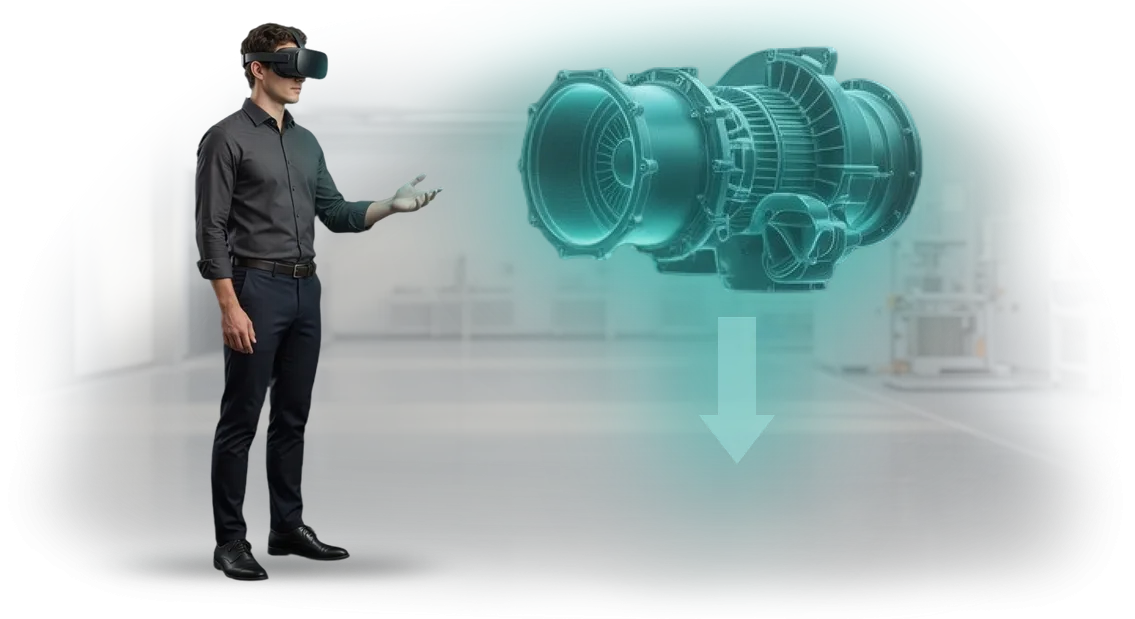
Dispatcher errors: how to prevent an accident?
An accident at a production facility or transport company often starts not with equipment failure but with human error. A dispatcher makes dozens of decisions per hour — one wrong action, a missed signal, or a delayed reaction leads to losses and risk to people.
Regular briefings don't prepare for stress: the theory is there, but at the critical moment the employee loses their composure.
That's why training dispatchers on virtual simulators is becoming the standard for those who want to prevent accidents rather than deal with the consequences.
Virtual training makes it possible to practice any scenario — from a standard shift to an emergency communication failure — without risk to real facilities.
A dispatcher simulator reproduces the workplace, interface, and colleague behavior, so the skill transfers to real work without quality loss. The employee learns to notice the first signs of an abnormal situation and act according to the algorithm. Accident prevention becomes a systematic process.
The main effect is a change in behavior at the critical moment. The company gets staff who don't panic but act according to a practiced scheme. Each scenario run is analyzed: you can see where the employee makes mistakes, and training is adjusted point by point.
This reduces the number of incidents caused by human error and cuts losses from downtime, fines, and equipment damage.
We model your workflows, risks, and emergency situations on professional VR equipment, based on your regulations. After the course, the dispatcher returns to their post with a ready-made action algorithm.
Training dispatchers: VR simulators and their advantages
For a dispatcher, the cost of a mistake is operational failures, financial losses, and risk to people. Traditional training comes down to lectures and tests that don't let you feel the real workload.
A VR simulator immerses the employee in a working environment where they train reactions and decisions — without consequences for production.
The main advantage is training staff without risk. In a virtual environment, any situation can be simulated: peak loads, emergency shutdowns, conflict calls. A mistake here doesn't lead to an accident but is remembered just as well as real experience.
At the same time, the company saves: there's no need to spend materials, stop equipment, or involve experienced mentors for every session.
VR simulators speed up training. The employee runs through the scenario repeatedly and drills the actions until they become automatic. The system objectively evaluates every decision — reaction time, sequence of operations, accuracy.
This makes it possible to quickly identify weak spots and build a program for a specific person rather than for the group as a whole.
Engagement is another benefit. Virtual reality holds attention completely: the person acts rather than listens. The material is absorbed faster and stays in memory longer, and the process itself doesn't feel like routine. This is especially important for young specialists who are used to an interactive format.
We develop such simulators on professional VR equipment that ensures stable operation at any scale — from five workstations to an entire branch. We'll calculate a scenario for your tasks and show how it works in practice.
VR and AR training formats for company needs
Each stage of working with personnel requires its own approach to training. A newcomer needs to safely master the basics and learn to act without mistakes in a stressful situation.
An experienced employee needs to hone skills and get used to emergency scenarios that are rarely encountered in real work. And for mass training, it's important to give dozens or hundreds of people an equally high level of preparation in a short time. There's no universal format here — so we help select one for a specific task.
In VR, the employee is fully immersed in a virtual environment where any working conditions and emergency situations can be simulated without risk to people or equipment.
AR supplements the real environment with hints and instructions right on the screen, which is convenient for training at active workstations.
The blended format combines both approaches and is most often used when you need to quickly train a large group of employees with different experience levels.
Format comparison: VR, AR, and blended learning
| Format | Who it suits | What it gives the client |
|---|---|---|
| VR simulators | Newcomers and employees who need to practice actions in complex and dangerous situations | Full immersion in the process without risk, repeated scenario runs until automatic, quick error analysis |
| AR instructions | Experienced employees working with real equipment | Hints and control of correct actions at the workplace, fewer errors when taking on a new task |
| Blended format | Mass training of employee groups with different skill levels | A common knowledge standard for everyone, flexible combination of theory and practice, instructor time savings |
A properly chosen format reduces training time and improves the quality of staff preparation. For example, for dispatchers who need to react quickly in emergency situations, we use VR simulators with realistic scenarios. For operators working with equipment — AR hints that help follow the regulations without errors.
We help you choose a format for your tasks and combine formats in one training program if needed. This covers the needs of newcomers, experienced employees, and mass groups without extra development costs.
How virtual simulator development works: 6 steps
Developing a virtual simulator for dispatchers is a process that's easy to control when broken down into clear stages. We've refined our workflow over the years: the client always knows what's happening at each step, what results they get, and where they can step in. No "black boxes" — only transparent stages, deadlines, and clear metrics.
-
Brief and task immersion. We gather requirements: which dispatcher operations need to be practiced, which mistakes are most common, which scenarios are critical for safety. We study your regulations and real working situations.
-
Scenario design. Together with your experts, we describe the training narrative: initial events, dispatcher actions, consequences, and decision options. The output is a scenario that you approve — and only then does production begin.
-
Prototype development. We model the key scene with basic graphics so you can "get a feel" for the logic and controls. This is the cheapest stage for changes: we adjust details before large resources are invested in rendering.
-
Full version production. We assemble all scenes, add professional graphics, sound, and interface. At this stage, you receive intermediate builds and see progress. Each version is checked against the scenario.
-
Testing with dispatchers. We launch the simulator on your employees, collect feedback and completion data. If something is inconvenient, slow, or illogical — we refine it before launch. The goal is to make training simple and useful.
-
Delivery and support. We install the system on your equipment, train administrators, and hand over instructions. After launch, we stay in touch: we update scenarios, help with technical support, and develop the simulator further.
The whole process usually takes 6–10 weeks depending on the number of scenarios. You can see the work status at any time, participate in the acceptance of each stage, and understand what you're paying for.
This approach eliminates surprises at the end and guarantees that the simulator actually teaches dispatchers rather than just "looking good".
What's included in VR training delivery for business
Here's what's included in VR training delivery for dispatchers. You get a complete package — from scenarios to training for your team. This is a turnkey solution that launches without involving technical specialists.
- Scenarios for your tasks. We study how dispatchers work and model the problem situations they face daily. The simulator trains exactly the skills your employees need.
- Interactive content. 3D models of the workplace, equipment, and urban environment reflect your specifics. Dispatchers find themselves in a familiar setting and don't waste time adapting to a generic picture.
- Administration system. You see who completed the training, how many attempts they made, and what mistakes they made. Progress is available in clear reports — no need to hire an instructor or figure out complex settings.
- Instructions and training materials. You receive detailed guides for launching, using, and supporting the system. All documents are written in plain language and designed for your team, not for developers.
- Training for your employees. We hold a demo session and explain how to use the VR simulator effectively. Your administrators will quickly master the system and be able to train other dispatchers without our involvement.
In the end, you get not just a program but a full-fledged staff development tool. All elements of the package work together: employees train in a safe environment, you track results, and training takes minimal time and launches right after installation.
Case study: how a virtual simulator changed operations
A real example — training dispatchers at a logistics company (name anonymized). Every mistake in accepting orders resulted in truck downtime and delays, and trainees took months to reach the required speed. After implementing the VR simulator, the situation changed within one quarter.
What changed in three months
Errors in route processing dropped by 40%. Newcomers began reaching the target processing speed in two weeks instead of six, and instructors stopped spending time on repetitive explanations — the simulator itself immerses trainees in typical situations.
Order processing time fell by a quarter, and the number of repeated calls from drivers dropped noticeably.
The training department head summed it up: "The virtual simulator gave us predictable onboarding speed. We stopped depending on the personal qualities of a particular instructor and got a measurable quality standard."
This VR training case study confirms the main point: the simulator works not just to tick a box — it's a practical error-management tool.
Today the company uses it both for annual dispatcher re-certification and for practicing rare emergency situations that previously had nowhere to be trained. A repeat order for new scenarios is the best indicator that the investment pays off.
How to choose a training format for your employees?
Every manager faces the question: which training format will deliver real results rather than just formally close the plan. Classic lectures and presentations provide theory but don't build lasting skills.
Video lessons are convenient for mass rollout but don't allow practicing actions in realistic conditions and don't give a reliable picture of how an employee acts.
A VR simulator is a different level: the employee enters a virtual situation where they must make decisions, respond to unexpected events, and see the consequences of their actions.
That's why the technology is especially effective for dispatchers and operators whose work carries high responsibility and involves rare but critical emergency scenarios.
To choose a format, evaluate three parameters: error frequency, cost of error, and skill practice complexity.
If a mistake is costly, there are many non-standard situations, and practicing them on real facilities is impossible or dangerous — a VR simulator handles these tasks better than any other tool. If you just need to acquaint staff with a new regulation, an online course or briefing is enough.
Implementation tip: don't try to do everything at once. Start with one pilot scenario that most often causes problems and measure the result — reaction speed, number of errors, employee confidence.
When you see the effect on real metrics, scale the solution to the entire training program. This way, you can gradually build a system where each format serves its own purpose.
Frequently asked questions about VR training implementation
Managers usually hesitate for four reasons: cost, timelines, compatibility, and return on investment. These same questions come up in almost every VR training project. We'll answer briefly — details can be discussed in an individual consultation.
How much does VR training cost?
A VR simulator is often cheaper than a series of in-person trainings when you factor in venue rental and business travel. It pays off with the first groups and requires no additional fees per trainee.
How long does implementation take?
Usually from two to six weeks. We handle development, setup, and testing ourselves, and you get involved at the acceptance stage. After launch, we provide support and updates.
Will we need to change equipment?
We use professional headsets and select a solution for your budget. Before starting, we test compatibility and take care of the technical side.
How do we know the training has paid off?
We prepare a report with metrics: action success rate, exercise time, error dynamics. You can see the progress of both individual employees and the group, and if desired, we integrate the results into your system.
If you didn't find an answer to your question — send it to us, and we'll add an explanation separately.Start your VR training development project today
Every dispatcher error is an operational failure and lost money. Training employees on real situations is expensive and risky, while a VR simulator allows practicing complex scenarios without consequences.
We develop such programs turnkey — from task analysis to launch. You don't need to understand the technology; just set the goal.
To order VR training for your dispatchers, take five steps:
- Leave a request for a consultation — describe which skills and situations matter for your employees.
- We'll conduct a short interview and propose a simulator concept integrated into your current training program.
- We'll prepare a commercial proposal with clear timelines and stages — no hidden conditions.
- We'll show a demonstration on your real scenarios so you can evaluate the result before development even starts.
- We'll run a pilot with a small group, collect feedback, and hand over the finished solution.
This approach reduces risks: you understand the budget, see intermediate results, and can influence the project at early stages.
Your dispatchers gain practical experience without disrupting operations, and you reduce onboarding time, lower turnover, and get a unified training standard.
Leave a consultation request right now — we'll send you preliminary solution options and answer your questions. And after a short call, we'll show a demonstration on your scenarios.
We'll start with a small prototype so you can see the value, and then scale the training to all departments.