

Why Classical Pharmacist Training Stops Working
Classical pharmacist training is lectures, presentations, and tests. This format conveys information but does not build skill: after a week, employees remember only a small part, and in real situations they act out of habit. Traditional training increasingly fails precisely where the cost of error is high.
Employee errors in pharma are not just a shortcoming but lost clients and health risks. A pharmacist must quickly select a drug, account for contraindications, and suggest an alternative.
In a stressful conversation at the counter, knowledge from a manual does not work: the pharmacist either gets lost or gives a template answer that does not solve the customer's problem.
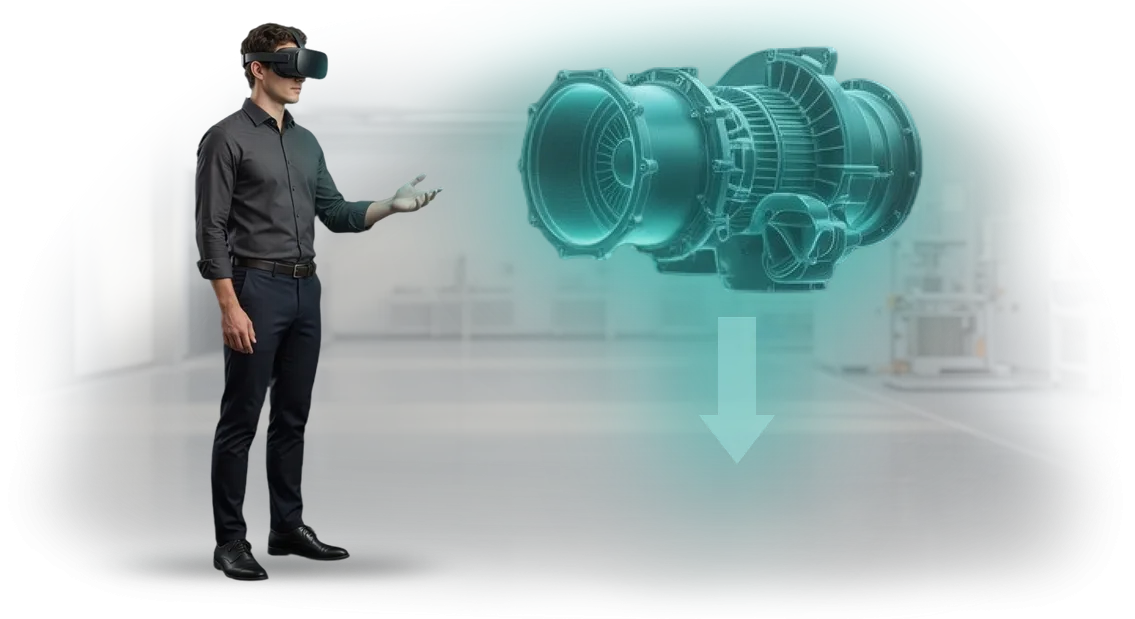
VR in pharma solves this problem through immersion. The employee finds themselves in a realistic pharmacy situation and trains dialogue with a virtual customer, receiving instant feedback.
Mistakes are made in a safe environment, and the skill is reinforced through practice, not memorization. The person experiences the scenario rather than recalling theory.
Experience shows: VR training shortens onboarding time for newcomers and noticeably cuts the number of errors after they hit the floor. We create simulators for your pharmacy chain's specific tasks — from greeting standards to complex consultations on drug interactions.
This closes the gap between theory and real work and makes pharmacist training predictable in terms of results.
What Benefits a VR Simulator Brings to Pharma Companies
Pharma companies invest serious budgets in staff training: lectures, seminars, internships. But theory is quickly forgotten, and errors in handling drugs are costly — complaints, conflicts with customers, and reputational risks.
A VR simulator moves training into a safe virtual environment where the employee practices actions without consequences for patients or the budget. It is exactly such solutions that our team develops for pharmaceutical manufacturers and distributors.
Employee Engagement
An employee absorbs material when they act, not just listen. In a VR simulator, the pharmacist goes through scenarios: selects drugs, counsels customers, works with prescriptions and objections.
This format holds attention, sparks interest, and motivates people to complete the training rather than go through the motions.
Training Cost Savings
One simulator scales across all branches of the chain — no need to spend on lecturer travel, classroom rentals, or consumables. Training happens at a convenient time, without leaving the shift, and new employees reach target proficiency faster. As a result, the company achieves noticeable savings with regular hiring and headcount growth.
Skills Improvement and Retention
Practice in a virtual environment improves retention of protocols and service standards. The employee repeats complex scenarios until a confident result, and the system records their achievements.
The manager sees an objective picture of each specialist's readiness and can adjust the program in time. This approach turns training from a formality into a real tool for advancing qualifications.
VR and AR Training Formats for Pharma Needs
Choosing a pharmacist training format is not about "which technology is trendier" but about the result: how many employees will actually master the skill and start using it on the job.
Some need full immersion without distractions, others need quick prompts right at the workplace. We match the format to your task, team size, and available training time.
Below are typical scenarios that pharma companies order most often. Each row shows how the format addresses a specific business need rather than just describing "technology for technology's sake."
| Format | For whom | What it gives the client |
|---|---|---|
| Full-immersion VR simulator | Newcomers who need to refine intake protocols, prescription control, and rare emergency situations | Practicing the skill in a safe environment with no risk to the patient or materials. The employee acts with their hands rather than observing from the side — retention is several times higher |
| AR prompts at the workplace | Experienced pharmacists when new standards are introduced or equipment changes | The employee sees a checklist or diagram right in their field of view — fewer errors, faster adaptation, no need to reread instructions |
| Hybrid training: VR + AR | Companies with a large workforce and frequently updated regulations | First, full immersion to build the baseline, then short AR sessions to maintain the skill. Result: a single work standard across all pharmacies or production sites |
We help you choose the format that will deliver fast results without overpaying for unnecessary options. At the start, we do a short audit of the task, show on your scenario how it will work, and decide together what to implement first. Then we run a pilot on a small group — and based on its results, scale to the entire workforce.
VR Training Development Stages: From Brief to Launch
Developing VR training for pharmacists is not buying a ready-made video but a joint project with clear stages. You always know what happens at each step, who is responsible for what, and when the result will appear. Below is a typical path from idea to a working system.
-
Brief and task immersion. We break down your scenarios: what skills need to be practiced, who will learn, and which employee errors cost the most. The output is a technical specification in plain language.
-
Scenario design. Together with your experts, we map out training situations: from standard prescription protocols to conflict dialogues with visitors. We define what a correct and incorrect action looks like.
-
Prototype. We quickly assemble a draft version of one scenario — so you can see the interface, logic, and overall atmosphere rather than just a description in a document.
-
Full version development. We fill the simulator with all scenarios, add prompts, an assessment system, and feedback. This is also where we integrate your regulatory documentation.
-
Testing with real employees. A pilot group goes through the training, we collect feedback, and refine the details: pacing, difficulty, clarity of instructions.
-
Launch and team onboarding. We deploy the program to the necessary devices, configure access, and train administrators. We provide instructions on how to add new users.
-
Support and evolution. We stay involved after launch: update scenarios, add new situations, and monitor stability. The training lives together with your business.
Each stage ends with a clear deliverable: a document, prototype, working version, or test report. You always understand what you are paying for and what you are getting.
What's Included in the VR Training Delivery Package for Employees
The delivery package is not a disc with a program but a ready-made solution for pharmacist training. The project includes scenarios, content, customization to your regulations, and technical maintenance for the entire period of use.
You get everything you need to launch VR training in a pharmacy chain without bringing in contractors.
- Training VR scenarios that model real pharmacist work situations: customer consultations, prescription checks, working with alternatives and objections.
- A library of interactive modules for skill practice and knowledge checks — with automatic assessment of employee actions and error analysis.
- Personal customization to your standards: drugs from your assortment, internal instructions, and work rules.
- A statistics module for managers: it shows who is completing the training, with what results, and which topics need review.
- Technical support and maintenance: content updates, bug fixes, and consultations for administrators and employees.
- Instructions and training materials: a user guide, administrator manual, and an introductory session script.
- Rights to system updates: new modules, updated drug information, and regulatory requirements.
In the end, you get a working training tool that is easy to integrate into the daily operations of a pharmacy chain and to develop as your assortment and standards evolve.
Case Study: How We Trained Pharmacists and Cut Onboarding Time in Half
Onboarding a new pharmacist means weeks of mentoring and early prescription errors. For the Pharmline chain, the situation was critical: every newcomer reached full workload only after six months, and turnover forced the training cycle to restart several times a year.
We proposed not lectures but a VR scenario simulating real pharmacy work. A newcomer enters a virtual store where they must counsel customers, check expiration dates, dispense prescription drugs, and resolve disputes.
A mistake has no real consequences but builds the right skill — exactly what standard tests do not provide.
The pilot results exceeded expectations: 40 employees completed the simulator in the first two months. Onboarding time dropped from 6 to 3 months — half — and the number of errors in prescription handling fell by 60%.
Mentors stopped spending hours on routine repetition of the basics and focused on truly difficult issues.
After the pilot, the client expanded the program to all 14 cities where they operate. Today, VR training is the standard for every new pharmacist.
For the business, this is not "an investment in technology" but a way to get a predictable employee in three months instead of six.
This is a case where training transforms from a cost item into a tool for employee retention and stable service quality. We work on professional VR equipment, so the result is equally reproducible in any region — whether in the capital or in a small town.
How to Choose the Right Training Format for Your Company?
The choice between VR and AR is not about fashion but about tasks. If you need to teach employees to act in complex or dangerous situations where errors are costly, VR provides full immersion and safe practice.
If you need a "here and now" prompt — when working with a new drug or equipment — AR overlays instructions onto the real world and speeds up actions.
Before choosing a format, answer three questions. What does the employee do after training — work hands-on with real objects or make decisions in nonstandard situations?
How important is scenario repeatability — in VR everyone goes through the same scenario, while AR adapts to a specific location. Where does the training take place — in a classroom or at the workplace?
Practice shows: for practicing algorithms, pharmacists — for example, drug dispensing or urgent conditions — more often choose VR. It allows you to play out the entire situation and analyze mistakes.
For day-to-day support in customer interactions — checking drug compatibility, dosages, instructions — AR works better: it runs on tablets and smartphones without a special room.
Another criterion is scale. VR requires headsets and space but gives full engagement. AR is easier to deploy on existing devices and scale to hundreds of employees.
The choice comes down to logic: if the task is solved by a prompt on a real object — AR; if a safe model of the process is needed — VR.
We start not with technology but with task analysis. We select a format that will deliver a measurable result — faster training, fewer errors, more confident employees. Not sure which one fits you? Give us an example of a task — we'll advise which solution will pay off faster.
Frequently Asked Questions and Doubts Before Ordering VR Training
Any responsible manager asks the same questions before ordering VR training: isn't it too complicated, isn't it too expensive, will special equipment be needed. This is normal — new technologies always raise doubts until you understand the details. Below we break down the most common concerns and show how we address them in our work.
Isn't it too difficult to integrate VR training into a regular work schedule?
No, it's simpler than it seems. We handle the entire process: from scenario to launch. An employee puts on a headset and enters a virtual pharmacy where they practice real situations — consultations, prescription work, or a difficult customer.
You only need to set aside 20–30 minutes per session, and the instructions are clear without special preparation. Your employees quickly get the hang of it, and you receive a complete system, not a "semi-finished product."
How much does VR simulator development cost, and is it more expensive than regular training?
These are one-time investments, and they pay off through savings on instructors, consumables, and staff downtime. A single VR simulator can be used hundreds of times without losing quality or incurring additional costs.
For pharmacists, this is especially beneficial: rare and complex situations are practiced without risk to real patients and without using up medications. The cost depends on the scope of scenarios — we always select an option that fits your budget and goals.
Will we have to buy expensive equipment?
To get started, a couple of standard virtual reality headsets are enough. You can buy them or rent them for the training period — no special rooms or complex infrastructure needed. If training is planned as an ongoing program, the purchase will quickly pay off.
If it's a one-off event or pilot launch, renting will be the most convenient and budget-friendly solution.
How quickly will VR training pay off and how do we measure results?
Payback comes from two things: the speed of employee preparation and the reduction in errors. After the VR simulator, pharmacists master service standards and prescription work faster, which means they start contributing earlier.
We build in an assessment system: you see who completed the training, how many attempts it took, and which skills need improvement. This data makes it easy to judge the effectiveness of the investment.
Who will maintain the simulator after launch?
We support the project throughout its entire lifecycle. We update scenarios to reflect changes in your products or regulations, help with technical issues, and provide additional training to employees if needed.
You are never left alone with the technology — we are with you at every stage, so the training runs reliably and does not require a dedicated in-house specialist.
Launch VR Training for Your Team This Quarter
While you are planning pharmacist training for next quarter, some employees continue to work intuitively rather than by standards.
A VR simulator solves this problem: newcomers step into real pharmacy situations without risk to customers, and experienced pharmacists hone their skills in a safe environment.
We have been doing VR development for over 10 years and deliver results turnkey: from scenario to launch on your equipment. You don't need to dive into technical details — we'll do everything at a professional level, and you'll get training that works.
- Launch VR training within the quarter — we work until the result.
- Demo access before purchase — test it on your task.
- Launch consultation — we'll select scenarios for your team.
- Employee training adapted to shift schedules — instruction without interrupting work.
- Support after launch — we update scenarios and add modules.
Leave a request on the website or call us — within a day we'll send demo access and call you back for a personal consultation. We'll discuss your business task, show examples for pharma, and propose a VR training launch plan for this quarter.
Take the first step now. In a few months, your employees will be doing hands-on practice in VR instead of listening to another lecture. It pays off many times faster than any traditional training.