

Experienced mentors leave — new employees learn from mistakes
Experienced mentors are the company's most valuable resource, yet also the most fragile. They accumulate mastery over years: they know unusual situations, feel the equipment, understand how to calm a client or avoid defects.
And then they leave in a single day — retiring, moving to another company, or getting promoted. That experience disappears along with them, because half of it is written down in no manual at all.
New employees are left alone with complex tasks. They learn through trial and error, and every mistake costs time, materials, nerves, and sometimes the company's reputation.
There simply aren't enough mentors to give each newcomer sufficient attention: one mentor per ten people is no longer training — it is remote supervision.
The outcome is always the same: a long time to reach full proficiency, turnover among newcomers, and inconsistent work standards across employees. Mistakes repeat because everyone learns from their own personal experience — instead of learning from the best.
The company pays for training twice: once for the process itself, and once for the consequences of mistakes.
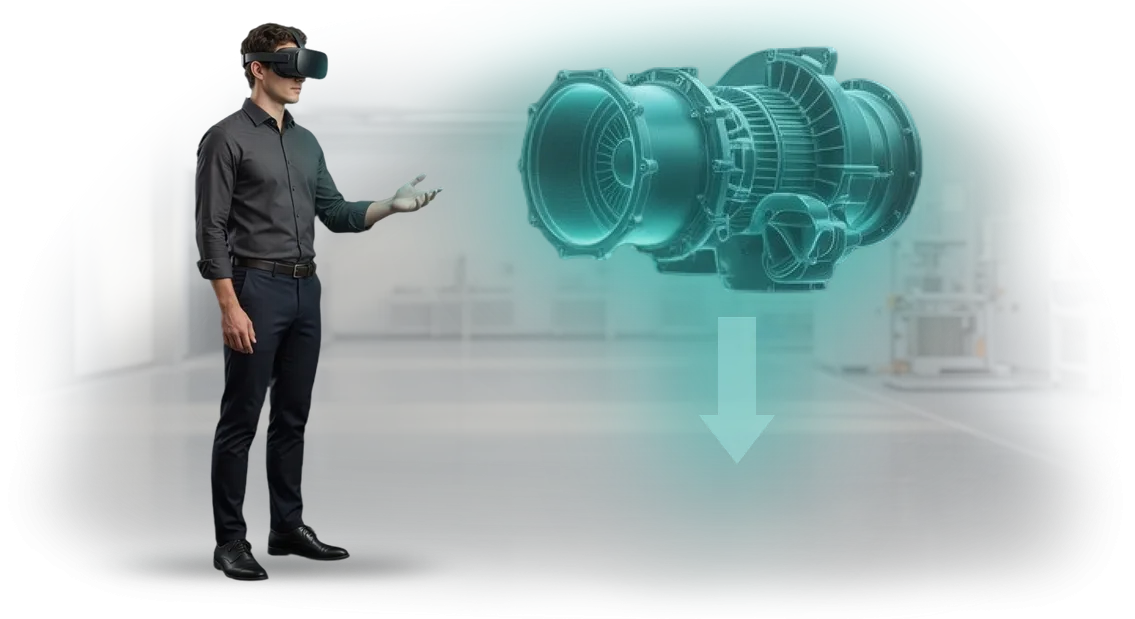
VR training and AR learning close this pain point. The experience of the best mentors is transferred into training scenarios, and every new employee runs through them as many times as needed — without risk to equipment, clients, or deadlines.
Knowledge stays in the company even after the mentor has already left. This way, knowledge transfer stops depending on the human factor and becomes a systematic process that works for the business every day.
What VR and AR training brings your business: speed, safety, engagement
Traditional mentor-led training is always a compromise: either expensive off-the-job training sessions or a long period of trial and error that costs the company even more.
A new mentor's mistake is not just lost time — it is a risk to clients, reputation, and the team's internal climate. VR and AR training solve this problem differently: the employee gains experience in a safe environment where an incorrect action does not lead to real losses.
Virtual reality makes it possible to create an exact replica of a work situation — from a difficult negotiation to an emergency equipment shutdown — and practice it as many times as needed.
This format delivers what matters most to business: fewer errors on real sites and lasting skills that remain after training. The employee refines actions to the point of automation before ever meeting a live client or real equipment.
Training speed grows severalfold: what used to take weeks of lectures and mentor-led practice is now mastered in a few immersive sessions. The company gains knowledge standardization — every employee runs the same scenarios and absorbs the same work standards.
This is especially important for mentors, who must not only know the material but also be able to pass it on to newcomers without losing quality.
Augmented reality amplifies the effect right at the workplace: the employee sees prompts in their field of view, checks against the reference standard, and receives immediate feedback.
For mentors, this is a continuous support tool that does not require stepping away from work and builds confidence in their actions. People feel that the company is investing in their development — and this directly affects staff loyalty and the desire to stay on the team.
Immersive learning is not a replacement for live interaction — it is a way to make corporate training predictable and measurable. You can see which skills have already been practiced, where the employee is struggling, and how quickly they reach the required level.
Staff performance grows, and with it — business results. We help implement VR and AR training for your scenarios and goals, so that the investment pays off through faster preparation and the quality of your team's work.
AR and VR trainer formats for your tasks
Employee training cannot be reduced to a single template. The same scenario works differently for a mentor, a newcomer, and an experienced specialist.
To make a trainer deliver measurable results — faster time to full competency, fewer errors, confident mentors — the format is matched to the specific task. Below is a comparison table of the main training types.
| Format | Who it is for | What it delivers to the client |
|---|---|---|
| Fully immersive VR trainer | Employees who need to practice actions in non-standard or hazardous situations | Full process simulation without risks. Practicing a skill to the point of automation, reducing errors on the real site |
| AR trainer with augmented reality | Mentors and new employees at the workplace | Step-by-step prompts right before the eyes, fast onboarding, process control without stopping production |
| Interactive dialogue simulator | Mentors, sales managers, and support teams | Practicing communication with a "difficult" client or trainee. Confidence in real negotiations, unified communication standards |
Choose a format using a simple checklist: which skills are being practiced — action sequences or communication; where the employee learns — in the office, on the production floor, or remotely; who the primary user is — a newcomer or a mentor.
If you are training mentors, AR prompts will help guide a trainee in real time, while a VR trainer will allow rehearsing difficult dialogues before contact with real people.
We help you select and combine formats for your training program.
Behind each one is professional equipment and proven tools, but what matters to you is not the technology — it is the result: the employee becomes independent faster, the mentor spends less time on routine, and the business gets predictable training quality. Leave a request — we will match a format to your task.
How VR trainer development works: 6 stages
We structured the development process so you understand what happens at every step and what result you will get.
Over the years we have delivered dozens of projects for different companies, and this sequence has proven its effectiveness: from the initial brief to a working trainer and beyond.
-
Brief and task immersion. We meet with you, study how mentors are currently trained, which situations cause difficulties, and which skills need to be strengthened. Based on this, we build a technical specification with training goals and expected results.
-
Scenario and methodology design. We develop the training scenario: which situations we model, how the trainer responds to user actions, how it evaluates errors and provides prompts. You see the training structure before development begins and can adjust it to your goals.
-
Prototype and approval. We create a rapid prototype of the key scenes — a simplified version of the future trainer. You see the interface and logic, try the interaction, and make revisions before full development begins. This saves time and budget.
-
VR solution development. Using professional equipment and proven tools, we build a complete trainer: graphics, scenarios, and an action assessment system. You regularly receive intermediate versions and track progress at every stage.
-
Testing and refinement. We test the trainer with real mentors: we gather a focus group, observe where they struggle, and make changes so the training is as useful and comfortable as possible.
-
Deployment and support. We help launch the trainer into your training system: we set up equipment, train administrators, and hand over instructions. After launch, we support the solution, update content, and stay in touch for further improvements.
What you get after launch — a complete package
After launch you receive not just a VR program, but a ready-made mentor training system. We deliver a package where every detail has been thought through: from the technical side to the methodology. There is no need to hire developers or methodologists — everything is already adapted to your task.
Here is what is included in the delivery:
- A ready-made VR trainer — scenarios based on your mentors' real situations. The employee undergoes training repeatedly and without risk, which increases confidence and speed of decision-making.
- Methodological materials — lesson plans, case studies, and assessment criteria. They integrate into the existing program and also work for group sessions without VR.
- Instructions for mentors — step-by-step guides for setting up and working with the trainer, including non-standard situations. Trainers will manage without the IT department.
- Administration system — a personal dashboard with each employee's progress: number of completions, errors, and dynamics. Use this data to adjust the program and see who is ready to work.
- Training for your team — a hands-on session with mentors: launching the trainer, methodology, and templates for conducting sessions. After this, trainers work independently.
- Support at launch — we help with setup, answer questions, and update materials until the trainer runs smoothly within your schedule.
This package covers everything: you have the tool, the methodology, and prepared people. All that remains is to assign the first employees to training — we will take care of the rest.
Case study: how a metallurgical plant trained hundreds of employees
Mentors on the production floor pass experience to newcomers, but their own preparation takes months and carries risk: a mistake on a real production line costs a lot.
A metallurgical plant faced this directly — they needed to train hundreds of employees in emergency procedures without stopping production.
How it happened
We developed a VR trainer that immerses mentors in a virtual workshop with realistic scenarios. In a single session, they can practice up to 15 emergency situations — from smoke buildup to equipment failure.
The mentor sees the consequences of their decisions immediately, in a safe environment, and internalizes the correct procedure through their own experience rather than through slides.
The client went from a pilot group to scaling across all workshops: in just a few months, more than 500 employees completed the training.
Measurable results
Mentor preparation time was reduced by 40% — from four weeks down to two and a half. Injuries during hazardous operations fell by a third in the first year, and the number of errors in practical assessments was cut in half.
The effectiveness of the trainer was confirmed by the mentors themselves: material retention doubled compared with classic briefings. The plant never stopped its lines and spent no materials on training accidents: the trainer paid for itself by eliminating downtime.
A follow-up order to update the scenarios confirmed that immersive training is a systematic solution, not a one-off experiment. For mentors — safe experience; for the enterprise — protection of people and savings of resources.
How to choose a VR/AR training format for your mentors?
The key thing when choosing a format is to base the decision not on technology trends, but on exactly which skills your mentors need to acquire and under what conditions.
A VR trainer is indispensable when training involves actions on equipment that are difficult or dangerous to practice on a real site: emergency situations, rare breakdowns, work with machinery.
The mentor can make mistakes dozens of times in a safe virtual environment and then bring a polished skill and confidence to the production floor.
The AR format solves a different task — accelerating the mastery of work processes without leaving the real environment.
When a mentor needs to quickly learn a new procedure or sequence of operations, prompts appearing directly in the field of view help cut onboarding time by 2–3 times.
This is especially valuable on assembly lines, in service teams, and in logistics, where every hour of downtime matters.
There is also a third path — combined programs where VR builds the foundational skill and AR reinforces it at the workplace. This way you cover both safety at the start and speed of adaptation in real conditions.
We help you avoid choosing at random: we audit your mentors' tasks, select the format for your business specifics, and scale to the scope of the task.
What you get is not just a trainer, but a measurable result: fewer errors and less adaptation time, more confidence and stability at work.
Answers to common questions about VR training
Before launching VR training, most clients ask the same questions: does it really work, what will it cost, what is needed to start, and how often will you need to invest in updates. We gathered answers to the most frequent ones — short and to the point.
Is VR training more effective than regular courses?
Yes. VR allows the employee not just to read an instruction, but to practice the action with their own hands in a safe environment. Studies show that information is absorbed more deeply than when watching a video or lecture, and the skill is reinforced faster.
This is especially noticeable in scenarios that are hard to reproduce in real life — emergency situations, working with aggressive clients, or rare equipment.
Two to three weeks after training, employees retain more details than after a classic format. For business, this means fewer errors on real tasks and a faster path to results for newcomers.
How much does VR trainer development cost?
The cost depends on the complexity of the scenario, the number of locations, and the level of detail. It is important to understand: this is not a one-time expense, but an investment that pays off.
VR training reduces spending on training facility rental, instructor travel, and lowers the number of errors on the production floor.
We always offer a phased approach: we start with one key scenario, evaluate the result, and then scale. This approach lets you manage the budget and avoid overpaying for unnecessary features at the start.
What equipment do employees need?
We use professional standalone VR headsets that require no powerful computer or cables — all you need is a dedicated space in the office. The employee puts on the headset, picks up the controllers, and within a couple of minutes is inside the scenario. Learners quickly get used to the controls: all actions are intuitive and guided by the system.
If you do not want to buy the kits right away, you can start with rental. Usually 2–4 headsets are enough per group, because sessions are held in turns or in pairs.
Can the trainer be updated after launch?
Yes. This is not a static product, but a living system. You can add new scenarios, change procedures, and introduce additional difficulty levels.
We support the project after launch as well: we help with refinements, update content to reflect changes in business processes, and provide technical support.
An update does not require a complete rework of the trainer — everything is built on modular logic. That is why new versions arrive faster and cost less than building a project from scratch.
Will employees resist VR?
Resistance usually comes from fear of the unfamiliar, not from the technology itself. We train a super-user or mentor who helps colleagues get comfortable, and we design scenarios with clear prompts at every step. After 5–10 minutes in the headset, the fear fades, replaced by interest.
What is more, VR training is also a way of caring for the employee: they practice in a safe environment and are not afraid of making a mistake in front of everyone. This format is often perceived as a perk and increases team loyalty.
If you still have questions — ask us directly, and we will analyze your specific case. We will consult with you and reply within one business day.Leave a request — start with a brief
You already understand that a VR trainer will help train mentors faster and shorten the onboarding time for new employees.
But before starting, it is important to confirm: does it actually solve your specific task, how long will development take, and what level of investment is needed. To find this out, you do not need to buy the project blind — start with a brief.
In a 30–40 minute conversation, we will analyze your situation and prepare preliminary options. After your inquiry, you will receive:
- a task audit: you will understand where VR will deliver maximum impact in mentor training;
- a preliminary solution: a scenario and trainer format for your employees;
- a cost and timeline estimate: we will share a budget range so you can plan the launch;
- an expert consultation: we will tell you which hardware and software will fit;
- practical examples: we will show similar projects for your industry;
- implementation recommendations: we will advise how to integrate the trainer into your current training program.
This obligates you to nothing — all information remains confidential. We are interested in long-term cooperation, so we will honestly tell you if a VR solution is not the right fit and suggest alternatives.
Leave a request on the website or call us — we will get in touch within one business day, clarify the details, and propose next steps. This will be the start of developing a VR trainer that will work for your mentors' results and pay off through faster, higher-quality training.