

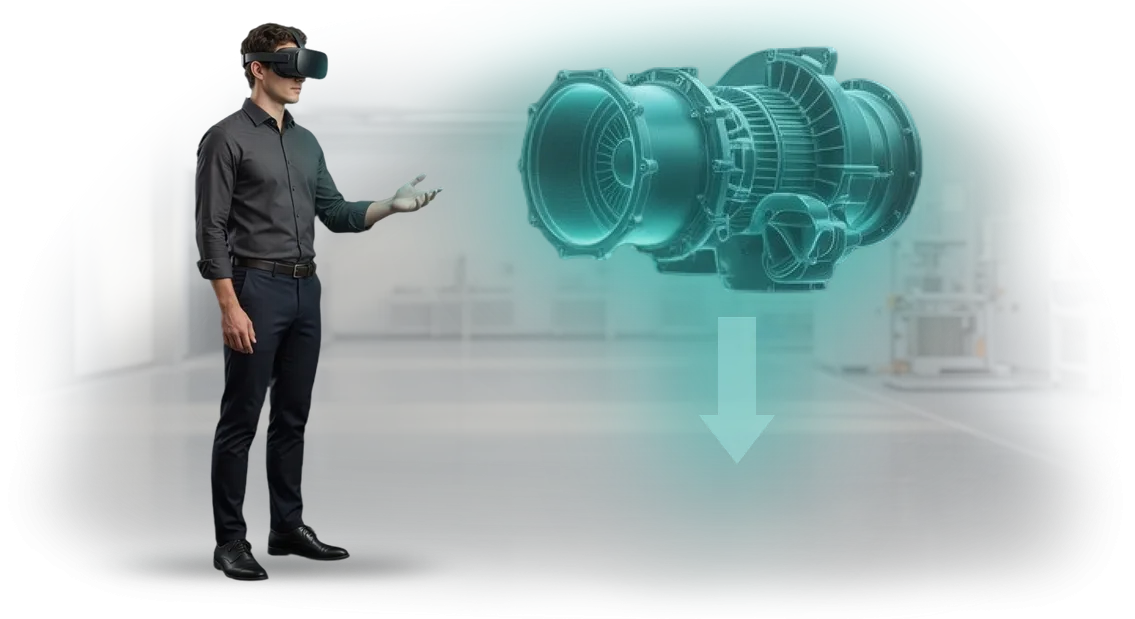
Chef mistakes cost a lot: how to change that?
Chef mistakes cost more than they seem: every overcooked piece of meat or unbalanced dish means a dissatisfied guest, spoiled ingredients, and a hit to the establishment's reputation.
Over the course of a month, such slip-ups turn into noticeable budget losses and an outflow of visitors who aren't willing to give a second chance.
The problem becomes especially acute against the backdrop of staff turnover: a new chef arrives without experience working with your menu, and on-the-job training in a live kitchen leaves no room for error.
In these conditions, quality control falls on managers, who are forced to check every plate instead of focusing on team development.
Traditional chef training doesn't save the day—theory doesn't turn into a lasting skill, and mistakes are too costly to practice on real ingredients.
We propose a different approach: VR training that lets a chef practice all processes in a virtual kitchen, make mistakes, and correct them without losses to the business.
The employee learns to act confidently before they even stand at a real stove, and you get an employee who knows your standards, bringing quality under control. This closes the gap between “hired” and “cooks correctly,” preserving your budget and reputation.
What a VR trainer will do for your restaurant
A VR trainer for chefs is not a substitute for practice, but a way to use virtual reality for a restaurant's real benefit. An employee enters an exact copy of your kitchen, where they can train as many times as needed without consuming ingredients or taking up senior chefs' time. The result is visible immediately: fewer mistakes, faster onboarding, and consistent dish quality.
The first and most obvious win is loss reduction. A beginner's mistakes in a virtual kitchen cost nothing: spoiled ingredients, wrong temperature, violated procedures—all of these can be repeated without consequences.
The chef refines the skill to automation in VR and only then works with real products. For the restaurant, this is direct savings on purchasing and write-offs.
The second benefit of virtual reality is a unified quality standard. All chefs—including shift and seasonal staff—train on the same program that incorporates your kitchen's techniques.
This removes dependence on “creative differences”: the same sauce, the same level of doneness on every shift. Guests get a consistent taste, and the manager gets a controlled process without daily oversight.
Third is employee motivation and team loyalty. Ordinary training at the stove is stress and fear of making mistakes. The VR environment eases that tension: here you can try, fail, and see progress through game-like scenarios.
Staff see such training as development, not evaluation. The result is lower turnover, stronger engagement, and chefs more willing to take on new dishes and tasks.
Finally, VR training in a restaurant speeds up onboarding in the first days. Instead of spending a week observing from the sidelines, a new employee performs basic operations at the level of a confident assistant by the second or third day.
This reduces the burden on experienced chefs and saves their time for truly complex tasks. The restaurant gets not just training, but a working tool that pays off through speed and quality.
VR training formats for chefs
Every restaurant faces the same challenge: train a chef so they work according to the establishment's standards from day one.
Ordinary lectures and videos provide no practice, and letting a beginner near a real stove before skills are honed is a risk to the kitchen and the business.
VR formats solve this in different ways: you can run a quick orientation, or build a full virtual copy of the kitchen and practice processes until they become automatic.
We select a format for your task—from a short introductory course to a detailed simulation of the workstation. All options integrate into existing training and scale to any team size.
| Format | Who it is for | What it gives the client |
|---|---|---|
| Express course in a virtual environment | New employees, inexperienced trainees | Fast immersion in the process: in a couple of hours a chef learns basic standards, safety rules, and zone layout—without using a real kitchen |
| Modular VR trainers | Current chefs, line staff | Practicing specific skills: cutting, cooking according to technical specification sheets, operating equipment. Mistakes are analyzed immediately, without writing off ingredients |
| Full kitchen simulation | Head chefs, managers, entire shift staff | Running a complete work cycle in conditions close to real life: task allocation, speed, team interaction. Helps identify weak points and improve coordination |
This approach pays off quickly: turnover during the probation period drops, errors and rework decrease, and dish standards become consistent across all chefs.
Even with a high flow of new employees, you don't lose quality—every staff member goes through the same program and arrives in the kitchen already prepared.
If you don't know where to start, we'll help you choose a format for your specific situation. We'll show implementation examples and calculate which option will deliver results faster in your business.
How the trainer is developed
Creating a VR trainer for chefs is not a “black box,” but a clear process with several stages. We've gone through it dozens of times for restaurant chains, culinary schools, and food production facilities, so every step is streamlined and doesn't drag on.
- Defining the task. We meet with you and discuss which skills need to be practiced: from cutting and heat treatment to plating standards and sanitary regulations. We review your procedures and typical new-hire mistakes.
- Creating the scenario. Together with your head chefs and methodologists, we write out the scenario: situations, actions, mistakes, and hints. In the end, you receive a document that can be approved before development begins.
- Prototype. We put together a draft version of the trainer with the key mechanics. You see what the process looks like and make adjustments before major resources are invested.
- Development. We design a realistic kitchen, add interactive zones, ingredients, tools, and an action evaluation system. We work on professional equipment to ensure the image is sharp and comfortable.
- Employee testing. We let 2-3 chefs of different levels try the trainer. We check whether it's clear, convenient, and actually helpful. We collect feedback and refine the interface.
- Deployment at your site. We install equipment, set up accounts, and provide a short briefing for administrators and staff. You get a ready-to-use system that operates without our constant presence.
- Support and updates. We stay in touch: we help with technical questions and update scenarios to match new standards or dishes. If new rules are introduced, we expand the trainer.
Each stage ends with an approval checkpoint—you see the interim result and provide feedback, rather than waiting for a “finished product whenever it appears.” The typical timeline from the first meeting to launch is from four weeks, depending on the number of skills being practiced and the complexity of the scenarios. Importantly, we fix the final timeline in the contract and do not change it during the process.
What is included in the project delivery
When you order VR training for chefs, the project includes not just a program, but a complete turnkey solution. We design the package so your team can launch training without involving developers or lengthy setup.
The standard delivery package includes:
- Ready-made VR trainer with tasks based on your standards: cutting technique practice, equipment operation, compliance with sanitary regulations.
- Instructions and method materials: guides for employees, a mentor's handbook, and an integration plan for the existing training system.
- Management dashboard: statistics for each chef, number of attempts, typical mistakes, readiness for real work.
- Content updates: adding new dishes, recipes, and standards without reconfiguring the entire program.
- Team training: a short session for administrators and instructors so they can launch and maintain the trainer on their own.
- Technical support for the entire usage period: setup, backup, and resolving any issues that arise.
Thanks to the complete package, the project launches in a matter of days rather than taking months to roll out. New employees reach the level of experienced colleagues faster, while the likelihood of errors in real work decreases and standards are observed consistently.
You get a tool that easily fits into current processes and grows with your menu and staffing requirements.
Case study: how a restaurant chain reduced costs
Training chefs in a restaurant chain is always a balance between how quickly a newcomer can start a shift and the quality of the dishes.
At the “Veresk” chain, training a trainee took a month, and the first working weeks were accompanied by errors in ingredient measurements and excess food consumption. Management wanted to reduce costs, but not through controlling every step—rather through proper training.
We proposed a VR trainer in which a chef practices cooking in a virtual kitchen: following the recipe, sequence of operations, and actions during peak hours.
Mistakes don't lead to spoiled products, and the scenario can be repeated dozens of times until the skill becomes confident. The training thus stopped depending on the mentor's workload or the availability of a free kitchen.
Results the manager saw
After two months, the chain recorded a 30% reduction in waste—employees followed the technical specification sheets more precisely and handled ingredients less wastefully. New chef training time was cut in half: two weeks instead of four.
Faster shift readiness means less downtime in the kitchen and a lower burden on experienced staff, who previously were constantly distracted by trainees.
Additionally, turnover during the probation period decreased: newcomers saw their progress and adapted to the chain's standards faster. The manager received clear statistics for each chef—which operations were difficult and who needed additional training. This turns training from an expense item into a management control tool.
This case study shows that VR training produces measurable operational results, not just a “modern image.” The client saw its effectiveness and, a year later, ordered additional modules for bartenders and hostesses—on their own initiative.
Addressing client concerns
Clients often hesitate about whether to implement VR training: Will chefs handle the new technology? Will the equipment break? Will the work schedule be disrupted? That's normal—any changes to staff training raise questions. Let's go through the main concerns in order.
Chefs don't know how to use VR—will we have to explain everything from scratch?
The VR trainer for chefs is designed so that anyone without technical experience can use it. The headset goes on in a minute, and control is based on natural hand movements—the employee simply performs the same actions as in the kitchen.
At the start, we conduct a short briefing for the whole shift, and the trainer itself includes hints at every step. On average, a chef masters the controls in 10–15 minutes and then works independently.
Will training distract employees from their main work and slow down the kitchen?
The training program fits into the regular schedule: sessions can be placed at the beginning of a shift, during quiet hours, or in dedicated time slots. One cycle takes 15–20 minutes, so the kitchen doesn't idle.
Moreover, after the first couple of training sessions, an employee starts working faster and making fewer mistakes—so you're not losing time; you're saving it.
The equipment is expensive and fragile—what if it breaks or gets smashed?
We use professional equipment designed for intensive daily use and protected against impact and dust. The project cost includes warranty service and rapid device replacement in case of failure.
Employees only need to be shown the handling rules once—after that, they manage on their own. In years of practice, we have never had a malfunction stop training.
These are just some of the concerns we hear in talks. If you have your own question, just ask us: we'll show a demo, answer, and prepare training for your kitchen. Staff adaptation and technical support are already included in the standard project, so you get results without extra hassle.How to choose the right VR training format for your task
The VR training format depends not on trendy technology, but on the business task: who you are teaching and what, how complex the skills are, and how often the program needs updating.
For fast standardization—for example, hygiene rules or equipment operation—a compact scenario that can be launched within weeks is enough.
For practicing culinary processes where the sequence of actions and response to non-standard situations matter, you need a full-fledged interactive trainer with immersion in a realistic kitchen.
Choosing the right format directly affects launch speed and staff benefits. If you have 200 chefs in different locations and need training in a single standard, it's more sensible to use a ready-made scenario with typical situations.
If you are developing head chefs or practicing signature recipes where every step is critical, you will need custom development that takes your tech card specifications and equipment into account.
Also assess the scale: how many employees undergo training monthly, how often standards change, and whether there is a need to verify material comprehension. Choosing VR training is always a balance between depth of detail and speed of implementation.
We help find that balance so you don't overpay for unnecessary features or receive an overly simplified product.
To do this, we analyze your task: goals, number of employees, timelines, and update frequency. Based on that, we propose two or three format options with a forecast of results and the required equipment.
In the end, you get not “VR for the sake of VR,” but a solution that pays off quickly through faster staff preparation and fewer errors in operations.
Order development of a VR trainer for your kitchen
A VR trainer for the kitchen helps new chefs get comfortable with processes faster and reduce the number of mistakes before they affect guests. It saves mentor resources and improves service quality.
To order VR training for your team, you only need to follow a few steps—no lengthy exploration of technical details.
- Leave a request on the website or contact us via messenger—we'll respond within a business day.
- We'll hold a consultation: we'll break down what tasks the training should address—safety, working with equipment, new recipes.
- We'll analyze your kitchen's processes and propose a trainer scenario that fits into the staff schedule.
- We'll prepare a cost estimate based on your scale: number of employees, number of scenarios, and launch timelines.
- We'll align on the development plan and implementation stages—you'll see results at every step.
- After launch, we stay in touch: we help update content, add modules, and adapt the program to menu changes.
Each item is part of a transparent process in which you control the result. We manage the project from brief to launch, so you don't have to coordinate contractors or dig into implementation details. You get ready-made training that integrates into operations without stopping the kitchen.
Don't put off your decision: leave a request now and get a consultation and a preliminary cost estimate within one business day. This way, you'll understand whether the VR format is right for your team even before signing a contract.