

Why Sales Consultant Training Falls Short
Customers go where they feel comfortable — and often the reason isn’t price, but poor service. A sales consultant couldn’t answer a question, didn’t recommend the right product, or simply looked disengaged — and the customer leaves for a competitor.
A manager sees weak sales, but doesn’t understand exactly where customers are lost: there’s no feedback loop, and every missed sale is a direct loss of revenue.
Typical sales training doesn’t solve the problem because it delivers theory and occasional role-play. Within a week, employees forget most of the material, and in a real stressful situation they fall back on old habits.
Lectures and presentations don’t build skill — they only transmit information that is hard to apply in practice without repeated reinforcement.
So the business spends time and budget on training, while service quality stays the same. Customers return only for assortment or price, not for service.
Loyalty suffers: an unhappy customer tells friends about a bad experience, and the brand’s reputation takes a hit even with a good product.
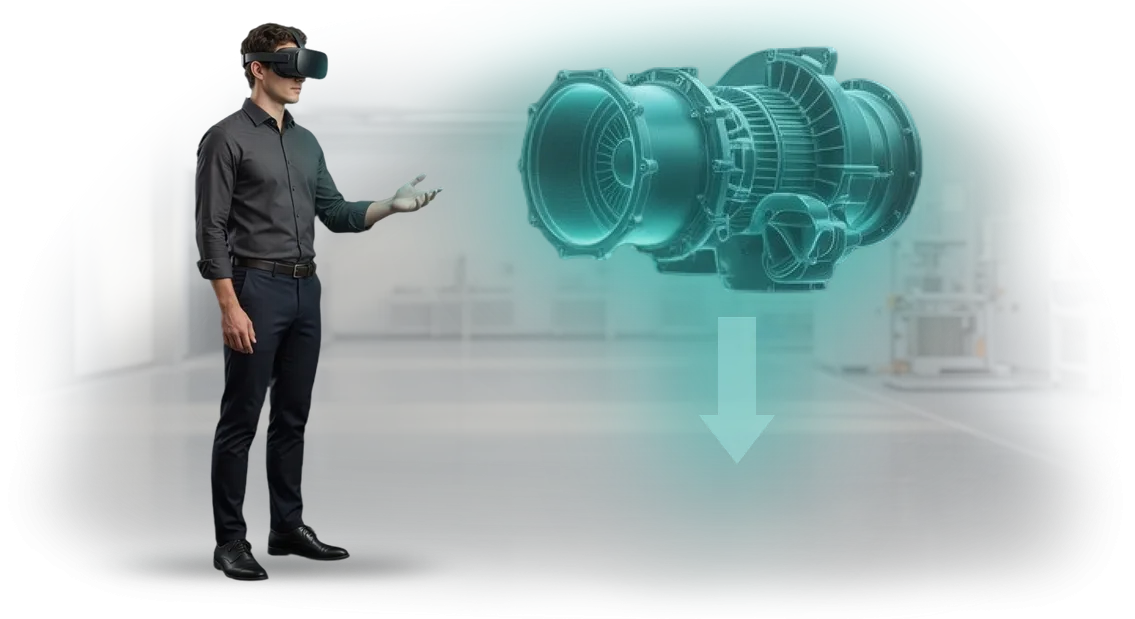
We close this gap with VR simulators for sales consultants. The virtual environment lets employees work through realistic customer interaction scenarios, learn to handle objections, and close deals — all in a safe setting with detailed error analysis. This turns training from theory into practicing real skills that directly affect sales.
What VR Training Delivers: Higher Sales and Profit
VR training turns a newcomer into a confident salesperson in a matter of days. Instead of theory and role-play with a colleague — practicing real dialogues with virtual customers. An employee trains as many times as needed until the skill becomes automatic.
This directly impacts conversion: the consultant doesn’t stumble on objections, identifies needs faster, and offers the right solution.
Systematic practice of scripts and techniques increases the average order value. The salesperson learns to spot upselling opportunities, offer accessories, and propose better-value bundles.
As a result, every other customer leaves with a bigger basket than planned, and revenue grows without any marketing spend.
Consistent service is what separates a strong brand from chaos. Virtual simulators set a single service standard: all employees act predictably, regardless of experience or mood.
Customers get predictable quality in every store, so they come back and trust the consultant’s recommendations.
Customer loyalty grows as a direct result of staff confidence. A salesperson who doesn’t fear tough questions and genuinely helps the customer choose is remembered.
This builds regular customers who bring friends and leave positive reviews — another source of profit without any advertising budget.
We create VR scenarios based on your products and typical retail situations. The simulator adapts to product categories, brand values, and the customer profile. You get not entertainment but a working tool that pays for itself through growth in key sales metrics.
VR and AR Training Formats for Sales Consultants
For a sales consultant, the core is live dialogue, not theory from manuals. Ordinary courses provide knowledge but not skill: in a stressful situation, an employee freezes, forgets the script, and loses the deal.
Sales simulation in VR and AR training makes it possible to rehearse real scenarios in a safe environment, without risking the company’s reputation.
We select the format for the task: from short virtual dialogues to multi-step scenarios with unusual customers. Below are the typical VR training formats our clients use.
| Format | Who it’s for | What it gives the client |
|---|---|---|
| Customer dialogue simulation | New employees who need to get up to speed quickly | Practice of the full sales cycle: from greeting to closing the deal. The employee gains hands-on experience without losing real customers. |
| Objection handling | Experienced salespeople who lose deals at the final stage | Training responses to tough questions — “too expensive,” “I’ll think about it,” “cheaper elsewhere.” Confidence and repeat-visit conversion increase. |
| Working with different customer types | The whole team when personalized service matters | Virtual characters with different personalities and needs. The salesperson learns to adapt to the customer and find an individual approach. |
| AR training for product knowledge and service standards | Employees in the store or warehouse | Visual product information right at the workplace: specs, benefits, scripts. Reduces onboarding time for new hires. |
How VR Simulator Development Works: Stages
We’ve broken the process into clear stages so you always know where the project stands and what you’ll get as a result. No “magic” — just transparent work with checkpoints and a fixed cost.
-
VR training brief. We start by analyzing your objective: what exactly your salespeople need to learn, what mistakes they make, and what result you want to see in a month.
We lock in goals, target audience, and performance criteria — for example, higher upselling conversion or shorter onboarding time for new hires.
-
Training scenario. Together with your top employees and methodologists, we describe typical situations: first contact, handling objections, product presentation.
We turn them into interactive dialogues with answer choices and branching — just like a real conversation with a customer.
-
Prototype and design. We create a visual mockup of the virtual store or sales area: layout, appearance of virtual customers, hint interface. You see and approve the visuals before development starts — no surprises at the final stage.
-
Simulator development. We build a full VR application: realistic environment, virtual customers with different personality and behavior scenarios, and a system for evaluating employee actions. We use professional equipment so the image is sharp and controls are intuitive.
-
Testing with real users. We give the simulator to your sales consultants, collect their feedback, and review analytics: where they get stuck, what phrases they use, what mistakes they repeat. Based on this, we refine the scenarios and interface.
-
Simulator launch. We install VR equipment, set up training rooms, and hand over administrator instructions. We train your team to run sessions and track employee progress — without involving developers.
-
Support and development. After launch, we stay in touch: we update content, add new scenarios for changes in assortment or policies, and help with technical issues. You get not a one-off product but a tool that evolves with your business.
In total: from brief to launch — usually 4–6 weeks, depending on scenario complexity. At every stage you receive an interim result you can show management and approve before moving to the next step.
What’s Included in the VR Simulator Delivery
Standard delivery of a VR simulator is not “just software” but a complete working package that gets your training running from day one.
You don’t need to finish anything, buy anything extra, or bring in contractors: everything required for launch and stable operation is already included in the project.
Here’s what you get:
- Training scenarios tailored to your goals — we practice typical dialogues, objections, and sales stages. Each scenario is designed so the employee experiences a real situation rather than memorizing instructions.
- 3D models of your products or space — we create an environment the employee recognizes (store, warehouse, showroom). This narrows the gap between training and real work.
- Integration with your LMS — the simulator automatically sends session results to your personnel tracking system. HR doesn’t fill out reports manually, and you see each employee’s progress in a familiar interface.
- Instructions and policies — a quick reference guide for the user, a trainer’s manual, and technical support documentation for the system administrator.
- Training for your team — we run a demo session for trainers and administrators so they can launch scenarios and work with results on their own.
- Warranty and support — we fix bugs and update content during the warranty period. If your products or processes change, we refine scenarios without a separate contract.
- Technical setup guide — step-by-step instructions for loading the simulator on workstations and connecting equipment.
The whole package is delivered ready to use: an employee puts on the headset, enters the scenario, and at the end sees their score and recommendations. All you have to do is schedule the training.
Case Study: 25% Sales Growth After VR Implementation
The electronics retail chain TechnoLife faced a typical retail problem: sales consultants took too long to reach target metrics, and some new hires quit within the first month.
Classic training provided theory, but practice of complex customer objections happened on the sales floor — with the risk of losing both the customer and the reputation.
We developed a VR simulator where a new employee, in a safe environment, went through dialogues with different customer types: from skeptic to hurried customer. The feedback system highlighted mistakes, and a mentor could see which scenarios were the most difficult. Implementation took a month, including content creation and equipment setup.
The pilot was launched in five stores. Within six months, the chain’s revenue grew by 25% — primarily due to a higher average order value and more successful deals. New-hire turnover dropped by half: employees stopped fearing “difficult” customers and felt confident sooner. Onboarding time decreased by a third — a month-long internship shortened to three weeks.
The result was stable, so TechnoLife is now scaling the program to all new stores and has ordered a module for training administrators. This isn’t a one-off experiment but part of an onboarding system where VR pays for itself in the first quarter after launch. Want the same predictable growth? We’ll show you what a project for your company looks like.
How to Choose the Right VR Training Format for Your Goal
When choosing VR training, it’s important to start from a specific business goal rather than a trendy format. There’s no universal solution: one thing is quickly onboarding dozens of new salespeople; another is honing rare skills of experienced consultants.
So first we define the goals — reducing training time, increasing conversion, or practicing difficult customer situations. This determines which VR training format will be effective for the task.
The first selection criterion is the number of employees to train. If it’s a store chain with constant turnover, short 10–15 minute modules are more cost-effective: they can be completed without taking time off work and are easy to deploy on any number of devices.
For a small team, individual scenarios with detailed review of every mistake work better — this way a sales consultant goes deeper into objections and product presentations.
The second criterion is the product specifics and complexity of the sales process. The more complex the product (electronics, cars, B2B equipment), the more value a VR simulator with realistic dialogue and non-standard customer questions provides.
For simple products, a script-based scenario is enough, where the key things are practiced: building rapport and guiding the customer to purchase.
The third criterion is budget and expected results. Decide what’s more important: a broad improvement in the overall level of salespeople or preparing a few strong consultants.
If the goal is measurable conversion growth, you need a format with analytics of each employee’s actions and clear reports for management.
We always help you choose the right VR training format for your task and scale — so you get exactly the result you pay for, without overpaying for unnecessary options.
Frequently Asked Questions About Implementing VR Training
Implementing VR training for sales consultants raises practical questions: timelines, budget, compatibility with current processes, and warranties. Below are honest answers based on experience with dozens of launched retail and service industry projects.
How long does VR training implementation take?
Usually two to four weeks: from brief to full deployment for the required number of employees. You’ll see the first test version within a few days — enough to evaluate the scenarios and adjust them to your salespeople.
How much does a project cost?
Cost depends on the number of scenarios and the format: ready-made modules or custom development based on your sales scripts.
We calculate the project according to your budget, not a “market average.” At the meeting we’ll show options: from a minimal pilot package to a full-scale training system.
Will VR training work with our hardware and IT infrastructure?
We don’t need to change your IT system or buy expensive machines — we provide professional headsets for rent or as part of the project. Development is done with universal tools, so it runs on equipment used in similar projects. We’ll set up and test everything else for you.
How quickly will VR training pay off?
The key savings come from reducing onboarding time for new salespeople. Instead of a week of mentoring and dull lectures, employees spend 2–3 hours practicing typical objections and service standards.
Repeat orders and higher average order value after such training are usually visible within the first month.
What happens if something breaks?
We support the project after launch: we respond quickly to requests, repair or replace equipment, and update modules for free when your sales scripts change.
The warranty is not a formality but part of the contract, so your employees will never be left without a working simulator.
If you didn’t find your question, write to us — we’ll find a solution for your task and calculate a pilot project.Order VR Training for Your Company’s Employees
Every day without well-tuned sales training is lost deals and customers leaving for competitors. A VR simulator turns theory into skill: an employee practices customer dialogues until they become automatic, without risking real sales.
You get a predictable result — a team that confidently guides the customer from greeting to checkout.
We handle the entire cycle: from idea to implementation in your training system. Contact us — we’ll discuss your goals, show examples, and calculate the cost for your scale.
It will take no more than an hour, and you’ll understand how VR training fits into your current processes and what impact it can deliver over time.
What you get by submitting a request for VR training:
- Consultation: we’ll analyze your situation, growth points, and suggest where VR will deliver quick results.
- Cost estimate for your task: an accurate quote with no hidden fees or “surprises” during the approval stage.
- Demo examples: we’ll show what VR scenarios for sales consultants look like in your industry.
- Implementation plan: timelines, stages, who does what, and how training integrates with your current program.
- Support at all stages: from scenario to launch and content updates.
- Result guarantee: we set training metrics in the contract — conversion, onboarding speed, repeat sales.
Take the first step toward a team that sells with more confidence. Submit a request for VR training, get a consultation and a cost estimate — we’ll respond within one business day.