

Team Leaders Can't Meet Challenges — Business Loses Profit
A team leader makes dozens of decisions every day: assigns tasks, defuses conflicts, responds to missed deadlines. When management skills fall short, every mistake turns into losses — key employees leave, projects drag on, profit suffers. Meanwhile, businesses often notice the problem too late, only after the damage is done.
Classic leadership training rarely changes behavior. Lectures, tests, and case studies provide knowledge but don't build the right response in a real stressful moment. The leader understands how to act but falls back on old habits in a crisis — driven by habit and emotion.
Each such failure is a direct loss for the business: turnover, missed contracts, overworked top performers, and demotivated teams. The cost of a single bad decision by a leader often exceeds the entire annual training budget. And a systemic problem remains invisible until it hits financial results.
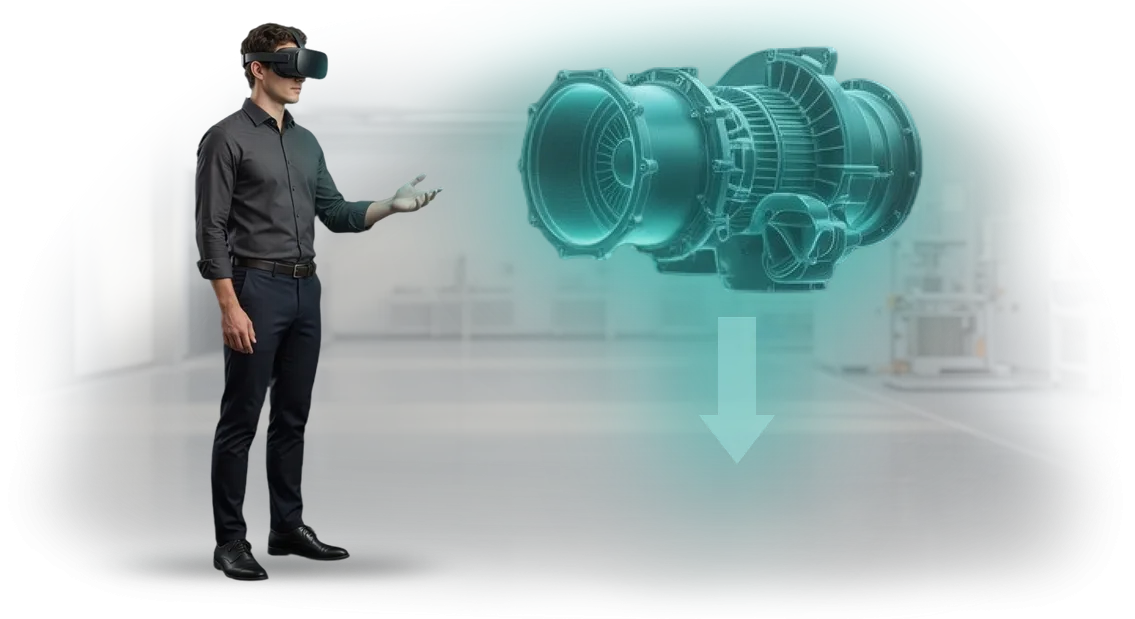
We solve this pain with a VR simulator for training team leaders. The leader enters realistic scenarios: a conflict with a subordinate, a tight deadline, a management crisis, a difficult termination conversation.
They train management skills until they become second nature, make mistakes in a safe environment, and receive a debriefing of their actions — without any harm to the business.
As a result, you get leaders who act confidently in any situation, and the business stops losing profit to expensive mistakes.
Key Benefits of VR Training for Business and Leaders
VR training has long stopped being an experiment — it is now a working tool for companies that want fast, measurable results.
Team leaders get a format that boosts training effectiveness and directly impacts business metrics, while employees get practice without fear of making mistakes.
The first benefit is increased productivity. Employees master skills in an environment that closely mirrors real work situations and immediately apply them in practice. Mistakes don't lead to real losses, and the time needed to adapt to a new role shrinks dramatically.
This is especially important for leaders: the faster a manager is trained, the faster the team grows and hits its targets.
The second benefit is safe practice of complex scenarios. Negotiating with a difficult client, resolving a team conflict, presenting a project to senior management — all of this can be rehearsed without risk to reputation or finances.
Each employee goes through a scenario several times until the skill sticks. As a result, in a real situation the person acts confidently instead of encountering a problem for the first time in front of a client.
The third benefit is lower training costs. No need to rent venues, spend time on trainer travel, or pull a large team away from work.
The program scales to any number of employees without losing quality, and staff onboarding accelerates: a newcomer works with an understanding of processes from the first month rather than by trial and error.
Finally, all of this adds up to sales growth. When managers practice dialogues in a virtual environment, their conversion in real deals increases.
Leaders see a direct link between training and revenue — which is why VR is becoming not just a trendy format but a cost-effective way to develop a team and achieve business goals.
VR Training Formats for Team Leaders: Simulations and Scenarios
Team leaders make decisions under uncertainty — and the price of a mistake in real work is high. VR training makes it possible to safely practice difficult situations: team conflicts, tough negotiations, urgent product launches.
We select different VR training formats for each level of management so the training addresses your specific business challenge.
| VR Training Format | Who It's For | What It Delivers |
|---|---|---|
| Negotiation Simulator | Leaders who meet with contractors and partners | Practice handling objections and arguments without risking relationships |
| Crisis Scenario | Directors and department heads | Skill of quick decisions in emergency situations, testing an action plan |
| Custom Program | Top managers and future leaders | Individual development path focused on weak areas |
| Team Scenario | The entire management team | Synchronized actions and unified response standards |
Simulators for leaders differ from ordinary training programs because they model a real context: subordinates, deadlines, limited resources, and incomplete information.
Training scenarios are built on your own cases, so the leader practices on situations that have already happened in the company or are expected in the coming quarter.
If the task is specific, a short session of three to five virtual meetings is enough. For systematic team growth, we build custom programs with progressively more complex scenarios.
During the initial consultation, we'll recommend a format that will deliver measurable results in your environment.
Stages of Creating VR Training: From Brief to Launch
We've structured the process so you always understand what happens at each stage and what result you get. No "black box": you see how training evolves from an idea into a working tool for your leaders.
- Training brief. We gather your requirements: which skills to strengthen, where leaders most often make mistakes, and what results you want to measure. We agree on timelines and success criteria so we can proceed without misunderstandings.
- Scenario design. An instructional designer turns your business challenge into a VR simulator scenario: situations, dialogues, decision points, and performance evaluation. This is not a "fun game" but a management case practiced in a safe environment.
- Simulator development. Programmers and 3D artists build the virtual environment on professional equipment. You get a stable version that runs on your headsets or ours — whichever is more convenient.
- Simulator testing. We test the scenario together with several leaders from your company. We check whether the instructions are clear, the reactions are realistic, and the action assessment works correctly. We fix any issues before launch.
- VR project launch. We install the program, set up workstations, and briefly train administrators. The simulator is ready: leaders complete it on schedule, and you see the results in a personal dashboard.
- Support and development. After launch, we stay in touch: we update scenarios for new tasks, add difficulty levels, and collect completion statistics. Training keeps working for team development instead of being a one-off experiment.
This approach saves your time: you no longer wait for results "blind," but understand at every step what's ready and what comes next. The result is a simulator your leaders enjoy completing and immediately apply at work.
What's Included in the VR Simulator Delivery: a Complete Business Package
You're not getting "bare code" or a box of equipment, but a ready-to-use tool that works on developing leaders from day one. The delivery package includes every component needed for launch, staff training, and result evaluation — from scenarios to analytics. You won't need to understand the technology; all the technical side is on us.
Here's exactly what's included:
- Adapted VR simulator for team leaders — scenarios with real work situations: conflict dialogues, task assignment, decisions under pressure. Exercises are built around the typical tasks of your managers.
- Staff instructions — short cheat sheets and video guides: an employee can launch the simulator on their own after 15 minutes of familiarization, with no long onboarding.
- Training analytics — clear progress reports for each participant and for the group as a whole. You see which skills are already developed and which need more attention.
- Technical support — setup, platform updates, and prompt assistance for employees with any issues. We're available throughout the entire usage period.
- Methodological materials for trainers — ready-made lesson plans, checklists, and integration scenarios for embedding the simulator into your company's current training system.
- Installation and commissioning — we come to you, deploy the solution, and test all modes. You can start training as early as the next day.
- Scenario updates — you can order new situations to reflect changes in your business processes so training always stays relevant.
This package covers the entire cycle: fast deployment, staff training, result control, and program development. You manage the content and see the effectiveness without worrying about the technical side. All you need to do is set the task — we'll launch the simulator turnkey.
Real Case Study: How VR Trained 100 Leaders in One Month
Before the VR simulator, training team leaders hit the same wall: live training is expensive, and practice with complex negotiations is rare and chaotic. Skills never stuck because each participant experienced only 1-2 scenarios per month — the rest was theory.
We proposed putting managers into a virtual environment where they can train as many times as needed, without risk to clients or reputation.
The result in one month: 100 leaders completed the program, each practicing 12 negotiation scenarios and averaging 6 repetitions of difficult situations. That's many times more practice than in-person formats provide.
Most importantly, the skill transferred into real work: conversion in negotiations with key clients rose by 23%, and the average deal size increased by 11%.
The client's head of learning and development department says: "For the first time, employees are repeating scenarios not because they're forced, but because they want to beat the difficult virtual opponent.
We see real changes in conversations with clients within two weeks." This engagement is no accident — it's the result of gamification and honest feedback from the simulator.
From a return-on-investment perspective, the project paid for itself in 3 months: virtual trainer costs are lower than live off-site training, and the effect lasts longer.
This isn't an experiment for the sake of technology — it's a working tool that generates measurable profit for the business.
How to Choose a VR Training Format for Your Company's Needs?
Choosing a VR training format starts not with technology but with a business challenge.
Answer the question: which skill should team leaders acquire, and how will it affect company metrics — will it reduce turnover, speed up new employees' path to target performance, or improve department manageability. The entire further choice depends on this.
If the goal is to practice specific management situations, short scenario simulators work well: negotiations, conflict, delegation. If you need to change the overall management approach, a comprehensive program with a simulated workday and decision reviews fits better.
For team leaders, interactive cases with feedback are often the choice: they teach acting in real circumstances without risk to the team.
The second criterion is scale and regularity. When training dozens or hundreds of people, scalability matters: the format should run without an instructor on site and fit easily into the work schedule.
For a small circle of top managers, the priority shifts toward scenario depth and personal analytics for each participant.
The third criterion is the VR project budget. It determines the number of scenarios and timelines, but doesn't change the core principle: the format has a minimum effective volume.
Two well-crafted scenarios that change behavior are better than ten templated ones that employees complete just to check a box.
Practical advice: start with a pilot with one group of leaders, evaluate the dynamics, and only then scale. We'll help you choose a format for your tasks and budget, and the pilot project will show measurable results within the first few weeks.
Frequently Asked Questions About Developing VR Training for Business
Doubt that VR training for team leaders is complex, time-consuming, and expensive? We hear these questions from every other client.
Below are answers to the key questions: development timelines, cost of VR training, integration with existing systems, and whether virtual reality is even necessary for leadership training. We answer honestly, drawing on dozens of completed projects.
How long does it take to develop a VR simulator?
Timelines depend on the complexity of the scenarios and the number of training modules. A basic program for building management skills can be launched in 4–6 weeks. We also agree on milestones in advance so you can see progress and plan the launch without delays.
How much does VR training cost?
The cost of VR training is calculated after an audit and depends on the number of scenarios, the number of users, and whether integration with your systems is required. We provide a transparent estimate from the start — no hidden fees.
In most cases, the simulator pays for itself by accelerating leadership preparation and reducing mistakes in real negotiations.
Is it difficult to integrate VR with current training processes?
No. We connect the VR simulator to your learning management system so results automatically flow into the overall reporting. Employees only need a headset and 15 minutes of free time — we'll set up everything else to match your policies and corporate standards.
Why use VR at all when regular training exists?
For team leaders, practicing complex dialogues is essential: giving feedback, handling conflicts, delegating. VR creates a safe environment where you can try different strategies and immediately see the consequences.
This is remembered far better than theory and delivers measurable growth in competencies — without risk to real relationships.
If you have any remaining questions, leave a request, and we'll send project examples for your industry.Start With a VR Training Consultation
For VR training to truly impact your results, it's important to start with a simple conversation. A VR training consultation is an opportunity to ask questions, describe your task, and understand whether the format fits your team.
We don't start selling from the first minute. First, we analyze which skills need to be developed, how many people will be trained, and what result you expect. Based on this, we propose a format, timelines, and an estimated budget. You get a cost calculation without unexpected surcharges.
During the consultation, you'll learn:
- The optimal VR training scenario for your team leaders' specific tasks
- A preliminary cost calculation and budget assessment
- Simulator preparation timelines and implementation stages
- Demo access to a live VR project for quality assessment
- Recommendations for a pilot launch and integration into your current training program
- A list of required equipment and specifications
- A clear action plan without technical jargon
No obligations after the consultation — just useful information and options that fit your needs. If we see that VR training won't solve your problem, we'll say so honestly.
Leave a request for a consultation — we'll get back to you within one business day, answer your questions, and show how VR simulators work in leadership training. The first step is simply a conversation about your goals.