

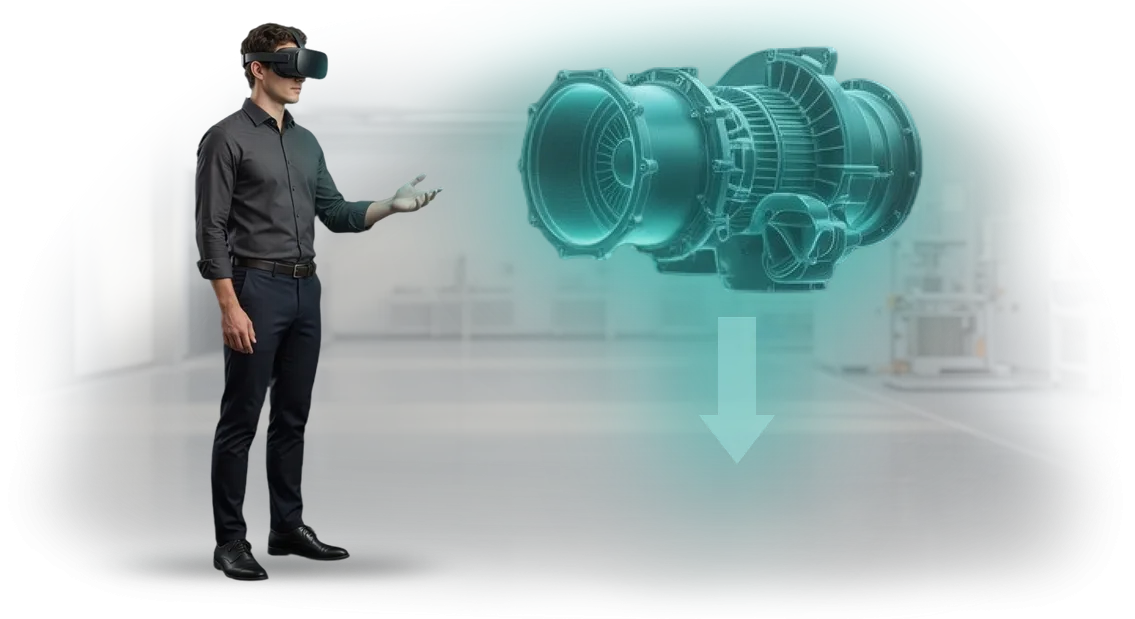
AR VR Chemistry Lab: Training without Risk and Unnecessary Costs
Chemical production is a constant risk: handling caustic substances, high temperatures, and the chance of human error. Every new employee must complete dozens of hours of instruction, but even after that real practice remains dangerous.
Training in an actual laboratory is expensive: reagents, equipment, waste disposal, and the time of experienced mentors. And a novice's mistake can lead to injury, fire, or an environmental incident.
We offer a different path. AR VR Chemistry Lab is a virtual laboratory where employees practice routine and emergency scenarios in a realistic 3D environment.
AR/VR training allows mistakes without consequences: spill a reagent, break a dosage, skip a step — none of this harms either the person or the production. The employee gains practical experience that they immediately carry over to the real process.
The virtual laboratory also solves the financial problem. No need to buy consumables, maintain stands, or set aside a separate room.
The program scales to any number of employees: training runs simultaneously across all branches, and results are automatically recorded for reporting. This format is especially effective for practicing rare and dangerous situations that cannot be safely reproduced in real life.
As a result, the company gets trained employees who know the action algorithms, follow safety procedures, and work confidently even in emergency situations.
We develop such laboratories to match the specific needs of each production — from scenario construction to implementation and support.
What Immersive Training Brings to Your Business
Immersive technologies turn training from a costly process into an investment. According to PwC research, employees trained in a virtual environment master skills on average 3–4 times faster than with classical formats.
This means the company gets a job-ready specialist sooner and starts earning from their work earlier.
Savings on Training
A chemical laboratory is an expensive space: reagents, equipment, waste disposal, and the risk of errors. A VR laboratory replaces most of these costs with virtual models.
Employees train on digital simulations, and real materials are used only at the final stages — training costs drop noticeably, and the frequency of repeat practice grows.
Skills Advancement
The virtual environment lets every employee run a scenario as many times as needed for a confident result. Rare or dangerous operations — emergency shutdowns, work with toxic substances — are practiced without consequences. In the end, personnel gain practical experience that previously required months of mentoring.
Safety and Speed of Implementation
Immersive technologies remove the main risk of in-person training — the novice's mistake. The simulator records every action and prompts the correct sequence.
The company gets a predictable level of readiness: the employee steps up to real equipment with already-formed skills, not just theoretical knowledge.
Performance Evaluation
After each session, the system collects objective data: completion speed, number of errors, reaction time. The manager sees who is ready for independent work and who needs more practice.
This turns training from "something to get through" into a manageable business process with a measurable result.
Training Program Formats for Your Objectives
Training with chemical substances and laboratory equipment is always a risk: a mistake costs reagents, time, and employee safety.
That's why we don't offer one universal course — we select a format for the task: introduce a beginner to the process, refine a complex skill, or support a lab technician during real work.
Every role — from student to experienced technologist — has its own scenario. Below is how we typically compare VR and AR training options: who will learn, how complex the operation is, and what business result you will get.
Format Comparison
| Format | For whom | What it gives the client |
|---|---|---|
| Full-cycle VR laboratory | Students, new employees without experience | Safe practice of the entire experiment from dosing to disposal. Mistakes don't lead to accidents, and the employee arrives at real equipment with the skill already formed. |
| VR simulators for individual operations | Technologists, lab technicians working with hazardous reagents | Automating specific actions: titration, mixing, equipment startup. Fewer errors and lower reagent consumption, higher execution speed. |
| AR instructions on the job | Current personnel on the shop floor or in the laboratory | Step-by-step prompts overlaid on real equipment: what volume to add, where to press. Less waste and less onboarding time, fast ramp-up to target output. |
With this approach, the VR chemistry laboratory stops being an "entertainment" and becomes a working tool: you pay only for the format that actually solves the task.
And if needed, formats can be combined — for example, a full cycle for beginners and short simulators for advanced training.
How an AR/VR Laboratory Project Unfolds
Developing a VR laboratory for training employees and students is a project we run in stages, transparently, with your participation at every step. You won't have to dig into technical details — we speak the language of learning tasks and results, not protocols.
- Brief and audit of training materials. We dive into your specifics: what experiments you run, which reagents and risks need to be conveyed virtually. Takes 1–2 weeks and ends with a technical specification that you approve.
- Methodological scenario. Together with your instructors, we break down every experiment: steps, typical errors, and the reaction to incorrect actions. This is how VR training mirrors the real process instead of turning into a game.
- Prototype development. We build a pilot module around one experiment — you see the graphics, interface, scale, and sense of space. This is our shared beacon: all edits are made before the full build, with no surprises at the finish.
- Full laboratory build. We complete the remaining scenarios and add the hint system, action control, and instructor panel. This is also where we set up AR hints for a blended training format.
- Pilot testing. We run a session with a group of employees or students and collect feedback on material comprehension and headset comfort. Based on the results, we refine the scenarios and interface.
- Launch and team training. We hand over the set of methodological materials and provide instruction for teachers and technical specialists. Your team launches the laboratory and supports the sessions on its own.
- Support and development. After implementation, we stay in touch: we update scenarios, add new experiments, monitor stable operation, and grow the laboratory to meet new tasks.
The project takes 4 to 12 weeks depending on the number of experiments and the depth of development. You influence the result at every stage — from the first brief to launch and subsequent updates.
A client at the Center for Advanced Training noted after launching the laboratory: "We expected employees to be distracted by the new format, but after the first session everyone passed the test better than usual.
Most importantly, we saw the project move from stage to stage and understood what the money was going toward."
What's Included in the AR/VR Solution Delivery
The VR solution delivery includes everything needed to launch a virtual chemistry laboratory at your educational institution. You get not scattered programs but a complete training package — from virtual modules to methodological materials.
- Virtual chemistry modules — a set of scenarios for conducting experiments with substances and reactions that in a regular classroom require complex equipment or are too dangerous.
- Methodological materials and lesson scenarios — ready-made lesson plans, workbooks, and recommendations for integrating VR/AR into the curriculum.
- Instructor workstation — a convenient control panel showing each student's progress, typical errors, and topics that need repetition.
- Customization to your tasks — adaptation of scenarios to student level, course specifics, and existing equipment.
- Instructor course — hands-on training in working with VR/AR and in running classes in the new format.
- Installation and commissioning — our team connects and verifies the system so you can launch training as early as the next semester.
- Support and updates — technical assistance and updates to virtual modules and features for the entire service life.
This way, you get a ready-made system rather than a set of separate programs. The team takes on launch and support; all that's left for you is to integrate the laboratory into the learning process and watch student engagement grow.
Case Study: Virtual Laboratory for Chemical Production
The usual training model for chemists requires expensive reagents, equipment downtime, and the time of experienced mentors. At the same time, a novice's mistakes can cost not only money but also safety — no one will allow practicing emergency situations on a real site.
For the chemical manufacturer KhimProm, we created a virtual laboratory where employees practice safety standards, dosages, and emergency actions.
Scenarios repeat without reagent consumption or risk to people, and the system itself records errors and prompts the correct sequence of operations.
Implementation Results
The first results showed measurable value. Training consumable costs fell by almost two-thirds, and new operator preparation time dropped from three weeks to five days.
The number of errors in practicing procedures fell by 90%, and probation-period turnover stopped being a problem: newcomers see their progress and refine skills to the point of automation.
On an annual basis, this means savings on reagents, mentor salaries, and overtime pay — the exact amount is calculated after audit.
For the company, this is not just a nice demonstration — it is a cost-effective tool that recovers its investment through fewer accidents and less downtime.
Three months later, the client ordered an expansion to the synthesis shop and a scenario for maintenance crews. Once a virtual laboratory proves its value in money and speed, it gets scaled to adjacent areas.
Common Doubts Before Getting Started
Many managers postpone launching VR training because of two fears: "employees won't figure it out" and "the solution will break." For a chemical laboratory these risks are more serious, since safety and precision matter. Both doubts are resolved at the planning stage.
We take on adaptation and the technical side. At every stage — from pilot to launch — engineering support is close at hand, so you don't need to hire a separate specialist.
Will employees resist or fail to master VR?
This is the most common question. We start with short orientation sessions: a person tries a scenario at a relaxed pace and within 15–20 minutes stops thinking about the controls. Then comes instruction, work in the virtual laboratory, and repetition.
We provide guides and videos for reinforcement. Within a week, employees work confidently.
What if the equipment breaks or training comes to a halt?
The equipment is selected to match the intensity of sessions, so failures are rare. We include a backup kit and access to an engineer — replacement and setup take hours, not days. For the AR/VR laboratory, we prepare emergency scenarios so the lesson plan stays intact.
We also set up remote monitoring: with any technical issue, you get a notification, and in most cases our team resolves it without your involvement.
The bottom line: a predictable process with no firefighting. We take the technical issues off your hands, and employees learn at a comfortable pace — that's the confidence you get.How to Choose the Right Format for Your Task?
The choice between VR and AR for a chemical laboratory starts not with equipment but with a question: what exactly should change in how employees work?
If the task is to drill a sequence of actions to automation, safely try dangerous reactions, or teach work with scarce reagents, virtual reality provides full immersion without risk.
If employees need prompts and data directly while working with real instruments, augmented reality is more convenient: it overlays instructions onto the physical object and reduces the number of errors.
Before proposing a solution, we conduct a needs audit: we review current training scenarios, typical novice errors, safety requirements, and how you evaluate results.
This is how we understand which format will deliver quick results in your particular case, rather than simply choosing a trendy technology. One task may only need a short 15-minute VR simulator; another may need full AR guidance for work in a real laboratory.
The guideline is simple: if the skill needs to be reinforced through repeated practice — choose VR. If you need to improve the accuracy and speed of actions at the real workplace — take a closer look at AR.
In both options, the employee gets a safe environment for mistakes, and you get clear progress statistics: how many attempts were needed, where difficulties arise, and whether the material was learned.
We don't sell a "one-size-fits-all solution" — we match the format to your tasks and budget.
After a short audit, you receive a recommendation with a rationale: which training format will pay off faster, how it will fit into your current training program, and which employee performance metrics will improve first. This way, you make a decision based on facts, not assumptions.
Ready to Discuss Your Task? Get a Proposal
Let's discuss your task and prepare a proposal for your training format. No abstract presentations — only specifics: what's included in the project, how long development will take, and how the VR laboratory will affect employee training.
We'll ask the right questions so the proposal accounts for your specifics, and we'll also send examples of virtual laboratory scenarios.
After your request, you'll receive:
- A consultation with engineers and methodologists — we'll review how VR training fits into your training programs, where it speeds up onboarding, and where it replaces expensive hands-on labs.
- Cost and timeline calculation for your scale: for a group, training center, or branch. We'll show how the investment pays off through lower reagent consumption and reduced instructor time.
- A demo of VR chemistry scenarios — real examples, not screenshots. You'll see the workstations, tasks, and the result assessment system.
- An implementation plan: what we launch first, how we integrate training into your current system, and how we measure each employee's progress.
- Clear terms of engagement: stages, checkpoints, and post-launch support. We stay in touch and adjust scenarios if requirements change.
Take the first step — send a request. It's non-binding, but you'll get an accurate picture of the training ahead. We'll prepare a solution that employees will actually use, not just open to check a box.