

Audit of 1C-Bitrix Site Integrations
We have audited integrations on hundreds of Bitrix projects over more than 10 years. Integrations are the most fragile part: the 1C exchange silently fails at 3 AM, a payment system stops working after an API update on their side, a marketplace integration creates duplicate orders. Without monitoring and documentation, these problems are discovered only through customer complaints or during the next crisis. Our audit is a complete inventory of all connections and an assessment of their reliability. You get a transparent picture and a clear plan to eliminate risks. Evaluate your project in 1 day — just contact us.
Why integration audit is critical for an online store?
A seemingly minor error in the 1C exchange can lead to shipping the wrong product, a 20% discrepancy in stock, and losing up to 15% of orders. We have seen projects where a payment gateway integration had no error handling — when the payment server was unavailable, the order simply hung without notification. After our audit, clients save up to 40% of support time and prevent up to 90% of incidents.
Integration Map
The first step is to compile a complete list of integrations. An average Bitrix site has 5–15 integrations, often with some undocumented. We find them all, including hidden or forgotten ones:
| Type | Examples | Mechanism |
|---|---|---|
| ERP/Accounting | 1C: Enterprise | CommerceML, REST |
| Payment Systems | Sberbank, YooKassa, Stripe | sale.payment modules |
| Delivery | CDEK, Boxberry, Russian Post | API modules |
| CRM | Bitrix24, amoCRM | REST API |
| Marketing | SendPulse, GetResponse | SMTP, REST |
| Analytics | GA4, Yandex.Metrica | JS counters |
| Marketplaces | Wildberries, Ozon | REST API |
| Call Tracking | CoMagic, CallTouch | JS + webhooks |
How we check 1C exchange?
The 1C exchange is the most problematic integration. We check:
Exchange Log
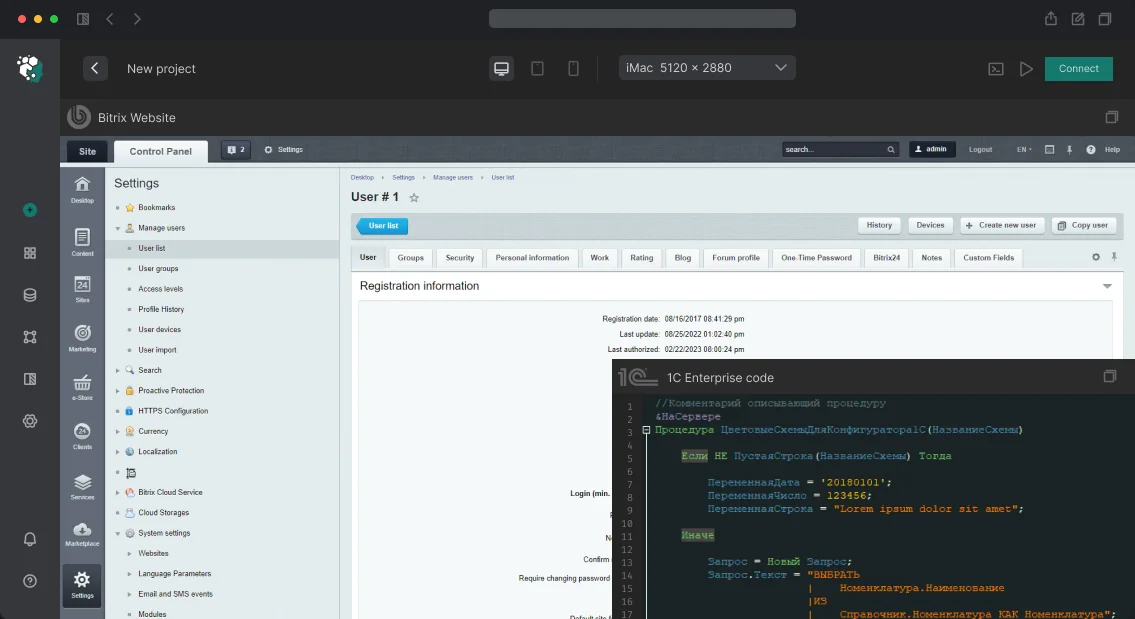
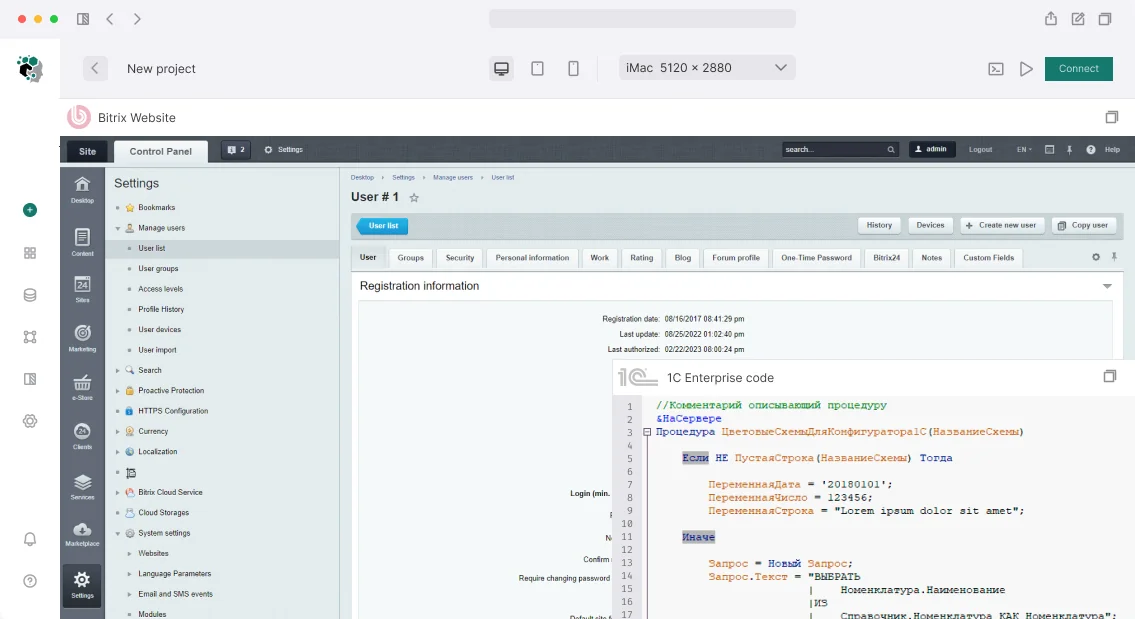
In Bitrix: Desktop — 1C-Bitrix — Data Exchange. We look at the last sync dates and errors in the log. The log is stored in files /bitrix/modules/sale/sync/ and in the database — table b_catalog_import_log.
Data Integrity
We perform a sample check: 10–20 random products compared between the site and 1C for prices, stock, availability. Discrepancies indicate a mapping problem or data loss during transfer. On average, we find 3–5% discrepancies that lead to duplicates or lost orders.
Schedule
We check the cron job for exchange: whether it runs on time, whether there are stuck processes (ps aux | grep import). Without a proper schedule, the integration works unstable.
CommerceML Format
When parsing errors occur, we examine the structure of XML files in /bitrix/catalog_import/. Common reasons: invalid characters in product names, exceeding PHP memory limit when importing a large file. More details about the format can be found in the CommerceML documentation.
Checking Payment Integrations
For each payment system:
- Last successful transaction (from
b_sale_order_payment) - API key validity (expiration, rotation)
- Webhook configuration for payment confirmation — URL must be accessible from the internet
- Error handling: what happens when the payment gateway is unavailable? Often we see that the site just shows an error, and the order hangs.
Comparison: Audit vs Self-Check
| Criteria | Self-Check | Our Audit |
|---|---|---|
| Coverage | 40–60% (hidden integrations often missed) | 95–100% |
| Time | 2–3 days to find and analyze | 3–5 days turnkey |
| Report Quality | Scattered notes | Structured report with priorities |
| Risk of Missing Critical Issue | High | Minimal — cross-checking |
What is included in integration audit
- Compiling a complete map of project integrations
- Checking logs and status of exchange with 1C, CRM, marketplaces
- Verifying API key and certificate validity
- Reliability assessment: error handling, monitoring
- Sample check of transmitted data integrity
- Final report with recommendations for risk elimination
Examples of typical errors we find
In one project, the integration with a mail service used SMTP without encryption, leading to password leakage. In another, a payment system API key was compromised and exposed in a public repository. We also often find integrations running in 'blind' mode: errors are logged, but nobody reads them.Final Report
For each integration: status (working / working with issues / unknown), last check date, identified risks, recommendations. Separately — a list of integrations without monitoring (failure will only be detected manually). We also provide a urgency assessment: which problems need to be fixed immediately, which can be planned. After the report, you can order turnkey integration improvement — our engineers will fix all identified issues, set up monitoring, and alerts. Contact us — get a preliminary assessment in one day. Order an audit — and within 5 days, you'll know all the weak points of your project.