

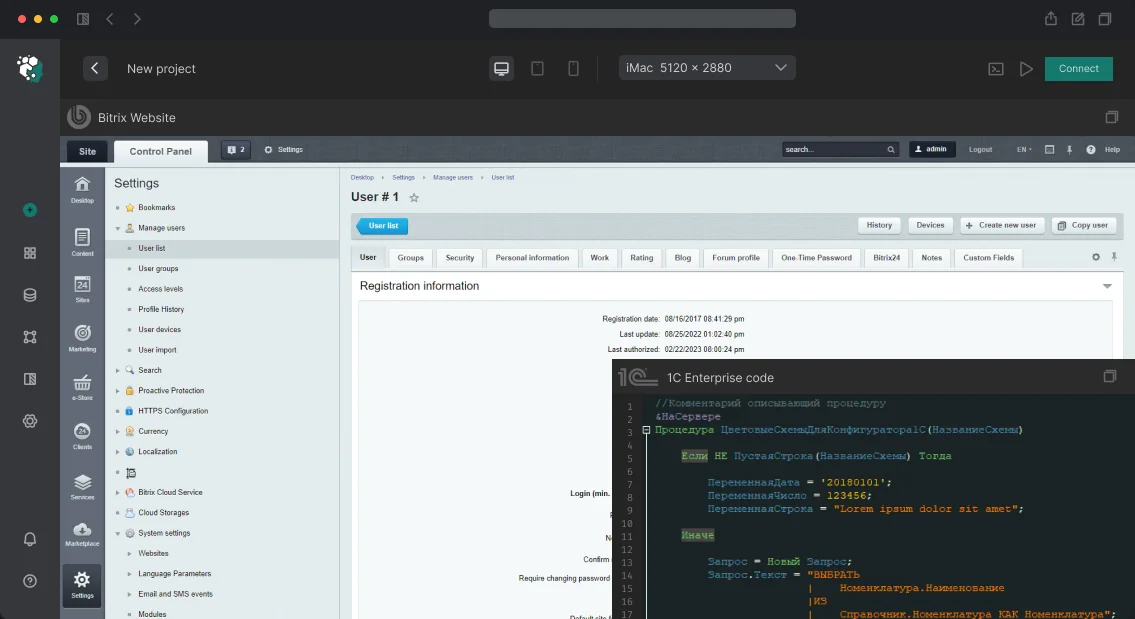
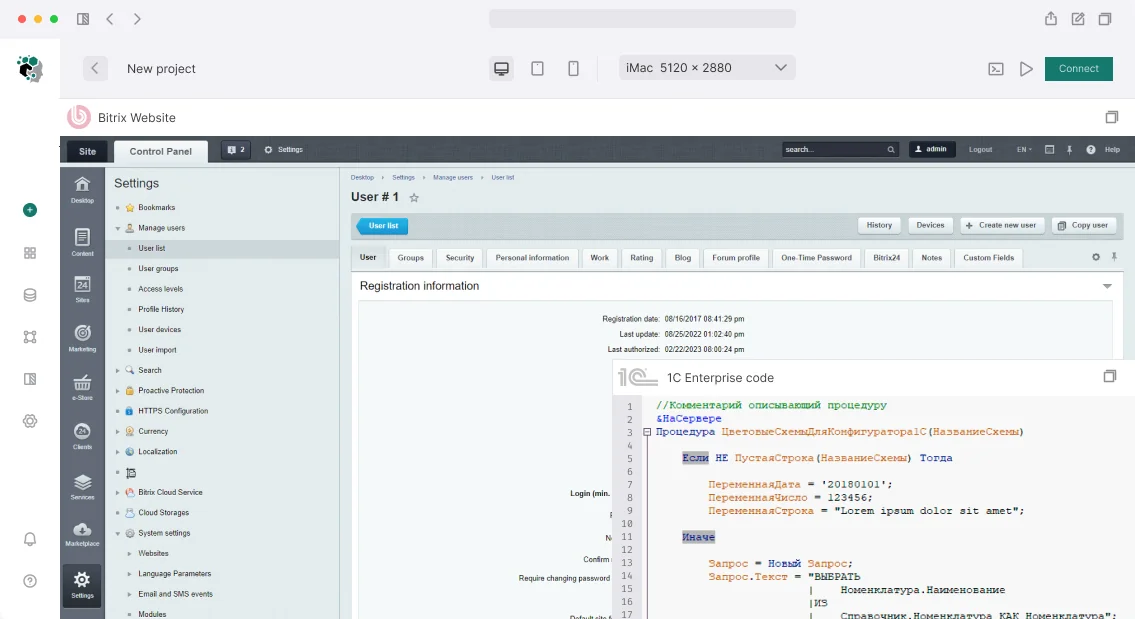
Overbooking due to manual reservation transfers is a classic revenue loss scenario for hotels. According to our statistics, up to 15% of bookings are lost due to delays or errors during double entry. A manager receives a request via the website on Bitrix, manually enters the reservation into Bnovo, then manually updates room availability back to the website. Two sources of truth—two places for errors. We've encountered this dozens of times. Our goal is to make the booking system and CMS communicate directly, without human intervention. This not only speeds up the process by 3 times, but also completely eliminates the risk of overbooking. Admin time savings reach 70%, and the cost of processing one booking is reduced by 2–3 times. For a typical hotel with 50 monthly bookings, admin time savings amount to about €300 per month, reducing costs by €3,600 annually.
Our bitrix bnovo integration leverages bnovo rest api for seamless data exchange between the PMS system for hotels and the website's bitrix booking module, ensuring bnovo webhooks handle real-time updates.
Bnovo is a PMS system for hotels with its own channel manager and REST API. Authorization is via the hotel's API key in the X-Api-Key header. Main entities: rooms, reservations, rates, availability. Direct integration via API is 3 times faster than ready-made modules—no need to wait for vendor updates. We guarantee no overbooking and stable synchronization.
Solving manual entry problem with 1C-Bitrix and Bnovo integration
Integration architecture
Bnovo provides a REST API (https://online.bnovo.ru/api/v1/). Data flow directions:
- Bnovo → Bitrix: synchronization of room availability and rates—so the widget on the site shows current occupancy.
- Bitrix → Bnovo: transfer of new reservations created via the site.
We avoid intermediate storage—data is transferred directly via API with caching on the Bitrix side.
Availability synchronization
Bnovo returns availability via GET /api/v1/availability?hotel_id={id}&date_from=YYYY-MM-DD&date_to=YYYY-MM-DD. The response contains an array of dates with the number of free rooms for each type.
A Bitrix agent runs every 10 minutes and updates the local availability cache in the bl_bnovo_availability table:
CREATE TABLE bl_bnovo_availability (
    room_type_id INT NOT NULL,
    date DATE NOT NULL,
    qty_available SMALLINT NOT NULL DEFAULT 0,
    synced_at TIMESTAMP NOT NULL,
    PRIMARY KEY (room_type_id, date)
);
The online booking widget on the site queries this table—without calling the Bnovo API in real time. This reduces dependency on external service availability and speeds up form response. API response time is under 500ms on average.
Creating a reservation in Bnovo from Bitrix
After successful order payment (event OnSalePaymentEntitySaved when IS_PAID = Y), the handler forms a request to Bnovo:
$response = $bnovoClient->post('/api/v1/reservations', [
    'hotel_id' => $this->hotelId,
    'room_id' => $roomId,
    'date_from' => $booking->getDateFrom()->format('Y-m-d'),
    'date_to' => $booking->getDateTo()->format('Y-m-d'),
    'rate_id' => $booking->getRateId(),
    'guest' => [
        'name' => $order->getPropertyValueByCode('NAME'),
        'phone' => $order->getPropertyValueByCode('PHONE'),
        'email' => $order->getPropertyValueByCode('EMAIL'),
    ],
    'amount' => $payment->getSum(),
    'source' => 'website',
]);
$bnovoReservationId = $response['reservation']['id'];
reservation_id from the response is saved in the order's UF field UF_BNOVO_RESERVATION_ID—this is necessary for subsequent operations (cancellation, date changes).
Webhooks from Bnovo
Bnovo can send webhooks when the status of a reservation created inside the PMS (not via the site) changes. Setup is in the "Integrations" section of the Bnovo control panel: specify the handler URL on the Bitrix side.
Handler /api/bnovo-webhook.php:
$payload = json_decode(file_get_contents('php://input'), true);

// Signature check: HMAC-SHA256 of request body + secret key
$expectedSign = hash_hmac('sha256', file_get_contents('php://input'), BNOVO_WEBHOOK_SECRET);
if (!hash_equals($expectedSign, $_SERVER['HTTP_X_BNOVO_SIGNATURE'] ?? '')) {
    http_response_code(403);
    exit;
}

switch ($payload['event']) {
    case 'reservation.created':
        // Create an order in Bitrix or notify the manager
        break;
    case 'reservation.cancelled':
        // Cancel the order in Bitrix
        BnovoSyncService::cancelOrder($payload['reservation_id']);
        break;
    case 'availability.updated':
        // Invalidate availability cache for affected dates
        BnovoCache::invalidate($payload['room_type_id'], $payload['dates']);
        break;
}
Source: Bnovo REST API documentation.
Why direct REST API integration is better than ready-made modules?
Ready-made modules from the Marketplace often do not cover hotel specifics: unique rates, complex cancellation rules, integration with cash registers. Direct REST API gives full control. Our team has 8+ years in hotel automation and 1c-bitrix hotel projects, and has implemented 50+ integrations with PMS systems. We write code for your scenario, not adjust your business to a module. Secure bitrix data exchange ensures consistency across all channels.
Rates and seasonal prices
Bnovo stores rates—pricing rule sets. The GET /api/v1/rates method returns a list with conditions: minimum nights, date restrictions, meal type. We sync rates into the bl_bnovo_rates table once an hour—they change rarely.
On the booking form on the site, rates are loaded via AJAX: the user selects dates, the site requests current rates with prices via GET /api/v1/rates/prices?room_id=X&date_from=...&date_to=... and displays accommodation options.
How to set up integration in 6 steps
- Obtain an API key from Bnovo via the control panel.
- Create the
bl_bnovo_availabilitytable in the database. - Set up a Bitrix agent for availability synchronization (period 10 minutes).
- Implement the
OnSalePaymentEntitySavedevent handler to transfer reservations. - Configure webhook notifications in Bnovo (reservations, cancellations, availability updates).
- Test synchronization on a staging site and perform load testing.
What's included in the integration work?
| Deliverable | Description |
|---|---|
| Analytics and design | Description of data flows, synchronization scheme selection |
| Bnovo API client | PHP library with caching and retry support |
| Availability synchronization | Bitrix agent with 10-minute period, bl_bnovo_availability table |
| Reservation transfer | OnSalePaymentEntitySaved event handler |
| Webhook handler | Receiving and verifying signed notifications |
| Rate synchronization | Periodic agent (once an hour) |
| Testing | Load testing, data correctness checks |
| Documentation | Synchronization scheme, monitoring instructions |
Implementation timeline
| Stage | Duration |
|---|---|
| API client and authentication setup | 1 day |
| Availability synchronization (agent + table) | 2 days |
| Transferring reservations to Bnovo on payment | 2 days |
| Webhook handler from Bnovo | 1–2 days |
| Rate synchronization | 1 day |
| Testing and debugging | 2 days |
| Total | 9–11 days |
The cost is calculated individually. We'll evaluate your project after getting familiar with your current site architecture. Get a demo access to the integration or order a pilot project. Contact us for a consultation. We guarantee stable synchronization operation: we monitor all critical channels together with your team.