

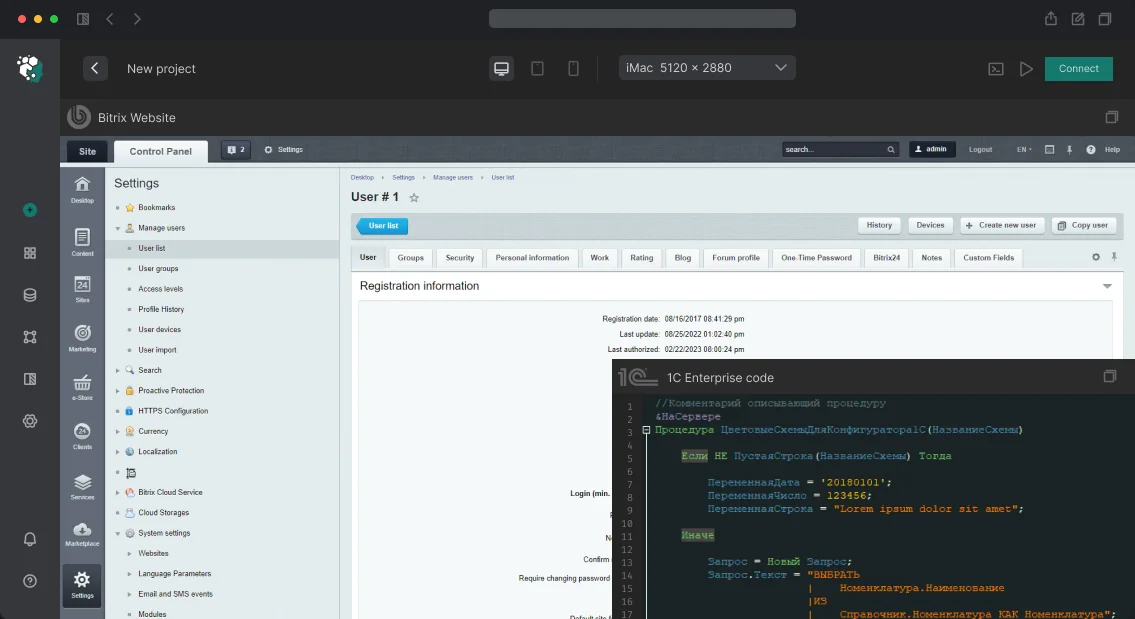
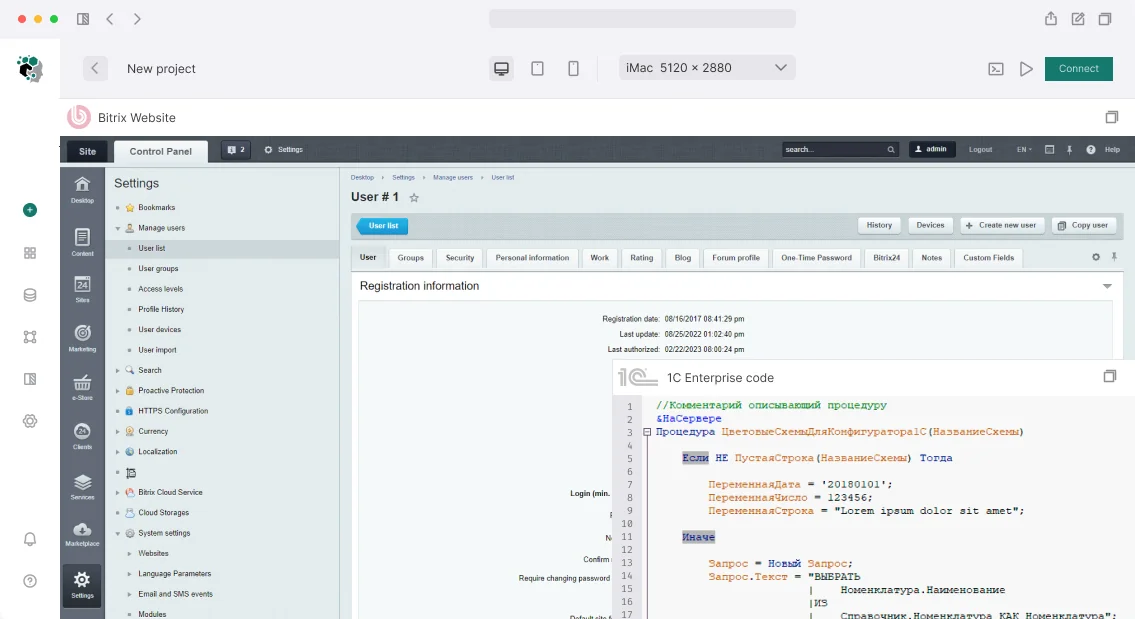
We've repeatedly encountered situations where a client uses 1C UNF and wants to synchronize the catalog and orders with a Bitrix site. UNF is the choice of small businesses that run CRM, warehouse, and sales in one place without the excessive complexity of ERP. Integration with Bitrix here works differently than with UT or KA: UNF lacks a full-fledged CommerceML exchange mechanism in the old style, but it does have REST API and Bitrix Drive — the official connector from 1C. Setting up the exchange requires understanding protocols and common errors: for example, item variants don't always map correctly to SKUs, and standard CommerceML does not transmit serial numbers. We'll cover two paths and show how to avoid duplicates and freezes.
How to Choose the Exchange Method?
Path 1: CommerceML (classic). UNF supports the standard exchange protocol via /bitrix/admin/1c_exchange.php. Nomenclature, prices, stock balances are exported, and orders are imported. It works, but with limitations: no full characteristics, no serial numbers, and CRM documents are not transmitted. Read more about the protocol at CommerceML.
Path 2: REST API + Webhooks. UNF from version 1.6 has a built-in HTTP service. Bitrix can poll it or receive push notifications about changes. This path is more flexible but requires development on both sides.
For most tasks (catalog + orders), CommerceML is sufficient. REST is needed when transferring non-standard objects: CRM deals, tasks, documents.
How to Set Up CommerceML in UNF Step by Step
- Go to Company → Integration → Exchange with site.
- Specify the site URL (e.g.,
https://example.com) and credentials (login/password for 1C exchange). - Select item groups for export — tick only those that should appear on the site.
- Set the price type (retail or wholesale) and choose warehouses for stock export.
- Configure order status mapping: in UNF, statuses are "New", "In Progress", "Completed", "Cancelled" — map them to your site's status chain.
- Run a test exchange manually via the "Run Exchange" button.
Orders from Bitrix to UNF
Orders are created in UNF as "Customer Order". The counterparty is created automatically from order data. Order processing takes an average of 2 seconds during synchronization. "Previously, status updated once every 15 minutes; now clients see changes instantly. That increased loyalty." — client, a service center.
Critical point: statuses. In UNF, an order goes through statuses: New → In Progress → Completed / Cancelled. In Bitrix, there is its own status chain. The mapping is configured in the exchange node. If not configured, orders in UNF will hang in "New" status.
Reverse status synchronization — when a manager changes the order status in UNF, this change must reach Bitrix. Standard exchange supports this: at the next exchange session, the order status is updated in Bitrix. But there is a delay equal to the exchange interval (usually 5–15 minutes).
Why REST API Is Faster Than CommerceML?
With CommerceML, synchronization delay is 5–15 minutes. For service companies where the client waits for repair status updates, this is critical. REST API with webhooks gives instant feedback — delay drops to 1–2 seconds. Over 90% of our clients with a service model choose REST.
Case Study: Service Center (from our practice)
Our client — a service center for equipment repair. They use UNF for CRM (client requests, repair history), and the site has a request form and customer personal account.
Task: website request must go to UNF as "Inquiry", and the client must see the repair status in the personal account on the site.
Solution: used UNF REST API. When the form is submitted on the site:
- Bitrix creates an order in its system.
- A script makes a POST request to the UNF HTTP service: creates an inquiry.
- UNF returns the inquiry ID; Bitrix saves it in a custom order field.
For reverse status synchronization — webhook from UNF: when the inquiry status changes, a POST request is sent to a Bitrix endpoint, which updates the order status.
Status synchronization delay: 0 (instant via hook) instead of 5 minutes with polling.
Example webhook configuration
{ "event": "crm.invoice.status.update", "url": "https://site.bitrix24.ru/rest/1/токен/hook.php" } Process Overview
| Stage | Duration | Result |
|---|---|---|
| Analysis of current data structure | 1–2 days | Schema of matching nomenclature and orders |
| Setup of CommerceML or REST | 2–3 days | Working exchange in test environment |
| Testing and debugging | 1–2 days | Error handling, duplicate cases |
| Documentation and training | 0.5 day | Operator instructions |
A typical project takes 5 to 7 days. Cost is calculated individually, but average time savings on synchronization is up to 90%.
What's Included in the Work
- Data structure and exchange schema analysis — 1–2 days
- CommerceML or REST API setup — 2–3 days
- Scenario testing (orders, nomenclature, statuses) — 1–2 days
- Documentation for operators and administrators — 0.5 day
- Employee training (1–2 hours) — included
- Post-launch support for 2 weeks
UNF Integration Limitations
| Parameter | UNF | UT 11 |
|---|---|---|
| Item characteristics | Variants (limited) | Full characteristics |
| Multiple warehouses | Yes | Yes |
| Serial accounting | Yes (basic) | Yes (extensive) |
| REST API | Yes | Limited |
| CRM objects in exchange | Only via REST | No |
| Max catalog items | up to 20,000 | up to 100,000 |
| Synchronization speed | 5–15 min (CommerceML), 1–2 sec (REST) | Depends on volume |
UNF is well-suited for integration if the catalog is small (up to 20,000 items) and lacks complex characteristics. If the business grows — plan for migration to KA or UT without rebuilding the site (preserve XML_ID of nomenclature).
Typical Errors and Checklist
- Status mapping not configured — orders hang.
- XML_ID of nomenclature mismatch during exchange — duplicates.
- All item groups uploaded, including service ones — clutter on site.
- Serial numbers used but CommerceML does not transmit them — need REST.
Conclusion
Our engineers hold 1C and Bitrix certifications, have over 5 years of experience, and have completed more than 50 integration projects. We guarantee seamless exchange without data loss. Order a turnkey setup — timeline from 5 days. Contact us for analysis of your project – get an engineer's consultation.