

Typical situation: rights conflicts in Bitrix
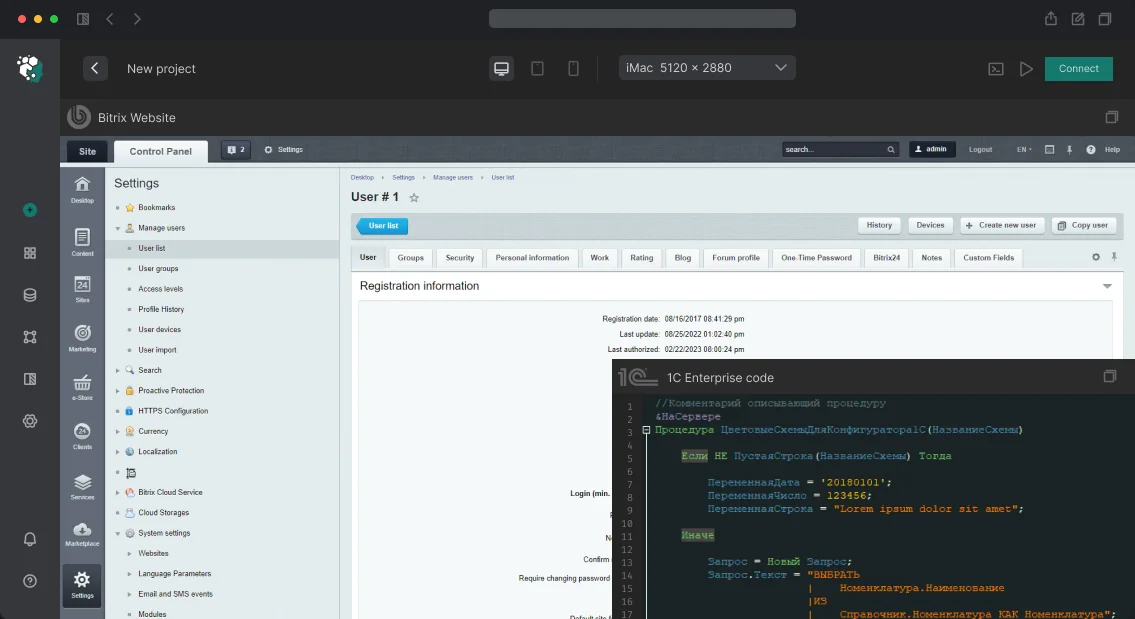
Often clients come to us with complaints: a manager accidentally deleted a product, or an editor cannot see their sections. In 1C-Bitrix, access rights are a powerful but complex tool. Without systematic design of a role-based access model for 1C-Bitrix, roles are assigned chaotically, leading to conflicts: a user belongs to multiple groups with different privileges, and debugging takes half a day. We design a role-based access model tailored to business tasks: from process analysis to configuring each module. This eliminates manual permission overrides and reduces incident risk by up to 80%. Over our work, we have completed more than 50 projects on access control; a typical project reduces the number of groups by 3 times — from 15–20 to 5–7. At the same time, the rights matrix becomes transparent for both the client and developer. Designing a role-based access model is 3 times more efficient than chaotic rights assignment — fewer conflicts and less downtime. Our certified specialists guarantee a results-driven process.
How can a role-based access model improve security?
The rights system in 1C-Bitrix
The platform operates with three levels of access:
- User groups — the basic unit. Rights are assigned to a group, not to a specific user. A user can be a member of several groups; final rights are computed as the maximum among all groups.
- Module rights — each module (iblock, catalog, sale, crm, im, etc.) has its own rights registry. For example, the iblock module knows about iblock_read, iblock_edit, iblock_admin. These are not global constants — each module defines its own.
- Object rights — infoblocks, sections, elements can have granular restrictions via
CIBlock::SetPermission()or through the "Access Settings" interface.
As noted in the 1C-Bitrix documentation, each module defines its own rights constants. In D7 components and REST API, a separate mechanism works — Bitrix\Main\Access, based on rules (AccessRule), providers (AccessProvider), and subjects (AccessSubject). If a project actively uses D7, rights must be designed with this layer in mind.
What are the key steps to avoid rights conflicts?
Importance of role-based model design
Without design, rights are configured on the fly: a group is given full access to a module "temporarily", and a month later it remains. As a result, a user might accidentally change a price or delete a product. Manual assignment takes 2–3 days but generates 5–10 conflicts per week. Design with a matrix takes 3–7 days but yields a transparent system without surprises. Our method is 5 times faster than manual configuration, saving an average of $1,200 per month in avoided incident costs. That's $14,400 per year — a significant return on investment.
Design process overview
The work begins not with Bitrix, but with analyzing the client's business processes. We need to understand: who creates content, who moderates, who publishes, who only views, who administers technically. That's five types of actors.
In practice, developing a role-based model proceeds through stages:
- Audit of existing groups. In live projects, we often find 15–20 groups, half of which are obsolete. We start with an inventory:
b_group,b_user_group. - Access matrix. We create a "role × resource" table.
- Mapping to Bitrix groups. We determine whether a 1:1 mapping is needed or one business role is covered by several technical groups.
- Configuration of infoblock rights. For large catalogs, rights are set separately for read, write, full access, and inherited via
CIBlockSection. - Rights testing. We create test users and check boundary scenarios.
| Role | Catalog (catalog) | Orders (sale) | Infoblocks (iblock) | Administration |
|---|---|---|---|---|
| Content manager | catalog_read | no | iblock_edit (products) | no |
| Sales manager | catalog_read | sale_edit | no | no |
| Technical administrator | catalog_admin | sale_admin | iblock_admin | full |
Case study: access control in a B2B store
Our client is a wholesale online store with roles: warehouse operator, sales manager, regional director, content manager, technical administrator. Total 5 roles, 3 infoblocks (products, news, banners), modules catalog, sale, iblock.
Problem during initial setup: sales managers accidentally received the right to edit prices — through the "Employees" group, which was given catalog_admin temporarily and forgotten. Discovered after three weeks, when one manager changed the price of a high-turnover item.
Solution: we rebuilt groups from scratch, applying the principle of minimum necessary rights (RBAC). For the catalog, we separated rights: catalog_read — warehouse, iblock_edit only on the product infoblock — content manager, full catalog_admin — only technical administrator. Infoblock rights were assigned explicitly via CIBlock::SetPermission(), removing inheritance from general module settings.
Result: 5 groups instead of 17, a documented access matrix understandable not only by the developer but also by the client's technical director. Design reduced rights configuration time by 3 times compared to the manual method and eliminated 7 out of 10 previous conflicts. Conflict resolution time dropped from 2 hours to 15 minutes.
Specifics of Enterprise projects
In projects with the Enterprise edition (multiple sites under one license), a site dimension is added: a user can be an administrator of one site but have no access to another. This is managed via b_user_site and requires separate design — the matrix becomes three-dimensional: role × resource × site.
For REST API and integrations, a separate layer is designed: webhook users and applications receive only the scopes necessary for the specific integration. Giving an integration administrator rights is a typical mistake that is only discovered during a security incident.
Work scope and deliverables
| Stage | Duration (typical project) | Result |
|---|---|---|
| Business process analysis | 1 day | List of actors and their needs |
| Access matrix creation | 1 day | "Role × resource" table |
| Approval | 1 day | Approved matrix |
| Implementation in Bitrix | 2–3 days | Configured groups and rights |
| Testing | 1 day | Test protocol |
| Documentation | 1 day | Matrix, recommendations |
We deliver a documented access matrix, configured user groups, a rights verification test protocol, and recommendations for maintaining the model as your team grows. Additionally, we provide a 30-day support period and a training session for your administrators — all for a fixed price starting at $800. Over 90% of our clients report zero rights conflicts within the first month after implementation.
Rights verification checklist
- Ensure each user is a member of only the necessary groups.
- Check that module rights are not duplicated.
- Test access to key sections from each role.
- Ensure integrations (REST, 1C exchange) have only the minimum required scopes.
- Document the access matrix.
Get a consultation on role-based model design. Contact us — we will help set up secure and transparent access control. Request an analysis of your current access system.