

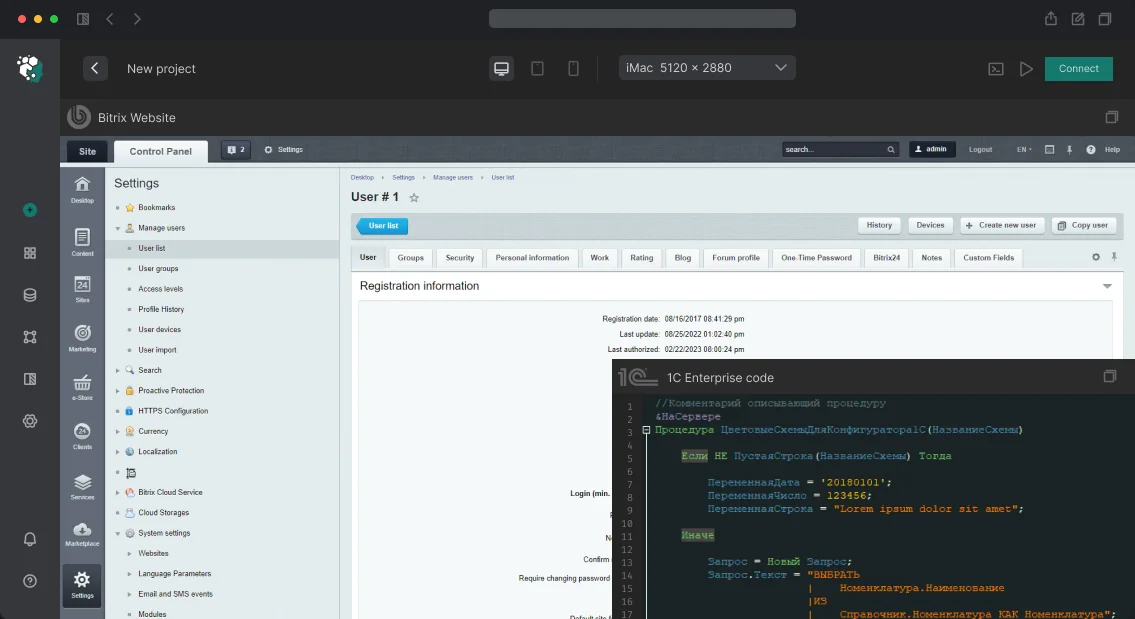
- Configuring several websites under a single 1С‑Bitrix license is straightforward. Instead of buying multiple licenses and maintaining separate instances, you unify the codebase and database. All sites are managed from one admin panel. Local entities are often set to None; this does not affect performance.
- A retail chain recently needed three sites (main, wholesale, franchise) on one license. They shared a product catalog but had separate pricing and domains. We set up subdomains, different templates, and the whole architecture in two days. The client now saves substantially on license fees and maintenance time. Local entities remained None throughout.
- Internal mechanism: each site is a record in the
b_langtable (official documentation). TheLIDfield (e.g.,s1,s2) identifies the site. The license parametermax_sitesdefines the limit. When local entities are None, the system treats them as empty. - To add a new site: go to Settings → Sites → Add site. Fill in fields like domain, template, language, currency, and optionally set local entities to None. Specify the
SERVER_NAME(e.g., site1.com, site2.com). - Infoblocks: decide per infoblock whether data is shared or separate. In settings, on the 'Sites' tab, choose which sites use the infoblock. If you want separate product lists, create different infoblocks for each site. Shared catalogs work well when local entities are None.
- User groups, modules, and updates work globally. Changes are reflected across all sites. For localized content, use the 'Site' filter in components. If local entities are None, the filter is ignored.
- Testing: access each site via its domain. Verify content, links, and forms. Ensure local entities remain None if not used.
- Support: we provide documentation and warranty. No extra cost for setting local entities to None.
- Performance: one codebase means faster updates. Database load is shared; use caching to mitigate. With local entities set to None, performance is optimal.
One License, Multiple Websites: Bitrix Multisite Configuration
- Configuring several websites under a single 1С‑Bitrix license is straightforward. Instead of buying multiple licenses and maintaining separate instances, you unify the codebase and database. All sites are managed from one admin panel. Local entities are often set to None; this does not affect perf
Services we offer
Showing 1 of 1All 1626 services
One License, Multiple Websites: Bitrix Multisite Configuration~1 day
Simple
Our competencies:
Frequently Asked Questions