

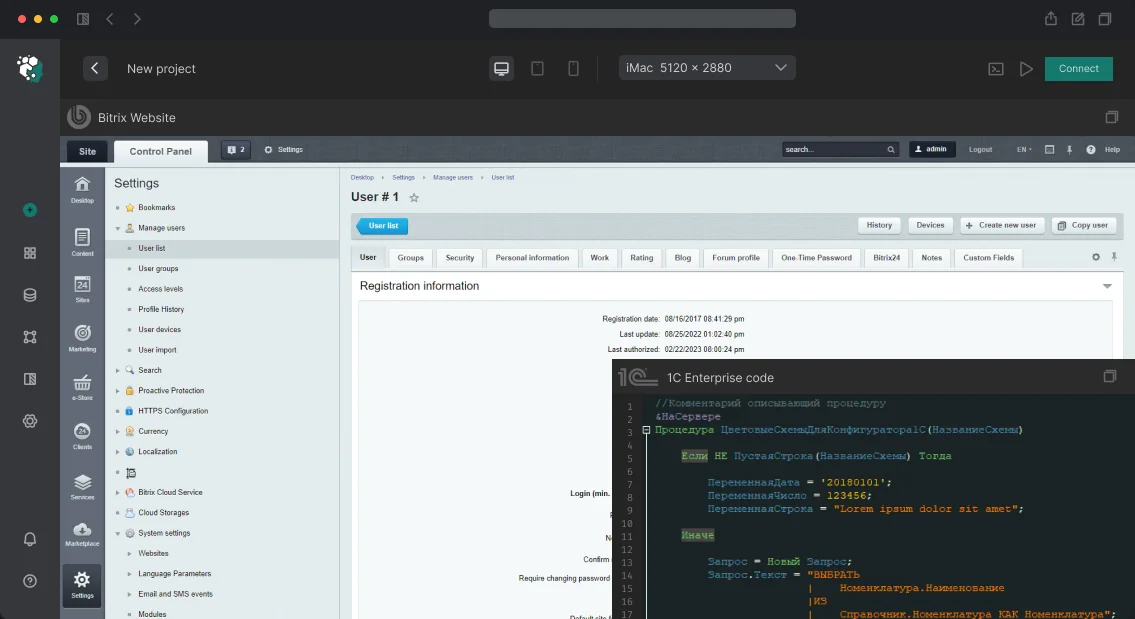
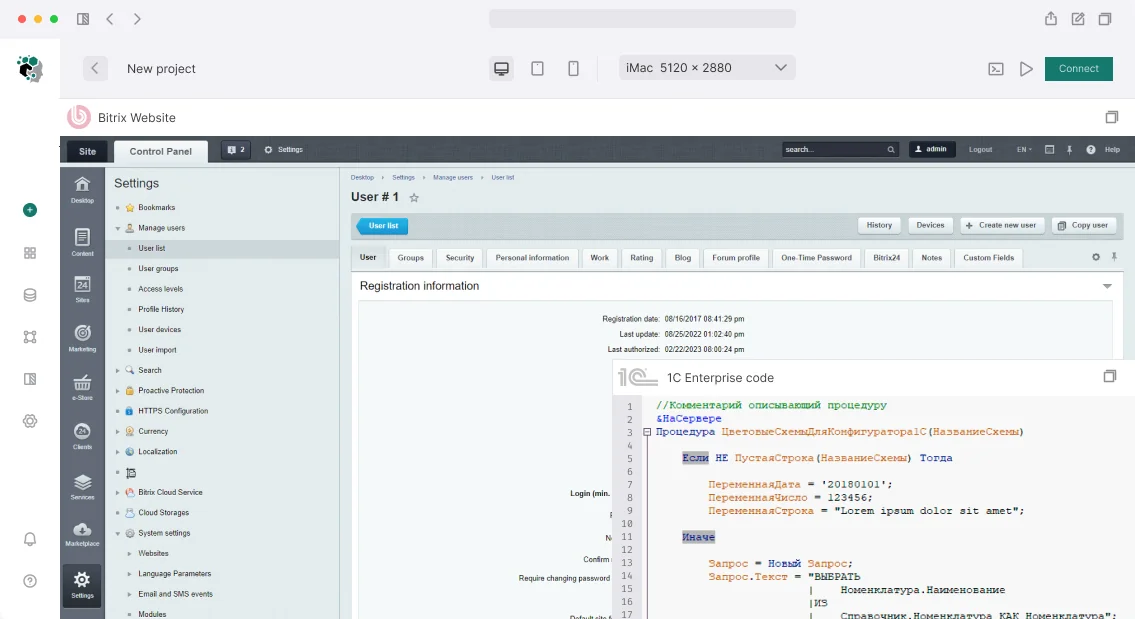
Your budget for custom development has run out, but processes are still manual. In-house developers are busy, and Bitrix24's low-code tools—robots, smart processes, and business processes—remain unconfigured. We've seen companies that purchased licenses but ended up with automation chaos: conflicting robots, stuck processes, unsynchronized stages. We configure low-code turnkey on Bitrix24: from audit to testing—without unnecessary code and with stability guaranteed. Our team has substantial experience in Bitrix24 low-code automation, having completed 50+ projects over 6 years.
How to set up smart processes for typical scenarios?
Smart processes are custom CRM entities with their own stages, fields, and automation. They allow creating a business object without writing PHP. Typical uses: contract approval, complaint handling, equipment tracking. Smart processes are 5x faster to set up than custom PHP modules. Using low-code robots reduces development time by 70% compared to traditional scripting.
Configuration includes five steps:
- Create the entity: CRM → Settings → Smart Processes → Create. Set the name and link to a funnel.
- Stages: define the sequence—draft, pending approval, approved, rejected.
- Fields: types—string, number, date, link to user or CRM entity.
- Access rights: roles—administrator, manager, head.
- Automation: robots and triggers on stage change.
Typical mistakes and durations
| Stage | Duration | Typical Mistakes |
|---|---|---|
| Entity creation | 30 minutes | Incorrect funnel linking |
| Field setup | 1 hour | Too many fields |
| Access rights | 30 minutes | Forgetting to close editing |
| Automation | 2 hours | Robot conflicts |
Smart processes are available on Professional and Enterprise plans. Basic smart process configuration starts at $500; complex business processes from $1500. Experience shows that configuring one smart process takes 2-4 hours.
Why do CRM robots conflict and how to avoid it?
Robots are actions performed automatically upon stage change. There are dozens of built-in actions: email, task, field, timer, webhook. Conflicts occur when multiple robots try to modify the same field simultaneously or run on the same stage without considering order.
We've developed three rules that save hours of debugging:
- One robot, one action. Don't mix email and field changes in one robot. A chain of three robots is easier to read than one robot with five actions.
- Conditions before action. Use a conditional robot (condition) before execution, not inside each action.
- Pass variables explicitly. The result of one robot (created task ID) is passed to the next via
{{ID}}. Document the chain.
Timeouts are another cause of failures. The "Wait" robot pauses the chain. If the stage changes during the wait, subsequent robots won't execute. Check logs in Automation → Robots.
For example, on one project, a client had three robots that all tried to update the "Status" field when a deal moved to "Won". This caused intermittent errors. We consolidated them into a single conditional robot that performed checks, reducing error rate to zero.
When are business processes more effective than robots?
Business processes (BPs) are more powerful: branching, loops, parallel flows, custom activities. They are ideal for multi-level approvals (manager → legal → director) and processes with conditions (if amount > 100,000 — additional approval).
| Tool | Setup Complexity | Flexibility | Performance |
|---|---|---|---|
| CRM Robots | Low (click) | Medium | High (tagged caching) |
| Business Processes | Medium (visual editor) | High | Medium (depends on steps count) |
BPs can be launched on CRM entities, list items, documents. They are also supported for smart processes. The choice between robots and BPs is a balance of setup speed and flexibility. For simple chains, robots suffice; for multi-stage approvals, use BPs.
What's included in turnkey low-code configuration
- Audit of current automation: identifying conflicting robots and duplicates.
- Designing smart processes for business scenarios.
- Configuring CRM robot chains with documented logic.
- Configuring business processes with branching and approvals.
- Connecting external services via webhooks (e.g., REST API).
- Testing scenarios: running an element through all stages with each robot verified.
- Documentation and training: transferring rights to administrators.
Official Bitrix24 documentation confirms that low-code automation reduces developer workload by 60%.
Our proven process for low-code configuration
We follow a structured approach to ensure reliability and maintainability:
- Discovery: Analyze existing manual processes and identify automation candidates.
- Design: Map out smart processes, robot chains, and business process flows using visual diagrams.
- Implementation: Configure entities, fields, robots, and BPs according to the design.
- Testing: Execute comprehensive test scenarios covering all branches and error conditions.
- Deployment: Move to production and monitor initial runs.
- Handover: Provide documentation and train administrators.
This process minimizes rework and ensures that the automation aligns with your business logic.
Ensuring stability and performance
Low-code tools in Bitrix24 are built on a robust infrastructure, but misconfiguration can lead to performance issues. We apply best practices:
- Use tagged caching settings to optimize robot execution.
- Limit the number of active robots on a single stage to avoid overload.
- Regularly clean up unfinished BPs to maintain database performance.
We also set up monitoring alerts for robot failures and process timeouts, so issues are caught early.
The result is a fully configured low-code ecosystem that reduces routine by 60% and operates without failures. We guarantee stability: if any issues arise within the first month after configuration, we fix them free of charge.
We will evaluate your project within one business day. Contact us to get a consultation and a preliminary work plan. Order low-code configuration today and receive a 10% discount on your first project.