

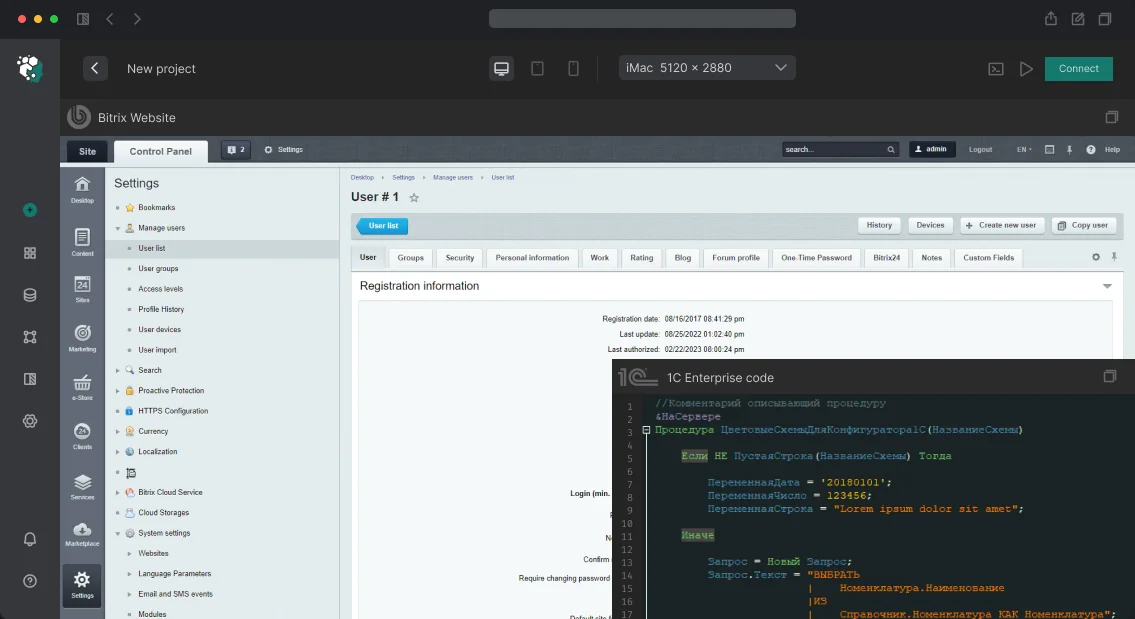
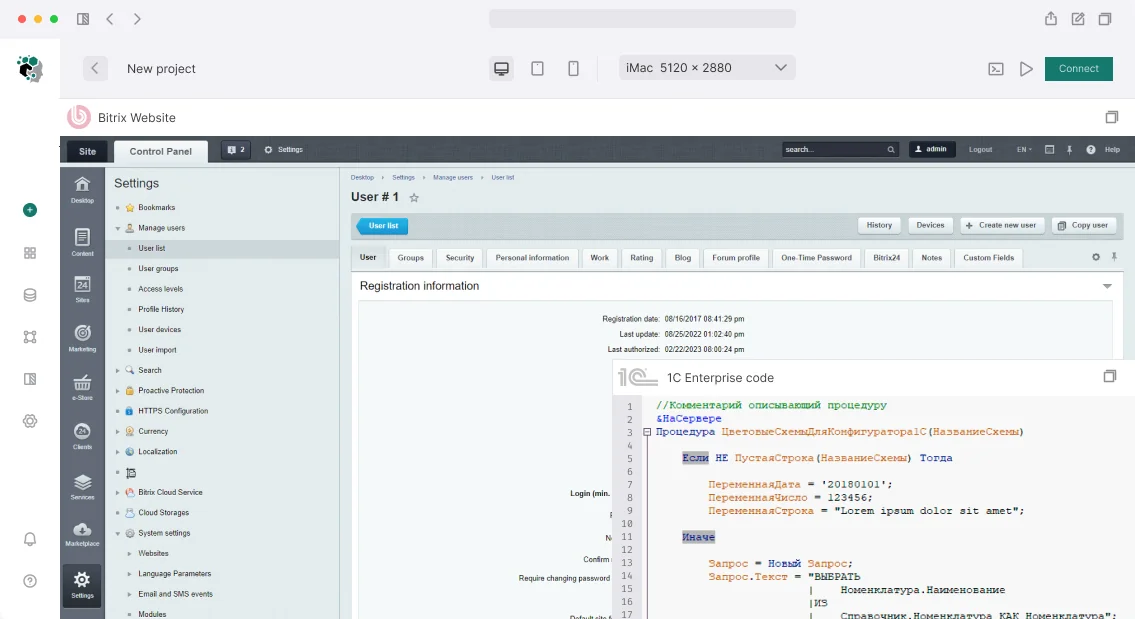
Standard Bitrix24 capabilities don't always cover specific business processes. For example, a procurement department may require a multi-stage approval section, integration with 1C UT, and a custom Vue.js interface. In such cases, we develop an SPA application embedded into the portal's left menu. Over 10+ years, we have implemented dozens of similar projects. Contact us to evaluate your project and we'll propose a solution. The budget is determined after analyzing your specific requirements.
How a Custom Bitrix24 Section Works
A custom section is an application embedded into the portal's left menu via the placement mechanism. Technically, it is an SPA loaded within an iframe inside the B24 interface. Registration is done using the REST API method placement.bind with type LEFT_MENU. More about placement can be found in the official documentation.
The entry point is a file served by your server (or a serverless function). Bitrix24 loads it into an iframe, passing authorization parameters: AUTH_ID, REFRESH_ID, member_id. Via these parameters, the application gains access to the REST API of the portal.
Full list of authorization parameters
In addition to AUTH_ID and REFRESH_ID, the iframe receives member_id, portal_id, app_id. See the documentation for the complete list.
BX24.init(function() {
    BX24.callMethod('user.current', {}, function(result) {
        // Current user for permission checks
    });
});
Step-by-Step Registration of a Custom Section
- Create an application in Market → My Applications, type: server.
- Specify the path to your SPA in the "File path" field.
- Register the placement using the
placement.bindmethod with typeLEFT_MENUand pass the URL. - Install the application on the portal.
When to Store Data in Smart Processes
Smart processes (\Bitrix\Crm\Service\Factory) are a constructor for CRM entities. Create a type via CRM → Settings → Automation → Smart Processes, add custom fields, configure a funnel. Data is stored in b_crm_dynamic_items_* tables.
A custom section in this case is an alternative UI for working with smart process data. Instead of the standard card and kanban, you design your own interface and read/write data via REST:
-
crm.item.list— get a list of items -
crm.item.add/crm.item.update— create and update -
crm.item.fields— field metadata
The advantage: you get funnels, robots, business processes, access rights, and change history for free. The limitation: REST API returns a maximum of 50 items per request; for large lists, pagination is needed. For 10,000+ records, the interface must implement server-side filtering.
When an External DB Is More Advantageous
If the data is more complex than a flat list — many-to-many relationships, hierarchies, specific indexes — it is easier to store in an external PostgreSQL or MySQL. The custom section communicates with your backend via API, while interacting with Bitrix24 only for authorization and obtaining user context.
Scheme: iframe loads SPA → SPA verifies AUTH_ID via oauth.bitrix.info/rest/ → gets user_id → requests data from your backend by user_id.
Advantage: no REST API limits, full control over data structure. Limitation: you lose built-in robots and business processes; access rights must be implemented by yourself.
| Criteria | Smart Processes | External DB |
|---|---|---|
| Data complexity | Flat lists, up to 5 relations | Any relations, hierarchies |
| Performance | Up to 10,000 entries without optimization | No limits |
| Built-in robots/BP | Yes | No |
| Access rights | From CRM | Own implementation needed |
| Development time | Faster (1-2 weeks) | Longer (2-4 weeks) |
Built-in smart process mechanisms allow implementing a section 2-3 times faster compared to an external DB, if the business logic fits the CRM model. However, for complex scenarios, an external DB offers flexibility and scalability.
Integration with B24 Interface
For a native feel, the custom section should use the Bitrix24 design system. The official UI kit: @bitrix24/b24-ui. It contains components visually identical to standard portal elements — buttons, tables, filters, sliders.
Key integration points:
- Slider — open an item card in the side panel via
BX24.openApplication({bx24_width: 800}) - Menu counters — update badge via
BX24.appOption.set('bx24_leftMenuCounter', count) - Notifications — send via
im.notify.system.addto alert users about events in the section
Access Rights
If data is in smart processes, rights are inherited from CRM (role settings for the CRM entity). For an external DB, implement verification via the REST user.current method + mapping B24 roles to your application's roles.
For checking department membership: department.get returns the structure, user.get with filter by UF_DEPARTMENT gives users of the unit.
What's Included in the Work
Our certified specialists develop custom sections turnkey and ensure stable operation after launch. The project includes:
- Architectural documentation and development plan approval
- Access to a repository and staging server
- Access rights setup and integration with robots/BP (if smart processes are used)
- Training for portal administrators on using the section
- Warranty support for 30 days after delivery
Submit a request, and we will evaluate the complexity and propose timelines. With over 10 years of experience and dozens of completed projects, we guarantee results. Significant cost savings compared to buying a ready-made CRM solution.
Timeline Estimation
| Component | Estimate |
|---|---|
| Application skeleton + registration in B24 | 1–2 days |
| CRUD list interface (table, filters) | 3–5 days |
| Element card with slider | 2–3 days |
| Access rights (external DB) | 2–3 days |
| Integration with robots/BP (smart process) | 1–2 days |
| Testing and deployment | 2–3 days |
For a medium-complexity section: 1.5–2.5 weeks. The main variable is the complexity of the business logic within the section, not the integration with Bitrix24 itself.
Points to Consider
Iframe applications operate in an isolated context. localStorage inside the iframe is bound to your server's domain, not the portal's domain. If you have multiple client portals, store member_id in the storage key to avoid data mixing.
The AUTH_ID token lives for 1 hour. For long sessions, implement auto-refresh via REFRESH_ID — otherwise, users will get an authorization error. To avoid typical development pitfalls, contact our engineers. We guarantee stable operation and provide 30-day warranty support.