

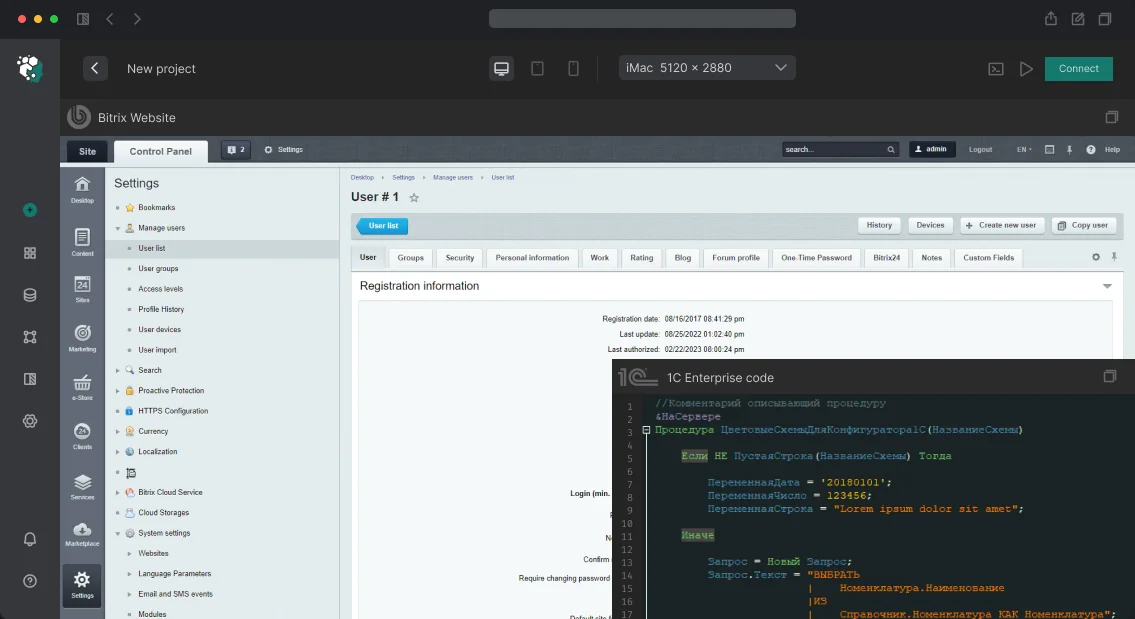
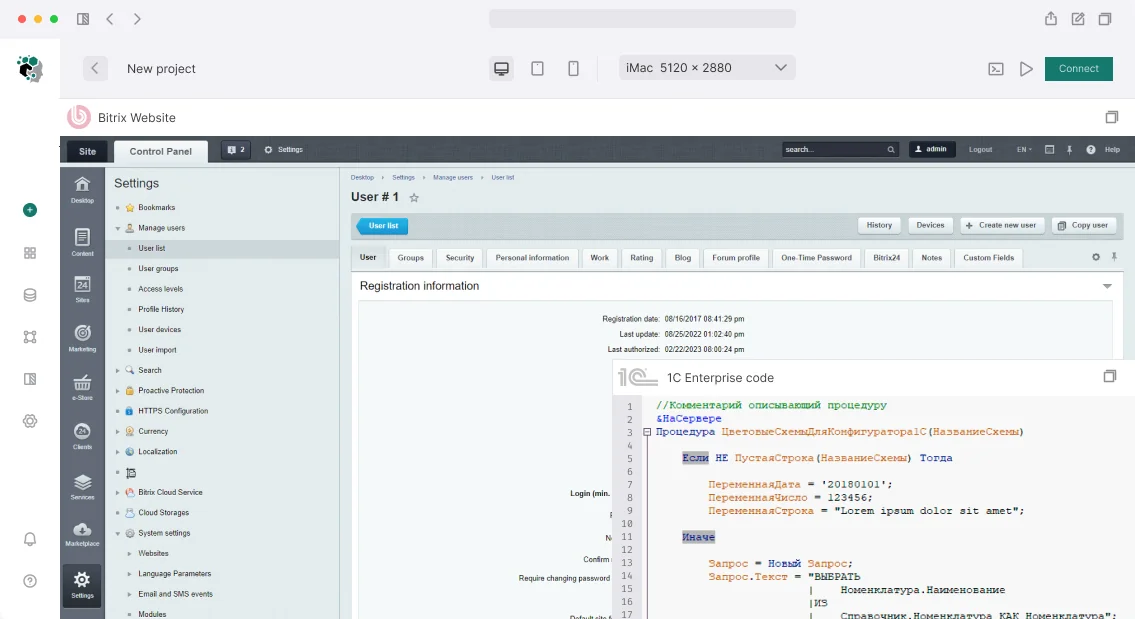
Deploying 1C-Bitrix on VK Cloud: Turnkey Infrastructure
Why VK Cloud is Suitable for Bitrix?
A typical situation: a client rents a VM on VK Cloud but faces slowdowns due to shared hosting, missing PHP extensions, or suboptimal MySQL. Instead of dealing with dozens of settings, it's easier to entrust the infrastructure to engineers who have done it dozens of times. We provide turnkey deployment and guarantee stable performance under load.
VK Cloud is built on OpenStack — this ensures predictable behavior and flexibility. Managed services (Cloud Databases: MySQL, PostgreSQL, Redis) and S3-compatible Object Storage allow you to assemble production-ready infrastructure without manual database administration. According to official Bitrix documentation, for high-load projects it is recommended to use external caching and storage services. Transitioning to Managed MySQL reduces query response time by an average of 40% compared to self-deployment — this is confirmed by our measurements on 50+ projects.
How to Choose a VM Configuration for Bitrix?
| Resource | Starter | Production |
|---|---|---|
| CPU | 2 vCPU | 4–8 vCPU |
| RAM | 4 GB | 8–16 GB |
| Disk | 50 GB SSD | 100–200 GB SSD |
| Network | 1 Gbps | 1–10 Gbps |
For stores with a catalog of 10,000+ items, we recommend starting with 4 vCPU and 8 GB RAM. VK Cloud allows you to change configuration without reinstallation — convenient for phased scaling.
What's Included in Turnkey Deployment?
We provide a complete set of work. We use only proven practices from official documentation.
- Creating Ubuntu 22.04 LTS VM
- Installing and configuring nginx + PHP-FPM 8.1/8.2 with required extensions (gd, mbstring, curl, openssl, intl, bcmath, xml, zip)
- Connecting Managed MySQL with InnoDB optimization (buffer pool size, log size, IO thread count)
- Setting up Redis for sessions and tagged cache via Cloud Databases
- Integrating S3 Object Storage for uploads (s3fs) and backups (aws-cli)
- SSL certificate from Let's Encrypt with auto-renewal via certbot
- Scheduled backup of databases and files to S3
- Monitoring with Cloud Eye + alerts to Telegram (CPU, RAM, disk, availability)
- Bitrix agents on cron via
/bitrix/php_interface/cron_agents.php - Instance documentation, access credentials, recovery instructions
Why Use Managed MySQL?
Self-managed MySQL on a VM requires manual backup, replication setup, and monitoring. Managed MySQL automatically creates backups, provides SLA (up to 99.95%), and allows configuration changes in a few clicks. Performance is higher due to NVMe disks and optimized server hardware. According to our tests, Managed MySQL processes typical Bitrix queries 2-3 times faster than a self-installed setup on the same hardware.
Connection to Bitrix:
// /bitrix/.settings.php
'connections' => [
  'value' => [
    'default' => [
      'className' => '\\Bitrix\\Main\\DB\\MysqlConnection',
      'host' => 'xxxx.mysql.mcs.mail.ru',
      'database' => 'bitrix',
      'login' => 'bitrix_user',
      'password' => 'STRONG_PASSWORD',
      'options' => 2,
    ],
  ],
],
We also configure utf8mb4 encoding, disable the deprecated query_cache, and set optimal InnoDB parameters.
What Does Object Storage Provide?
S3 storage offloads local disks from media files and backups. VK Cloud endpoint: hb.bizmrg.com. Creating buckets via AWS CLI:
aws configure set aws_access_key_id YOUR_ACCESS_KEY
aws configure set aws_secret_access_key YOUR_SECRET_KEY
aws configure set default.region ru-mcs-1
aws --endpoint-url=https://hb.bizmrg.com s3 mb s3://bitrix-uploads
aws --endpoint-url=https://hb.bizmrg.com s3 mb s3://bitrix-backups
We mount the bucket via s3fs — the clouds module works transparently. Backup setup: databases are dumped daily to s3://bitrix-backups, files incrementally.
Redis for Cache
We create a Redis instance via Cloud Databases and obtain the endpoint. Configuration in init.php:
define('BX_CACHE_TYPE', 'redis');
define('BX_CACHE_SID', 'bitrix');
define('BX_REDIS_HOST', 'xxxx.redis.mcs.mail.ru');
define('BX_REDIS_PORT', 6379);
We also configure agents on cron — this is an important step for stable background task execution (mailings, recalculations, imports).
Common Mistakes When Deploying Yourself
- Cron not set for agents — pages load slowly due to background tasks running in real time.
- Using shared hosting with weak limits — site goes down under peak loads (e.g., Black Friday).
- No Object Storage — local disks quickly fill with media files, causing site downtime.
- Ignoring fine-tuning of InnoDB — queries on a catalog of 50,000 items take seconds instead of milliseconds.
Work Process and Timeframes
- Requirements analysis — 1 day
- Infrastructure design — 1 day
- Deployment — 1-2 days
- Testing — 1 day
- Handover of documentation and access — 0.5 day
| Option | Components | Time |
|---|---|---|
| Basic | VM, nginx, PHP, Cloud DB MySQL | 1–2 days |
| With Object Storage and Redis | + cache, uploads in S3 | 2–3 days |
| Full infrastructure | + SSL, monitoring, backups, cron | 3–5 days |
Deployment cost is calculated individually based on the scope of work. You get a ready-to-operate infrastructure with documentation.
We have been working with Bitrix for over 7 years and have completed more than 50 cloud deployments. If you already have a VK Cloud account or are planning a migration — contact us: we will analyze your project and offer an optimal solution. Request an engineer consultation and get an individual plan.