

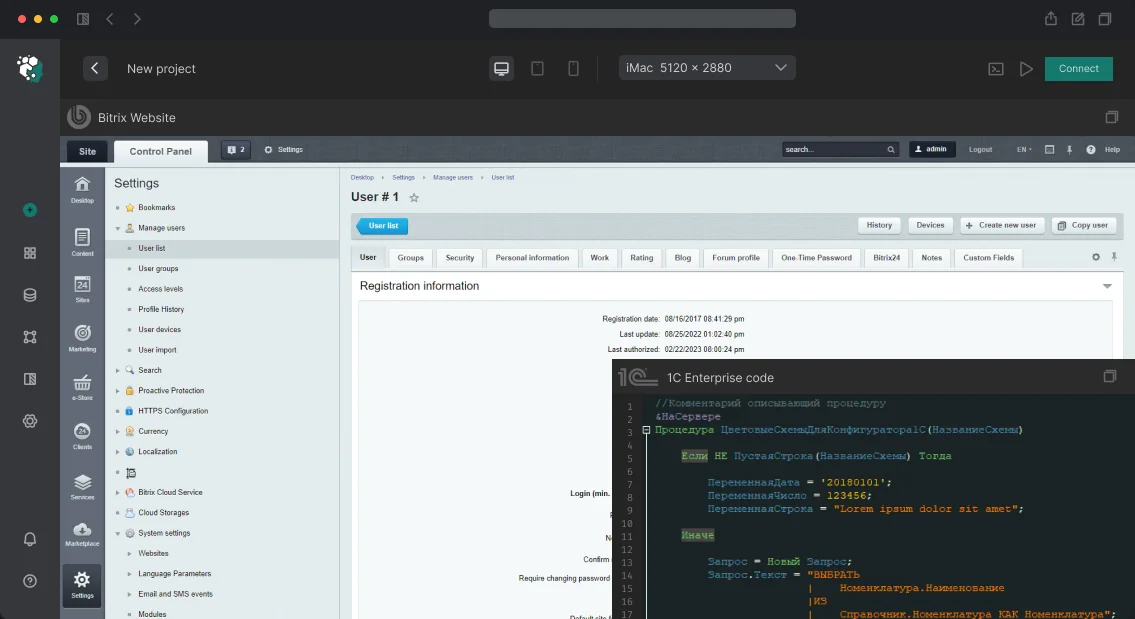
A trade catalog with 100,000 items—empty descriptions or copies from supplier sites. Manual writing would take a year for a copywriting team, and regular updates make it endless. Duplicate content guarantees search engine penalties: Yandex and Google demote such pages. SEO specialists see traffic drops, managers spend hours manually editing each card. We solve this with automatic parsing: extract, clean, rewrite, and write into infoblocks. The result is unique descriptions without manual work—filling takes days, not years.
Our engineers connect a parser to your 1C-Bitrix project. We use infoblocks v2.0, HL-blocks, and ORM. We write in PHP 8.1+ with Composer and strict typing. Filling speed is up to 20 times faster than manual entry. With AI rewriting via GPT, budget savings reach 70%—three times cheaper than an in-house copywriter. Get a consultation on automating your catalog: we will analyze your sources and propose a solution.
Description Sources
Source selection determines quality and legal risks. Consider the main options:
- Manufacturer website—most relevant content, but often hard to parse and contains copyright. Use as a basis for rewriting, not as final text.
- Aggregators (Yandex.Market, OZON, Wildberries)—large volume, standardized format. Same legal caveats.
- Official distributors—more lenient about content use, often interested in distribution.
- Manufacturer databases (Icecat, Synccentric)—legal option with an API, paid, but gives clean data with license.
Parsing from manufacturer websites often violates copyright. To avoid claims, we focus on legal databases or use rewriting after extraction. The contract defines content responsibility.
How to Automate Rewriting with AI?
After parsing, raw descriptions need uniqueness. We use the GPT API to generate rewritten text. The process:
- Parse the source content.
- Clean junk, leave pure text.
- Send to GPT with prompt: 'Rewrite the product description, keep characteristics and keywords, change phrase structure.'
- Write the result to the infoblock: PREVIEW_TEXT (first paragraph) and DETAIL_TEXT (full).
- Set DESCRIPTION_SOURCE = 'parsed' to track the source.
This approach yields unique content, does not violate copyright, and saves up to 70% of the copywriting budget—tens of about $9–13 in savings monthly. With AI rewriting, you get descriptions that search engines do not consider duplicates—uniqueness compared to the source reaches 80%. Parsing with AI rewriting pays off in 2–3 months.
Why Protect Manual Edits?
Managers may manually improve descriptions. Do not blindly overwrite—add logic:
- If DETAIL_TEXT is empty—write the parsed text with DESCRIPTION_SOURCE flag.
- If filled—skip the element when updating. Flag absent? Means description was edited manually—leave untouched.
Example code: flag check
if (empty($arFields['DETAIL_TEXT']) || $arFields['DESCRIPTION_SOURCE'] === 'parsed') {
    $el->Update($elementId, ['DETAIL_TEXT' => $newText, 'DESCRIPTION_SOURCE' => 'parsed']);
}
Eliminating Content Duplicates
Duplication is the main SEO issue. Solution—rewrite after parsing. Use GPT API for uniqueness: send text with prompt 'rewrite in your own words, preserving meaning and keywords.' Or hire copywriters for selective processing of top items. Another option—use multiple sources and mix descriptions via a template engine.
Writing to Bitrix Fields
Bitrix splits description into two fields:
- PREVIEW_TEXT—short description (for listing)
- DETAIL_TEXT—full description (for product card)
When parsing a long description: first paragraph → PREVIEW_TEXT, full text → DETAIL_TEXT. Text type is set by PREVIEW_TEXT_TYPE and DETAIL_TEXT_TYPE (values: text or html).
Updating an element:
$el = new CIBlockElement();
$el->Update($elementId, [
    'PREVIEW_TEXT' => $shortDesc,
    'PREVIEW_TEXT_TYPE' => 'html',
    'DETAIL_TEXT' => $fullDesc,
    'DETAIL_TEXT_TYPE' => 'html',
]);
Documentation CIBlockElement helps with other methods.
Comparison of Parsing Sources
| Source | Legality | Uniqueness | Cost |
|---|---|---|---|
| Manufacturer website | Medium (depends on policy) | High | Free |
| Aggregators | Low (copy) | Low | Free |
| Distributors | High | Medium | Free / partnership |
| Icecat / Synccentric | Full license | High | Paid API |
What's Included
- Source analysis and extraction structure selection
- Parser development with anti-blocking measures
- Text cleaning and normalization (HTMLPurifier, regex)
- Infoblock integration: PREVIEW_TEXT and DETAIL_TEXT
- Manual edit protection via DESCRIPTION_SOURCE flag
- Testing on 100–200 items
- Documentation and manager training
Timeline and Cost
| Stage | Duration |
|---|---|
| Source analysis, extraction structure selection | 2–4 hours |
| Parser development for descriptions | 1–2 days |
| Text cleaning and normalization logic | 4–8 hours |
| Infoblock integration, manual edit protection | 4–6 hours |
| Testing on 100–200 items | 4 hours |
Total: 4–6 working days. If AI rewriting after parsing is needed, add 1–2 days for GPT API integration. Cost is calculated individually for your project.
Contact us for an assessment of your project—we will fill the catalog in 4–6 days and save up to 70% of your text writing budget. Get a consultation on catalog automation: we will analyze sources, choose the optimal solution, and propose implementation.