

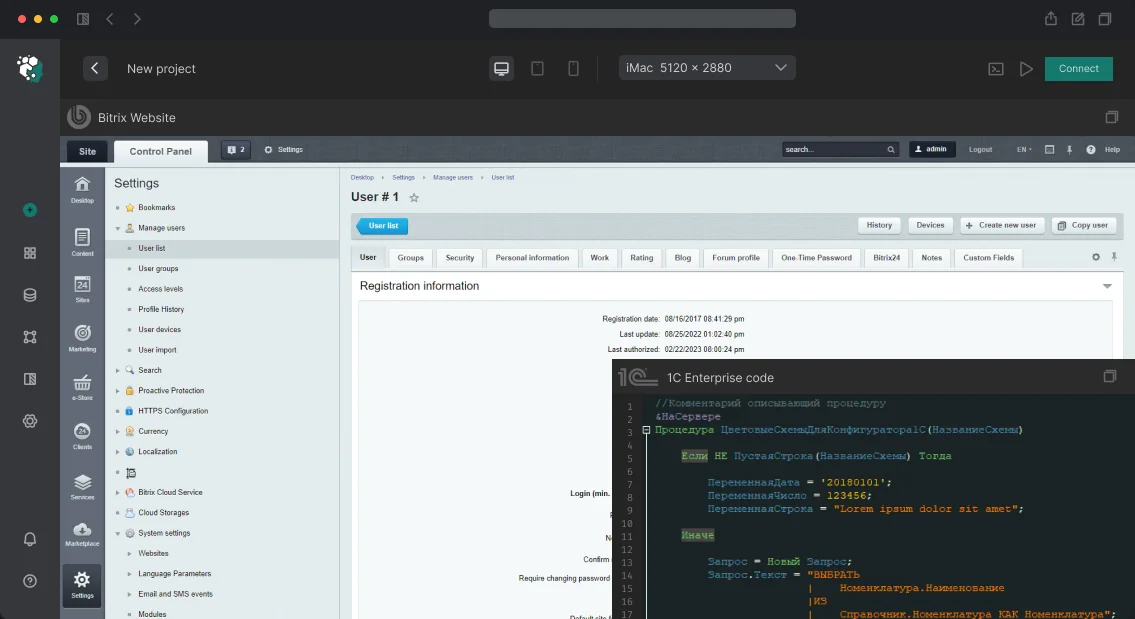
This article is your guide to 1C Bitrix exchange optimization, CommerceML tuning, and catalog import acceleration techniques. Exchange involving 50,000 products takes 4 hours and blocks the entire site during business hours. This is a typical symptom when the catalog has grown 10x but the settings remain unchanged. Every hour of downtime costs thousands of dollars. We encounter such projects daily: clients complain about slowdowns, and the root cause is an outdated exchange mechanism. Speed optimization involves a comprehensive audit and redesign on both the 1С and 1С-Битрикс sides. Our experience includes 10+ years with Bitrix and over 50 integration projects. Our specialists are certified 1С-Битрикс developers with 10+ years of experience. This article covers key methods: batch loading, deferred indexing, and caching. You'll learn how to cut exchange time from several hours to 20–30 minutes. For a tailored solution, contact us for a consultation—we'll prepare a proposal within one day.
How to profile the 1С exchange?
Before optimizing, measure. Add timestamps to the exchange log:
Profiling code example
// In the OnIBlockElementImport handler
$timings[] = [
    'step' => 'element_import',
    'element' => $elementXmlId,
    'time' => microtime(true) - $startTime,
];
After the exchange, analyze where 80% of the time is spent. Typical candidates:
- XML parsing—files too large, not split into parts
- Database writes—indexes, triggers, non-optimal INSERT
- Price recalculation—if auto-recalculation by rules is enabled
- Search update—reindexing search index on every change
XML Parsing as a Bottleneck
Split the export into batches. In 1С settings, set "Number of elements per file" to 1000–2000. Each file is processed by a separate HTTP request. Bitrix processes the file in 30–60 seconds instead of hanging for 2+ hours. Batch processing is 10x faster than point-by-point.
Enable ZIP compression. A file with 2000 products uncompressed is 8–15 MB; compressed it's 1–3 MB. This is significant for the channel between 1С and hosting, especially with slow connections. In the publication settings of 1С ( CommerceML protocol): set Use data compression: Yes, Compression threshold: 1024 bytes. CommerceML is a standard for exchanging catalog data between 1С and web systems.
How to optimize database writes during import?
Standard Bitrix import calls CIBlockElement::Add/Update for each element—a full cycle with checks, event handlers, and cache invalidation. For 50,000 elements, that's 50,000 individual transactions.
Disable unnecessary events during import:
// Before import
define('BX_BUFFER_MESS', true); // do not send email notifications
$GLOBALS['STOP_STATISTICS'] = true; // do not update statistics
define('NO_AGENT_STATISTIC', true);
Deferred reindexing. Search reindexes after every element change. For batch import, disable auto-indexing and run reindexing as a separate agent after the exchange completes:
// Temporarily disable indexing
\Bitrix\Main\Config\Option::set('search', 'indexer_auto_mode', 'N');
// After exchange, run reindexing
CSearch::ReIndexAll(true, CATALOG_IBLOCK_ID);
Batch cache invalidation. Instead of BXClearCache on every element update, collect changed elements into an array and invalidate cache in a batch at the end of the exchange.
Optimizing Database Queries During Import
When updating an element, Bitrix performs a SELECT to check existence, then UPDATE or INSERT. For batch import, preload all XML_IDs into memory and avoid SELECT per element:
// One query to get all existing elements
$existing = [];
$res = CIBlockElement::GetList(
    [],
    ['IBLOCK_ID' => CATALOG_IBLOCK_ID],
    false,
    false,
    ['ID', 'XML_ID']
);
while ($el = $res->Fetch()) {
    $existing[$el['XML_ID']] = $el['ID'];
}
// Now during import:
isset($existing[$xmlId]) instead of SELECT
Separating Exchange by Data Type
Full exchange (catalog + prices + stock) in one session is excessive. Split into independent streams:
| Stream | Contents | Frequency | Load |
|---|---|---|---|
| Full catalog | Descriptions, properties, images | Once/night | High, at night |
| Prices | Only offers*.xml with prices |
Every hour | Low |
| Stock | Only offers*.xml with stock |
Every 15 min | Minimal |
| Orders | orders.xml |
Every 15–30 min | Minimal |
In 1С, you can configure multiple independent scheduled jobs for different export types.
Caching on the Bitrix Side
Check the catalog module cache settings: Settings → Product Settings → Performance:
- Catalog element cache: enable, TTL 3600 seconds
- Property cache: enable
- Trade offer cache: enable for stores with variations
During exchange, cache is automatically invalidated for changed elements. If invalidation takes long, check the cache disk size (/bitrix/cache/iblock/), increase memory_limit if needed.
Case Study: Cutting Exchange Time from 4 Hours to 25 Minutes
One of our clients, an auto parts e‑store with 65,000 SKUs, ran exchange once a day and it took 4+ hours, blocking price recalculation for the entire period. From our practice.
Issues found:
- Entire catalog in one XML file (240 MB)
- Reindexing search on every element
- Price recalculation by 12 rules on each price change
-
BXClearCachefor the whole infoblock every 100 elements
After optimization:
- Splitting into files of 2000 elements
- Deferred reindexing in a separate agent
- Price recalculation only after import completion, not during
- Batch cache invalidation at session end
Result: full exchange in 25 minutes. Stock and price updates only (every hour) in 3–4 minutes. Cost savings of approximately $400 per month due to reduced site downtime.
What's Included in the Optimization Service?
When ordering a turn‑key service, we:
- Profile and audit the current exchange
- Split export into batches, configure ZIP
- Disable unnecessary events, set up deferred indexing
- Implement batch cache invalidation and XML_ID preloading
- Separate exchange by data type (catalog, prices, stock)
- Document all settings and hand over instructions
Basic optimization starts at $500; a full audit with custom import is from $1,500. Optimization timelines:
| Stage | Time |
|---|---|
| Profiling and analysis | 4–8 hours |
| Batch splitting + ZIP | 2–4 hours |
| Deferred indexing + cache | 1 day |
| Stream separation | 1–2 days |
| Full audit and custom import | 3–5 days |
We'll estimate your volume and provide exact timelines. Order an exchange audit—we'll identify bottlenecks and propose an optimization plan.