

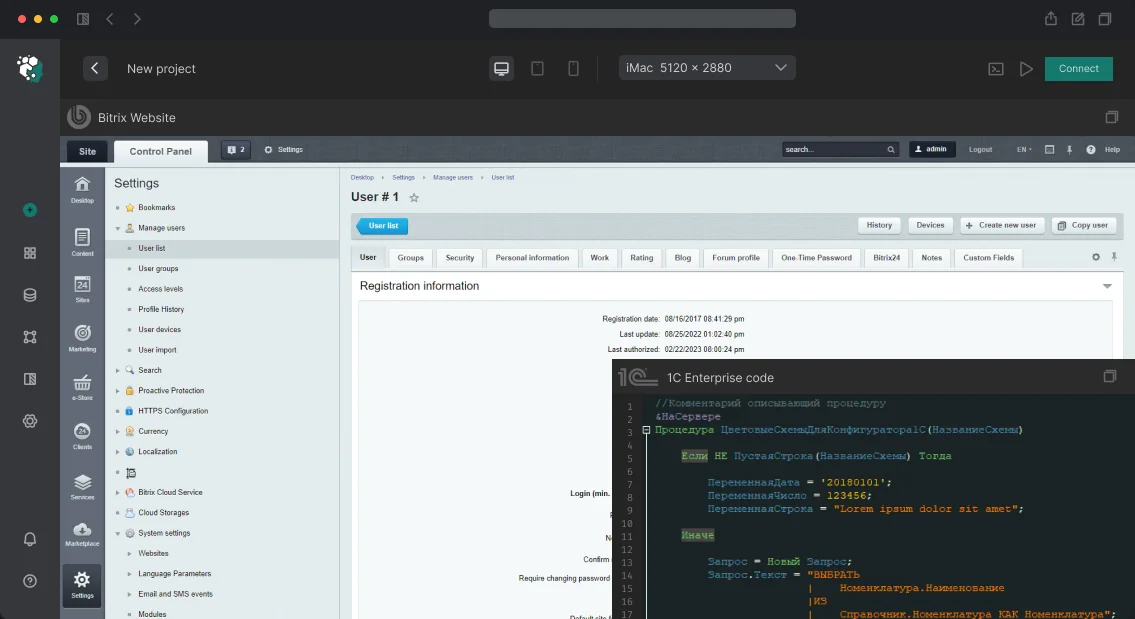
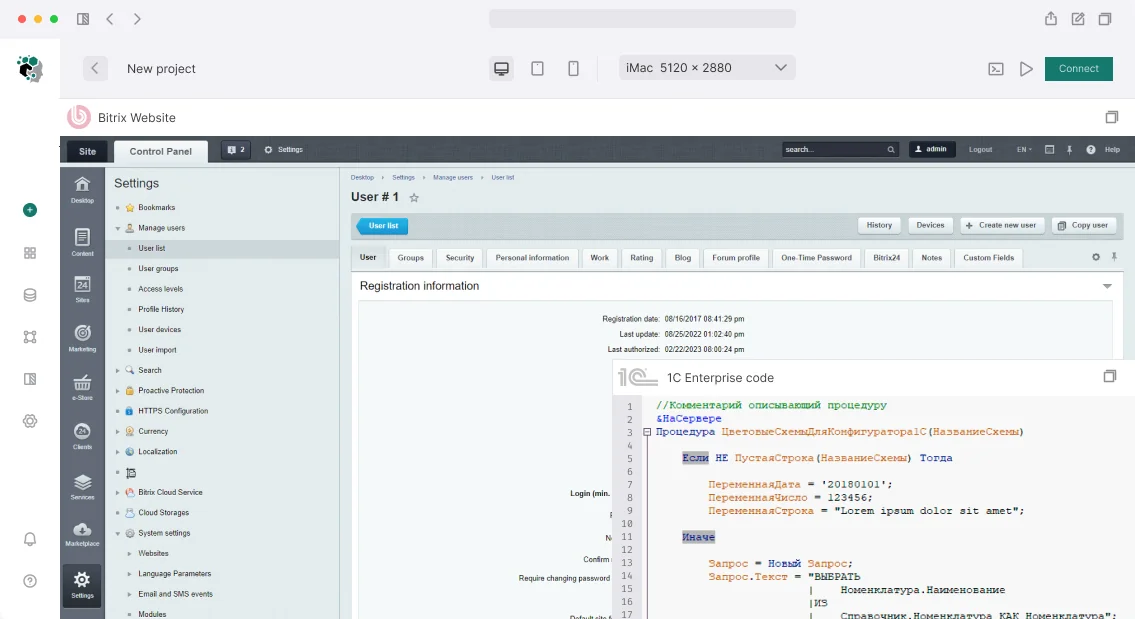
A coworking space can lose up to 30% of its revenue if bookings are handled through phone calls and spreadsheets. We've seen this on dozens of projects: an empty desk at 2 PM is lost profit. Our experience shows that automating bookings on 1C-Bitrix frees up to 20% of admin time and increases occupancy. The cost of such development pays off within 3–6 months. We offer a turnkey coworking website: from a space catalog to access control integration and 54-FZ fiscalization. Assess your project — contact us for a free consultation.
A coworking website must sell time: display spaces, let users pick an available slot, accept payment, and issue a QR code for entry — all without admin intervention. On 1C-Bitrix, this is achieved using the sale module, Highload blocks for bookings, and access control integration. For fiscalization, we connect AtolOnline or CloudPayments with 54-FZ support.
Why 1C-Bitrix for a Coworking Website?
The platform provides flexibility for complex tariff structures: hourly rental, daily passes, monthly unlimited. Infoblocks v2.0 and Highload blocks allow storing spaces, bookings, and registrations. Built-in business processes automate checking expired subscriptions via agents (CAgent). We also leverage integration with 1C:Trade Management via CommerceML to synchronize products and orders.
How to Automate Bookings Without Conflicts?
Booking is the core of a coworking site. Standard Bitrix modules are designed for product e-commerce, but here you need to sell time slots with visual occupancy. We use custom development on top of the sale module.
Highload Block for Bookings
The central entity is a Highload block called "Bookings" (BookingTable):
| Field | Type | Purpose |
|---|---|---|
| UF_SPACE_ID | Binding | Space from infoblock |
| UF_USER_ID | Number | Who booked |
| UF_DATE | Date | Booking date |
| UF_TIME_FROM | String | Start time (HH:MM) |
| UF_TIME_TO | String | End time (HH:MM) |
| UF_ORDER_ID | Number | Order ID from sale module |
| UF_STATUS | List | Awaiting payment / Paid / Cancelled / Completed |
| UF_QR_TOKEN | String | Unique token for QR code |
| UF_CHECKIN | Date/time | Actual entry time via access control |
| UF_CHECKOUT | Date/time | Actual exit time |
Indexes: composite index on UF_SPACE_ID + UF_DATE + UF_STATUS for fast occupancy queries.
Preventing Double Bookings
When two users try to book the same slot simultaneously, we use optimistic locking: before creating the record, the controller checks for overlaps and uses a DB transaction. If the slot is already taken, an error is returned, and the frontend updates the calendar.
Slots with status "Awaiting payment" are automatically cancelled after 15 minutes by an agent. This prevents popular meeting rooms from being blocked by unpaid reservations.
Space Catalog and Tariffs
An infoblock "Spaces" with sections by type: Hot desk, Fixed desk, Meeting room, Private office, Event hall. Properties: capacity, area, equipment, floor, photos, 3D tour (Matterport), minimum booking time.
The tariff structure is implemented through SKUs of the sale module. For example, the product "Hot desk" has offers: 1 hour, 1 day, 10 days/month, Unlimited/month. Subscriptions are processed as recurring payments with automatic expiration checks via an agent.
Access Control Integration
After payment, the system generates a unique UF_QR_TOKEN (UUID v4) and sends a QR code via email and in the personal account. When scanning the QR on the access control reader, the endpoint /api/skud/verify/ validates the token, status "Paid", and a ±15-minute time window. The protocol depends on the model: for ZKTeco or Sigur — REST API; for Bolid Orion — via an intermediate server.
Tenant Personal Account
Tabs: My bookings, Subscription, Visit history (check-in/check-out from access control), Favorites. For "Unlimited" subscriptions, the QR code is tied to the user for the entire period.
What's Included in Turnkey Development
- Project design: prototypes, Highload ER diagram, booking scenarios
- Design: mockups for catalog, calendar, personal account (mobile responsive)
- Development: infoblocks,
saleproducts, booking system, access control integration - Fiscalization: connect online cash register (ATOL, CloudPayments) with data transfer to OFD
- Testing: load testing, booking conflict checks, access control scenarios
- Documentation: technical and user
- Training: admin instruction on managing catalog and bookings
Implementation Timeline
| Stage | Content | Timeline |
|---|---|---|
| Analysis | Space catalog, tariff matrix, access control requirements | 5–7 days |
| Design | Prototypes, ER diagram, booking scenarios | 7–10 days |
| Design | Mockups (catalog, calendar, personal account), mobile responsive | 10–12 days |
| Catalog and tariffs | Infoblocks, sale products, SKUs |
7–10 days |
| Booking system | Highload, calendar, payment, conflict prevention | 14–18 days |
| Access control integration | API endpoint, QR generation, testing with hardware | 7–10 days |
| Personal account and community | Personal account, residents, events | 7–10 days |
| Testing and launch | Load testing, access control commissioning | 5–7 days |
Total timeline: 9–12 weeks. Access control integration depends on the equipment model: if the system supports REST API out of the box, we finish within 7 days. If an intermediate server is needed, up to 10 days. The hardware must be installed before the integration stage begins.
Order a turnkey coworking website — we will audit your current processes and propose the optimal solution.