

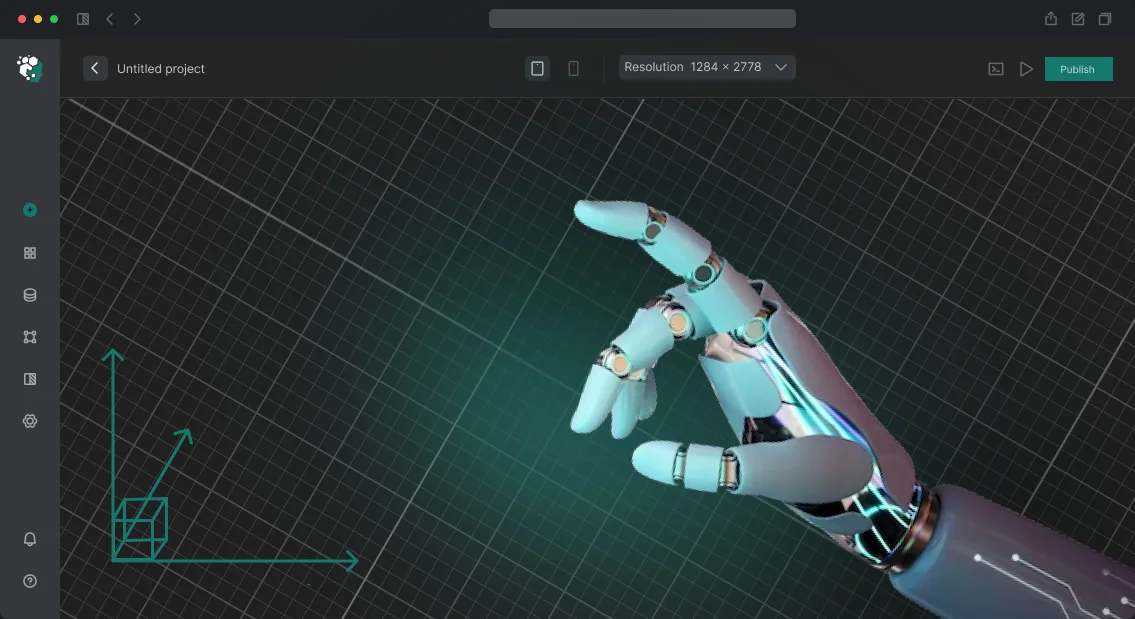






Why Competitors Are Outperforming You in 3D Animation? The Answer — Unreal Engine 5.7
Your competitors are already showing clients videos that take your breath away: vivid lighting, deep perspective, cinematic motion smoothness.
And your 3D animations look flat and technical — they aren't shared, they aren't remembered, so you lose even before the price discussion stage. The buyer compares the image, and in that comparison your product loses — even if the product itself is no worse.
The problem isn't your team's effort or the quality of modeling. Classic tools and old rendering approaches don't deliver the cinematic quality modern viewers expect.
To get a decent result, you have to sacrifice deadlines or budget — and in the end, the video is either expensive, slow, or compromised in quality. This is a dead end that leaves many projects stuck for years.
We approached it from a different angle — virtual production on Unreal Engine 5.7.
It's not just "another render" but a fundamentally different way to create 3D animation: the scene, light, and camera exist in real time, so you get a cinematic image immediately, not after long iterations.
The team sees the final frame at the moment of shooting, like on a real film set, and can change it without rebuilding.
For business, this means three things. First — speed: the video is produced several times faster than on a traditional pipeline. Second — expressiveness: the product is shown in the most favorable light, with dynamics and depth that capture the viewer in the first seconds.
Third — manageability: edits are made quickly, without losing quality and without a "full redraw". As a result, you get not just an image, but a working tool that boosts brand recognition and conversion into orders.
What You Get from Virtual Production: 5 Key Benefits
The realism of virtual production on Unreal Engine 5.7 is not just a nice image but a trust-building tool.
When a product or interior looks real, the client makes a purchase decision faster, and your 3D videos start building brand recognition even in complex scenarios — from neon signs to reflections in shop windows.
Speed is the second key advantage. Instead of long location shoots and post-production, we assemble the scene in a digital environment and make edits in hours, not weeks.
This lets you release videos for a product launch exactly on time and respond quickly to market changes without losing momentum.
Cost savings naturally follow: no studio rental, expensive logistics, or extras. Virtual production pays for itself on the first project, and then you get more content for the same budget — from short vertical versions to full presentation films.
Engagement is what sets such a video apart from ordinary animation. The viewer sees a dynamic, almost tangible image that holds attention 2-3 times longer.
This directly affects conversion: the longer someone watches and explores your product, the more likely they are to leave a request or make a purchase.
The main thing is that all these benefits work together. Our engineers set up virtual production so that each video matches your business goals: growing reach, increasing sales, or launching a new product.
You get not just a "nice image" but a measurable result — in traffic numbers, requests, and revenue.
Virtual Production Formats for Your Task
The same project can be delivered in different formats — the question is which one will lead to sales and reach growth faster. We choose the option based on your budget, deadlines, and end goal: from full-cycle production to individual scenes that can be used for years.
Below is a comparison of the three main formats we take on.
| Format | Who it's for | What it gives the client |
|---|---|---|
| Full cycle (turnkey video) | For launching a product, brand, or major campaign | A finished video product: from idea to editing. Maximum viewer engagement, increased recognition and conversion |
| Individual scenes and backgrounds | For presentations, booths, events | An impressive "image" without shooting and logistics. Quick launch and budget savings while maintaining the required visual level |
| Interactive formats (virtual showrooms, 3D configurators) | For holding attention and increasing time on site | The buyer interacts with the product themselves — this increases loyalty and the share of orders without a manager's involvement |
What the client gets in the end All formats are built on a professional virtual production platform, so you get a consistent result without the risk of reshoots. Scenes shot once can be easily adapted for new tasks: social media, advertising, employee training.
This means you are not paying for "video for the sake of video" but for an asset that continues to generate requests even after the project is completed.
If needed, we enhance the video with interactive elements so the viewer doesn't just watch but immediately interacts with the product.
All that's left is to choose the format for your task — after that, we will put together a cost estimate and show how it will work in your particular niche.
How We Work: 7 Steps from Brief to Launch
We have structured the process so that you always understand what stage the project is at and what you will get in the end. Each step is agreed with you — this shortens timelines, eliminates unexpected revisions, and avoids unnecessary costs.
Our approach to 3D animation production stages has been proven on commercial projects. Modern 3D graphics technologies allow us to show intermediate results almost in real time.
- Brief — you describe the task, audience, and goals of the video. We ask clarifying questions and record the requirements and deadlines so that everyone understands the scope of work.
- Concept — we offer a script, visual style, and running time. You approve the direction before production starts; this saves budget and time.
- Preparation — we create 3D scenes, characters, and graphic elements. We show the first materials so you can see how the project is developing and adjust details in time.
- Production — we animate, render, and edit the video. You receive intermediate versions for quality control and can influence the result.
- Revisions — we make changes based on your comments. Stage approvals help resolve all feedback before the final and avoid rework after delivery.
- Delivery — we provide source files and final files in the required formats. You immediately use the video on the website, in social media, and in presentations.
- Support — we stay in touch after the project, adapt the material for different platforms, and make targeted edits as needed.
What a 3D Animation and Visualization Project Includes
We assemble each 3D animation and visualization project as a finished product, not a set of files. The client receives a complete package: from script to final video that can already be published, shown to clients, or used at events. Below is what is included in the work.
- Script and storyboard — we turn your task into an understandable story: we define the key frames, narrative accents, and running time. You see in advance what the video will look like and make edits before production begins.
- 3D models and environment — we create objects, spaces, and characters according to your brand guidelines. No need to search for stock models — everything is made for the task: product, interior, architecture, or abstract graphics.
- Object and camera animation — we bring the scene to life: product movement, building fly-around, dynamic transitions. This is what holds viewer attention and makes the video memorable.
- Visualization and rendering — you get photorealistic frames that look like a real shoot but without the cost of a studio and equipment. We work on a professional render engine — this guarantees stable quality and accurate color reproduction.
- Editing and sound — we assemble the video into a single timeline: add music, voiceover, subtitles, and graphic elements. You receive a finished file in the required formats — for social media, website, or exhibition screen.
- Integration and adaptation — we cut versions for different platforms: vertical for Reels and TikTok, square for posts, widescreen for presentations. No need to "adjust" the content yourself to platform requirements.
- Post-delivery support — we answer questions, make minor edits, and update the video if usage conditions change.
As a result, you get not just an "image" but a tool that works for your business: it increases recognition, explains a complex product in 30 seconds, and sets you apart from competitors. All stages are agreed with you — you control the process and understand what you are paying for.
Case Study: How We Created a Sales Video for an Industrial Brand
For the industrial brand PromVector, we created a sales-focused video based on virtual production. The client manufactures complex equipment that is hard to show live at an exhibition or in advertising: ordinary photos don't convey the scale or operating principle.
We built a digital scene where every component and mechanism comes to life, and the viewer sees the product in action — that's how the video that became the main sales tool was born.
The video was placed on the website, in presentations for partners, and on the big screen at an industry exhibition. Instead of dry diagrams and text descriptions — a dynamic image that holds attention and removes objections before a conversation with a manager.
That was exactly what the brand was missing: before, clients spent 20-30 minutes studying the catalog; now key advantages are clear in a minute and a half.
Numbers After Launch
The effect proved measurable. In the first month, the video received 3 times more views than all the brand's static materials combined.
Website requests grew 2.5 times, and at the exhibition every third conversation at the booth started with the words "we saw your video". Brand awareness also grew: a month after the event, 60% of surveyed booth visitors remembered the brand name without prompting.
Six months later, the client returned with a new project — for the next product line. That is the best proof that animation works not as a one-off image but as a systematic tool that increases reach, simplifies sales, and pays off through growth in requests.
Frequently Asked Questions About Ordering 3D Production
Before starting a 3D production project, there are always questions: how quickly will we get the result, will the budget go over, will we keep the rights to the video. Here we answer the most common ones so you can make a decision with confidence.
How long does it take to create a 3D video?
The minimum task — a 20-second animated video for social media — we complete in 10-14 days. Complex production with photorealistic 3D visualization and characters — 30-45 days. We set the exact timeframe in the contract after the brief and do not change it without your consent.
How is the cost calculated and what does it depend on?
The cost is calculated after an audit of the scene volume, level of detail, video length, and urgency. Pricing tiers differ for a basic 3D video, product and interior visualization, and immersive virtual production on Unreal Engine 5.7.
We provide a detailed stage-by-stage cost estimate before the start, and it does not change during the process.
What about the rights to the finished video?
After full payment, you receive all rights to use the video without restrictions: for advertising, on the website, in social media, at events. We provide closing documents and source files along with the final version — no hidden fees or licensing traps.
What if I don't like the result?
We don't take on a project without a clear idea of the result. At the brief stage, you approve the style and script; during the process, we show intermediate versions — edits are made at every stage for free.
If the final result doesn't match expectations, we return the prepayment for the uncompleted stages; this is stated in the contract.
Order a 3D Video That Sells: Your Next Step
Leaving a request is not an obligation, but a way to get specifics: how much the video will cost, when it will be ready, and how it will drive sales.
We respond within one business day, ask clarifying questions about your audience, product, and platforms, and then propose a script that solves your specific business problem.
What you get after contacting us:
- A cost estimate tailored to your budget: we give you an exact figure rather than a "from-to" range, broken down by stage — no hidden extras.
- Realistic production timelines: we honestly tell you when the script, rough cut, and final video will be ready, and we lock those dates into the plan.
- Format and style selection: 3D animation, visualization, or a combined video — we choose the option that works best for your audience and platform.
- Work examples for your industry: we show cases close to your task so you understand the level of quality and presentation style in advance.
- Signed agreements: we record the scope of work, deadlines, and cost in a commercial proposal — no discrepancies with what we discussed on the call.
- Support at every stage: you always know who is working on the project, what is already done, and when the next intermediate result will be ready.
After you send the request, you will receive a transparent cost estimate, a work plan, and examples relevant to your task — the rest is your decision. Fill out the form or write to us in a messenger, and we'll start with a short conversation about your product.
How to Choose the Right Virtual Production Format for Your Budget?
Choosing a format is not a question of "expensive or cheap" but a question of what result the business needs and where the video will work.
If the goal is a spectacular product launch, a presentation on a large screen, or shooting with live actors in the frame, virtual production pays off through speed and image quality.
If you need a high-quality 3D video for a website, social media, or outdoor advertising, classic 3D visualization will work and cost significantly less.
We always start with the task, not with a specific technology. At the meeting, we analyze where the video will be shown, who the target audience is, what the budget and deadlines are.
Based on that, we propose the optimal format: full virtual production, combined shooting, or 3D graphics without shooting. This way, you pay for what actually works for your task and don't overpay for extras.
If the budget is limited but you want an "expensive" look, there are intermediate solutions. For example, a 3D scene with realistic lighting that is edited together with regular video footage — it looks like full virtual production but costs many times less.
For many products and services, this format is enough to stand out from competitors and increase conversion.
The main thing is not to overpay for an effect that doesn't generate profit. We'll advise where full virtual production is worth using and where stylish 3D graphics are enough, and we'll lock in the cost before the work begins.
In the end, you get a video that solves a business problem and a transparent budget with no surprises.