

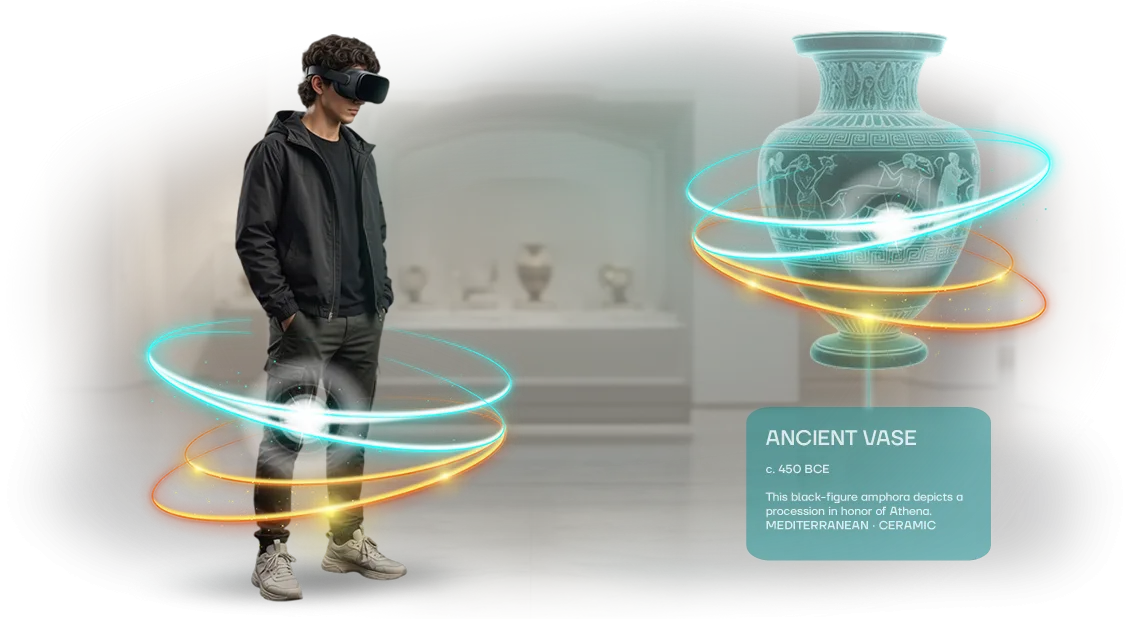






Guests seek vivid impressions, but the museum is invisible online
Modern guests plan their trip long before the visit: they study websites, read reviews, watch videos. A museum that is absent from the online space is invisible to this audience.
Brest Fortress is a place of enormous historical power, but most potential visitors see only static photographs that do not convey the scale and atmosphere of the memorial.
People need experiences before they buy a ticket. They want to “try on” a tour for themselves, feel the spirit of the place, walk through significant locations. That is why online tours and a virtual museum become the first step in the funnel of new visitors.
A digital exhibition makes it possible to look into the fortress from anywhere in the world, spark interest, and turn casual interest into a real visit.
We help museums close this gap: we create a 3D tour of Brest Fortress that immerses viewers in history and gives a sense of presence. These are not just panoramas, but a thoughtfully designed scenario where every step leads to an emotional response.
Such a virtual museum works for recognition, attracts new visitors, and makes heritage accessible to everyone — and this is the bridge between online interest and an in-person visit that is currently missing.
What you get: live tours, new traffic, and growing recognition
The 3D tour of Brest Fortress turns browsing the site into a live tour. Visitors choose their own route, examine details, and move from hall to hall — so the time spent in the exhibition increases many times over.
This is the first thing the museum notices: guests no longer skim the text but immerse themselves in the space and remember it.
People want to share such impressions. They send the link to friends, post it on social media, and show it to family — every transition adds new touchpoints with the brand.
Audience reach grows without investment in advertising, and the fortress becomes closer to those who have not yet been on the tour.
An online walk works as a warm invitation: after seeing the halls and grounds, a person is more willing to plan an offline visit. This brings the museum new visitors who already know where they are going. For others, the tour remains a way to connect with history — at any time and from any device.
For a department head, such a page provides not just a beautiful showcase but a measurable result. The virtual tour collects contacts of interested guests and turns interest into concrete inquiries.
You see how many people have gone along the route, which halls attracted attention, and you can use this data to develop the exhibition.
We create 3D tours for a specific task — from one hall to the entire complex. We discuss goals, select shooting points, set up navigation, and embed the tour into your website.
You get a ready-made tool that immediately starts bringing new guests and increasing recognition of Brest Fortress.
3D tour Brest Fortress formats: tailored to your exhibition
Every site has its own task: one needs to give visitors the freedom to explore on their own, another needs to lead them along a thoughtfully designed scenario with full immersion.
That is why we build the 3D tour Brest Fortress in the format that fits your exhibition and solves your task — without unnecessary options or overpayment.
| Format | Who it is for | What it gives the visitor and the client |
|---|---|---|
| Free exploration | Museums, memorials and open-air sites with a rich exhibition | Visitors choose their own route and pace, while the exhibition gains a modern showcase available at any time |
| Turnkey guided tour | Organizers of group tours, tour operators and educational projects | A ready-made interactive tour with guidance through key points and historical details — with no dependency on a guide's schedule |
| Interactive experience for events | Venues and teams that host events, festivals and open days | Guests engage through tasks, photo spots and an unusual navigation format, while organizers get a striking reason to bring in a new audience |
We select the 3D tour format to match the goals of a specific exhibition: for some spaces, free access to details matters more, for others — a ready-made scenario that leads a person from the entrance to the landmark objects.
In both cases the client gets a tool that works for recognition and attendance — and remains in demand after launch.
How the project works: from brief to launch and support
We break the creation of a 3D tour into clear stages — you always see what is happening and can influence the result. No «black box»: after the first discussion you receive a plan, timelines and checkpoints where we approve interim results.
- Brief and goals. A short survey: who the tour is for — tourists, investors or educational programs, which fortress sites to show first, what style your brand has. We lock in expectations so nothing has to be redone later.
- Plan and estimate. We propose the tour structure, the number of locations and interactive options — from navigation to pop-up descriptions. We agree on timelines and cost before work begins, with no hidden extra charges.
- Shooting and preparing materials. We travel to the site, shoot panoramas and assemble a route through the significant points of the fortress. At this stage you receive the first frames and understand how everything will look.
- Assembling the tour and interface. We combine the panoramas into a single environment: transitions between levels, points of interest, buttons, descriptions. We run the technical part on professional equipment and proven tools — this guarantees stable operation on any device.
- Tests and revisions. You receive a link to the test version and go through it at your own pace. We collect feedback, make changes and show the final version for approval.
- Launch. We publish the tour on your website or a separate page, connect view counters and check loading speed. After activation you get a working tool, not a «reminder of the project».
- Support after launch. We stay in touch: we help with updates, refresh texts and objects, and add new points to the tour as the museum or exhibition develops. You are not left alone with the product.
What is included: a ready-to-use exhibition and tools for growth
We hand over to you a ready-to-use, fully functioning exhibition: the tour is already hosted online and opens on any device — computer, tablet, or smartphone. Visitors do not need to install anything or register — they immediately enter the virtual space of the fortress.
Along with the tour, you receive a complete kit for independent work:
- Ready-made 3D exhibition of the fortress: a virtual tour with panoramas of the grounds, halls, and memorial objects. Visitors move as if in real space — without installing applications.
- Content management system: you change descriptions, add points, photos, and videos — updates take minutes.
- Access and permissions: administrator and editor accounts for employees with different levels — from viewing statistics to editing.
- Team training: an online session for managers and attendants — how to work with the panel, respond to visitors, and collect requests.
- Regulations and instructions: guides on updating, common questions, and using the tour in museum operations.
- Promotional materials: ready-made texts, banners, and QR codes for posters, the website, and social media — you don't need to create them from scratch.
- Technical support: for the first weeks, we assign an engineer — they are available if you need additional configuration or explanation.
The entire kit is packaged into a single checklist — you see the delivery scope and amount of work in advance.
All that remains is to connect the tour to the museum's website or social media — and the first visitors will be able to walk through the fortress from anywhere in the world.
Case study: how a virtual exposition attracted new guests to a museum
Visitors come to a museum for emotions, but they are often not ready to wait for a guided tour or they travel remotely. A virtual exposition solves this task: it shows exhibits at any time and from any device, expanding the audience without the cost of new floor space.
One such project we did for the Brest Hero Fortress Museum-Reserve — it was a virtual exposition that brought together the key objects of the memorial.
In the first month of operation, it was viewed by more than 12 thousand people — almost twice as many as visit offline during the same period. The average time guests spent in the tour was 7 minutes, and the share of visitors who explored at least five locations reached 63%.
For comparison: a regular informational video on a website is watched for no longer than two minutes.
The main result for the client was not just reach, but new guests: about 18% of virtual viewers then came to the museum in person.
“We expected the tour to become a convenient addition, but we got a full-fledged audience acquisition channel. It is especially valuable that the exposition is used by schoolchildren from other regions and foreign tourists who are only planning a trip,” noted the museum director.
After the first launch, the partners came back to us for an expansion: they added an audio guide and a separate scenario for children’s groups. We continue to support the project, updating the virtual exposition for new exhibitions.
This confirms that a properly made 3D tour works not as a one-time campaign, but as a long-term tool for growing museum attendance and recognition.
How to choose the format of a virtual exhibition for your museum’s goals?
Before choosing the format of a virtual exhibition, it is important to understand what task it solves.
For a museum, this is usually not just “being online,” but attracting new visitors, giving a remote audience an emotion, and presenting the exhibition in a way that makes them want to come in person.
This determines the choice of format — from a panoramic overview to a full-fledged 3D scene with interactive elements.
If the goal is to quickly introduce people to the space, a virtual tour with navigation through halls and key objects is enough. This format works well for fortresses and memorials: the guest sees the scale, moves along the route, and gets a sense of presence.
For example, a 3D tour of Brest Fortress can include the main points of the complex, photo panoramas, and short historical notes — this is enough to spark interest and bring the visitor in person.
When a deep educational or commercial story is needed, it is worth choosing an interactive virtual exhibition: inside the scene, exhibits can be “opened,” viewed in detail, and audio guides, video, and augmented reality can be enabled.
This format is more expensive, but it gives more reasons to return and holds attention longer — especially for remote school groups and travel aggregators.
Budget and timelines are not limitations, but selection criteria. We will help determine the optimal scope: start with key points and expand the project when you see the return. The main thing is to define the project goals: attraction, education, or ticket sales. For these, we will select a format that delivers results without overpaying.
Common doubts before ordering a virtual exposition
Before ordering a virtual exposition, managers have the same doubts: will the tour be inconvenient, will it lose quality, how are edits made, and will the investment pay off. We break down each fear.
Will a virtual tour be difficult to use?
The tour opens in a browser without installation. The controls are intuitive — the visitor explores the space and moves between points, and hints appear right on the screen. No training is needed.
Will the tour work on different devices and with slow internet? We adapt it to any screen — from a smartphone to a monitor. For slow internet, we build a lightweight mode, keeping the key points and not losing the audience.
Can edits be made after launch? Edits are a normal part of the project. First, we agree on the scenario so that you can see the structure before development. After launch, we set aside time for changes and fix the deadlines in the contract.
Will the investment in the exposition pay off? The tour works around the clock, attracts attention without an advertising budget, strengthens interest in the site and encourages a personal visit. The investment pays off through higher attendance and greater recognition.
We put all agreements in writing during the first discussion. You get a clear process and a predictable result.
Get a virtual exhibition plan in two days — start with the brief
To launch a virtual tour of Brest Fortress, you don’t need to write a technical specification or understand formats. Just leave a request — we’ll send you a brief that takes 10-15 minutes and consists of questions about your goals, audience, and desired result.
After receiving the brief, our engineers analyze the task and prepare a virtual exhibition plan.
This is not an abstract description, but a specific list of locations, shooting points, and interactive elements that will lead the visitor to the desired action — booking a tour, buying a ticket, or exploring the exhibits.
What you will get after the brief
- Exhibition plan in two business days — a list of zones and movement scenarios through the fortress.
- Format recommendations — we’ll advise which option suits your tasks and budget.
- Implementation timeline — a breakdown of stages with dates: from shooting to publishing the tour on your website.
- Cost calculation — a transparent estimate with no hidden fees or “technical” add-ons.
- Examples of similar projects — we’ll show cases for museums, memorial complexes, and tourism sites.
- A dedicated manager — one contact for all questions, without being passed between departments.
The brief does not obligate you to anything. Even if you decide not to proceed, you’ll still understand what your future 3D tour will look like and how much it costs. Leave a request — we’ll respond within one business day and send you the brief.