



Why an ordinary online museum walk doesn't hold visitors
A visitor comes to the museum's website hoping to see the exhibition, but gets a static set of photos with captions. They scroll through several halls without feeling the atmosphere or the scale of the space, and within a minute they close the tab. Such an online museum walk gives the visitor nothing worth staying for.
For the museum, this means losing audience attention: a virtual museum tour laid out like a picture gallery neither engages nor sticks. Younger audiences don't stay, return visits drop, and the potential to attract online visitors remains unrealized. A disappointed viewer is unlikely to visit the museum in person or recommend it to friends.
The reason is that simply viewing photos doesn't create a sense of presence.
Without an interactive tour that lets you move around, zoom into details, and choose your own route, the visitor perceives the museum as "just another photo album" — and loses interest within seconds.
We help museums close that gap: we design interactive online walks that hold attention and turn a casual viewer into an engaged guest.
Instead of boringly flipping through photos, the visitor gets a vivid exploration of the exhibition — and the museum once again becomes a place worth returning to.
What a virtual tour gives visitors and your brand
Emotional immersion instead of dry viewing
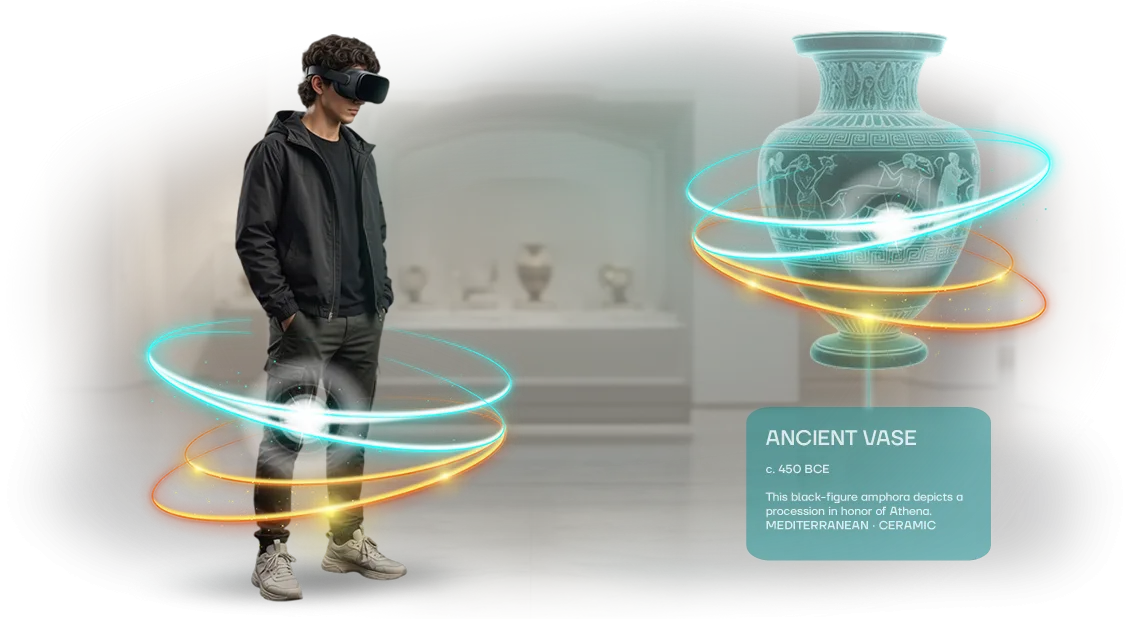
Visitors are tired of static photos and long descriptions under exhibits. They want to step inside the space, feel the atmosphere of the hall, and examine details up close.
An online museum walk creates that sense of presence: guests choose their own route, zoom in on objects, and move from hall to hall.
Such immersion is memorable and creates a desire to share the experience. It turns a one-time site visit into an emotional experience people want to relive or tell friends about.
Audience engagement and growing interest in the exhibition
An online tour holds attention several times longer than a regular photo page. Guests explore the halls at their own pace, return to favorite exhibits, and open additional materials. Each of these actions is a signal of interest that the museum can use for further communication.
Engaged visitors are more likely to follow the museum's social media, attend real exhibitions, and recommend them to friends. In this way, the virtual format drives growth in a live audience, not just site traffic.
Brand recognition and increased citations
An unusual format itself becomes a news story. Journalists, bloggers, and city portals happily write about museums that launch online walks — that's free PR and additional links to your site.
Each publication reinforces the museum's positioning as modern and audience-friendly. The brand is remembered and stands out among other cultural venues, while media mentions work for you long after launch.
Convenience for guests and removing barriers
Not everyone can visit a museum in person: distance, opening hours, and ticket queues get in the way. An online walk removes these barriers — visitors can enter the exhibition from anywhere in the world at any time.
This is especially valuable for people with disabilities, families with children, and tourists planning their route before a trip. By expanding access, the museum grows its audience without expanding its physical space.
Increased website traffic and repeat visits
An online tour is a reason to return to the site even if the exhibition is already familiar. A guest can finish the walk later, share the link, or stop by for updates. This increases overall traffic and improves the site's behavioral metrics.
And for those who haven't visited the museum physically yet, the virtual walk becomes a "sample" — after it, the desire to come in person only grows.
Virtual tour formats: which one to choose for your collection
It's important to understand: there is no single ideal format. Each one solves its own task — from a simple introduction to the exhibition to a full immersion in the collection's history.
The right choice depends on what matters most to you: maximum audience reach, holding attention on details, or creating a memorable brand event.
| Format | For whom | What it gives the viewer |
|---|---|---|
| Panoramic 3D tour | For a broad audience accustomed to interactive maps and "at a glance" viewing | Quick self-guided movement through halls, freedom to choose viewpoints, a sense of personal presence. Minimal entry barrier for viewers |
| Interactive virtual hall | For museums and galleries with rich exhibitions where it is important to show every exhibit | Immersion in the atmosphere of the space. The ability to zoom into details, read accompanying texts, and see what is often hidden behind glass in reality |
| Animated scenario with a route | For collections with a strong story that need to be presented as an engaging narrative | A ready-made journey through the exhibition with clear dramaturgy. The viewer never gets lost and gets the maximum impression in a short time |
These are not just "three kinds of pictures." A panoramic tour works with the habit of "looking around," an interactive hall with the desire to examine things closely, and an animated route with the need to hear a story.
Whichever format you choose, you get a tool that works for your reputation around the clock. It doesn't get tired, doesn't need days off, and keeps welcoming guests even when the physical doors are closed.
We help you decide on the right format for your collection and deliver a turnkey project: from the first sketches to publishing the finished walk online.
How we create an online tour in five stages
Every museum or exhibition project is unique: you have your own exhibits, your own audience, and your own goals.
We don't fit clients into a ready-made template; instead, we build the process around a specific result — so that the online museum walk works for recognition, engagement, and return visits.
-
Brief and audience analysis. We discuss the tour's goals, study the space and collection, and determine who will be watching and what should capture their attention. The output is a technical specification and a stage-by-stage development plan for the virtual tour.
-
Tour script. Together with your experts or curators, we build the logic of the route: where the visitor starts, which exhibits they see, what stories they hear. The script makes the walk lively and meaningful, not just a "360-degree photo."
-
Creating the virtual exhibition. We shoot the space with professional equipment or build it in 3D graphics — depending on which better conveys the atmosphere. The result is an accurate copy of the halls that can be viewed both from the inside and outside.
-
Editing and assembling the tour. We connect scenes, add navigation points, interactive captions, an audio guide, or video inserts. We check how the tour opens on different devices and fine-tune every detail so nothing lags or leads visitors astray.
-
Publication and launch. We place the tour on your website or a separate page, set up access for visitors, and train your team to update content. Launching the online tour happens quickly, and afterward you can easily change the exhibition without reworking the entire platform.
This process guarantees a clear result at every step — you always see what's being produced and can make edits before the tour goes live.
What is included in the delivery of a virtual tour for your website
We will provide not just a link to the tour, but a complete package that can be immediately placed on your website to start attracting visitors. Everything needed to launch the online walk will already be assembled and configured.
- Ready-made tour page — a separate landing page designed to match your corporate style. A visitor gets into the tour in one click, without extra transitions or waiting for loading.
- Virtual tour player — smooth movement through halls, zooming into exhibits, and switching between locations. Works on desktops, tablets, and smartphones — convenient for the 70% of audiences who visit from a phone.
- Responsive layout for your website — we embed the player into the desired section or put it on a separate page. No conflicts with your platform: everything is tested on different devices before publication.
- Texts and captions for halls — we prepare descriptions of exhibits and halls that are clear to an ordinary visitor, not just a professional art historian. This increases time spent in the tour by 40-60% — people move from one hall to another.
- Navigation scheme and museum map — visitors always see where they are and can choose a route: overview, by masterpieces, or by period. A simple interface that requires no learning — confirmed by tests with "cold" users.
- Training for your staff — in 1-2 hours we show administrators how to update descriptions, change the order of halls, and add new exhibits without contacting developers. You don't depend on us for daily operations.
- Publication instructions — a short guide on how to place the tour on the website, in social media, or in a QR code at the entrance. The whole process takes no more than an hour and requires no special knowledge.
This package allows you to launch an online museum walk within 2-3 weeks after approving the mock-up — without hiring contractors or diving into technical details. You get a working tool, not a "semi-finished product" that still needs finishing.
Case study: how an animated tour brought the exhibition to life
Challenge and solution
When the City History Museum approached us, its exhibition was rich, but the website brought in almost no visitors. Photos of the halls didn't convey the atmosphere, and guests quickly left.
We proposed an animated tour — an online museum walk that lets visitors go through the halls, examine the exhibits, and learn their stories without leaving home.
Instead of static shots, the museum got a "living" route: smooth movement, emphasis on key objects, and reference materials in a convenient format. The tour opens on any device, loads within seconds, and requires no app installation.
That removed the first barrier: today almost everyone starts their acquaintance with a museum through its website.
Implementation results
The key numbers appeared within a month after launch. Average time on the site increased by 120% — people started not just viewing one page but completing the entire tour.
The growth in museum website traffic was visible from the first weeks, and the number of inquiries via the form and by phone increased multiple times. Schools began using the walk to prepare for excursions, and families used it to plan weekends.
The museum director summed it up: "What matters to us is not statistics, but real visitors. Previously, after visiting the site, many people doubted whether it was worth the trip.
Now they come and say: we've already seen everything virtually, we want to see it live." That's how a virtual tour case study should work — bringing in real visitors.
What if I have specific requirements for the exhibition?
Let us take the stress away: yes, any specific exhibition can be shown online. We have worked with museums where halls have complex layouts and some exhibits are in open storage or behind glass — and we found a solution every time. A non-standard virtual tour is built not from a template, but around your collection.
For us, individual requirements are not a limitation but a task. We shoot rare exhibits that cannot be moved or placed on display in full compliance with all safety standards.
Complex routes, narrow passages, enfilades, and even open-air objects — we adapt all of this to the tour format so the visitor feels natural.
Content adaptation begins with a brief: you tell us what's important to show, and we think through the movement logic, shooting points, and supporting materials. If you have original texts, an audio guide, or a special story, we integrate them into the walk.
As a result, the viewer gets an online visit that conveys the spirit of the place, not just a set of panoramas.
The main thing is the result: your specific exhibition becomes accessible to visitors from anywhere in the world, while valuable items remain safe. You don't spend time on technical issues — we handle the shooting, processing, and launch. Give us the most unusual challenge, and we'll show you how it turns into a lively online tour.
Common doubts before ordering a virtual tour
Before ordering a virtual tour, clients most often have doubts about four things: who will support the tour after launch, whether the rights to exhibit photos remain theirs, how quickly the tour loads, and how it will fit into an existing website.
These are the right questions — they determine whether the online museum walk becomes a long-term tool.
How do guarantees and technical support work?
We support the tour after launch: we monitor stability, make edits promptly, and respond to inquiries. You never face the product alone — you always know who to contact.
Who owns the rights to exhibit photos?
We transfer full ownership of all shot materials to you. You can use them for announcements, brochures, social media, and presentations without additional payments or approvals.
How quickly does the online tour load?
We optimize each panorama for average internet speed, so the tour opens within seconds even on a smartphone. A visitor doesn't have time to get bored and leave for another resource.
Is the tour compatible with our website?
Yes. We embed the online walk into your platform as a ready-made block: it displays correctly on desktops, tablets, and smartphones and doesn't affect the loading speed of other pages.
If you still have doubts, request demo access to a similar project — in a few minutes you'll see what the tour looks like from a visitor's perspective. We'll answer your questions and prepare a timeline estimate for your task.Get a virtual tour estimate for your website
To start, a simple request is enough: write to us, and we'll prepare a commercial proposal for your exhibition.
You'll receive the exact cost of the online museum walk, timeline, and scope of work — without vague "from-to" ranges — as well as examples of similar projects so you can understand the result in advance.
We work remotely with museums, galleries, and exhibition spaces, so the cost doesn't depend on your city. The finished virtual tour is easy to embed in a website, use on social media, and on partner platforms — visitors don't need to install anything.
By ordering a virtual tour estimate now, you receive:
- an online tour consultation: we'll advise which format fits your collection and budget;
- a commercial proposal with a fixed price and timeline — no hidden surcharges;
- demo versions of our completed virtual exhibitions so you can assess the quality;
- a work plan: which halls to shoot and what to prepare to speed up launch;
- a priority start date — we begin work immediately after confirmation;
- post-publication support: edits, consultations, and traffic analytics.
Submit a request for a tour cost estimate — we'll respond within one business day, answer all your questions, and send a commercial proposal for your exhibition. Make your collection accessible to everyone — even those who cannot visit the museum in person.