

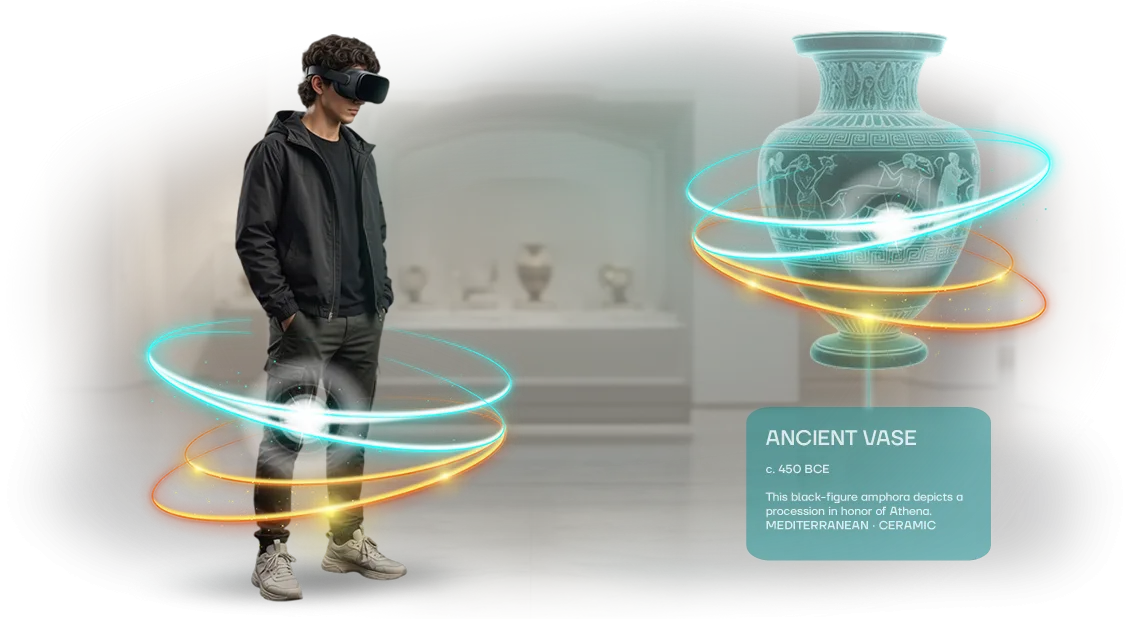






Visitors never make it to the museum — and never see the collection
The collection exists, the curators and scholarly work exist — but the viewer does not. People live in other cities and countries, getting there is long and expensive, and in the end only those who happen to be nearby see the museum.
An exhibition into which years of work have been invested sits idle, and attendance rests on a narrow circle of locals.
A virtual museum tour removes this limitation. A visitor opens the halls from their own device, walks the route at their own pace, zooms in on exhibits, reads the explanations — and gets a full impression without leaving home. For the museum, this is a way to reach remote visitors who would physically never have come.
What this gives the institution. Access to the collection stops depending on geography: school groups from other regions, tourists, researchers and people with limited mobility become your audience.
Reach grows, repeat visits appear — a person returns to the online museum tour before a real trip or after it.
We build such projects so that they work for attendance, rather than simply "hanging on the website." The museum tour becomes an independent acquisition channel: it is shown on social media, recommended to friends, embedded in educational programs.
Some online guests come to the museum in person — a virtual visit often becomes the first step toward a real one.
What a museum gains from a virtual tour
A virtual museum tour stops being a "website add-on" and becomes a standalone channel that operates around the clock.
Halls that physically accommodate a limited number of guests per day accept an unlimited flow online — and every visitor gets a full-fledged experience, not just a set of photographs.
For the museum, this is direct audience growth: it attracts those who cannot come — from other cities, countries, people with health restrictions, as well as school groups and families who choose the "look first, visit later" format.
The second benefit is museum recognition. A virtual museum tour lives in search, on social media, and in recommendations; people forward it to each other, bloggers and educational platforms write about it.
Made once, it keeps bringing in new people for months — unlike a one-off advertising campaign that ends along with its budget.
The third effect is visitor engagement. A person isn't just scrolling through a page: they walk through the halls, zoom in on exhibits, listen to explanations, complete tasks.
This format holds attention many times longer than an ordinary article about a museum, which means the visitor remembers the museum itself and comes back — either offline or for paid online programs.
A separate direction is educational programs. A virtual tour easily fits into history, local studies, and art lessons: the teacher doesn't need to organize a field trip, and students go through the material in an interactive form.
This opens up partnerships for the museum with schools, universities, and cultural projects — new occasions for joint programs and grants.
We handle this task end to end: from the idea and the tour script to launch and support. You get not a "website with panoramas" but a tool that brings people in, holds their attention, and works for the museum's reputation.
Virtual tour formats for the museum's task
The format is chosen not by how pretty the picture looks, but by the museum's task: to showcase a permanent exhibition, guide visitors through a temporary exhibition, or provide access to collections that are not physically displayed. Below are working scenarios that we implement most often.
| Format | Who it suits | What it gives the museum |
|---|---|---|
| 3D tour of the halls | Permanent exhibition, large museums | The visitor follows the route at their own pace, time on site and repeat visits grow |
| Panoramic walkthrough | Branches, estates, sites with limited access | Showcasing places you cannot travel to: reach grows without the cost of hosting guests |
| Interactive tour | Educational programs, school groups | Engages a younger audience: tasks and hints hold attention longer than a static page |
| Virtual tour with an audio guide | Museums with a strong history behind the exhibits | The guest listens to the story and stays in the tour longer, the share of complete viewings grows |
| Tour of a temporary exhibition | Projects with a short lifespan | The exhibition remains accessible after dismantling and continues to bring in visitors |
How to choose for your task
If the goal is recognition and reach, start with a panoramic walkthrough of the strongest halls: it is faster to launch, and it is clear to any visitor from the first screen.
If the goal is depth and educational impact, we add interactivity and an audio guide: the guest does not just look, but follows a route with tasks and explanations.
The formats do not exclude each other: a tour of the permanent exhibition can easily be complemented by a separate walkthrough of a temporary exhibition, and an audio guide can be connected to any of them.
We select a set for your task and budget, rather than selling the most expensive option — start with one format, and add the rest when you see the audience's response.
How a project works: from idea to tour launch
The process is structured so that you understand what is happening at every step and when you will receive a finished museum tour.
No "surprises in the middle": timelines, areas of responsibility, and approval points are fixed at the start — you always know what stage the project is at and what comes next.
- Brief and goals. We discuss the task: whom we are bringing into the museum — tourists, school groups, sponsors; what matters more — reach, recognition, or preparation for a visit. We fix which halls and exhibits we show first.
- Tour plan and script. We propose a route through the halls, points of interest, and the logic of transitions between them. We agree on the structure before work begins — edits at this stage cost you neither time nor rework.
- Filming the halls. Our engineers come to the site and film the exhibition with professional equipment. We work during hours convenient for the museum, including when there are no visitors.
- Assembling the tour. From the filmed material we assemble a complete tour: the route, captions for exhibits, guide explanations, and additional materials. You see a draft version and say what to strengthen.
- Approval. We show the finished tour and make edits to texts, emphases, and the order of halls. We agree on the final look before publication.
- Tour launch. We place the tour on your website and on the platforms from which visitors come. We check that everything opens on a smartphone, tablet, and computer.
- Post-launch support. We help update the exhibition, add new halls, and make sure the tour runs reliably.
What you get as a result
A ready virtual tour that can be shown to visitors, partners, and sponsors without your involvement. We stay in touch after launch too: updating halls and making edits is part of the work, not a separate matter.
What is included in the delivery
The delivery is not a set of files, but a ready-to-use museum tour that can be shown to visitors on launch day. Everything needed for operation is handed over in a single package: the tour itself, texts, navigation scheme, staff training, and documentation. You won't have to assemble contractors piece by piece or finish the project on your own.
What exactly you receive
- Ready-made virtual tour — an assembled route through the halls with smooth transitions, captions, and points of interest. Opens on any device: a visitor enters and walks through, with no instructions or software installation.
- Navigation through the halls — a clear scheme: map, transitions between floors, search by exhibits. The guest doesn't get lost and reaches the desired hall in a couple of clicks.
- Texts and descriptions — prepared annotations for exhibits and halls, proofread and adapted for on-screen reading. We coordinate the wording with your curators and research staff.
- Staff training — we conduct sessions with your team: how to update exhibits, change texts, add new halls. After training, edits are made in-house, without contacting us.
- Documentation — a clear guide for working with the tour: structure, roles, typical tasks. It stays with you and will survive a change of responsible staff.
- Accesses and rights — we transfer everything to your accounts. No lock-in to us: the tour is entirely yours.
- Post-launch support period — we help with the first updates and answer the team's questions until the process is up and running.
Each item addresses its own task: the tour attracts visitors, navigation keeps them on the route, training removes dependence on the contractor. Together this delivers a result that lives and evolves within the museum, rather than requiring constant external involvement.
Describe your exposition — we'll come back with an assessment and a delivery plan tailored to your format.
Case study: how a museum walk increased reach
The client's task
A regional museum approached us with a collection known far beyond the city, but physically accessible to few: the hall holds a limited number of guests per day, and school groups and tourists from other regions rarely made the trip.
The management wanted not a "website with photographs" but a full-fledged walk through the museum — so that a visitor could go through the halls at their own pace, stop at exhibits and return to them, rather than scrolling through a gallery in a minute.
What we did and how we measured it
We built a virtual walk through the halls with tour logic: a route, explanations for the exhibits, the ability to linger at a display case and return to it later.
We separately developed a scenario for those visiting for the first time and for those who had already been to the museum in person — for them, depth matters more than an overview.
The result was assessed by metrics the museum understood: how many people complete the walk to the end, how much time they spend inside, whether they come back again and what they write in their feedback.
Based on the first months' results, the number of virtual visitors grew severalfold, and the average viewing time exceeded the time of an ordinary visit to the hall — people began to linger at exhibits they had previously known only from labels.
What this gave the museum
Attendance growth stopped depending on geography and hall capacity: the walk is completed both by those who could not come and by those preparing for a visit in advance.
Visitor feedback became a source of ideas for the offline program — from the comments, the museum understood which exhibits deserved separate stories.
After launch, the project was expanded: new halls and themed routes were added, and the museum returned to us with a repeat order.
We apply the same approach to virtual exhibitions and 3D showrooms in other fields — we always measure the result in visitors, time and repeat visits, not in pretty pictures.
What if the exposition gets updated or something breaks?
A virtual museum tour is not a "deliver and forget" project. Expositions change, new halls and temporary exhibitions appear, and equipment has a life of its own.
That is why we build tour support into the project from the start: exposition updates, a work guarantee, and a clear procedure for technical failures. The client gets not a one-off product, but a living service that evolves together with the museum.
How the exposition gets updated
When you bring in a new exhibit or change a hall, there is no need to rebuild the tour from scratch. We add new zones, change captions, photos, and routes — the visitor sees the current exposition, not last year's. An update takes days, not months, and does not require your involvement in the technical part.
What happens when something fails
Any digital system can fail — what matters is how quickly it is resolved.
We provide backup scenarios so the tour stays available even when there are equipment problems, and we take on service maintenance: we monitor operation, respond to requests, and eliminate causes, not just symptoms.
What does post-launch support include?
We support the tour: we update the exposition at your request, monitor operational stability, advise museum staff, and promptly resolve technical failures. You get a single point of contact instead of searching for contractors for every issue.
Do you provide a guarantee for the tour's operation?
Yes. A launched project is covered by a guarantee, and beyond that — as you prefer: one-off updates or ongoing service maintenance. We fix the terms and response times in advance so there are no surprises for you.
Will we be able to change the content ourselves?
Yes, for museum staff we build a clear control panel: you can replace text, add an exhibit or a hall without a programmer. If it is more convenient, we handle the updates ourselves.
This approach removes the main fear: the tour will not become outdated in six months and will not "die" at the first breakdown. It stays functional and up to date for as long as the museum needs it.
Let's discuss your museum walk
To order a museum walk, you don't need to prepare a technical brief dozens of pages long.
It's enough to tell us what kind of space you have, whom you want to showcase in it, and what result you consider a success: growing visitor numbers, collection recognition, ticket sales for offline events, or reporting to partners.
That's enough to discuss the project concretely and propose a format that solves your task rather than simply "looking nice."
After the conversation, we come back with a work plan: what the walk includes, which zones and exhibits we show, how navigation works for the guest, how long each stage will take, and when you can launch.
You see the timeline estimate and team composition before the start, rather than learning about the nuances midway through. If something in the plan doesn't match your priorities, we can adjust it calmly before work begins.
Here's what you get when you reach out to us:
- a breakdown of the task and a clear walk scenario tailored to your audience — tourists, schoolchildren, collectors, partners;
- a work plan with stages, timelines, and areas of responsibility for both parties;
- an estimate of timelines and effort before the project starts, with no surprises along the way;
- a walk that a guest can take from a phone or computer without installing programs or following instructions;
- a ready set of materials for promotion: links, stills, short videos for social media;
- training for your team — staff update descriptions and add new exhibits themselves;
- post-launch support: we monitor stability and help with changes.
Getting started is simple: describe your task in whatever form is convenient — by email or a short call. We'll ask clarifying questions, suggest format options, and come back with an estimate and work plan.
From there, you decide when to start the project: you can launch a walk for an exhibition, an anniversary, or the start of a season, or you can calmly prepare it for the next event.