

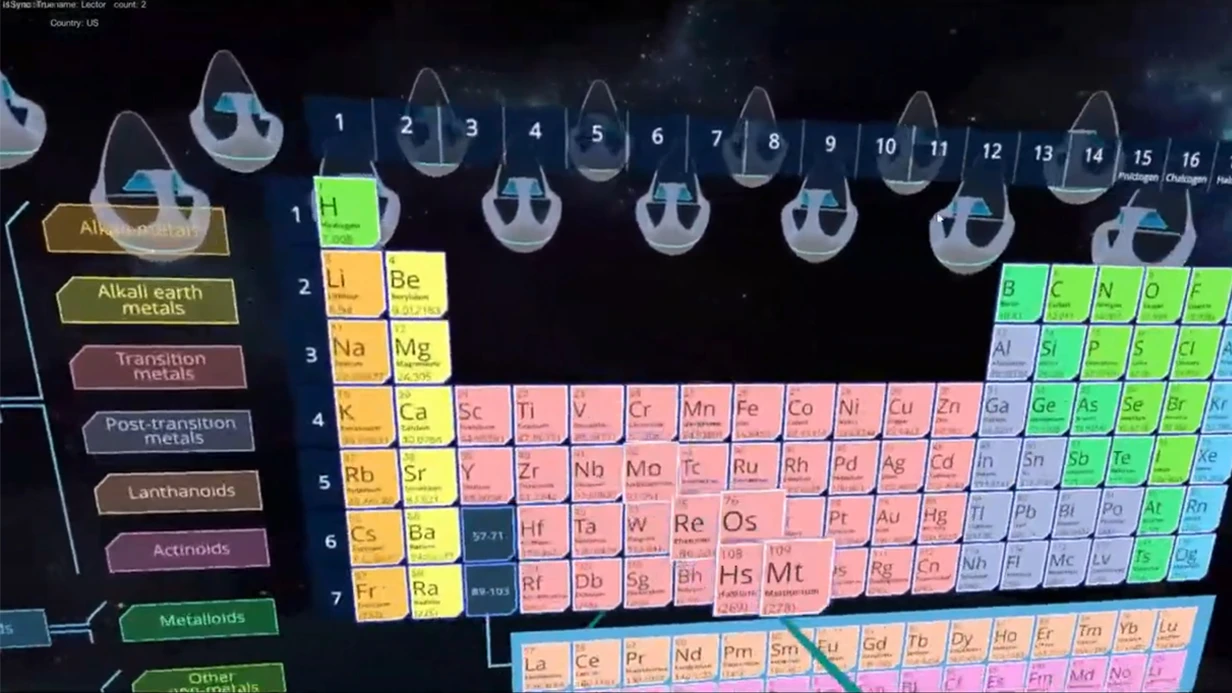


VR museum tour: visitors come back again
A museum with a strong collection often loses not to competitors but to habit: a visitor comes once, walks through the halls in forty minutes, and never returns.
A younger audience chooses experiences, not displays behind glass, and a static exhibition loses to them with no chance. Ticket revenue stays flat, even though the museum already has the holdings, the knowledge, and the stories — what's missing is a format that showcases them.
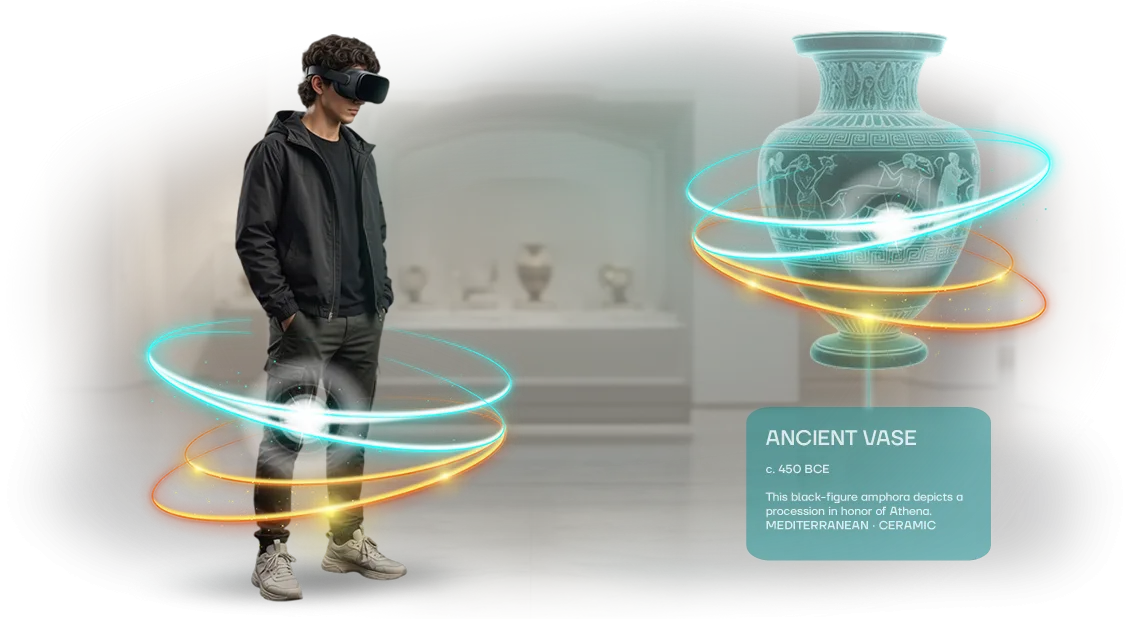
A VR museum tour solves exactly this problem: it turns the collection into an immersive exhibition that a visitor enters not as a spectator but as a participant.
You can walk through halls that aren't part of the permanent exhibition, see an exhibit at full scale, hear a story told in the first person.
A virtual tour for a museum removes the main limitations of physical space — capacity, opening hours, the fragility of exhibits — and makes museum attendance a manageable figure rather than a seasonal accident.
For the client, this works on three levels. Visitor engagement grows thanks to the format: a person spends not minutes but dozens of minutes in the exhibition, because they're interested in exploring, not rushing through.
Return visits are sustained by new scenes and updated routes — a reason to come back appears without rebuilding the halls. And the museum's recognition extends beyond its walls: people share the experience, talk about it, and bring their friends to it.
We deliver such projects turnkey: from script and artistic design to launch at the museum's venue. Let's discuss your exhibition — we'll come back with an assessment and a plan for turning it into a format that people return to.
What a museum gains from the virtual format
A virtual museum tour is no longer an experiment and is becoming a working channel: it brings back those who have long stopped visiting the halls, and opens the museum to people who physically cannot come.
For a director, this is not "yet another digital toy" but a tool that directly works with audience reach and the museum's visibility — the very metrics one is held accountable for at the end of the season.
The first effect is bringing the audience back.
Some visitors put off a visit because of distance, being busy, or the weather; the virtual format removes these reasons and reminds people about the museum at the moment when they are scrolling through a feed or looking for something to do in the evening.
After an online introduction, the share of those who come to the halls is noticeably higher: the person has already chosen what they want to see and comes with a purpose.
The second is reaching remote guests. The museum stops being tied to geography: schools from other cities, tourists, compatriots abroad, and visitors with limited mobility gain access to the exhibition.
This expands the audience without building new halls and without increasing the staff of attendants.
The third is visibility. A virtual tour lives in search and social media as an independent reason to talk about the museum: it gets forwarded, written about, and shown in classrooms.
Each such mention works for the reputation more strongly than one-off advertising, because it stays online for a long time.
The fourth is educational value. The virtual format fits easily into educational programs: a teacher can conduct a lesson based on the exhibition without taking the class on a trip, and the museum becomes a permanent partner of schools and universities. This is not a one-off event but a regular channel for working with a young audience.
The fifth is new reasons to visit. An online introduction does not replace a trip to the museum but whets the interest: what you saw on the screen makes you want to examine it in person. In this way, the virtual tour feeds repeat visits and ticket sales rather than competing with them.
We handle this task in full: we design the scenario around your goals, assemble the tour, and hand it over so that you can update the exhibition on your own.
Virtual tour formats for the museum's task
The format is chosen not by how pretty the picture looks, but by the museum's task: to attract a new audience, to showcase the collections, to relieve the pressure on guides, or to sell tickets to those who physically cannot travel.
Below are four working scenarios that we most often build for museums. You can take one or assemble a hybrid tour: leave some halls as a panorama, and put key exhibits in 3D.
| Format | For whom | What it gives the museum |
|---|---|---|
| Panoramic tour | Schoolchildren, tourists, local residents | A quick entry into the topic: the visitor walks through the halls from a phone or laptop and decides whether to come in person |
| VR hall | On-site guests, partner venues | An event people come back for: a queue at the venue, a reason for posters and publications |
| 3D reconstruction of an exhibit | Researchers, collectors, donors | A showcase of the collections and of what has been lost: the item can be examined from all sides without taking it out of the display case |
| Hybrid tour | Mixed groups, remote classes | One scenario for everyone: the hall, the home, and the classroom go together, and the guide leads the group simultaneously |
What this changes for the museum
A panoramic tour and a VR hall serve different tasks: the first is reach and recognition, the second is an event program and repeat visits.
A 3D reconstruction of an exhibit strengthens research and donor work, while a hybrid tour removes the geographic limitation — those who could not come before now reach you.
We select the virtual exhibition format to match your visiting scenario, not the other way around. Describe your task — we will come back with an estimate and a plan for which set of formats covers it.
How the project unfolds: from idea to launch
A virtual tour project is not about "making a pretty picture" but a managed process with clear checkpoints. At every stage, the client sees what is happening, how long it will take, and what they will get as a result.
Below is how we run the work from the first conversation to the moment the tour starts welcoming visitors.
- Brief and goals. We discuss the task: whom we want to attract, what to show first, and how we will know the tour has worked. The output is a short document with goals and success criteria, so we don't argue about tastes later.
- Concept and script. We propose the route structure, the logic of transitions between halls, and the highlights that hold attention. We agree on the concept before work begins — revisions at this stage cost time, not rework.
- Approval and scope lock-in. We sign off on the script, the list of exhibits and zones, and the presentation format. You know exactly what will be included in the project and within what timeframe — no surprises halfway through.
- Shooting and assembly. Our engineers work with professional equipment, so the result is stable and doesn't "drift" when viewed on different devices. We assemble the scenes and fill them with captions, audio, and interactivity.
- Launching the virtual tour. We deploy the project, test it with real visitors and on real devices, and connect analytics. You see how many people enter, how many make it to the end, and where interest drops off.
- Project support. After launch, we don't leave you on your own: we update exhibitions, add halls, and monitor performance. The tour lives and evolves together with your museum.
Development timelines depend on scale: we launch a small single-hall tour noticeably faster than a multi-level route with dozens of points. We give exact timelines after the brief — and we stick to them, because the plan is agreed in advance.
What is included in the delivery
The client receives not a set of files and instructions, but a ready-made VR museum tour that can be shown to visitors and partners immediately after handover.
Below is what is included in the delivery, so you understand what our team is responsible for and what will remain with the museum after the project is completed.
- A ready-made virtual tour — an assembled tour of the halls with panoramas, transitions between zones, and points of interest at key exhibits. The visitor goes through the route in a browser or headset, without installing apps and without your involvement.
- Navigation and a clear interface — a menu of halls, a route map, hints, and transition buttons. The guest does not get lost and reaches the end of the tour instead of closing it at the second minute.
- Texts and media for your exhibits — descriptions, captions, audio accompaniment, and footage from your collections. We compile and edit them together with your research staff so that the wording is accurate.
- Integration into the museum's website — we place the tour on your domain and link it with the schedule, tickets, and collection sections. The visitor enters the tour from an ordinary page, without switching to third-party services.
- Staff training — we show your team how to update descriptions, add exhibits and halls, and view visit statistics. After training, the museum runs the tour independently.
- Warranty obligations — we fix the support and response time for failures in the contract. If something stops opening or displaying, our engineers resolve it within the agreed timeframes.
- Transfer of materials and access — source files, accounts, and documentation remain with the museum. You are not tied to us and can develop the project on your own.
Such a package covers the entire path: from the idea and texts to launch and further operation. You do not need to look for separate contractors for shooting, layout, and placement — one team does everything and is responsible for the result as a whole.
Case study: how a museum increased visitor traffic
Client's task
A museum with a permanent exhibition and occasional visiting exhibitions was hitting a ceiling: it was known mainly to locals, and school groups and tourists came only in season.
The management wanted to expand the audience beyond the city and give people a reason to return, without rebuilding the halls or stopping operations.
What we did
We created a VR tour of the museum: a visitor walks through the halls at a comfortable pace, stops at exhibits that are normally behind display cases, and listens to explanations.
We also made a short format for social media and the website — so that a person could "look inside" the museum before buying a ticket.
Results
- Online reach grew severalfold: the tour is taken not only by city residents, but also by viewers from other regions and countries.
- The share of repeat visits grew: people return to the museum offline after having viewed the halls in advance.
- School groups began booking more actively — it is easier for teachers to show the exhibition before the trip.
- Requests for tours extended beyond the season: the virtual format works all year round.
"We expected it to be a beautiful showcase, but we got a working tool for attracting visitors. People come to the museum already knowing what they want to see," — museum director.
The project was delivered on time and without stopping the museum's core operations. After launch, the client returned to us for an expansion — we added new halls and updated scenarios for temporary exhibitions.
How to choose the right format for the task?
Start not from the technology, but from the question "who will come to us and why." If a VR museum tour is needed to attract those who physically cannot travel to you — schoolchildren from other cities, tourists, people with health limitations — the format is built around independently walking through the halls at a comfortable pace.
If the task is to enhance the impression of a live visit and give the visitor something a regular exhibition cannot show, the logic is different: short scenes, reconstructions, the opportunity to look where in reality no one is allowed.
The second reference point is the museum's goal. For recognition and reach, it is more important that the tour can be easily opened from any device and shared via a link.
For educational programs — that it contains tasks, explanations, and a clear sequence that can be used to guide a group. For working with partners and sponsors — that the solution looks solid and can be shown on a large screen in the hall or at an off-site event. The same museum gets different solutions for different goals, and that is normal.
The third reference point is how much time the visitor is willing to spend inside. A short format of 5–7 minutes is completed to the end by almost everyone; a long one of 30–40 minutes gives depth but requires strong engagement and clear navigation.
If in doubt — start with a compact version: it is easier to promote, and halls can be expanded and supplemented later, when you see which sections the audience goes through more willingly.
The practical rule is simple: first you describe whom you are bringing and what a person should take away after the tour, then you choose the format.
We help you go through this step calmly — we analyze your goals and audience, offer 2–3 solution options with different depth and timelines, and explain what each will give.
That way you choose not the "most sophisticated" option, but the one that really works for the museum's task.
Frequently asked questions before ordering a virtual tour
Before launching a virtual tour, a client usually has three main concerns: what happens if something breaks; how to change content when new exhibits or halls appear; and whether the need to buy special equipment will scare off visitors.
We answer them honestly and to the point — so you can make a decision without surprises at the launch stage.
Support and warranty
We don't leave the project after delivery. The launched tour is covered by a warranty on the operation of all scenarios, and after that — ongoing support: we monitor stability and respond promptly if something stops opening for visitors. You don't need to keep a technical specialist on staff — we handle these matters.
Content updates
Expositions change, new halls and exhibits appear — the tour shouldn't become outdated. We build in the ability to update texts, add halls, and change the route without rebuilding the project from scratch. We agree on update timelines in advance so you can time it to the opening of a new exhibition.
Visitor requirements
The tour can be viewed from an ordinary computer, tablet, or phone — no special equipment needed. Those who want deeper immersion can connect a virtual reality headset, but that's an option, not a mandatory requirement. This way you don't lose the part of your audience that isn't ready to buy hardware.
What happens if the tour stops working?
The launched project is covered by a warranty, and after that — ongoing support: we monitor stability and respond to failures. You won't have to look for a specialist on the side.
How often can content be updated?
As often as your exposition needs. We build in the ability to add halls and change the route in advance, so updating doesn't turn into rebuilding the project from scratch.
Do visitors need special hardware?
No. The tour works from an ordinary computer, tablet, or phone. A virtual reality headset is optional, for deeper immersion.
Describe your task — we'll get back to you with an estimate, a plan, and launch timelines.
Let's discuss your virtual tour
Discussing a project isn't just "talking and parting ways." After the first conversation, you're left with a clear picture: what exactly we're doing, at what scope, on what timeline, and how it will work for your audience.
From there, you make your decision calmly, without pressure and without needing to understand the technical details — that's our part of the job.
We ask the right questions: who your visitors are, what they should see and remember, which halls or exhibits are most important to show first, whether a tour is needed for those who can't come in person.
Based on the answers, we put together a work plan and prepare a project estimate — with stages, timelines, and areas of responsibility. You see the entire path in advance, rather than learning about the nuances halfway through.
To make the decision concrete, we show you what it looks like in real life: we demonstrate the approach on similar scenarios, explain how navigation works, how a visitor moves between halls, and what happens if they access it from a phone or computer. That way, you're comparing results, not promises.
What you get after reaching out:
- A breakdown of the task and your audience — no vague generalities.
- A stage-by-stage work plan: preparation, filming and digitization, assembly, review, launch.
- A project estimate with timelines and a clear scope.
- A demonstration of the approach using closely related examples.
- Recommendations on what to include right away and what can be added later.
- A consultation with the specialist who will lead the project, not a sales manager.
- Transparent support terms after launch.
Ordering a virtual museum tour makes sense when you understand what you're paying for and what you'll get in the end. Describe your task in two or three sentences — we'll come back with an estimate and a work plan, and then you can decide whether this format works for you.