



How Guest Losses Impact a Shopping Center's Revenue
A shopping center visitor rarely comes for something specific — more often it's a stroll, spontaneous purchases, and a desire to spend time comfortably.
If a person can't quickly find the right store or gets lost in the transitions, they become irritated and within a few minutes leave the building without buying anything.
This isn't just an inconvenience — it's a direct loss of revenue: every such guest could have left money with the tenants.
According to estimates, a significant share of visitors spend more time looking for the right location than making the actual purchase, and some never reach their destination at all.
A complicated customer journey — long enfilades, lack of landmarks, overloaded signage — forces people to simplify their route: they only walk around the first floor and leave without ever seeing the rest.
On a monthly scale, this means thousands of missed store visits and hundreds of about $9–13 in savings in lost profit that both the tenants and the shopping center itself could have earned.
The problem is compounded by the fact that tenants see declining revenue and associate it with low foot traffic at a particular location. They start doubting the effectiveness of their placement, demand a review of the rent, or leave entirely for competitors.
The shopping center loses not only current profit but also its long-term attractiveness to tenants — and therefore the investment value of the property.
This isn't solved with signs on the walls, but with clear navigation that leads the guest straight to their destination. This is exactly where we can help: we develop routes and sign systems that reduce search time and turn wandering into purposeful movement.
The guest finds the store in a minute, spends time shopping — and comes back again. That's how we recover lost revenue and strengthen your center's position in the market.
5 Key Benefits of AR Navigation for Your Business
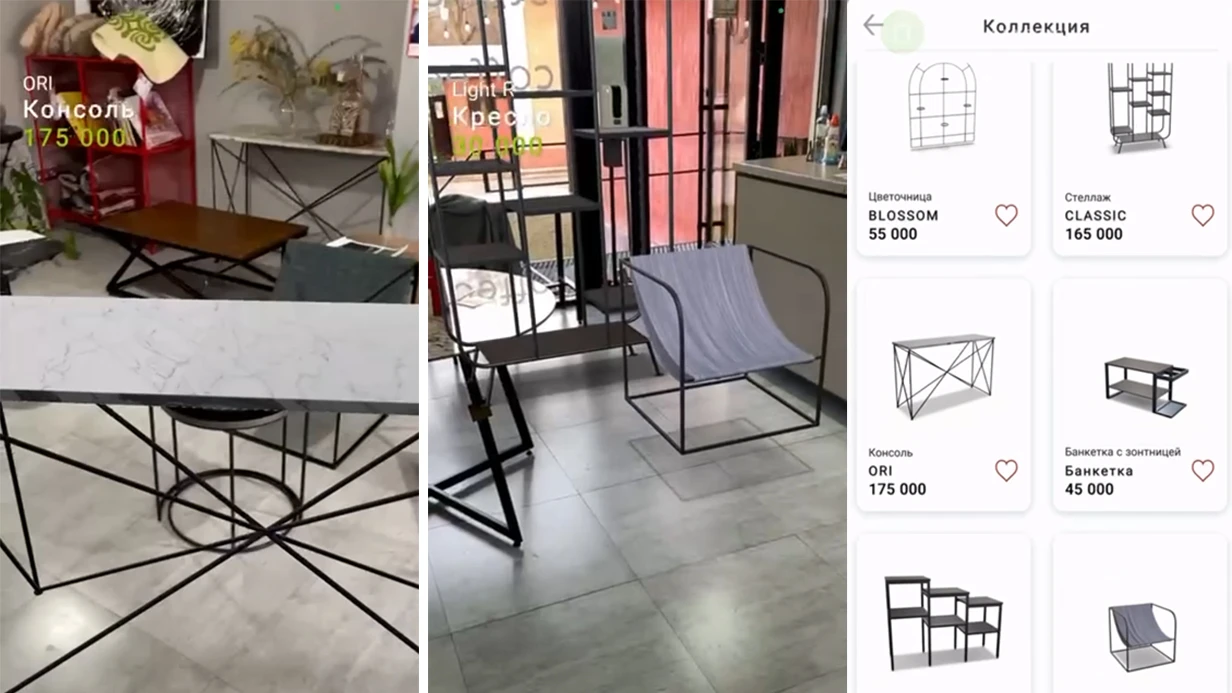
A shopping center visitor spends time looking for the right store — and often leaves without buying anything. AR navigation overlays the route onto the smartphone camera image and guides the guest to their destination, showing promotions along the way.
This gives businesses five key advantages: increased sales, a higher average check, visitor loyalty, brand recognition, and valuable data about customer behavior.
When a person sees a short route and a good offer nearby, the likelihood of entering a store grows noticeably. Promotions appear at the right moment — just a few steps from the storefront, which stimulates impulse purchases.
In addition, you can direct the guest to several locations in a single visit, increasing the average check and the number of purchases per visit.
AR navigation turns a trip through the shopping center into a simple and clear process: the guest quickly finds the parking lot, a café, the restroom, or the right brand. The less effort a visitor has to make, the more pleasant their impression of the center.
They return again and recommend the shopping center to others — loyalty grows without additional investment in advertising.
A modern AR interface in itself attracts attention and looks high-tech. Visitors photograph the unusual navigation and share it on social media, creating free brand mentions.
This makes the shopping center memorable as a progressive venue that cares about its guests — recognition is enhanced naturally.
AR navigation also shows which zones are popular, where guests stop, and which routes they choose. This data helps plan rental spaces, place advertising, and manage customer flows.
As a result, navigation pays off through increased sales, loyalty, and brand recognition, while the customer experience becomes the advantage that sets your shopping center apart from competitors.
AR Navigation Formats for Your Shopping Center's Needs
For a shopping center, it's important to choose a navigation format that matches guest flows and the goals of property owners. One solution doesn't fit all: different scenarios — from quick one-time assistance to ongoing customer engagement — require different tools.
We've compared the main formats so you can rely not on "trendy technology" but on concrete results.
| Format | Who it's for and what scenario | What it gives the customer |
|---|---|---|
| Built-in kiosks | A guest who is already in the mall and looking for a specific store; works without a phone | Reduced load on the information desk, quick answers to "where is it?", a modern image |
| Mall mobile app | Regular guests willing to install the app; navigation throughout the mall, parking, events | Increased loyalty, push notifications about promotions, collection of route and interest data |
| Web version via QR code | A one-time visitor who doesn't want to install anything; "here and now" | Maximum reach without installation, easy start, integration with maps and social media for sharing |
Each format solves its own task: kiosks cover the "guest is already in the building and lost" scenario, the app builds long-term communication with the customer, and the web version works as a fast and free entry point to navigation for everyone else.
You can choose one format or combine them: for example, kiosks in atriums and QR codes on signs give full coverage without requiring installation.
It's important that any format is clear from the first screen and requires no training.
We design interfaces for the average visitor — from a child to an elderly person — so navigation doesn't become a source of stress, but instead saves the guest time and increases their shopping enjoyment. This directly affects how long a person stays in the mall and whether they come back again.
Stages of Launching AR Navigation in a Shopping Center
Implementing AR navigation in a shopping center is a project that requires a clear sequence: from the first discussion to stable daily operation.
We've gone through this process dozens of times and packaged it into clear stages — you always know what's happening, who is responsible for what, and when you'll see results.
-
Brief and space audit — we meet with you and discuss goals: where visitors get lost, which zones need to be "highlighted," which stores should be emphasized. We study the mall's layout, entrance groups, and points of interest. You get an understanding of exactly how navigation will fit into your guest journey.
-
Plan, timeline, and approval — we lock in the scope of work, stages, and launch dates. We define who approves on your side and how quickly we receive feedback.
The result is a transparent schedule that accounts for all internal mall regulations (for example, operating hours, access to technical rooms).
-
Design concept and content — we develop the interface style, map, signs, and texts to match your brand identity. You see how navigation looks on a visitor's phone screen even before programming begins. At this stage, it's important to approve the mockups so nothing needs to be redone later.
-
Launch and training — we install the solution, connect it to the network, and set up navigation on professional equipment. We run a test route with your team and train administrators on how to use the system and quickly resolve visitor questions. You get a working tool, not just a "development project."
-
Support and analysis — after launch, we monitor stability and update content as tenants or the layout change. Once a month, we prepare a short report on which routes were searched most often and where visitors linger. This helps you plan leasing and promotions more accurately.
The total time from brief to launch in a typical shopping center is 3–5 weeks. We work remotely, but if necessary, we visit the site to properly account for all the building's specifics.
What's Included in an AR Navigation Project: Delivery Package
An AR navigation project is not just a mobile app. It's a full set of deliverables that together form a working system for your shopping center: from colorful 3D content to trained staff.
Below is a complete checklist so you clearly understand what's included in the scope of work and what you're paying for.
-
Building and route content — an up-to-date 3D model of your shopping center: levels, zones, storefronts, escalators. We add points of interest (stores, cafés, restrooms, parking) and plot optimal routes taking into account the layout's specifics.
-
Mobile app for visitors — works on smartphones and requires no additional equipment installation. The visitor sees their location and direction of movement using arrows on the screen or augmented reality.
-
Integration with mall infrastructure — connection to maps and signage, adaptation to the brand and corporate style, placement of navigation at kiosks and in tenant apps to increase reach and convenience.
-
Staff training — we conduct training for administrators, security, and information desk staff: how to use the system, help visitors, quickly update content, and handle typical situations.
-
Instructions and regulations — we provide clear guides on using the app, updating points of interest, and actions in the event of technical failures. Staff always know what to do.
-
Support and updates — warranty support for the entire duration of cooperation. We update content (new stores, promotions, layout changes) and monitor the stability of navigation.
-
Reporting for the management company — you receive usage statistics for navigation: popular destinations, number of routes built. This data helps analyze traffic and make decisions about layout and rental spaces.
As a result, you don't get a "raw app" but a ready-made tool: content is prepared, staff is trained, updates and support are included. All that's left is to launch the navigation and tell visitors about it.
Case Study: How AR Navigation Increased Sales in a Shopping Center
In a large shopping center with a hundred stores, visitors often got lost: finding the right boutique took up to 20 minutes, and there was neither time nor desire to walk the entire complex.
Some tenants in the far gallery suffered from lost revenue — guests simply never reached them. We proposed a solution: embed AR navigation into the mall's mobile app that shows the route right on top of the camera image.
Within two months after launch, target-finding time was cut in half, and the number of visits to stores in remote zones grew by a third.
One in four users returned to navigation repeatedly, and tenants' average check increased because people started going into departments they hadn't noticed before.
Implementation Results
- Time to find the desired store decreased by 50%.
- Foot traffic to distant sections grew by 30%.
- 25% of users used AR navigation regularly.
- Guests began spending 15–20 more minutes in the mall — that's additional revenue for the food court and entertainment areas.
Client Testimonial
«TRC “Gallery”» — the center's managing director shared the result: «Previously, guests visited three or four stores, and now they discover half the complex. We see it both in the analytics and on the tenants' faces — they're asking to extend their contracts for next year. AR navigation has become not just a gimmick for us, but a working sales tool».
We delivered the project "turnkey": from routes to integration with the mobile app. A month after launch, the center ordered an additional version for "Black Friday" — with holiday routes and special offers.
We bring this experience into new projects: if navigation helps a visitor find what they need in seconds, tenants get foot traffic, and the building owner gets loyal guests and growing profitability.
Frequently Asked Questions About Implementing AR Navigation
Before launching AR navigation, shopping center managers usually have the same questions: won't the technology distract visitors, how will it fit into the existing infrastructure, and will it require complex equipment.
We answer the main objections so you can make a decision faster and launch a useful service for customers.
Won't AR navigation distract visitors and create safety risks?
No. Navigation works through a familiar smartphone — the person sees hints right on the screen while walking along a regular route. No glasses or virtual objects in the air.
Activity zones can be limited: for example, you can disable hints near escalators and staircases or in high-traffic areas so as not to interfere with customer flow.
How does AR navigation integrate with a shopping center's existing systems?
It embeds into your app or launches as a separate module — there's no need to change the checkout system, accounting programs, or equipment. All you need is a floor plan and a list of navigation points.
Our team works remotely, so integration happens without stopping mall operations and usually takes 2–4 weeks.
Will visitors actually use the navigation?
The entry barrier is minimal: the visitor points their camera at a QR code or immediately sees the feature in the app — no additional downloads. AR navigation shows the route to the desired store, café, or restroom, reducing search time.
According to our analytics, the percentage of people who reach their target point grows manifold, and this directly affects the average check and loyalty to the shopping center.
What if AR navigation doesn't work on older smartphones?
We use a browser-based version — it opens on any smartphone without installing an app. So navigation works on most devices, and graphics and hints adapt to any screen size. The visitor gets an equally convenient experience both on a new device and on a budget model.
Who will support the navigation after launch?
We stay in touch: we monitor stability, update the map when the tenant mix changes, and add new points at your request. You won't have to deal with technical details — you get a working service and fast help whenever you need it.
Order AR Navigation Development for Your Shopping Center
Order AR navigation development for a shopping center from our team. You'll get a tool that guides visitors from the entrance to the desired store without unnecessary questions.
The visitor doesn't look for signs or ask for directions: they point their smartphone camera — and see arrows right on top of the image. This reduces the load on administrators and increases visit satisfaction.
We handle the entire cycle: from idea to launch and support. All you have to do is use the result. After ordering, you receive a ready-made solution that saves staff time and increases guest return. Here's what's included in our standard package:
- Designing navigation scenarios for your mall's layout
- Developing an AR interface understandable to any visitor
- Integration with your map and store directory
- Testing on real devices and route debugging
- Training your team to work with the system
- Technical support and updates after launch
- Guest movement analytics for improving the layout
To order development, contact us in any convenient way: via messenger, by phone, or through the form on the website. We'll provide a consultation, clarify your tasks, and prepare a cost calculation for your project — with no hidden fees or obligations.
Leave a request right now. Within just a few days, you'll know how AR navigation will transform your shopping center.
What If I Have Non-Standard Navigation Requirements?
Unusual layouts, multi-level spaces, special staff routes, or non-obvious logistics points — for us, this is not a problem but a familiar task. We don't offer a "boxed" solution that gets forced onto your facility with compromises.
We design navigation around specific people-flow scenarios, taking into account the architecture and business goals of the shopping center.
Custom development isn't slow or intimidating. Over 10 years of practice, we've built a flexible technical foundation that allows us to adapt the interface, route logic, and visual style to any requirement.
If the standard "from point A to point B" algorithm doesn't fit, we'll design a scenario with additional points of interest, waiting zones, or service routes — in whatever way is convenient for visitors and the management company.
For the specifics of a shopping center, this means you get a tool that works toward your KPIs: it reduces congestion in tight spots, directs guests to the right stores, and improves convenience.
All changes are coordinated with you at every stage — from the movement diagram to the final screen design.
If you already have a concept or technical specification — great, we'll implement it. If you don't have requirements yet, but you know a standard solution won't work — come for a consultation: we'll review your scenarios and propose a solution that fits your budget and timeline.