


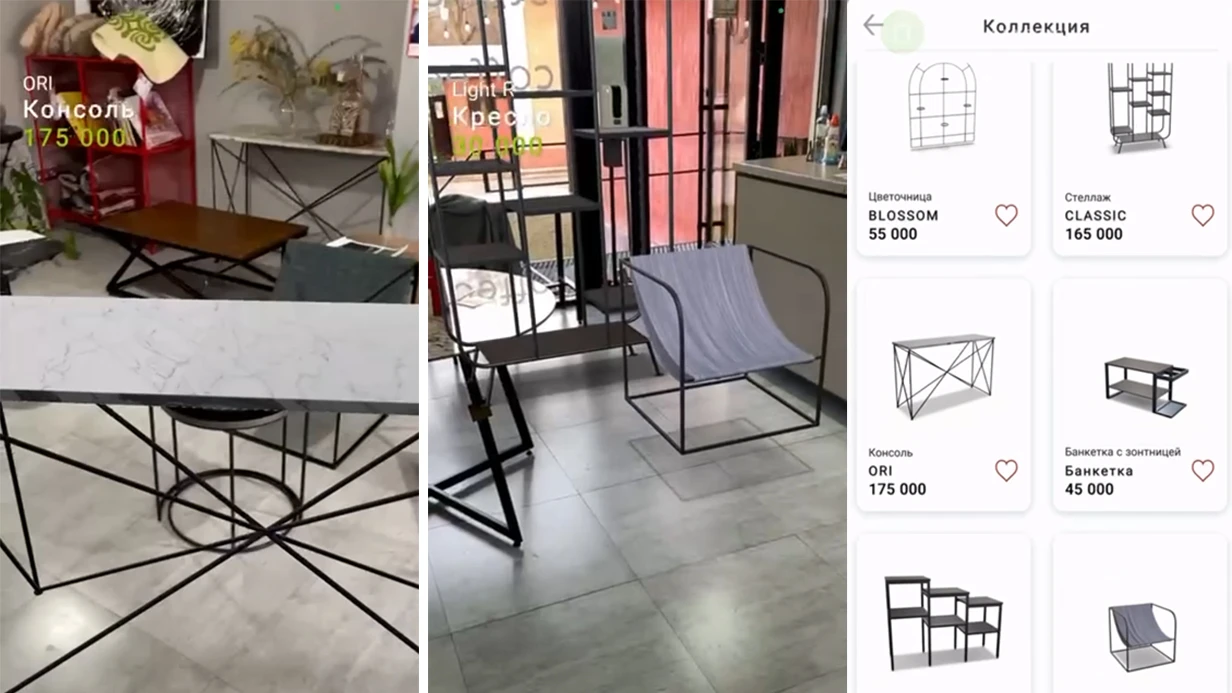





Purchasers can't see how beds and mattresses will fit into their interior
When choosing beds and mattresses, the buyer only sees photos in a catalog but can't try them on in their own bedroom.
Size, color, texture seem right, but after delivery it turns out: the massive bed clutters the room, the mattress doesn't match the decor, the interior "falls apart".
This is the main reason for doubt — a person fears making a mistake, puts off the decision, and goes to those who help visualize the result before purchase.
Augmented reality for furniture removes this fear: the buyer sees a favorite model right in their room, at real scale and with lighting accounted for.
They don't need to guess — the app shows how the bed will stand next to the wardrobe, whether it covers a power socket, and what walkway remains. Thus, beds and mattresses stop being a "risky purchase" and become a desired find.
Wehave been creating digital solutions for furniture retail for over ten years. Interior try-on through a professional AR application speeds up the choice, reduces returns due to "didn't expect a different size" and increases catalog conversion.
The buyer makes sure the purchase fits their room — and makes a decision in one visit rather than a week of deliberation.
Your manager stops wasting time on persuasion — just give the client a phone with a "View in room" button. This works even without a company mobile app: it embeds into the website, catalog or messenger.
And "before/after" photos and videos that the buyer takes themselves continue to sell your brand on social media.
Volumetric visualization of beds increases store conversion
Store conversion growth
It's hard for a buyer to imagine how a bed or mattress will look in their bedroom. Because of this, they doubt and put off the purchase.
Volumetric visualization right in the catalog or on the website removes this doubt: a person sees the model in their interior, moves it, changes the color — and makes a decision faster.
According to our estimates, such solutions increase the share of orders from viewing by 20–35%. The store gets sales growth without expanding the consulting staff and without backup discounts.
Reduced returns
A frequent reason for returning a bed is a mismatch of expectations: color, size, the feel of the room. When a buyer has already seen the product at scale in their room in augmented reality, they are less likely to be disappointed in the purchase. This reduces the number of returns and disputes, and therefore spending on logistics and resale.
The benefit is simple: fewer returns — higher margin per order.
Higher average order value
Augmented reality encourages buying more expensive models. The buyer sees how a premium bed fits into their interior and is more willing to agree to an enhanced configuration or a more expensive mattress. This gives the store a higher average order value with the same inbound inquiries.
Competitive advantage
In the beds and mattresses niche, few use volumetric visualization. While competitors show flat photos, you give the client a living experience. This sets the store apart in search and social media, increases awareness and strengthens the brand's position as modern.
Our team has been implementing such solutions for over 10 years — from consultant to website — so you get a working tool, not a pretty prototype.
Visualization formats: from catalog to full AR try-on
Buyers' tasks are not all the same: some need a quick way to show the assortment to a dealer, while others want to give the client the opportunity to "try on" a bed in their bedroom without leaving home.
The visualization format depends on this, and therefore the budget, timelines and the buyer journey itself. We offer three formats, each covering its own task.
| Format | For whom | What it provides |
|---|---|---|
| 3D catalog | Sales managers, online store, print products | Quick display of all models and colors. The buyer sees the product from the best angles without waiting for a studio shoot. |
| Interior scenes | Marketing, social media, advertising, website | Photorealistic images of a bed in a finished interior. Form a "picture of life" for the client and raise brand awareness. |
| AR try-on | Retail stores, showrooms, online catalog | The buyer sees a bed or mattress in their room, at real scale and with lighting accounted for. Reduces the fear of error and returns. |
Often one project combines all three formats: 3D catalog works for wholesalers, interior scenes for advertising, and AR try-on for the end buyer. This way you get a unified visual style across all sales channels without spending budget on repeated photo shoots.
It's best to start with the format that addresses the main business pain: a quick catalog, beautiful images, or an interactive try-on.
We help choose the right format for your task and assortment volume. If needed, all three formats are made in one project and delivered as a ready-made set for the sales department, marketing, and website.
How the project goes: from brief to launch
We built the process so you always understand what stage the project is at and what happens next. No "black box": each stage ends with a result that you can see and assess before moving to the next step.
Stages of work
-
Brief. We discuss the task: which beds and mattresses need to be visualized, where the client will use the application — in the showroom, on the site or at an exhibition. We also determine how this fits into your current work with buyers.
-
Plan and visual concept. Based on the brief, we propose a scenario: how a buyer opens the camera, selects a model, places it in their room. We agree on the appearance and function set so you understand in advance what the result will be.
-
Implementation and prototype. We develop an application prototype. Already at this stage you see how mattress models look in space, how the menu and buttons help the client rather than interfere. We develop on proven augmented reality tools — you get stable performance without surprises.
-
Approval of intermediate versions. About halfway through the work, we show a working demo version. You try it on your smartphone, collect feedback from showroom managers and make edits before the app is given to buyers.
-
Testing on devices. We check how the app behaves on different smartphones and in different lighting. It's important that the camera reliably recognizes the floor and walls, and bed models stand straight and look natural.
-
Launch and team training. We publish the app or provide a link for clients, and your salespeople get a short instruction: how to show mattresses, what to pay attention to, and what phrases to use.
-
Support and development. After launch, we help update the catalog, add new models and seasonal collections. If you want to expand functionality — for example, add size comparison or online ordering — we'll do it within the maintenance framework.
At each stage you receive clear materials for approval, not technical documents. So the whole process takes predictable time, and you accept the result even before the first buyer sees the application.
What's included in the delivery: a kit for your business
We deliver not just an application but a ready-to-run solution from day one. The package includes everything needed for your managers to quickly show clients beds and mattresses in a real interior — without lengthy integrations and separate contractors.
- Ready AR application — the client "places" a bed or mattress in their room via a smartphone camera and immediately sees the scale, color, and combination with the interior.
- Admin panel — you independently add new models, change prices and descriptions without contacting developers.
- Staff training — we conduct trainings for managers: how to launch visualization, work with the app, and respond to client objections.
- Instructions and regulations — reminders for employees and step-by-step guides: from first launch to daily work.
- Warranty support — we support the project after launch, promptly resolve issues and update the application for new business needs.
- Content assistance — we advise on how to prepare digital copies of your products, or take the preparation on ourselves.
- Usage analytics — you see which models are viewed more often and which lead to inquiries, and adjust the assortment accordingly.
Case study: how a furniture showroom chain increased sales with AR
A furniture showroom chain "MebelPro" came to us with a typical pain point: buyers take a long time choosing a bed or mattress but often return the order after delivery.
It turned out the reason wasn't quality but uncertainty — the client couldn't imagine how the product would fit into their interior, whether it would suit in size and style.
We proposed an AR catalog where every item can be "tried on" in their own room through a smartphone camera.
The idea turned out to be simple for the client and powerful for business. Instead of flat photos, the buyer sees a realistic bed model at 1:1 scale, changes the color, views it from all sides. The doubt is removed before the purchase — not after. For the showroom, this means fewer rejections and more confident decisions.
Implementation results
Two months after the AR catalog launch, the chain noted a 30% increase in inquiries. Conversion from inquiry to purchase grew one and a half times, and the share of returns due to "didn't fit the interior" dropped threefold.
Salespeople gained a convenient consultation tool: the buyer sees and understands what they are choosing.
What matters for repeat sales
A post-delivery survey showed: 9 out of 10 buyers who used AR called this tool decisive in their choice. They more often recommend the showroom to friends and return for related products — mattresses, bedding, accessories. Thus AR became not just a feature but a loyalty growth point.
We supported the project turnkey: produced the catalog, set up website integration and trained the staff. The result speaks for itself — the chain scaled the solution to all its stores. Ready to achieve the same result for you.
How to choose the right visualization format for your furniture?
Choosing a visualization format is like choosing a sales tool: there is no universal solution, but there is the right one for your task.
When it comes to beds and mattresses, it's important to understand what exactly you want — fast growth of online orders, client confidence when buying in a showroom, or a bright reason for marketing.
3D catalog is the base to start with if you have many models and a limited budget. It allows you to show the product from different angles, quickly launch a storefront and update it without photo shoots.
This format covers the basic need: the client sees the details and doesn't leave for a competitor because of unclear photos.
When the product is expensive or sold through a showroom, add an interactive scene — the ability to "rotate" the bed, change the upholstery, open drawers.
This holds attention much longer than a static image and helps the consultant bring the client to a decision faster.
AR try-on is the next level. For beds and mattresses it is especially valuable: the buyer sees the model in their bedroom, assesses the scale, color, and combination with the wallpaper.
This removes the main fear before purchase — "how will it look at my home" — and significantly reduces returns.
Whichever format seems suitable, start with a consultation: we'll analyze the assortment, goals and budget and propose the option that brings maximum benefit to your business. The rest is a matter of technique.
FAQ from clients about AR visualization development
When ordering AR visualization for beds and mattresses, clients most often ask about the same things. We've collected answers to the main questions — so you know in advance how the work is structured and what you can expect.
What guarantees do you provide?
We work under a contract with a fixed estimate and deadlines. You get rights to the result, and we take responsibility for quality: before launch we test on real devices and fix errors free of charge. If something doesn't work as it should, we'll return to refinement at our own expense.
How long does development take?
A typical project — visualization of a catalog of 10–30 items — takes 2–4 weeks. The time depends on the number of models and interior complexity, but we always set dates in the plan and meet them. Intermediate demonstrations let you see the result and adjust the process along the way.
What devices will the application work on?
AR visualization works on modern smartphones and tablets — both iOS and Android. Your salespeople and clients won't need additional equipment: the device camera is enough. We configure the project for the models your team uses.
Can the application be refined after launch?
Yes, we support the project after release. You can add new beds and mattresses, change finishes, create additional interiors and improve the interface. You're not tied to one version — the app evolves together with the assortment.
Still have doubts — ask them directly: we'll advise on how AR visualization fits into your sales processes.Leave a request: get a demo for your products
You already understand how AR visualization changes the presentation of beds and mattresses: the buyer sees the product in their interior, doubts decrease, sales increase. One step remains — to test it on your assortment.
Leave a request, and we'll prepare a demo example for one of your models, calculate the cost and timeline for your furniture line.
This is non-binding. You'll get a clear result and an understandable action plan, not an abstract description of services.
What's included in the first contact:
- A demo video or interactive AR version for your products — see how it works.
- Project calculation: cost, timeline, stages for your assortment of beds and mattresses.
- Consultation on usage scenarios: online catalog, website, showroom, marketplace.
- Recommendations for integration with your website and social media — without complex technical details.
- An assessment of the potential for conversion growth and return reduction — based on the experience of similar projects.
- Priority contact with your manager within one business day.
You don't need to be a technical specialist — we handle the shooting, processing and setup ourselves. Just send a request or write to a messenger, and we'll show how your beds and mattresses "come to life" in the buyer's interior. This is the best way to make sure the technology brings measurable value to your business.