




Office Furniture in AR: How to Stop Losing Customers at the Selection Stage
A client walks into the office, sees a table or chair in a photo—and can’t decide to buy. The main question isn’t price or specifications: they can’t picture how that furniture will look in their meeting room, by the window, or in an open-space layout.
The hesitation turns into the classic “I’ll think it over,” after which the lead goes cold and the sale goes to a competitor.
It is at the selection stage that up to 30–40% of potential orders are lost. People are afraid of choosing the wrong size, color, or combination with an existing interior.
Even high-quality catalogs and 3D renders don’t help: they show furniture in a studio setting, not in the client’s actual room.
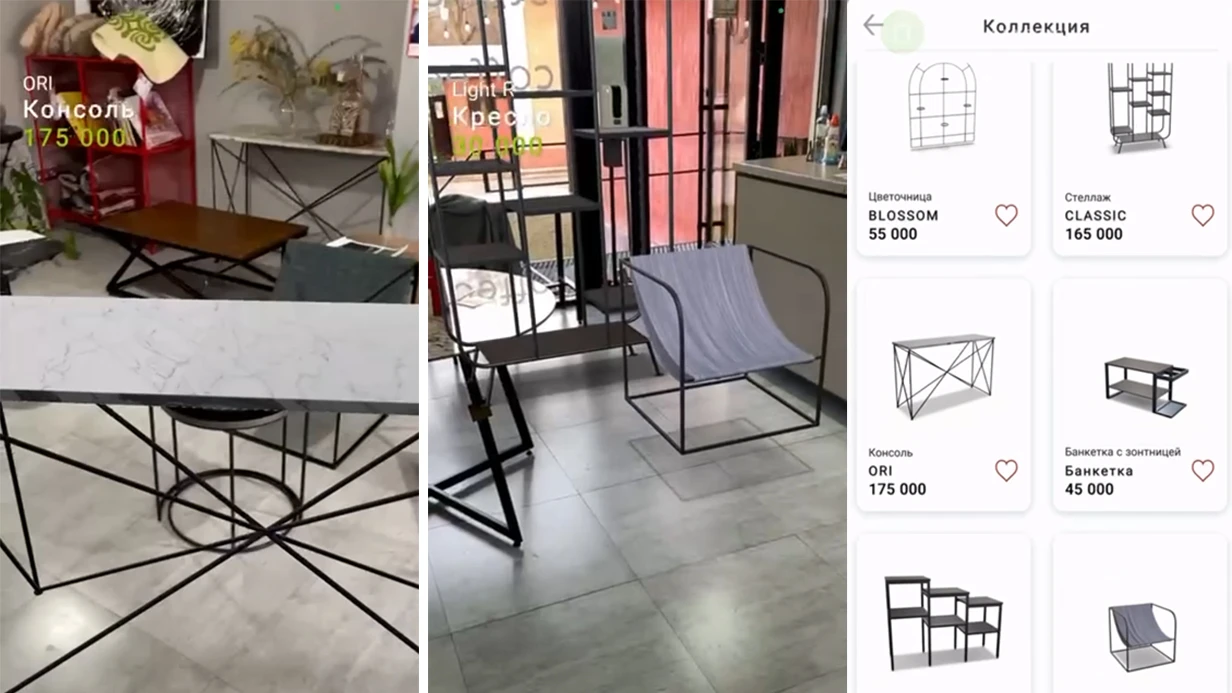
AR visualization of office furniture solves this problem. The buyer points their smartphone or tablet camera at their office and sees right on the screen how the chosen desk, chair, or cabinet will fit into their space, in real scale and with real lighting.
They can move the object, change color or configuration, and see how much space remains for walking around. This isn’t a demo video; it’s an interactive catalog that works in real time and removes the main objections before a return question even arises.
For the seller, this means consultations without extra meetings and site visits, a shorter sales cycle, and greater trust. When the client “arranges” furniture in their own interior themselves, they’ve already made the decision mentally—the only thing left is placing the order.
This presentation format for office furniture sets the company apart from competitors and turns doubt into a confident “yes.”
Why AR Visualization Sells Better Than a Flat Catalog
A flat catalog shows the product, but not the main thing—how it will change the buyer’s life.
They see an office chair or desk against a white background, but the question remains: “Will it fit my interior?” AR visualization removes this barrier: the buyer sees the furniture in their own real space, moves it around, changes colors, and assesses the scale. That’s how trust is born, and trust means higher conversion.
First benefit—real emotions instead of boring page-flipping. When a visitor controls the image themselves, they become engaged: they examine every detail, try it against their style, and discuss it with colleagues.
This kind of product experience takes just minutes but leaves a vivid impression. It is the emotional connection that pushes a person toward a purchase decision—they can already imagine using this furniture.
Second benefit—wide audience reach. An AR solution easily integrates into a product presentation at an exhibition, in a showroom, or on a website.
Every visitor becomes a carrier of your brand: they take photos and videos of interesting moments, share them on social media, and show friends. One demonstration thus turns into dozens of mentions of your company without spending on extra advertising. Reach grows naturally.
Third benefit—brand recognition. An ordinary catalog is forgotten within an hour, but an unusual AR meet-and-greet with the product is not. A modern format signals that the company follows trends, cares about customers, and is ready to surprise.
This perception strengthens the brand position, sets you apart from competitors, and creates a foundation for long-term customer relationships.
The bottom line is simple: AR visualization of office furniture is not just a pretty effect; it’s a tool that delivers measurable business results.
Check whether your presentation gives the buyer an emotion, an opportunity to “try on” the product, and a reason to tell others about you. If not, it’s time to fix that.
AR Visualization Formats for Office Furniture for Your Task
The right AR visualization format for office furniture depends on where you meet your customer: in an online store, in a showroom, or at an exhibition. Each touchpoint needs its own scenario; otherwise, the technology won’t pay off. We choose the format for your sales funnel rather than simply “adding AR.”
In an online store, the customer can’t see the furniture in person—they need a quick virtual try-on. Simply point the camera at the floor or a table, and the chair or cabinet appears in real scale. This removes the biggest fear, “it won’t fit,” and speeds up the purchase decision.
For a showroom or exhibition, an AR showroom works better: a space where visitors place several items at once and see a complete picture of an office.
This way, the client isn’t just looking at a display; they “step into” the future interior—engagement and time spent at the stand grow dramatically.
| Format | For whom / where it is used | What it gives the business |
|---|---|---|
| Virtual try-on in the catalog | Online office furniture store | Fewer returns, higher conversion, larger average order value |
| AR showroom | Demonstration hall, showroom | Stronger attention retention, more time spent with the brand, easier manager workflow |
| AR for exhibitions | Industry events, conferences | Flow of leads, strong visual impact, collected contacts of interested customers |
We adapt each format to your catalog: we upload your office furniture models, set up the scenario, and train your staff. After launch, we measure how clients interact with the AR and refine the format—simplifying steps, adding popular items, and improving visualization.
You get a ready-made sales tool that delivers measurable results: more inquiries, more repeat orders, and stronger brand recognition.
How the Project Works: From Brief to Launch
To ensure the result matches expectations, process predictability matters. That’s why we’ve structured our work so that you understand what’s happening at every stage and can influence the project’s course—from the initial brief to app launch and subsequent support. Below are the key stages of AR visualization development for office furniture.
- Brief and product immersion. We study your office furniture catalog, use cases, and customer needs. We determine which models need to be shown first and which interior formats matter to your buyers.
- Plan and estimate. We fix the development stages, timeline, and cost. We agree on the scope of work and control points so that you know exactly what we are responsible for and when you get the result.
- Layout approval. We create an interface prototype and the logic for choosing furniture in an interior. You see what the app will look like and make changes before the main development begins.
- Development and intermediate versions. At every stage, we show the result on professional equipment. You provide prompt feedback, and we adjust details so that we don’t have to redo everything at the finish.
- App launch. We build the final version, publish it in official app catalogs, or provide a direct distribution link. We train your employees so they can immediately use the new tool in sales.
- Support and evolution. After launch, we stay in touch: we quickly fix issues, update the catalog with new furniture models, and add features as your business grows.
What’s Included in the Delivery: A Package for Your Marketing
You receive not just an app, but a ready-made tool that immediately plugs into your marketing processes. We put the package together so that managers, designers, and clients can use AR visualization without developer involvement. Below is the complete scope of delivery.
- Ready-made AR scenes — branded interiors with your office furniture that open via QR code or link. A visitor points the camera at a marker and sees a desk or chair take its place in the real space.
- 3D model library — digital copies of every catalog item: from chairs and desks to cabinets and partitions. Each model conveys shape, texture, and color, so the client immediately understands what the item looks like in real life.
- Source files — editable scene and model projects. You can add new items, change textures, and update the catalog yourself without additional payments.
- Instructions and regulations — simple guides for employees: how to place a marker, set up lighting, and run a demonstration. No technical training required.
- Staff training — we conduct a short hands-on workshop for your team: managers learn to launch scenes, sales managers learn to use AR in negotiations, and marketers learn to integrate visualization into advertising.
- Technical support — after launch, we stay in touch: we help with updates, fix errors, and consult employees while they get used to the tool.
This package saves implementation time and ensures that AR visualization doesn’t become a “dead feature.” Your sales department gets a clear way to show furniture in the client’s interior, and marketing gets a fresh content format for exhibitions, catalogs, and social media.
Submit a request—we’ll prepare a package for your catalog and show you how it will work in your specific scenarios.
Case Study: How AR Visualization Doubled Catalog Conversion
The furniture company OfisStil came to us with a typical pain point: people were viewing their office furniture catalog, but few inquiries were coming in.
It was hard for buyers to imagine how a desk or cabinet would fit into their office—so the decision was postponed, and a competitor got the client.
We digitized 40 key catalog items and added AR visualization to the website: a visitor “places” any item into their own room through a smartphone or tablet camera. No measurements or guessing—the scale, color, and fit with the interior are immediately visible. This format shortens the path from “interesting” to “I’ll take it.”
Results after two months: catalog-to-inquiry conversion doubled, and average time on the product page tripled. Customers began ordering full sets more often—they could see how a chair and cabinet matched their office. The sales team noted that phone calls became more “specific”: people already knew what they wanted.
The company owner said in a testimonial: “We expected interest, but got measurable profit. AR visualization paid for itself in a month and a half and now works like a permanent salesperson who never gets tired of showing the product in action.”
We are now scaling this approach for other furniture brands—adding new items, creating virtual showrooms, and connecting AR to the shopping cart. If your furniture catalog sales are stuck on “it’s unclear how it will look,” this is solvable.
How to Choose the Right AR Visualization Format for Your Task?
The choice of an AR visualization format always starts with one question: where exactly does the customer meet your product, and what action should they take?
For office furniture, this could be a quick catalog view on the website, a model try-on in the showroom, a presentation to a major client, or an interactive zone at an exhibition.
Each scenario has its own requirements: sometimes instant loading without installing an app matters; other times, the ability to save a project and return to it later; and sometimes full integration with the product database and cost calculation system.
If your goal is to increase conversion for an online office furniture store, a web-based AR format is usually the best fit: the buyer points their smartphone camera at their workspace and sees how a chair or desk fits into the interior.
This reduces the fear of making a mistake and the number of returns, because the person sees the scale and color combinations in advance.
For showrooms and exhibitions, a dedicated AR application works better—it runs smoothly in offline mode and lets a manager demonstrate the entire furniture line from a single tablet instead of carrying catalogs and samples.
When choosing a format, we look at the specifics of your business: the number of SKUs, the type of buyers (retail or B2B purchases), and how the visualization should connect with your catalog and CRM.
That’s why there is no universal “correct” option—there is an optimal solution for your task. At the start, we do a short analysis, clarify the use case, and only then propose the format and scope of work.
In the end, for office furniture, a properly chosen AR format delivers measurable results: higher average order value, less time spent approving a design with the customer, and more confidence for the buyer.
If you’re unsure which option is right for you, come to us with your task—we’ll help you decide and deliver a turnkey solution.
What If Something Goes Wrong? Guarantees and Support
We understand: when you invest in AR visualization of office furniture, you want assurance that everything will work at the right moment. We take on the technical side so that you can focus on meeting the client and negotiating.
That’s why every project includes guarantees and dedicated support—it’s part of the service, not an option.
The guarantee covers stable app performance: we test the scenario on your devices or provide our own; we check lighting, room dimensions, and compatibility with the furniture. If a failure occurs during preparation or during the demonstration, we fix it with priority. You don’t need to understand technical details—our team handles all issues.
Support also continues after launch. You get a direct line to a personal manager—they stay in touch throughout the project and help with setup, bringing in technical specialists when needed.
Average response time is up to 30 minutes during business hours, and on the day of an event we support you in “here and now” mode.
For non-standard situations, we have backup scenarios: additional devices, a spare marker placement plan, and quick content replacement. You won’t be left alone with a problem—we’ve prepared contingencies that most clients never even notice.
What happens if something doesn’t work during a presentation in front of the client?
Nothing critical: our specialist is on the line, and within a few minutes you’ll get an instruction or a remote solution. If needed, we’ll launch a backup copy of the app—we keep all intermediate versions.
Our job is to make sure your presentation goes ahead, even if something doesn’t go according to plan. In such cases, we take care of the entire technical side, and you simply continue your negotiations.
Submit a Request: Get a Demo and Project Estimate
Submitting a request takes a couple of minutes and doesn’t obligate you in any way. We’ll call or write back, clarify the task in one short conversation—and prepare a demo and estimate for your specific project, not some generic offer from the website.
What you get after reaching out:
- Consultation — we’ll discuss goals, audience, and the use case for AR visualization of office furniture.
- Demo — we’ll show real cases where furniture and interiors look like finished photos, so you can assess the quality.
- Timeline estimate — broken down by stages and days, so you know when the solution can go live.
- Scope of work — a detailed description of what we do and what data we need from you.
- Transparent estimate — all figures are fixed before the start, with no hidden charges or “surprises” along the way.
- Implementation options — from a simple augmented-reality catalog to a full VR showroom for your catalog.
- Usage recommendations — how to integrate the solution into sales, on the website, or in a showroom so that it generates inquiries.
This approach resolves the key questions before you even start: you see the format, the budget, and the timeline. All that’s left is to make a decision—and we’ll handle the entire technical side.
Submit a request now—get a substantive conversation, a demo, and an estimate for your task. It comes with no obligation.