



How lighting fixtures lose sales without visualization
A buyer chooses a chandelier or sconce not by technical specifications, but by the feeling of "how this will look in my home." A regular catalog with photos on a white background doesn't convey that feeling: the person can't imagine the scale, the light color, or how the fixture will fit into an existing interior — so they hesitate, postpone the purchase, and ultimately go to a competitor who offered the chance to see the lighting in an interior.
For a store or brand, this is a quiet loss: the client came, looked, showed interest, but didn't decide. Without product visualization, it's impossible to shorten the path from interest to payment.
And if there's a company nearby with an AR tool, the buyer chooses it — because that's where they feel confident. It's not about price, but about who removes the fear of making a mistake faster.
Lighting sales directly depend on how easily a person can mentally place the fixture in their apartment and integrate it into the interior concept.
We close this gap. Our augmented reality solutions show how lighting fixtures look in a real room: with the correct scale, warm or cool light, in the context of furniture and finishes.
The client sees not an abstract picture, but their future interior — and makes a decision confidently. For you, this means higher conversion, fewer returns, and an advantage over competitors who are still selling "blind."
What AR visualization gives your business
The main problem in lighting sales is that the buyer can't imagine how a specific chandelier or sconce will fit into their room. They see the fixture in a showroom or in a picture, but doubt the size, brightness, and how it works with the furniture.
The situation is made worse by the fact that lighting fixtures are rarely bought impulsively — it's a thoughtful purchase, and every doubt increases the risk of the customer going to a competitor.
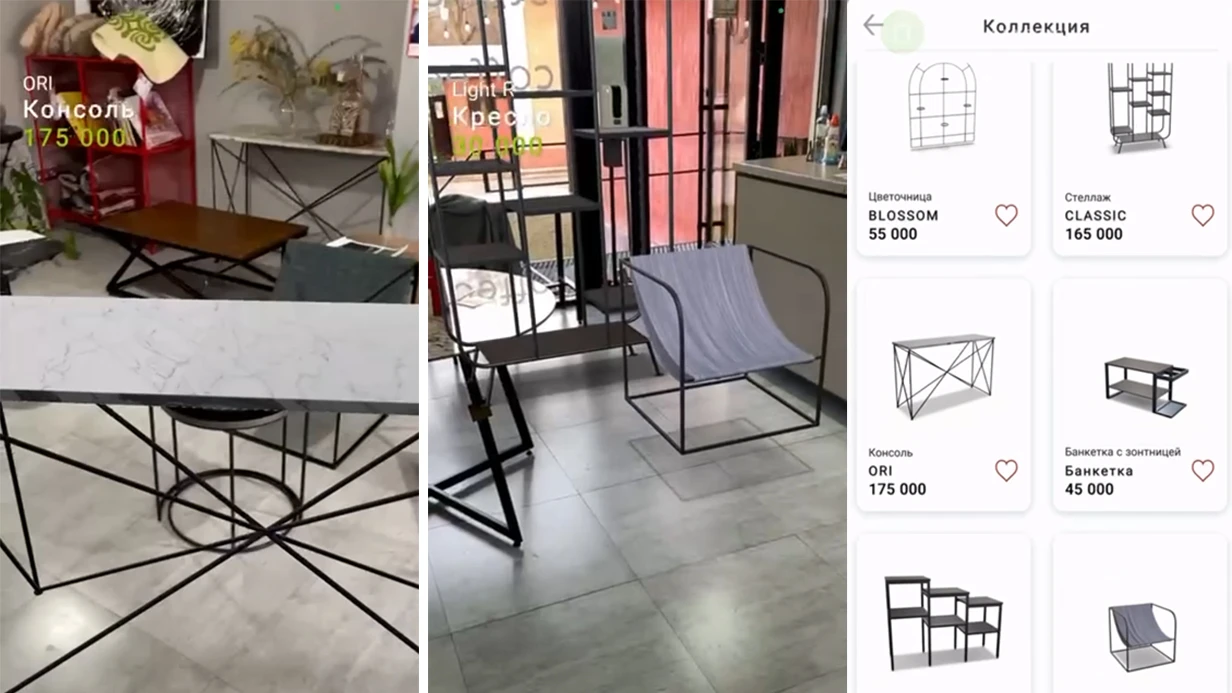
AR visualization removes these barriers. The client points their smartphone camera at their living room and immediately sees the fixture at actual size, from the right angle, and with accurate color rendering.
This turns the choice from abstract into visual, so the buyer moves faster toward placing an order and postpones the decision less often.
Such visual clarity directly affects returns. When a person sees in advance how the fixture looks in their interior, they don't feel disappointed after delivery and don't request a replacement.
The return rate drops, logistics and repackaging costs decrease, and the sales department doesn't waste time on complaints.
Lighting fixtures are an emotionally purchased product, and AR adds exactly that emotion. The client moves the lamp around the room, changes the angle, turns lighting scenarios on and off, takes photos and consults with family.
This engages them in the process, increases time spent on the site, and raises the chance they'll come back for a second purchase for the bedroom or office.
People share such photos with friends and on social media — which means additional reach for your brand without an advertising budget.
In the end, AR visualization works on three key metrics: conversion from the catalog grows, returns decrease, and the average ticket increases through upsells and more expensive models. Your catalog becomes an interactive sales tool rather than just a set of product cards. This makes a lighting store noticeably stronger than competitors who offer only static photos.
AR visualization formats for lighting fixtures
A buyer chooses a lighting fixture "blind" — based on photos in a catalog or website. Even high-quality photos don't show how the fixture will fit into a specific interior, what light it will give, or its scale. As a result, clients hesitate, postpone purchases, and return products.
AR visualization removes these doubts: the person sees the fixture in their space before buying. We offer three formats for different tasks — from a quick check in an online catalog to a full interactive showroom. Each option pays off through higher conversion and fewer returns.
| Format | For whom | What it gives the client |
|---|---|---|
| Quick view in the catalog | Online stores, manufacturer websites | The buyer "places" the fixture in their room via smartphone and immediately sees the size, color, and style. Fewer doubts → more completed orders and fewer returns |
| Location-based app | Showrooms, salons, exhibitions | The visitor points the camera at an area and sees how the model will look in their space. The consultant selects an option faster, the conversation becomes concrete rather than abstract |
| Interactive showroom | Showrooms, dealer centers, exhibitions | The entire assortment in AR without physical samples. The client changes color, size, and quantity of fixtures in a minute — convenient for showing a product line without using warehouse space for demos |
The formats are easily integrated into an existing website, mobile app, or salesperson's tablet. We select a solution for your business process — so the client gets the right experience, and you get measurable results in sales and loyalty.
How we implement AR visualization in your business
We built the process so you see results at every stage rather than waiting for a "big bang" at the end. This reduces risks, saves budget, and lets you make corrections quickly while they're still inexpensive.
-
Brief and task immersion. We study how your clients currently choose lighting fixtures: they browse the catalog, visit the showroom, doubt compatibility. We record goals, success criteria, and project timelines.
-
Interactive prototype. We build a working visualization model on your real products. You see how the buyer will choose a chandelier, sconce, or track system, and you approve the logic before full development begins.
-
AR module development. We create the interface, fixture catalog, and visualization scenarios: trying on a photo of a room, adjusting size, brightness, and color. We use professional equipment — the app runs stably on different smartphone models.
-
Integration into your system. We connect the module to the website, CRM, or mobile app, and set up loading of current prices and stock levels. Your managers get a convenient tool that requires no technical knowledge.
-
Launch and support. We test with real users, fix issues, and train your team. After launch we stay in touch — we accept refinement requests, add new features, and monitor performance.
The full implementation cycle takes 2 to 6 weeks — the timeline depends on the size of the catalog and the depth of integration. You always know what stage the project is at and can adjust priorities. In the end, you get a tool that starts generating inquiries from day one, not after six months.
What's included in an AR visualization project
An AR visualization project isn't one-time "screen magic," but a working sales tool that needs to be integrated into your team's daily operations.
We put together a turnkey package — from app installation to manager training — so you get measurable results rather than a new headache.
- AR app for clients. Works on regular smartphones and tablets: the visitor points the camera at a floor plan or QR code and sees how a specific fixture looks in the room. This removes the buyer's main fear — "how will this look in my home."
- Admin panel for your catalog. You change prices, add new fixture models, and hide sold-out items yourself — without submitting requests to developers or waiting for them to update it.
- AR launch at your site. We set up publishing in app stores, test scenarios on different devices, and help with the first launch at an exhibition, showroom, or salon.
- Employee training. We conduct a training session for managers and consultants: how to show a fixture in an interior in a few minutes, what to suggest to a client, how to turn interest into an order. These are simple scripts, not technical lectures.
- Instructions and guidelines. We provide short cheat sheets for staff: how to update the catalog, how to display the image on a large screen, how to view view statistics for each model.
- Support and development. We accompany you after launch: we fix inaccuracies, adapt scenarios for new lighting collections, and refine functionality to suit your sales department's needs.
This approach provides a full cycle: you get not just code, but a ready-made scheme that both your salespeople and your clients use. After launch, the team works with the app independently, while we stay close to develop scenarios alongside your assortment.
Case study: how a lighting salon increased sales
The lighting salon ArtLux sells premium designer fixtures. Buyers often postponed purchases because they couldn't imagine how a specific model would look in their own room.
Managers spent hours on consultations and brought samples, but orders still fell through — the client doubted the scale, color, and how it fit with the interior.
We suggested an AR catalog to the salon: the buyer selects a fixture, points the smartphone camera at their room, and sees the fixture at actual size with realistic lighting.
This removed the main fears — the client immediately understands whether the size works and how the model looks against the wall or above a table. Implementation took three weeks, staff needed one day of training, and visitors use the catalog without a salesperson's help.
Result after a month: sales increased by 25%. The share of successful consultations doubled, and repeat inquiries for additional fixtures for other rooms grew by 40%.
Managers spend 30% less time per deal — the client independently selects models they like, and the salesperson helps with the choice and paperwork.
The case showed: AR tools pay off in home goods sales. The salon not only increased revenue but also strengthened its position as a tech-savvy boutique where people come for an experience, not just a purchase.
Two months later, the client ordered a catalog expansion across all categories — from sconces to ceiling chandeliers.
How to choose an AR format for your task?
There's no universal AR format, and that's good news: you can choose exactly the option that will benefit your business. The real question is — where does the customer encounter lighting fixtures and what action do you want them to take? The display format, the platform, and the implementation budget all depend on this.
If a client chooses a chandelier or sconce through an online store, they need to imagine the fixture in their interior. Here the best choice is visualization through a smartphone camera: the person points the phone at the room and sees the fixture at real scale.
This format removes the main objection — "how will this look in my place" — reduces returns, and increases purchase confidence. In this case, AR for business works as a virtual consultant available to the client around the clock.
For a showroom or lighting salon, a stationary format with a tablet is more convenient: the consultant shows fixtures in different finish options and with different lighting types without moving heavy samples.
For an exhibition or collection presentation, an interactive zone is better suited, where visitors turn fixtures on, off, and change them themselves.
This increases the time of contact with the brand and gives a reason to photograph the result and share it on social media — free reach for your advertising.
When choosing a format, it's important to consider where exactly AR will be used: on the website, in the app, in a display window, or at a booth. The good news: in most cases, visitors don't need to download or install anything — a regular phone camera is enough. This removes the entry barrier and makes the technology accessible to people of any age.
We help not just "implement AR" but choose the right scenario and avoid unnecessary costs. During a consultation, we'll analyze your task, show examples for companies selling lighting fixtures, and propose a format that delivers measurable results. Book a consultation — together we'll find a solution that works for your business.
Frequently asked questions about AR projects
We understand that questions about cost, timelines, and integration arise before you start. We've collected answers to the most common ones here. If your question isn't listed — write to us, and we'll work through your case.
How much does such a project cost?
The cost depends on the number of scenarios, the number of lighting fixture models, and the level of detail. After the brief, we fix the estimate in the contract — no hidden payments. You pay for a clear result.
How long does development take?
A typical project takes three to six weeks. We put together a calendar plan with checkpoints and show a demo at the intermediate stage. If you change requirements, we adjust the timeline in advance.
Will we have to restructure our workflows?
No. The solution integrates into your current catalog or website; a regular smartphone or tablet is enough. Employees will figure it out in a few hours; the interface is intuitive. After launch, we stay in touch: we update content and answer questions.
What guarantees do you provide?
We fix timelines, scope, and budget in the contract. After delivery, there's a testing period when you check the solution on real tasks. Any issues found are fixed within the agreed scope.
Shall we discuss your AR visualization project?
Clients and partners often can't imagine how a lighting fixture will look in their interior. Photos and catalogs show this schematically, and returns due to "it didn't match expectations" are expensive.
AR visualization removes this risk. The buyer looks at the fixture in their space, from the right angle, and with different lighting levels.
Leave a request for a consultation — tell us about your task, we'll ask a few clarifying questions and offer the optimal scenario. After the conversation, we'll send you a cost estimate and timeline for your project — not average market figures.
What you get after submitting a request
- Consultation with an AR visualization specialist for lighting fixtures in interiors.
- A cost estimate tailored to your project: scope of work, number of models and scenes, integration methods.
- Development timeline and a phased plan — you'll know when you get the ready solution.
- Format selection: a standalone app, a web version, or a solution for your catalog.
- Examples of projects in your niche — evaluate the quality and results before you start.
- A personal manager who leads the project from brief to launch.
Fill out the form below — we'll get in touch within one business day and confirm the arrangements.
The request doesn't obligate you in any way, but already at the first consultation you'll understand how AR visualization can help you sell lighting fixtures faster and more confidently.