






The client doesn't see bedroom furniture in their interior — and doesn't buy
A bedroom furniture buyer doesn't choose with their eyes but with their imagination. They look at a bed or wardrobe in the showroom but can't picture how it will look in their own bedroom: does the size fit, does the color match the wallpaper, will there be room to walk around.
That's when the main objection is born — "I need to think about it" — which most often means "I'll go look somewhere else."
Without trying it in an interior, the purchase is postponed, and the client leaves for a competitor who was able to remove their doubts.
Even if your assortment is wider and your prices are lower, what decides it isn't that but confidence: a person buys when they see how an item lives in their space.
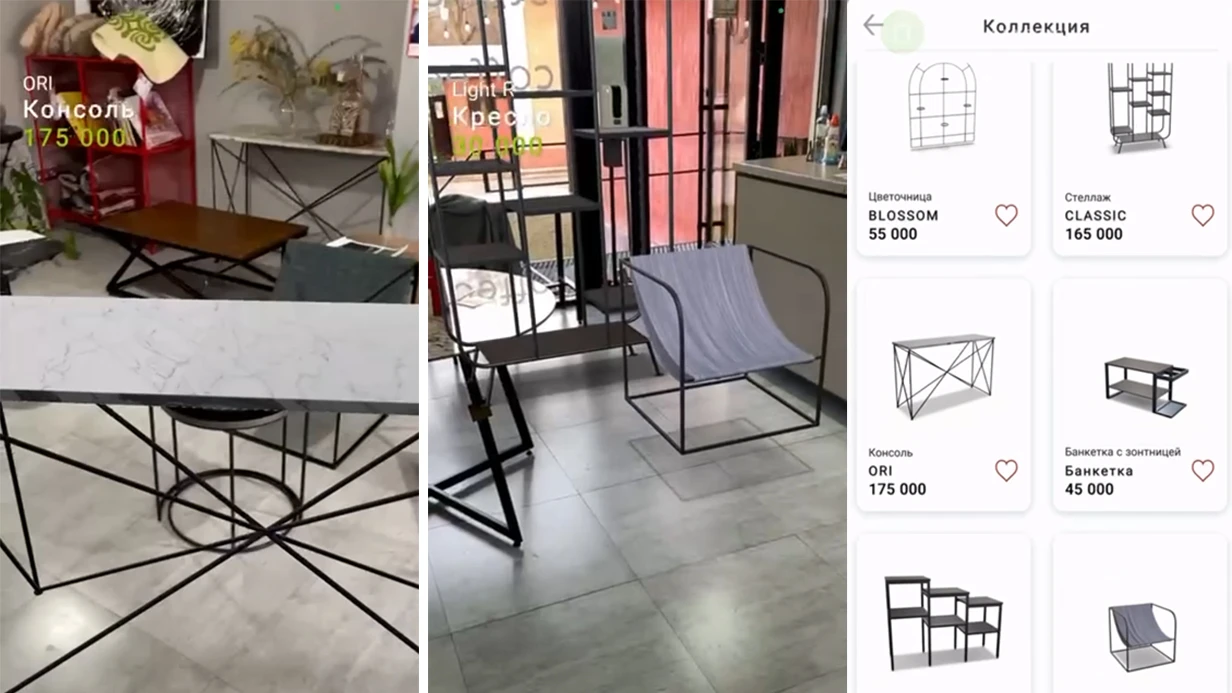
AR furniture visualization helps solve this task — a technology that brings a digital model directly into the buyer's real room.
By showing bedroom furniture in the context of their own walls, you remove the main objections before the conversation with a manager even starts. The buyer sees the scale, color, texture, and how it fits together — and makes a decision 1.5–2 times faster.
This isn't just convenience but a conversion growth tool: every try-on in an interior brings the deal closer.
We design AR scenarios for catalogs and websites of furniture manufacturers so that a smartphone is all the client needs. They point the camera at a corner of the room — and there's a bed or nightstand with accurate proportions in front of them.
No measurements and no complicated instructions: just a fast path from "look" to "buy."
What AR visualization gives business: from guest reactions to leads
AR visualization of bedroom furniture turns a stand or catalog into a live experience. The buyer sees how a bed or wardrobe will look right in their own room — this holds attention far longer than regular photos or a consultation.
The first measurable benefit is customer engagement. A visitor doesn't just look but interacts: changes the color, the size, moves the item around their space.
This kind of activity is memorable, people tell their friends about it, and at an exhibition a line forms around the stand.
The second benefit is fewer returns. When a person sees furniture in their own interior, they don't need to guess whether it fits by dimensions and style.
The decision is made faster and more confidently, and the likelihood of a mistaken order drops — money doesn't go toward return logistics.
Third — leads from the exhibition. An AR session can become a point of contact: after a guest has "tried on" the furniture, they're more willing to leave their contacts to get a selection or a designer consultation. These are warm leads with high conversion to purchase, not just business cards for the memory.
The fourth benefit is brand recognition. Unusual visualization itself becomes a media hook: visitors film the process, post videos, and tag the company. This way the brand gets free reach before the buyer even makes it to the catalog or website.
In the end, an AR tool pays off not through a single action but through a chain: it attracts attention, removes objections, collects inquiries, and strengthens positioning.
For a business, this is a comprehensive step toward growing sales and loyalty without extra advertising budgets.
AR visualization formats for bedroom furniture for your task
The choice of AR visualization format depends on where you meet the client: on the website, at an exhibition, or in a social media feed. Each scenario solves its own task — removing doubts before a purchase, drawing attention to a stand, or starting a wave of brand mentions. Let's look at three working options.
Bedroom furniture visualization is not just a 3D model. It's a way to show the product in the context of the client's room. This way the buyer stops guessing whether the bed fits by size and color — and makes a decision faster.
| Format | For whom | What it gives the client |
|---|---|---|
| AR catalog | Online stores and bedroom furniture brands | The buyer "places" the selected bed into their room, sees the scale and color — fewer doubts, fewer returns, more orders. |
| AR zone at an exhibition | Manufacturers and distributors | Visitors try on furniture in a real interior, take photos and share their impressions — the stand is remembered, contacts are collected faster. |
| AR filter for social media | Marketing campaigns and brands | Users "install" furniture in their home and publish the result — reach grows without advertising spend. |
We work with professional equipment and set up visualization for your catalog: real models, correct proportions, natural light. We'll advise which format suits your task, and if needed combine several options into a single system.
How the project goes: from brief to launch and support
We're explaining how work on AR bedroom furniture visualization is structured. The process is split into six stages — at each key step you get a result for approval and make edits. Transparency and predictability help control timelines and budget.
-
Brief and task analysis. We fill out the development brief together with you: we clarify the bedroom furniture assortment, target customer scenarios, and AR entry points. At this stage we lock in the timeline, budget, and expected reach.
-
Prototype and concept approval. We show how the user will point the camera at a room, choose a bed or wardrobe, and change the upholstery color. You approve the interaction logic before design begins.
-
Interface design and layout. We draw the screens in your brand style and adapt them for mobile devices. You receive mockups for approval — this is where your final "okay" matters so the work doesn't have to be redone later.
-
AR module development and integration. We build a working version of the visualization, connect the bedroom furniture catalog, and set up floor and wall recognition. We check scaling accuracy on different smartphones.
-
Testing and AR launch. We give you a test link or QR code: your managers and clients test the app in real conditions. We make final edits and publish the app to the stores or implement it on your website.
-
Support and development. After launch we stay in touch: we update 3D models, add new items, and monitor stable operation. On request, we prepare a report on how many users opened the AR and which models were viewed most often.
You participate only at key points: brief, prototype, mockups, and final testing. We take care of the rest.
What's included in the delivery: a kit for launch and sales growth
Get a complete kit for launching AR visualization of bedroom furniture — from source files to instructions for your team. You get not just an app but a ready-made sales tool that works from day one.
The kit includes:
- AR project source files — you own the solution and can update models when the assortment changes, without bringing in developers.
- Manager training — a live workshop on working with the app and bedroom furniture sales scripts.
- Cheat sheets for salespeople — short instructions on how to show a client the product in their interior in 2 minutes and respond to objections.
- Integration with your catalog — the app works with current models, colors, and prices, and adding a new product takes hours, not weeks.
- Technical support after launch — a dedicated communication channel with responses during the business day. We'll help with updates and refinements.
- Launch guide — a step-by-step plan for implementing AR in your sales department: where to start, which metrics to track, how to evaluate the result.
Manager training isn't a lecture but practice with real situations from your store. We cover how a client hesitates over size, color, and how it fits the interior. After the workshop, salespeople run the demo themselves and close purchases faster.
Post-launch support removes the main fear — "we're left alone with the app." We support the project until you're convinced AR is driving sales growth. If you need to update models or add features, you know who to call.
Case study: how AR visualization increased furniture sales
A bedroom furniture buyer finds it hard to imagine how a bed will fit in a room. They look at flat photos, doubt the dimensions, and postpone the decision. Because of this the store loses leads — the client leaves to "think" and doesn't come back.
We removed the barrier with AR visualization: a "Place in room" button appears on the website. The person points their smartphone camera, and the bedroom set appears in their interior at real scale.
You can walk around the bed, move it, change the color — it's a fitting room that works around the clock.
For the Sonny Dvorik salon chain, we measured the result. Average time interacting with a model grew from a couple of minutes to 7–8: buyers examine the bed from different angles. Leads from the storefront grew, and half of them come in outside business hours.
Returns and delivery refusals also decreased — the client had already seen the furniture in their own walls.
The salon director confirms: "Previously they asked whether the size would fit. Now they ask if it can be made in a different color. AR removes objections before the call, and the salesperson just works with the need."
This case is an example of how AR in a bedroom furniture catalog becomes a sales tool: it holds attention, removes fears, and brings leads. Payback comes quickly, and most importantly — the buyer arrives ready to purchase instead of hesitating.
How to choose the right visualization format for your task?
The choice of format depends on where the buyer encounters your furniture and what action they need to take. In a catalog or online store, virtual try-on works — a person opens the smartphone camera, points it at their bedroom, and sees how the bed or nightstand will fit.
This solves the main task — removing the fear of making a mistake and nudging toward a purchase, even when the buyer isn't ready to drive to a showroom.
For an exhibition or showroom, an interactive AR zone is a better fit. A visitor doesn't browse a catalog but arranges furniture right in the stand space — this holds attention far longer, gives live photos, and a reason to approach a manager.
Plus, this format sets you apart from neighboring exhibitors and is remembered as an event, not just a stand.
For social media and advertising, short AR effects and volumetric videos are optimal. They work for reach and recognition: a follower is interested in trying your item in their room and sharing the result, and the brand gets free mentions. If your goal isn't just sales but also audience growth, this format pays off fast.
How to find your bearings without diving into the technical side? Look at the business task: you need catalog conversion — choose virtual try-on; presenting new products at an event matters — an AR zone; the task is to grow reach — social media effects.
We'll help connect the format with your target audience: online shoppers value speed and clarity, exhibition visitors value impressions and live contact, and followers value lightweight interactivity they want to repeat and share.
The important thing is that the furniture looks authentic: correct proportions, materials, and lighting — then the purchase decision is made faster and returns decrease.
Tell us where and how you want to show your product — we'll recommend a suitable format and show examples for your task.
Frequently asked questions about implementing AR visualization: honest answers
Before launching AR visualization for bedroom furniture, you ask three main questions: will it work for clients, will it be implemented quickly, and will the catalog need to be reshot. We answer honestly and without complicated technical jargon.
What devices will this work on?
The augmented reality product showcase opens on most modern smartphones and tablets — both iOS and Android. The client doesn't need to install a separate app: just point the camera at a photo or open a catalog page.
We test on current models, so the result is stable across different screens. Your buyers will see how a bed or wardrobe looks in their room without any special knowledge or settings.
How quickly can we launch such a project?
You'll get the first working version within a few days after the mockup is approved. Full implementation usually takes 2–3 weeks — the timeline depends on the number of items and the complexity of your catalog.
We use a ready-made technology foundation, so most of the time goes not into development but into careful integration with your website or app. The final launch doesn't interrupt the operation of your point of sale.
Will we have to reshoot the catalog?
No, you won't need to reshoot the entire catalog. Your current furniture photos are enough — we'll prepare them for the AR format. In some cases we'll ask you to shoot a couple of additional angles, but that won't require studio photography.
We work with the material you already have, and if a product was shot in an unusual way, we'll help carefully reshoot the individual items without extra budget.
These are just some of the questions we hear at the start. If you still have doubts — ask your question directly, and we'll show how AR visualization already works for furniture brands.Leave a request — we'll calculate the project and show a format for your task
Leave a request — and within one business day you'll receive a cost estimate and an implementation plan for your task.
We'll show examples of how AR bedroom furniture visualization works in a catalog, on a website, and in an app — from simple viewing to full try-on in the client's interior.
For a furniture business, this isn't just technology but a way to reduce returns and increase the average order value. When a buyer sees how a bedroom set fits into their room, the decision is made faster and more confidently. We'll help you choose a format that delivers results without unnecessary spending.
During the consultation we'll review your situation: audience, sales channels, assortment. We'll propose a solution that fits into your current sales and marketing processes. No abstract presentations — only specifics about your product.
What you get after your request:
- A project cost estimate based on your assortment and number of models;
- A selection of AR format: catalog, showcase, interior try-on, promo campaign;
- An implementation plan with stages and timelines;
- A consultation on AR solutions for bedroom furniture;
- Examples of work in your niche so you can assess quality;
- Answers to questions about integration with your website and CRM.
Leave your request — and within a day you'll know exactly what the project looks like, how much it costs, and when it pays off. We'll get in touch at a convenient time, answer your questions, and prepare a commercial proposal.